
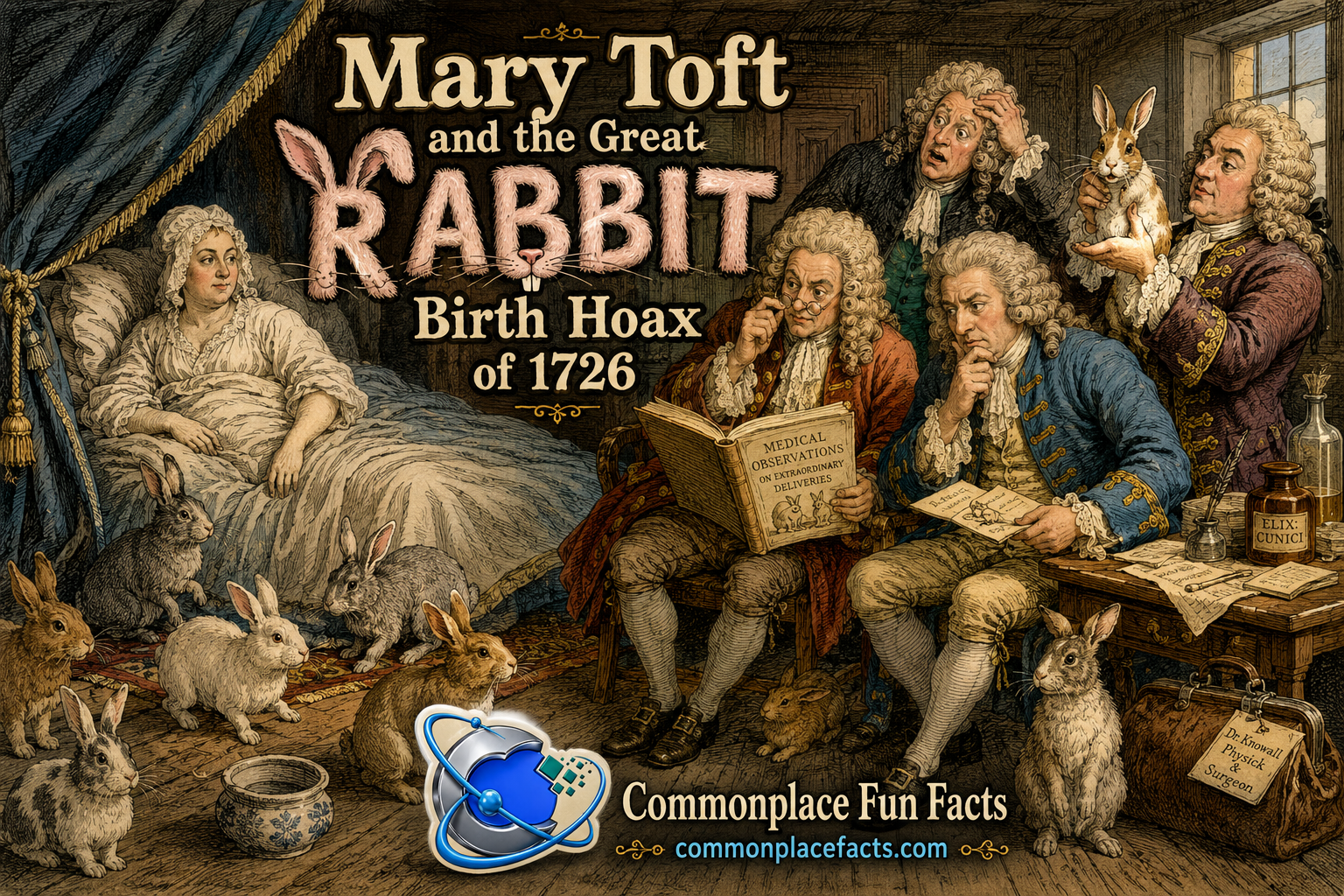

In 1726, Mary Toft, a poor woman from Surrey, England, convinced some of the finest medical minds in Britain that she was giving birth to rabbits.
There are sentences that require a little setup. That is not one of them.
Toft did not merely tell a neighbor that something unusual had happened, allowing gossip to do the rest. Doctors examined her. Surgeons attended her supposed deliveries. Rabbit parts were produced. Physicians traveled from London. King George I became interested enough to dispatch members of his own medical circle to investigate. One royal surgeon became sufficiently convinced that he published an account of the phenomenon.
And all of this happened despite a fairly significant obstacle to the theory: women typically cannot give birth to rabbits.
The story of Mary Toft and the rabbit birth hoax is usually told as a hilarious episode in the history of medical gullibility. It certainly qualifies. There is, however, considerably more going on here. It is also a story about scientific assumptions, professional pride, social class, the treatment of women, confirmation bias, and the astonishing human ability to look directly at evidence and see precisely what we expected to see.
Also rabbits. Quite a lot of rabbits.
Contents
Who Was Mary Toft?
Mary Toft was born around 1703 and lived in Godalming, Surrey, southwest of London. She was poor, illiterate, and married to Joshua Toft, a journeyman clothworker. By 1726 she already had children and was pregnant again.

That pregnancy ended badly. Toft suffered a miscarriage, although contemporary accounts are not entirely consistent about the exact timing and progression of events. What happened afterward would transform an otherwise obscure working-class woman into a national sensation.
In September, Toft appeared to go into labor again. What emerged was not a baby.
According to contemporary accounts, she produced assorted animal tissue, including something described as resembling part of a cat. Her family called in John Howard, a surgeon and man-midwife from nearby Guildford. Howard subsequently reported extracting additional animal parts from Toft.
Then the rabbits started arriving.
Howard claimed that Toft produced a rabbit’s head, other animal remains, and eventually a succession of dead rabbits. At one point, according to accounts of the affair, she was supposedly producing them at approximately one rabbit per day.
This is the moment at which modern readers naturally ask whether eighteenth-century medical schools had entrance examinations.
In fairness, there was more to the story than people simply accepting the proposition, “Well, apparently women can have rabbits now.” Howard believed he had physical evidence in front of him. Moreover, one of the prevailing medical ideas of the period made Toft’s claim seem slightly less impossible than it does today.
Only slightly, mind you. There are limits to how much intellectual assistance any theory can provide when the patient is producing livestock.
The Medical Theory That Helped Make Rabbits Plausible
To understand why anyone took Mary Toft seriously, we need to meet a once-respectable idea known as “maternal impression.”
For centuries, people believed that the experiences, emotions, fears, cravings, and imagination of a pregnant woman could physically alter her unborn child. If a pregnant woman were badly frightened by an animal, for example, some believed the experience might somehow leave a corresponding mark or deformity on the baby.
This was not merely folk superstition whispered between grandmothers. Variations of the idea appeared in medical thought well into the modern era.
Toft supplied a story that fit neatly into this worldview. She said that while pregnant she had been working in a field when she saw a rabbit. She chased it but failed to catch it. She subsequently developed an intense longing for rabbit meat and dreamed about rabbits.
Nathanael St. André, one of the royal surgeons who later examined Toft, recorded this account in his pamphlet, ‘A Short Narrative of an Extraordinary Delivery of Rabbets,’ first published in December 1726 and reissued in 1727. A copy survives in Duke University’s History of Medicine Collections, which provides a fascinating look at St. André’s account of the Mary Toft case.
Under the theory of maternal impression, Toft’s rabbit encounter supplied a mechanism of sorts. Her mind had supposedly been so affected by rabbits that her reproductive system apparently decided to subcontract.
We should resist feeling too superior. The history of medicine is filled with brilliant people confidently embracing ideas that later generations found bewildering. We have previously encountered this phenomenon with Franz Anton Mesmer and his theory of animal magnetism. The great advantage of being alive today is that we can easily identify all the ridiculous medical beliefs of the past. Identifying our own is a service traditionally reserved for our descendants.
The Rabbit Woman Goes National
John Howard did not keep the case to himself. He wrote to prominent physicians and other influential people describing what was happening in Surrey.
News eventually reached the royal court.

King George I was sufficiently intrigued to send investigators. Among them was Nathanael St. André, a Swiss-born surgeon and anatomist attached to the royal household, who traveled to Guildford with Samuel Molyneux, secretary to the Prince of Wales.
They arrived in November 1726 at an especially convenient moment: Mary Toft was supposedly in labor again.
St. André witnessed the production of rabbit material and became persuaded that something extraordinary was happening. He examined the specimens, questioned Toft, and carried some of the evidence back toward London.
The episode was rapidly becoming more than a bizarre village curiosity. It now involved the royal household and respected medical professionals. Newspapers and pamphleteers picked up the story. Curiosity spread.
And here the situation became psychologically interesting.
Once distinguished people had publicly invested their reputations in the proposition that Mary Toft might genuinely be giving birth to rabbits, changing their minds became more expensive. Evidence was no longer being evaluated in an intellectual vacuum. Careers, prestige, pride, and very public embarrassment had entered the examination room.
We have discussed this particular human weakness before in connection with the saying “It’s easier to fool people than to convince them that they have been fooled”. Ironically, that quotation is itself commonly misattributed to Mark Twain, because apparently the universe enjoys thematic consistency.
Fortunately, Someone Examined the Rabbit
Not everyone was convinced.
King George sent another surgeon, Cyriacus Ahlers, to investigate. Ahlers witnessed some of Toft’s alleged rabbit deliveries but came away suspicious.
Then he did something unexpectedly troublesome for the developing miracle.
He examined the rabbits.
Ahlers discovered that the rectum of one rabbit contained hard fecal pellets with pieces of hay, straw, and corn. This presented a fairly serious problem. A rabbit that had supposedly developed entirely inside a human body had somehow been eating ordinary rabbit food.
There were several possible interpretations.
One was that Mary Toft possessed not only the ability to gestate rabbits but also an internal agricultural ecosystem capable of growing hay and grain.
The other was fraud.
Ahlers favored fraud.
He reported his suspicions to the king on November 21 and suggested that Toft and John Howard might be working together. Other anatomical clues were also difficult to reconcile with the claim that the animals had developed inside a woman.
The case was beginning to wobble.
For anyone who enjoys historical cases in which physical evidence turns out to mean something very different from what everyone originally thought, there is an oddly similar flavor to the woman who supposedly vomited beetles. The specimens may be perfectly real. The difficult question is how they arrived at the scene.
Mary Toft Goes to London
On November 29, Toft was moved to Lacy’s Bagnio, a bathhouse in London’s Leicester Fields, where she could be watched more carefully.
St. André summoned James Douglas, a respected anatomist and man-midwife, hoping that Douglas would validate the case. Instead, Douglas arrived already strongly suspicious that the entire business was fraudulent.
Sir Richard Manningham, another prominent physician and obstetric practitioner, also became involved. He, too, developed doubts.
The room now contained an impressive collection of medical expertise, conflicting opinions, professional reputations, and one woman who had somehow made rabbit obstetrics the hottest scientific issue in London.
Then something curious happened. Under close observation, Mary stopped producing rabbits.
She continued to experience apparent labor pains, but the rabbit supply chain had developed difficulties.
Soon the reason became clearer.
The Porter and the Suspiciously Small Rabbit
A porter at Lacy’s Bagnio was caught trying to obtain a rabbit for Toft.
According to the surviving accounts, he said that Margaret Toft, Mary’s sister-in-law, had asked him to find the smallest rabbit he could procure.
There are moments in any investigation when the evidence remains ambiguous and careful professionals must resist premature conclusions. “Please find me a very small rabbit and bring it secretly to the woman who claims to be giving birth to rabbits” was not one of those moments.
The authorities became involved. Toft was questioned, but she initially refused to confess.
By this point she was also physically ill. Contemporary accounts indicate that she suffered infection and severe distress during the ordeal. Whatever else can be said about the deception, this was not a harmless parlor trick involving a rabbit concealed beneath a tablecloth.
The mechanism of the fraud involved placing animal remains inside her body so they could later be extracted during supposed deliveries. That procedure exposed her to considerable pain and danger.
Mary Toft Confesses
On December 7, 1726, Mary Toft finally confessed.
The circumstances deserve attention. Sir Richard Manningham threatened her with invasive experimental surgery if she did not explain what was happening. Faced with that prospect, Toft admitted that dead rabbits had been inserted into her body and subsequently removed in imitation of childbirth.
The University of Glasgow Special Collections preserves extensive material relating to the affair, including several surviving versions of Mary Toft’s confession.
Those confessions create another historical problem: they do not tell exactly the same story.
At different times Toft implicated different people, including her mother-in-law, John Howard, and a mysterious woman sometimes described as the wife of an organ grinder. That makes it dangerous to state with confidence exactly who designed the fraud, who assisted with it, or what everyone’s motives were.
History occasionally provides a signed confession and then, just to keep researchers humble, provides several incompatible versions.
Why Would Mary Toft Do This?
The simplest explanation is money. The Tofts were poor, and unusual people and medical curiosities could attract paying crowds. Turning Mary into a living wonder offered at least the possibility of financial reward.
But “she did it for money” may be too neat.
Modern historians have looked more closely at Toft’s social position, her poverty, the physical suffering involved, and the remarkable power imbalance between this illiterate working-class woman and the educated men who examined, displayed, interrogated, and wrote about her.
Historian Karen Harvey has studied Toft’s surviving confessions in an effort to recover something of Mary’s own experience from documents overwhelmingly produced by men. Her scholarly article, “What Mary Toft Felt: Women’s Voices, Pain, Power and the Body”, is especially useful for understanding why the story cannot simply be reduced to “clever peasant woman tricks stupid doctors.”
Toft committed a fraud. That much is clear. It is considerably less clear how much control she had over the affair once it expanded, who pressured or assisted her, what she expected to gain, or how much of her increasingly public ordeal she actually wanted.
By the time eminent physicians, royal representatives, crowds, journalists, and government authorities were involved, Mary Toft was at the center of a machine considerably larger than herself.
The Doctors Discover That Satirists Have Heard About This
The medical profession’s problems did not end when Toft confessed.
They had really just begun.
Eighteenth-century Britain possessed a vigorous culture of pamphlets, cartoons, poems, songs, political satire, and public mockery. In other words, social media had already been invented; it merely required a printing press and more patience.
At least fifteen pamphlets and songs appeared discussing or ridiculing the affair. The Royal College of Surgeons has preserved material from the controversy and provides an excellent overview of the Mary Toft scandal and its medical aftermath.
William Hogarth, who rarely encountered public foolishness without feeling professionally obligated to help it achieve immortality, produced the etching “Cunicularii, or the Wise Men of Godliman in Consultation.”
The picture mocks the doctors gathered around Toft and turns the whole affair into a spectacle of medical credulity.

This was especially painful because the eighteenth century was an era in which male physicians and “man-midwives” were increasingly asserting scientific authority over childbirth, an area traditionally dominated by women. Then, just as members of the emerging medical establishment were demonstrating their superior expertise, a poor woman from Surrey handed them a rabbit.
Followed by another rabbit.
Followed by enough rabbits to make satire almost unnecessary.
What Happened to Mary Toft?
Toft was arrested and sent to Bridewell prison in London as a “notorious and vile cheat.”
Despite the enormous publicity surrounding the case, the prosecution eventually fizzled. The legal system had some difficulty determining exactly what crime fit the circumstances, and she was ultimately released.
She returned to Godalming.
Rather wonderfully, parish records later documented the birth of another daughter, with language making clear that this was her first child after the infamous “pretended Rabett-breeding.” Even eighteenth-century parish clerks apparently understood the importance of leaving helpful notes for future historians.
Mary largely disappeared from national attention. She surfaced again in the records in 1740 in connection with receiving stolen goods and died in 1763.
The doctors had a harder time escaping.
Nathanael St. André’s reputation suffered badly. The scandal became a cautionary tale about gullibility, professional vanity, and the danger of reaching a spectacular conclusion before exhausting the boring explanations.
The Rabbits Had Help From Confirmation Bias
The easiest lesson from the Mary Toft story is that people in 1726 were astonishingly gullible.
It is also the least interesting lesson.
Not every doctor believed her. Ahlers was skeptical. Douglas was skeptical. Manningham became skeptical. Investigators eventually tested the physical evidence and uncovered the fraud.
The more useful question is why intelligent people believed as much as they did for as long as they did.
Part of the answer was maternal impression. If you already believed that a mother’s imagination could physically alter her fetus, Mary Toft’s account did not arrive in an intellectual vacuum. It fit inside an existing framework.
Another part was the presence of physical evidence. There really were rabbit parts. The mistake was assuming that their presence proved the explanation being offered for them.
This distinction is wonderfully important. The question was not, “Are these actual rabbits?”
They were.
The question was, “Does childbirth provide the best explanation for how they got here?”
It did not.
This same pattern appears throughout the history of hoaxes. During the Great Moon Hoax of 1835, elaborate scientific details helped make fantastic claims about life on the Moon seem credible. More than a century later, inspectors in the Great Salad Oil Scandal saw what appeared to be enormous tanks filled with valuable oil because they had been given reasons to expect enormous tanks filled with valuable oil.
In each case, the evidence was not necessarily imaginary. What failed was the interpretation.
It Is Comforting to Think We Would Never Fall for This
We would like to imagine that a modern version of Mary Toft would be laughed out of the hospital before the first rabbit had finished filling out its insurance paperwork.
On the narrow biological question, that is probably true. Modern obstetrics has progressed far enough that unexplained rabbit pregnancies are unlikely to survive peer review.
The underlying cognitive problem, however, remains stubbornly current.
People are remarkably good at examining new information through the filter of what they already believe. We give extra weight to evidence that supports our expectations and become unusually inventive when explaining away evidence that does not.
Professional expertise helps, but it does not provide immunity. In some circumstances it can make matters worse, because expertise supplies a person with a larger vocabulary and more sophisticated arguments with which to defend the wrong conclusion.
Then reputation enters the picture. Once someone has publicly championed an idea, abandoning it requires admitting error. If colleagues, newspapers, royal patrons, and half of London are watching, the psychological cost becomes considerably higher.
At that point, a rabbit whose droppings contained corn, hay, and straw can become less an obvious contradiction and more an irritating detail requiring further study.
Mary Toft Was More Than a Punchline
There is another reason to be careful when laughing at this story.
Mary Toft’s body became the laboratory in which everyone else’s theories were tested.
She underwent repeated intimate examinations. She suffered pain and infection. She was moved from Surrey to London, placed under constant observation, interrogated, threatened with surgery, arrested, imprisoned, exhibited to the curious, and then immortalized in satirical prints and medical literature.
None of that transforms fraud into truth. She did not give birth to rabbits.
But it does make the human story substantially more complicated.
The physicians were victims of deception, but Mary was also a poor woman surrounded by powerful men who treated her body as an extraordinary scientific specimen. The public laughed at the doctors for being fooled and at Mary for fooling them. Very few people involved seem to have emerged from the affair looking particularly admirable.
That, too, gives the story a strangely modern quality.
The Rabbits Were Fake. The Lesson Wasn’t.
Nearly three centuries later, Mary Toft remains famous because the headline is irresistible: the woman who convinced doctors she was giving birth to rabbits.
But the absurdity is only the entrance to the rabbit hole. Sorry. There was no realistic possibility of getting through this article without using that expression at least once.
The real story is about what happens when extraordinary evidence enters a world already prepared to interpret it in a particular way. Some physicians believed in maternal impression. Some encountered actual rabbit tissue. Some had professional reputations tied to their conclusions. The result was a feedback loop in which each strange development seemed to make the case more important rather than less believable.
Eventually someone asked the sort of boring question on which good investigations often depend.
What has this rabbit been eating?
And with that, one of the most extraordinary reproductive mysteries in medical history became an entirely different kind of mystery: how so many intelligent people managed to get as far as they did before checking the rabbit.
The technology has changed since 1726. Medicine has changed. Science has changed. We have genetics, ultrasound, laboratory testing, instant communication, and access to more information than King George I could have imagined.
Human beings, however, remain recognizably human.
Give us a surprising claim, a little supporting evidence, an explanation that fits something we already believe, and a few respected people willing to endorse it, and we can still get ourselves remarkably far down the road before somebody thinks to inspect the rabbit.
You may also enjoy…

The Woman Who Vomited Beetles: A Bizarre Lesson in Medical Certainty
Meet Mary Riordan, the woman who vomited beetles in an 1824 medical report, proving that every generation’s “settled science” deserves a little humility.

Franz Anton Mesmer: The Doctor Who “Mesmerized” Europe With Animal Magnetism
Franz Anton Mesmer’s theory of animal magnetism captivated 18th-century Europe. Discover how mesmerism sparked a medical craze and helped inspire modern hypnosis.

Paruria Erratica: The Weird Medical Case of the Woman Who Urinated from Eyes, Ears, Nose & Navel
Discover the bizarre 18th-century case of Maria Burton, a woman who urinated from her eyes, ears, nose, and navel — a rare condition known as Paruria Erratica.






Leave a Reply