
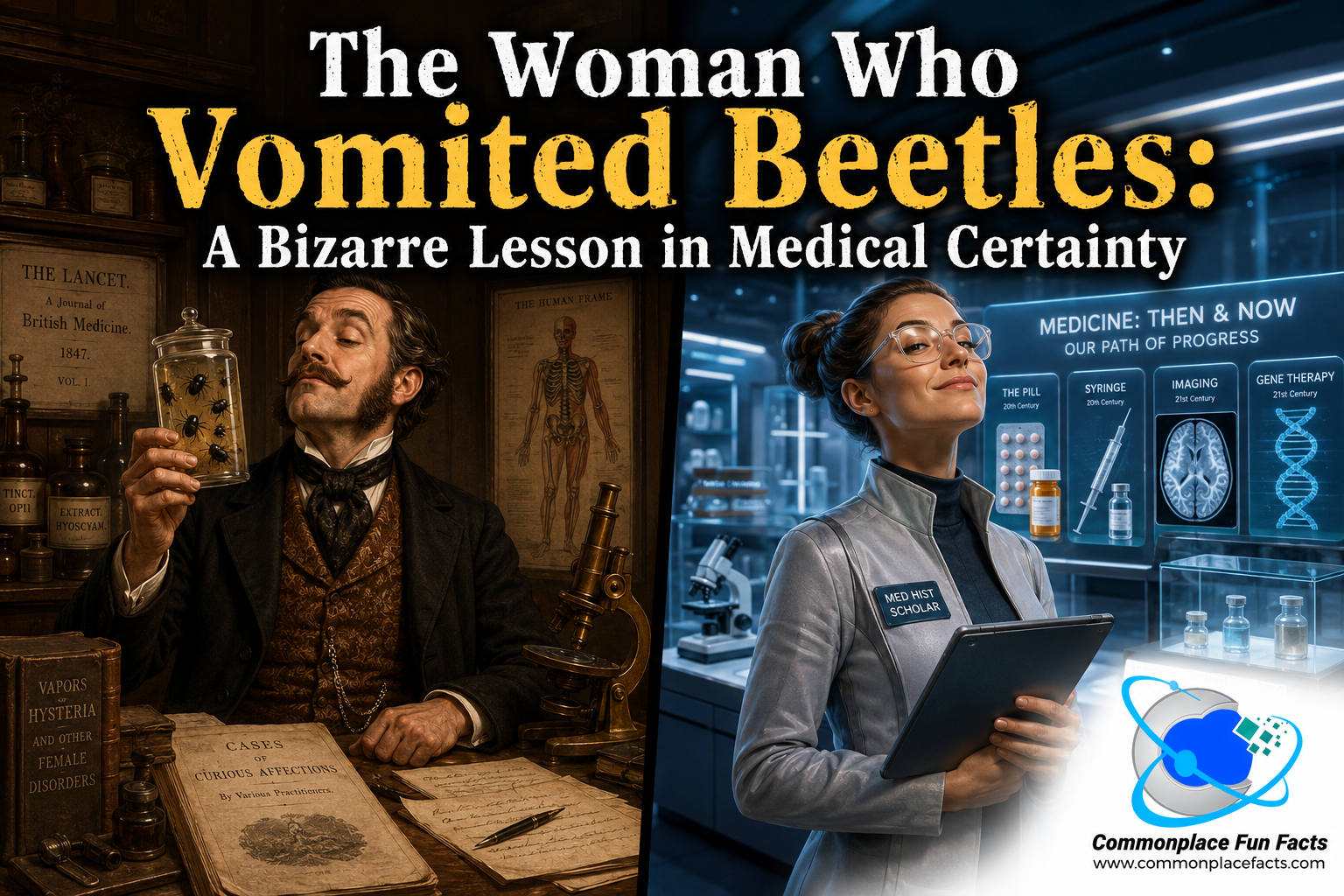

The Medical Certainty of the Case of the Woman Who Vomited Beetles
Every generation has a favorite hobby, and it is not collecting stamps, complaining about young people, or pretending that kale is food. It is looking backward at previous generations and wondering how anyone could have been so astonishingly wrong while still managing to operate doors.
We look at the medical theories of the past and smile the smile of the enlightened. Phrenology, the practice of measuring skull bumps to determine personality? Adorable. Trepanation, the art of drilling holes in people’s heads to let out whatever was making them inconvenient at dinner parties? Bold strategy. Bloodletting? Nothing says “medical progress” quite like treating weakness by removing more blood. Corpse medicine, the popular practice of grinding up bits of the deceased and prescribing them to the living? That was either a health plan or the world’s least appealing cookbook.
We shake our heads and say, “Poor simple people. They did not know better.”
This is one of the most dangerous sentences in human history.
Not because they did know better. Frequently, they did not. Sometimes they knew worse with confidence. But the truly uncomfortable part is that they usually did not think of themselves as ignorant. They believed they were applying the best knowledge available. They had experts. They had institutions. They had impressive titles. They had publications. They had footnotes, professional societies, and men with letters after their names solemnly reporting things that should have caused someone in the room to say, “Perhaps we should all take a walk and come back to this.”
Contents
Enter Mary Riordan, and a Lot of Beetles
Which brings us, naturally, to Mary Riordan, the Irish woman who vomited beetles.
There is no graceful way to ease into that sentence, so there it is, sitting on the table like an old container of leftovers pulled from the refrigerator that no one can quite identify.
In 1824, Dr. William Pickells published the case of Mary Riordan in the Transactions of the Association of Fellows and Licentiates of the King’s and Queen’s College of Physicians in Ireland. That was not the nineteenth-century equivalent of someone’s cousin’s newsletter printed in a shed. It was a serious medical publication from a serious medical association, which is precisely what makes the whole episode so wonderfully alarming.
A Graveyard, a Diagnosis, and a Very Bad Week
Mary Riordan was a young woman from Ireland whose troubles reportedly began after the death of her mother. Overcome with grief, she spent long periods at the grave. On one occasion, she was found unconscious after passing a freezing winter night there in the rain, which is the sort of thing that would make even a healthy person wake up feeling as though every organ had filed a grievance.

Afterward, her health deteriorated. She suffered terrible stomach pains. She developed the habit of eating chalk, which she claimed relieved her discomfort. Her condition became so serious that a priest was summoned more than once to administer last rites.
Then one evening in the spring of 1822, according to the report, she vomited something extraordinary. She described it to Dr. Pickells as “a green thing as long and as thick as one of her fingers, which flew. It had wings, a great many feet, and a turned up tail.”
There are bad days, and then there are days when you tell your doctor you have just vomited a winged green finger-beast with a tail.
Most of us would consider that a fairly strong argument for canceling the remainder of the week.
But the story did not end there. Over the following months, Mary allegedly discharged insects from both her mouth and her bowels. Larvae, pupae, and beetles appeared at different stages of development. Dr. Pickells claimed that hundreds of larvae had been vomited from her stomach and more than a hundred passed through her intestines. In his words, he believed he was actually understating the total.
A naturalist helped identify some of the creatures. They were said to include species associated with damp, dark places, such as cellars, graveyards, and decaying environments. This fit neatly with Pickells’s preferred explanation: that Mary had somehow swallowed insect eggs or larvae during her long night in the graveyard, and that these had survived inside her body, matured, multiplied, and eventually emerged in the most horrifying possible manner.
This explanation has a certain storybook logic to it. Sad young woman spends night in graveyard. Graveyard beetles enter her body. Beetles later emerge. There is an awful symmetry to the thing, like a folk tale written by someone who hated sleep.
When Biology Refused to Cooperate
The problem is that biology was not invited to the meeting.
Modern readers immediately see the obvious difficulties. Beetles do not normally establish thriving multigenerational colonies in the human stomach. The digestive system is not a charming woodland habitat. It is a chemical assault course designed to turn food into usable energy and regret. Some parasitic organisms can survive in the human body, of course, and there are real conditions involving larvae in tissue or the gastrointestinal tract. But Mary Riordan’s alleged production of insects in all stages of development over an extended period is a much harder claim to swallow, which is saying something in a story already full of strangely swallowed things.
The evidentiary problems are just as large. Pickells personally observed only some of the specimens. Many were reportedly destroyed by the family to avoid publicity. Others escaped. The original flying creature was not preserved, leading us to suspect that it was captured and successfully relocated to a loving home by Newt Scamander. The household conditions, the handling of the specimens, the possibility of contamination, and the reliability of the patient’s reports all create enormous questions.
Today, we might suspect several possibilities. Mary may have suffered from genuine physical illness. She may have had pica, a condition involving the consumption of non-food substances such as chalk or clay. We have previously shared the story of the man with that condition who ate an entire airplane, which makes Mary Riordan seem like an amateur by comparison.
She may also have suffered from a severe psychological disorder such as Munchausen Syndrome or another condition involving deception, delusion, or self-harm. Insects may have been introduced after the fact, accidentally or deliberately. The specimens may have been real insects, but not evidence of internal beetle agriculture.
The point is not that Mary was lying. The point is that the case demanded skepticism, and skepticism appears to have arrived late, still unable to connect with its missing luggage.
Mary Riordan was not the only historical patient whose body allegedly treated basic anatomy as a loose suggestion. For another published medical case that made physicians reach for both their notebooks and possibly a stiff drink, see the strange story of “Paruria Erratica: The Woman Who Urinated From Her Eyes, Ears, Nose, and Navel”.
Dr. Pickells was not stupid. That is what makes the story important. He was an educated physician writing for educated physicians. He did not think he was preserving a superstition. He thought he was documenting a medical curiosity. He believed he had observed enough to make the case worthy of publication.
And that is where the story stops being merely funny and starts becoming useful.
Bad Ideas in Respectable Clothing
We like to imagine that false beliefs survive because ignorant people cling to them while wise people roll their eyes from across the room. Sometimes that is true. But many errors do not enter history through the servant’s entrance. They walk through the front door wearing professional attire.

Phrenology was not just a tavern joke. It had charts, lectures, practitioners, and elaborate claims. Bloodletting was not simply folk medicine practiced by confused villagers with leeches and optimism. It was endorsed for centuries by serious physicians. Corpse medicine appeared in medical and royal circles. Trepanation has ancient roots and was sometimes performed with ritual or therapeutic purpose. These practices were not always fringe beliefs held by people who “didn’t know any better.” Often, they were part of accepted systems of thought.
That is the uncomfortable part. Bad ideas do not always look ridiculous when people are standing inside them.
From the inside, they look like consensus. They look like tradition. They look like the available evidence. They look like something a respected person said in a respected venue using respected vocabulary. Then time passes, the scaffolding collapses, and later generations say, “How quaint.”
We are very good at the condescending smile.
We are less good at recognizing that one day we will be the quaint ones.
One Day, We Will Be the Quaint Ones
Future generations may look at parts of our medical world with the same mixture of gratitude, horror, and bafflement with which we view the past. They may not laugh at nuclear medicine, gene therapy, or advanced pharmaceuticals because those fields are foolish. They are not. They represent extraordinary achievements. Nuclear medicine can diagnose and treat disease in ways earlier physicians could scarcely imagine. Gene therapy offers hope for conditions once considered untouchable. Modern pharmaceuticals have transformed survival, pain management, infection control, mental health treatment, and countless other areas.
But future generations may still find some of our methods crude. They may wonder why we treated entire bodies when the problem was cellular. They may marvel that we accepted harsh side effects because we lacked subtler tools. They may look at today’s drug advertisements, with their cheerful music and whispered warnings of catastrophic complications, and conclude that our civilization had achieved the curious ability to sell both hope and nausea in thirty seconds.
They may ask why we used broad categories for complex illnesses. Why we understood some diseases only after damage had already occurred. Why we accepted trial-and-error prescribing as normal. Why we exposed patients to certain risks because better options had not yet been invented. Why we were so confident about things that were later revised, replaced, or quietly escorted out of the medical building.
And we will not be there to defend ourselves, which is probably just as well. History rarely allows cross-examination.
This does not mean modern medicine is the same as nineteenth-century beetle-vomiting reports. It is not. We have better tools, better methods, better testing, better imaging, better statistical analysis, better laboratories, and better safeguards. The difference between modern science and old medical speculation is enormous.
But “better” is not the same thing as “finished.”
Peer Review Is Not a Magic Spell
Peer review matters. Credentials matter. Scholarly publication matters. They are essential parts of responsible inquiry. But they are not magic spells. A published article is not a sacrament. A journal is not a temple. A person with a string of initials after his name is still capable of being wrong, especially if everyone around him is wrong in the same direction.
Science is not a pile of conclusions guarded by experts. It is a method for testing conclusions, revising them, and occasionally watching cherished assumptions masquerading as consensus burst into flames in the parking lot.
That is why the Mary Riordan case is more than a bizarre medical footnote. It is a cautionary tale about the difference between documentation and truth. Dr. Pickells documented something. He preserved observations, reports, interpretations, and specimens. He put them into the scholarly world. But publication did not transform the case into fact. It only made the error more durable.
There is a lesson there for anyone tempted to say, “Well, it was published.”
So were many things.
The Stories We Build from Facts
The better question is not whether something appeared in print. The better question is whether the evidence supports it. Were alternative explanations considered? Were the observations controlled? Were the assumptions tested? Did the investigator see what he claimed to see, or did he see part of it and trust the rest? Did the theory explain the facts, or did the facts get marched at pitchfork-point into the theory?
Dr. Pickells saw insects. He heard Mary’s account. He knew the graveyard story. He knew she ate chalk and clay. He knew some insects lived in damp, dark places. From those facts, he constructed a narrative. It was dramatic, coherent, and wrong.
That is how human beings often think. We do not merely collect facts. We arrange them. We turn them into stories. Sometimes the story helps us understand reality. Sometimes it quietly takes reality hostage.
The temptation is especially strong when a story is vivid. “A grieving woman with stomach pain may have experienced psychological distress and specimen contamination occurred under poorly controlled conditions” is plausible, but it will not sell many tickets. “A woman swallowed graveyard beetle eggs and later vomited hundreds of insects” has a certain flair. It is medically dubious, but narratively committed.
And humans are narrative creatures. We prefer a strange story to an uncertain explanation. We would rather be confidently wrong than indefinitely puzzled. This is why humility is not a decorative virtue. It is a safety feature.
Smile, But Maybe Keep One Eyebrow Raised
The past is full of people who believed things that now seem absurd. The future will be full of people saying the same about us. The goal is not to avoid ever being wrong. That is impossible. The goal is to be less arrogantly wrong. To build systems that can correct errors. To hold conclusions firmly enough to act, but lightly enough to revise. To remember that today’s certainty may be tomorrow’s museum exhibit.

Mary Riordan’s case is funny because it involves alleged beetle-vomiting, and the human mind is not morally equipped to ignore that. But it is also sobering because it shows how easily intelligence, credentials, publication, and sincerity can coexist with serious error.
Dr. Pickells believed he was reporting science. Perhaps, in a limited sense, he was. He observed, recorded, consulted, and published. But his interpretation outran his evidence, climbed a fence, and disappeared into the woods.
That is not merely an 1824 problem.
It is a human problem.
So the next time we read about corpse medicine or bloodletting or skull-bump personality charts, we may still smile. We are only human. Some ideas deserve a little side-eye from history.
But perhaps we should smile with caution.
After all, somewhere in the future, a student may be reading about us. About our medicines, our theories, our confident medical advertisements, our best practices, our scholarly journals, and our experts with all the right credentials. That student may lean back, sigh, and say, “Can you believe they thought that?”
And then, if history has any sense of humor at all, that will be said while benefiting from some practice the next generation will later find ridiculous.
Because every age has its vomited beetles.
The trick is remembering that some of ours may not have hatched yet.
You may also enjoy…

Paruria Erratica: The Weird Medical Case of the Woman Who Urinated from Eyes, Ears, Nose & Navel
Discover the bizarre 18th-century case of Maria Burton, a woman who urinated from her eyes, ears, nose, and navel — a rare condition known as Paruria Erratica.

Corpse Medicine: The Grisly History of Eating the Dead to Stay Alive
For centuries, Europeans used human remains as medicine, from powdered mummies and skull tinctures to blood from executions. Welcome to the grisly history of corpse medicine.

Radithor: The Radium Medicine That Worked Fine… Until the Patient’s Jaw Fell Off
Learn about Radithor — the radium-based medicine that worked just fine — until the patient’s jaw fell off.





Leave a Reply