

There is a basic rule of advertising that has survived remarkably unchanged since the nineteenth century: never describe your product with an adjective that invites the universe to prove you wrong.
“Reliable” is fine. “Durable” gives everybody room to maneuver. “Improved” has supported generations of marketing departments without committing anyone to anything measurable whatsoever. But words such as “unsinkable,” “unbreakable,” and “indestructible” are practically engraved invitations for history to begin clearing its schedule.
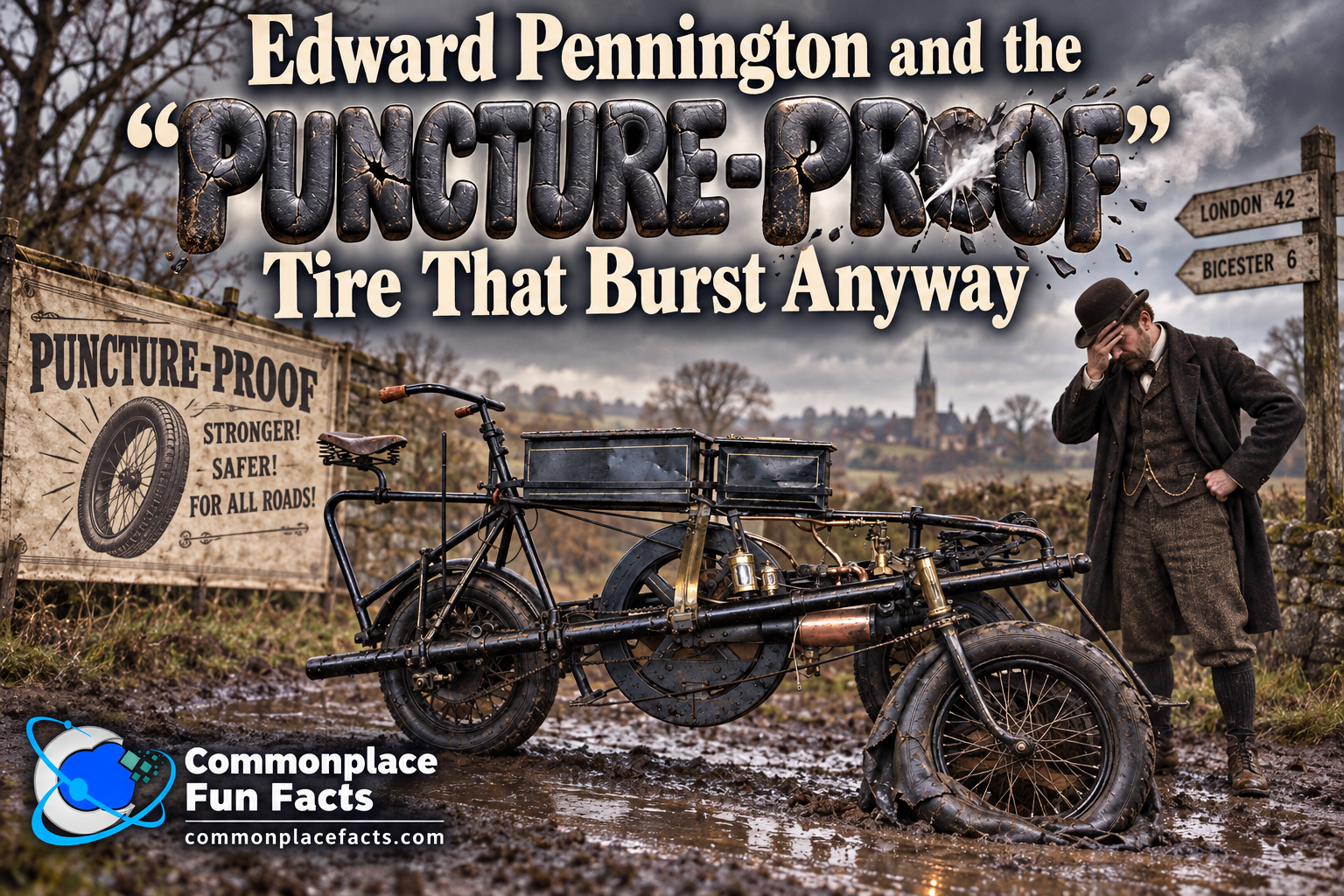
In 1896, American inventor and automobile promoter Edward Joel Pennington, usually known as E. J. Pennington, added another such phrase to the list. He advertised the pneumatic tires on his remarkable new Pennington Autocar as “non-puncturable”—what we would ordinarily call puncture-proof today. Then one of his cars took part in the famous London-to-Brighton Emancipation Run, one of the most important events in early British motoring, and failed to finish after a tire burst.
At first glance, this appears to be one of history’s cleaner examples of advertising meeting reality at highway speed. But Pennington and his supporters did not concede that the failure disproved anything they had said about the tire. On the contrary, they had an explanation for why the claim still stood.
Whether that explanation was ingenious, absurd, technically correct, or some especially entertaining combination of all three is a question we will leave for later—and ultimately for the reader to decide.
Contents
Edward Pennington Arrived Just as Nobody Knew What a Car Should Be
Edward Joel Pennington was an American inventor, engineer, entrepreneur, promoter, and, depending on which historian you consult, a man to whom the phrase “investment opportunity” should have been introduced only under adult supervision. He was active during one of the most chaotic and exciting periods in technological history.

By the early 1890s, inventors had demonstrated that practical mechanically powered road vehicles were possible. What nobody knew was what those vehicles should look like. Today, even radically different automobiles share a recognizable basic vocabulary: there are four wheels, the passengers generally sit inside, the steering controls are toward the front, and the engine or motor is placed somewhere engineers have agreed is preferable to the passenger’s lap.
None of that was inevitable in the 1890s. Early automotive inventors experimented with three wheels, four wheels, gasoline, steam, electricity, steering tillers, bicycle handlebars, enormous wheels, tiny wheels, engines beneath seats, engines behind seats, and designs that appeared to have been assembled after someone emptied a bicycle shop and a plumbing-supply warehouse onto the same floor.
The automobile industry had not yet decided what an automobile was. That made it an excellent time to be genuinely inventive and an equally excellent time to be extremely confident.
Pennington was both.
Pennington Was More Than Just a Salesman
It would be easy to dismiss Pennington as merely a nineteenth-century snake-oil salesman who happened to replace the snake oil with gasoline, but that would be too simple. Pennington actually invented things.
His surviving patents include designs for motorized cycles and other self-propelled vehicles. In an 1896 U.S. patent for a motor vehicle, for example, Pennington described a lightweight gasoline-powered machine suitable for bicycles, tricycles, quadricycles, and similar vehicles. Later patents covered additional self-propelled vehicle designs.
Pennington is sometimes credited with coining the term “motorcycle.” Whether he actually invented the expression is difficult to prove, but “motor cycle” was being used in English by 1894 in material promoting Pennington’s machines, placing his work among the earliest documented English uses of the term.
His machines were not merely drawings in a prospectus. Vehicles and engines associated with Pennington were built, exhibited, photographed, and demonstrated. The problem was that Pennington’s genuine inventiveness traveled everywhere with an equally powerful gift for promotion.
He did not merely develop an engine; he developed an engine that was about to change everything. He did not merely construct a vehicle; he constructed the vehicle that demonstrated why all the other vehicles were now essentially wasting everybody’s time. Before automobiles fully captured his attention, he had already promoted ambitious airship projects as well.
Pennington’s career repeatedly followed the same general pattern: an interesting idea appeared, an extraordinary claim followed, investors became interested, publicity accumulated, and practical reality eventually arrived looking less enthusiastic. This tendency would become particularly useful when he reached Britain.
Britain Was Ready for the Horseless Carriage
During the 1890s, Britain was beginning to awaken to the possibilities of the automobile. One of the central figures in that movement was Harry Lawson, a bicycle entrepreneur and promoter who wanted to build a British automobile industry by acquiring valuable patents and controlling the rights needed to manufacture the new machines.
Lawson assembled companies, investors, patents, engineers, and promotional schemes with an enthusiasm that makes the corporate structure of the period difficult to explain without either a diagram or prescription medication. Pennington fit beautifully into this world, and his vehicle patents attracted Lawson’s attention. Pennington became associated with the Great Horseless Carriage Company and the famous Motor Mills in Coventry.
Contemporary accounts show Pennington demonstrating vehicles and engines in Britain during 1896. At the International Horseless Carriage Exhibition that May, for example, machines using Kane-Pennington motors were displayed alongside competing steam, gasoline, and electric designs. Pennington reportedly told observers that one of his motor bicycles could reach 35 miles per hour without any help from the rider.
Whether every Pennington performance claim should be treated with the same confidence one would extend to a modern laboratory test is another matter. Pennington understood something that remains true of new technology: the future is easier to sell when it arrives accompanied by impressive numbers.
The Pennington Autocar Was Difficult to Mistake for Anything Else
Among the machines that emerged from Pennington’s British adventures was the Pennington Autocar. The National Motor Museum describes the surviving 1896 example as a simple design built around a frame manufactured by Humber and powered by a two-cylinder, 1,868 cc engine.
Calling it a “car” requires us to approach the term with the generous spirit appropriate to 1896. The Pennington Autocar was essentially a long three-wheeled machine with two wheels at the front and one driven wheel at the rear. Its exposed frame, bicycle-style seats, engine, piping, and controls gave it the appearance of transportation designed by someone who had heard a detailed description of an automobile but had not yet seen one.
Pennington claimed it could reach 40 miles per hour, which would have been an extraordinary speed for the period. He also described the vehicle as capable of carrying four people. Then an advertisement appeared showing one carrying nine.

This was presumably intended to demonstrate the strength and versatility of the machine rather than introduce the important automotive principle that the stated seating capacity is merely a suggestion. The photograph remains one of the great images of early motoring: nine men positioned on and around a lightweight three-wheeled vehicle that looks as though it should file a formal complaint after carrying four.
Only a handful of Pennington Autocars appear to have been built. The National Motor Museum estimates perhaps five. But numbers were never the most important part of Pennington’s business.
Claims were.
And one of the Autocar’s most interesting claims concerned its enormous pneumatic tires.
The Problem With Pneumatic Tires Was the Pneumatic Part
Pneumatic tires were an enormous advance over the solid tires used on earlier cycles and vehicles. Putting a cushion of compressed air between the road and the rider dramatically improved comfort, particularly at a time when roads could be charitably described as having considerable personality.
Unfortunately, pneumatic tires possessed an inherent design flaw.
They contained air.
Air is useful in a tire only so long as it remains there, and nineteenth-century roads offered an impressive assortment of nails, stones, metal fragments, sharp edges, and other opportunities for it to reconsider its living arrangements. A tire that resisted punctures would therefore have been enormously attractive.
Pennington did not merely say his tires resisted punctures. In his advertising, he called them “non-puncturable”—a claim that amounted to promising what we would now ordinarily call a puncture-proof tire. The National Motor Museum today describes them as “impuncturable,” while contemporary accounts also used the wonderfully absolute word “unpuncturable.” Whatever the vocabulary, the promise was substantially the same: sharp objects were not supposed to reach the air chamber.
Contemporary descriptions indicate that the tires used a protective structure intended to shield the inner air tube from nails and similar objects. A later account reproducing material from The Autocar described nails penetrating the outer portion of the tire but having their points bent backward by the protective armor before reaching the air chamber.
So this was not an entirely imaginary claim. Pennington’s tires apparently incorporated an actual attempt to solve the puncture problem. The difficulty was that protecting a tire from nails does not necessarily protect it from everything else that can happen to a tire, and that distinction was about to become unexpectedly important.
Meanwhile, Britain Was Liberating the Automobile
In 1896, British motorists were still operating under laws originally designed for an earlier generation of mechanically propelled road vehicles. The old restrictions were severe enough to make practical automobile use extraordinarily difficult: speed limits were painfully low, mechanical road vehicles could require a crew of several people, and one person had to precede the vehicle on foot to warn and assist other road users.
The famous “Red Flag Act” nickname has created a small historical trap here. The 1865 legislation really had required the man walking ahead to carry a red flag, but Parliament removed the literal flag requirement in 1878 while leaving the pedestrian requirement intact. So by 1896 the man was still out there; he had simply been relieved of flag duty. That distinction rarely survives retellings because history, like advertising, tends to prefer the version with better visuals.
The restrictions occasionally produced wonderfully absurd results. Earlier in 1896, motorist Walter Arnold was prosecuted after driving at the scandalous speed of 8 miles per hour. You can read about the first famous speeding ticket here.
Parliament finally responded with the Locomotives on Highways Act 1896. The law created a category of “light locomotives” and exempted qualifying vehicles from many of the older restrictions. Their maximum speed rose to 14 miles per hour, subject to lower local limits.
Fourteen miles per hour does not sound especially liberating today. Try driving 14 miles per hour on a modern road and observe how rapidly the motorists behind you begin organizing a revolution. In 1896, however, it represented freedom.
The Automobile Celebrated by Driving to Brighton
The new rules took effect on November 14, 1896, and Harry Lawson’s Motor Car Club decided to celebrate by organizing a run from London to Brighton. The event became known as the Emancipation Run.

The National Motor Museum records 58 entries, although only about 33 vehicles are believed to have actually started. Steam and electric machines joined gasoline-powered cars on the road. The weather was dreadful, the roads were muddy, the machines were experimental, and the crowds were enormous.
Only about 22 vehicles are believed to have reached Brighton, and even that number comes with the sort of qualification that appears whenever historians attempt to impose orderly statistics on an event that apparently had only a passing acquaintance with order. Among the participants were some of the most important figures in early automotive history, including Gottlieb Daimler, Frederick Simms, Harry Lawson, the Bollée brothers, and Edward Pennington.
A Pennington Autocar joined the procession, which should have been a wonderful opportunity. Pennington was participating in a highly publicized demonstration of the technology he had been enthusiastically promoting. The machine was lightweight. It was fast, at least according to Pennington. It had enormous pneumatic tires.
Puncture-proof ones.
Then Pennington reached Croydon.
The Puncture-Proof Tire Burst
The Pennington did not complete its road journey to Brighton. The National Motor Museum gives the reason with admirable economy: the Autocar was withdrawn “after bursting a tyre.” For most manufacturers, that would have ended the discussion. For Edward Pennington, it merely opened a new and more linguistically interesting phase of the discussion.
Contemporary material from The Autocar records Pennington explaining afterward that his driving-wheel tire had burst at Croydon, and the magazine immediately addressed the obvious problem. Yes, the tire had burst. But, the editor emphasized, it had not been punctured.
The distinction was apparently important enough that The Autocar defended the “unpuncturable” claim even after the failure. The magazine said it had evidence demonstrating that nails could enter the tire’s outer surface without reaching the air tube because protective material bent the points backward.
Therefore, according to the defense, the tire remained perfectly capable of surviving a puncturing object. It had merely become unusable for a completely different reason. This is the nineteenth-century equivalent of assuring a customer that the waterproof watch did not leak; the crystal simply detached and allowed the ocean inside.
Was Pennington Technically Right?
Annoyingly, he may have been right about this particular failure. A burst tire and a punctured tire are not necessarily the same thing, although one burst at Croydon obviously did not prove the much broader claim that the tire was truly “non-puncturable.”
In ordinary usage, a puncture occurs when a sharp object penetrates far enough into a pneumatic tire to reach the air chamber or inner tube and allow air to escape. A tire can burst because of structural failure, excessive pressure, damage, separation, or other causes that do not involve that kind of penetration. If Pennington’s protective system really prevented nails from reaching the inner tube, then the Croydon failure did not necessarily disprove his claim. It did not, however, establish that the tire was literally incapable of being punctured.
It merely demonstrated that a puncture-proof tire could still leave you stranded beside the road, which is useful information to possess before purchasing one.
The episode therefore becomes much more interesting than the frequently repeated version in which Pennington claimed to have invented puncture-proof tires and immediately suffered a puncture. That is not quite what the evidence says. Pennington reportedly described the failure as a burst, and The Autocar explicitly insisted that the tire had “burst, not punctured.” The National Motor Museum likewise describes the Autocar as having been withdrawn “after bursting a tyre.”
And somehow that makes the story better. Pennington did not merely experience irony; he found a loophole in it.
The Emancipation Run Was Not Exactly a Controlled Experiment
It is also worth remembering what the Pennington was being asked to do. The London-to-Brighton Run was not a gentle modern parade of carefully restored antique automobiles traveling under ideal conditions. It was 1896, and many of the vehicles involved were effectively prototypes.

They were traveling over wet, muddy roads in miserable weather surrounded by crowds, bicycles, horses, other experimental machines, and a transportation infrastructure that had been constructed without anticipating that dozens of inventors would suddenly descend upon it in contraptions powered by explosions. Mechanical failures were everywhere, and completing the journey at all was an accomplishment.
So Pennington’s burst tire was not, by itself, proof that the entire vehicle was worthless. But Pennington had created his own problem by making such an absolute claim. If he had advertised “reinforced pneumatic tires,” the Croydon incident would barely rate a footnote. If he had called them “puncture-resistant,” everyone could have nodded sympathetically and blamed the road.
He chose “non-puncturable.” That is the kind of claim historians keep.
Was Edward Pennington a Genius, a Charlatan, or Both?
Pennington’s reputation became decidedly complicated. The National Motor Museum describes him as exceptionally skilled at obtaining financial backing for his projects while noting that few, if any, of his investors ever recovered their money. Automotive historian Michael Sedgwick eventually called him the “charlatan par excellence” of the horseless-carriage era, and that judgment has followed Pennington ever since.
It is understandable. He promoted an extraordinary number of projects, his claims were frequently extravagant, and his companies tended to perform much better at attracting publicity and capital than at producing profitable quantities of useful machinery.
But calling him simply a fraud misses something important. Pennington possessed real mechanical ability. He held patents, designed machinery, experimented with lightweight engines, and built vehicles that actually existed. His ideas were discussed seriously by contemporary engineers, and some of the technology he explored, including large-section pneumatic tires and lightweight motorized cycles, pointed toward developments that would become genuinely important.
A Royal Aeronautical Society historical study describes him as a “notorious promoter and inventor” whose ventures largely failed, while also documenting the engineers who actually worked on his Autocar projects. That combination may be the most accurate way to understand him.
Pennington was not someone with no ideas who pretended to be an inventor. He was an inventor whose enthusiasm for his ideas regularly escaped whatever containment system was supposed to keep claims attached to evidence.
Technological revolutions produce people like that. When a technology is genuinely changing the world, the boundary between visionary prediction and complete nonsense becomes unusually difficult to identify in advance. Sometimes the eccentric inventor is right, sometimes the skeptical experts are right, and sometimes the inventor’s tire explodes in Croydon and everyone begins arguing about the definition of “puncture.”
One Pennington Autocar Is Still Here
Pennington’s companies disappeared, and most of his machines disappeared with them. One 1896 Pennington Autocar survives. It is preserved in Britain’s National Motor Museum at Beaulieu and is believed to be the only surviving example.
Look at it today and it is easy to laugh: the strange shape, the exposed machinery, the bicycle saddles, the enormous tires, and the claim that four people could ride it while a promotional image somehow found room for nine. But the machine deserves something better than ridicule.
It comes from a moment when engineers were still trying to discover the basic architecture of personal motor transportation, and failure was unavoidable. Most early automotive ideas vanished because better ideas replaced them. Three wheels yielded to four. Steering systems evolved. Engines improved. Manufacturing became standardized. Roads improved. Tire technology changed beyond recognition.
The strange Pennington Autocar belongs to the evolutionary explosion that had to occur before the modern automobile could exist. It just happened to be promoted by a man constitutionally incapable of underselling anything.
The Pennington Principle of Advertising
Edward Pennington died in 1911, long before automobiles became the ubiquitous machines we know today. The companies bearing his name did not become Ford, General Motors, Mercedes-Benz, or any of the other giants that emerged from the early automotive era, and his name survives mostly among specialists in veteran automobiles, motorcycles, and the more entertaining side alleys of technological history.
But Pennington’s supposedly puncture-proof tire deserves to be remembered—not because he invented the perfect tire, because he clearly did not, and not because it was immediately exposed as fraudulent by suffering exactly the failure he said could never happen. Oddly enough, the evidence does not quite support that version either.
The tire burst, but the contemporary account says it had not been punctured. The Croydon failure therefore did not, by itself, disprove Pennington’s “non-puncturable” claim. It did, however, fail spectacularly in the only sense the customer probably cared about: whether the tire would still get the car to Brighton.
There is a useful lesson in that. Engineering asks whether something works. Advertising asks whether you can describe it as working. Lawyers ask exactly what you meant by “non-puncturable.”
And history sits patiently by the roadside waiting to see whether the tire makes it to Brighton.
You may also enjoy…

The David Buick Story: Toilets, Bathtubs, Automobiles, and Obscurity
David Buick, born in 1854 in Scotland, contributed significantly to plumbing and the automotive industry, creating the overhead valve engine. Despite founding Buick Auto Vim, he faced business failures, losing control to William Durant. Ultimately, Buick died in obscurity in 1929, leaving behind a legacy overshadowed by his inventions.

Theodore Roosevelt and the Runaway Streetcar: How a Speeding Trolley Nearly Took Down a President
In 1902, President Theodore Roosevelt narrowly escaped death when a streetcar collided with his carriage, killing a Secret Service agent. His close call with death brought the nation perilously close to losing two presidents in one year. While Roosevelt was able to joke about the incident later on, the incident highlighted the nation’s vulnerability to…

The Epic History of the Interstate Highway System: Dirt, Detours, and Dwight D.
Discover the surprising history of the U.S. Interstate Highway System—from muddy 1919 convoys to engineering marvels and Cold War strategy. Explore how America’s roads transformed travel, economy, and national defense.


Leave a Reply