
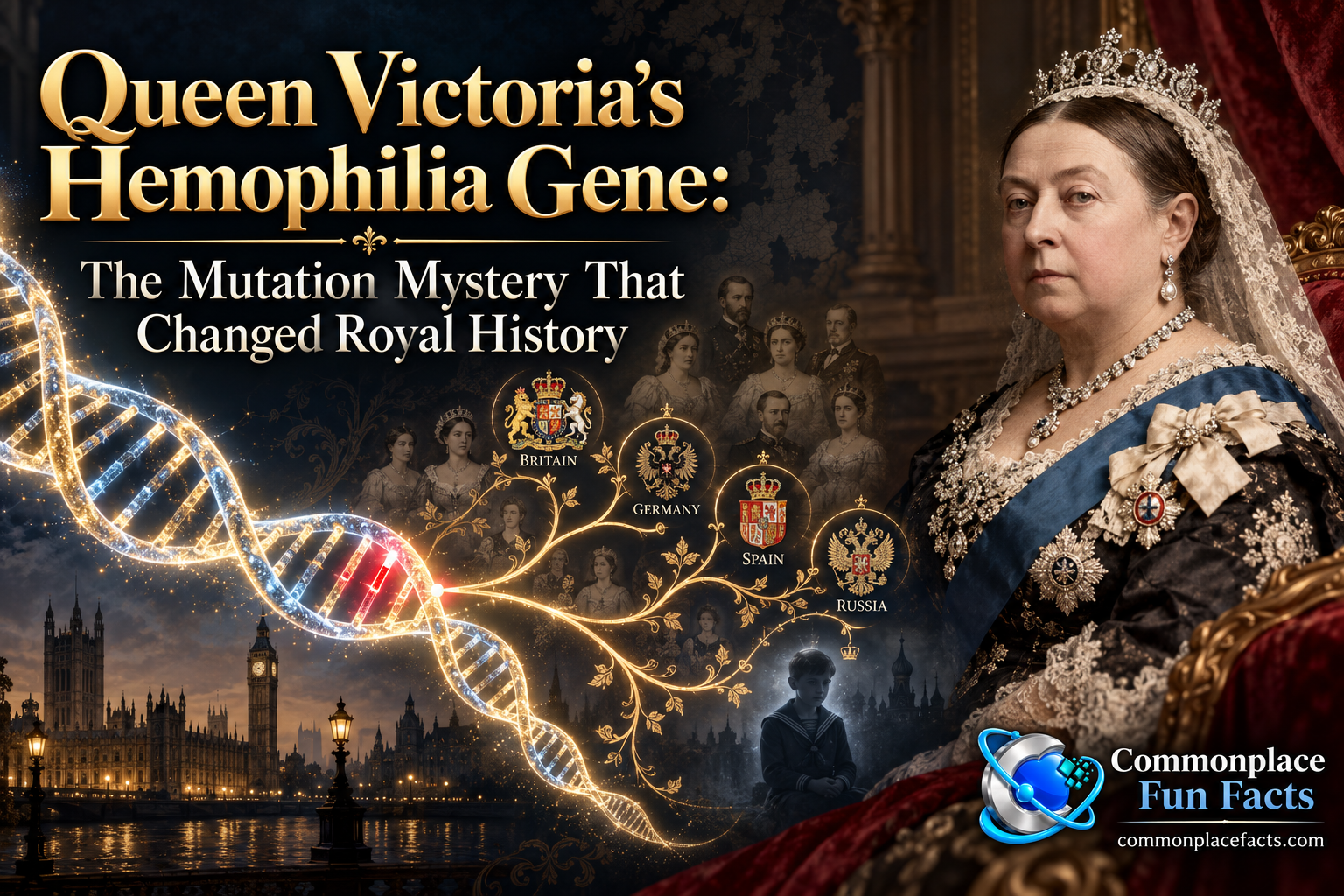

Queen Victoria gave her name to an era, ruled Britain for more than 63 years, produced nine children, and accumulated so many royal descendants that she became known as the “Grandmother of Europe.” She also managed to distribute one particularly unfortunate genetic mutation across several of the continent’s ruling houses.
That mutation caused hemophilia, the bleeding disorder that became so closely associated with European royalty that it acquired the nickname “the royal disease.” Victoria’s son Leopold suffered from it. Two of her daughters carried it into other dynasties. Eventually it appeared in the royal families of Germany, Spain, and Russia, where it afflicted Tsarevich Alexei, the only son of Nicholas II and Alexandra.
For generations, historians could trace the hemophilia gene backward through royal family trees until every branch converged on the same person: Queen Victoria.
And then the trail stopped.
No one in Victoria’s known ancestry had hemophilia. Neither of her parents was known to come from a family affected by it. Yet Victoria unquestionably carried the mutation and passed it to her children. Modern DNA analysis has even identified the particular genetic defect responsible.
What science still cannot tell us is where Victoria got it.
Contents
A Genetic Surprise in the House of Hanover
When Alexandrina Victoria was born on May 24, 1819, nobody had any reason to regard her genes as especially interesting. Her most immediate problem was that she occupied fifth place in the succession and had acquired a first name that practically demanded stationery with extra-wide margins.

Events soon improved her position considerably. By 1837, the eighteen-year-old was queen. The following year brought the wonderfully chaotic coronation of Queen Victoria, an affair involving confused bishops, a painfully tight ring, and an elderly peer tumbling down the steps of the throne. Apparently the Victorian Age needed a dress rehearsal.
Victoria married Prince Albert of Saxe-Coburg and Gotha in 1840, and the couple eventually had nine children. Most of those children married into European royal houses, which was very useful for diplomacy and considerably less useful when one of the genes being distributed with the wedding presents happened to be defective.
The first unmistakable warning appeared in Victoria’s eighth child, Prince Leopold, born in 1853. Leopold suffered repeated and sometimes dangerous bleeding episodes throughout his life. He survived to adulthood, married Princess Helena of Waldeck and Pyrmont, and fathered two children, but his health remained precarious. In 1884, while in Cannes, he slipped and fell, injuring his knee and striking his head. He died the following morning at only thirty years old, apparently from a cerebral hemorrhage.
Leopold had hemophilia.
Why the Family Tree Pointed Straight at Victoria
Hemophilia comes in several forms. The varieties relevant here are hemophilia A, caused by pathogenic variants in the F8 gene, which encodes clotting factor VIII, and hemophilia B, caused by variants in the F9 gene, which encodes factor IX. Both genes are located on the X chromosome.

That X-linked inheritance pattern makes hemophilia unusually convenient for genealogical detective work, although presumably the families involved would have preferred a less personally consequential hobby.
A male normally has one X chromosome and one Y chromosome. He receives his X from his mother and his Y from his father. If his only X carries a disease-causing F9 mutation, he has no second copy of the gene to compensate for it and may develop hemophilia B.
A female normally has two X chromosomes. If only one carries the mutation, she is generally described as a carrier, although modern medicine recognizes that some female carriers can themselves experience abnormal bleeding depending on their factor IX levels and patterns of X-chromosome inactivation.
The inheritance pattern therefore creates a trail. A carrier mother has a 50 percent chance of passing the affected X chromosome to each child. A son receiving it may have hemophilia; a daughter receiving it may become a carrier. An affected father, meanwhile, gives his X chromosome to all of his daughters but none of his sons.
Victoria did not display the severe disease suffered by Leopold, but the family tree makes her carrier status effectively unavoidable. Leopold received his X chromosome from her.
Then there were Victoria’s daughters.
The Mutation Goes on a European Tour
At least two of Victoria’s five daughters, Alice and Beatrice, inherited the mutation. Through them, the gene embarked on the sort of continental tour normally reserved for diplomats, armies, and people whose luggage included several trunks and a personal footman.

Princess Alice married Louis IV, Grand Duke of Hesse. Their son Friedrich, known as “Frittie,” had hemophilia and died as a small child after falling from a window. Two of Alice’s daughters, Irene and Alix, carried the mutation onward.
Alix would become much better known after converting to Russian Orthodoxy, adopting the name Alexandra Feodorovna, and marrying Tsar Nicholas II of Russia. Their first four children were daughters. Their fifth child, born in 1904, was the son and heir for whom the imperial couple had desperately hoped.
Tsarevich Alexei had hemophilia.
Victoria’s daughter Beatrice carried the mutation into another branch of the family. Beatrice’s daughter Victoria Eugenie—known as Ena—married King Alfonso XIII of Spain. Two of their sons, Alfonso and Gonzalo, suffered from hemophilia.
Thus, within a few generations, one mutation carried by a British queen had appeared among some of the most prominent royal families in Europe. A medical review of the disease notes that Victoria’s descendants transmitted hemophilia B into the German, Spanish, and Russian royal houses. The history of hemophilia makes for an unusually literal example of royal blood becoming a matter of state.
Then Came Rasputin
The Russian branch gave Victoria’s genetic inheritance its greatest historical significance. Alexei’s hemophilia belongs to that surprisingly large category of medical conditions whose consequences escaped the sickroom and wandered directly into world history, as we explored in our look at illnesses that changed history.

Alexei’s condition was kept largely secret. This was not simply a matter of parental privacy. He was the heir to the Russian throne, and announcing that the future tsar had a potentially fatal inherited bleeding disorder was not precisely the sort of information imperial public-relations offices liked to circulate.
Alexandra became increasingly desperate for anyone who might help her son. That desperation helped bring her under the influence of Grigori Rasputin, the Siberian mystic whose apparent ability to calm Alexei—or, on at least some occasions, to coincide rather impressively with his recovery—gave him extraordinary access to the imperial family.
Rasputin would eventually become nearly as famous for the extraordinary stories surrounding his murder as for his relationship with the Romanovs, a subject we explore in the strange and frequently embellished story of how Rasputin died.
Rasputin did not cause the Russian Revolution. Russia had a few other problems at the time, including political repression, social upheaval, economic distress, military catastrophe, and a world war. History generally becomes suspicious when somebody tries to explain a revolution involving millions of people with one eccentric Siberian.
But Alexei’s illness helped create the circumstances that elevated Rasputin. His influence over Alexandra became politically damaging, especially because the reason for his privileged position could not be publicly explained.
When Nicholas abdicated in 1917, Russia entered the bewildering sequence of governments, revolutions, and constitutional experiments that would eventually produce, among other curiosities, the Russian republic that officially existed for only about six hours.
One tiny mutation had not brought down the Romanovs. It had, however, managed to secure itself a surprisingly respectable supporting role.
For More Than a Century, Nobody Knew Which Hemophilia It Was
There was another mystery hiding inside the first one. Historians knew that Victoria’s descendants had hemophilia, but they did not know whether they had hemophilia A or hemophilia B.
The specific disorder now known as hemophilia B was formally distinguished from classic hemophilia in 1952. It became known as “Christmas disease,” not because it causes festive seasonal bleeding, but because the first patient described in the landmark study had the surname Christmas. Medical terminology occasionally has a sense of humor that it refuses to acknowledge.
By then, the affected royal lines were disappearing. There was no convenient living member of Victoria’s family with the disease from whom researchers could simply collect a blood sample.
Then scientists received help from an unlikely source.
The Bolsheviks had provided the samples.
The Romanov Bones Give Up Their Secret
Nicholas II, Alexandra, Alexei, and Alexei’s four sisters were murdered by Bolshevik guards in Yekaterinburg in July 1918. Their bodies were concealed, and identifying the remains became a scientific problem decades later.

Modern DNA analysis eventually confirmed the identities of the Romanov remains. That created an extraordinary opportunity. Scientists now possessed genetic material from Alexandra, who had inherited Victoria’s mutation, and from Alexei, who had suffered from the disease.
In 2009, researchers led by Evgeny Rogaev published the answer in the journal Science. Their genetic analysis of the Romanov remains found the likely disease-causing mutation in F9, the gene responsible for producing clotting factor IX.
The royal disease was hemophilia B.
More specifically, researchers found a single-base substitution in intron 3 of the F9 gene, immediately before exon 4 at a site involved in RNA splicing. The 2009 researchers predicted that the mutation would disrupt normal splicing and produce a truncated form of factor IX; later laboratory work confirmed the abnormal splicing mechanism. The result was severe hemophilia B.
After more than a century, science had tracked down the molecular culprit.
Unfortunately, the culprit declined to identify where it had entered the family.
So Where Did Victoria Get the Hemophilia Gene?
This is where the story stops being merely a history of hereditary disease and turns into a genuine genetic mystery.
There is no known history of hemophilia among Queen Victoria’s ancestors. That makes the most likely explanation a de novo mutation: a new genetic change rather than a variant that had been quietly traveling through the family for generations.

Popular culture has had some fun with that mystery. In the 2006 Doctor Who episode “Tooth and Claw,” Queen Victoria encounters a werewolf that is trying to infect her with a bite. After the creature is defeated, Victoria is shown with a fresh cut on her wrist. The Doctor suspiciously asks whether the werewolf bit her; Victoria insists that it is merely a splinter wound. Later, after noting that the “royal disease” appeared in Victoria’s family without an obvious earlier history, the Doctor wonders whether “hemophilia” might simply have been a Victorian euphemism for something rather more lupine. The explanation is tantalizing. It is also, needless to say, not the explanation favored by geneticists.
The actual possibilities are less cinematic, although still rather interesting. The mutation could have arisen in the reproductive cells of either of Victoria’s parents. A mutation in one of her mother’s eggs could have produced Victoria’s affected X chromosome. Alternatively, the mutation could have arisen in the sperm cell from her father that contributed his X chromosome to Victoria.
A mutation occurring very early in Victoria’s own embryonic development is another theoretical possibility, although discussions of the royal mutation have generally concentrated on its arising during the formation of a parental egg or sperm.
The important point is that neither parent needed to have hemophilia. A genetic mutation can arise in an individual reproductive cell without being present throughout the parent’s body. Biology has ways of introducing unexpected plot developments without first clearing them with the family genealogist.
Was Victoria’s Father Responsible?
Victoria’s official father was Prince Edward, Duke of Kent and Strathearn, the fourth son of King George III. His age has long made him an appealing suspect.
Edward was fifty when Victoria was conceived and fifty-one when she was born. Because sperm-producing cells continue dividing throughout a man’s life, advanced paternal age is associated with increased rates of some new mutations. Earlier discussions of Victoria’s hemophilia therefore often suggested that the mutation probably arose in one of Edward’s sperm cells.
It is plausible. It is not proven.
Research into mutations of the F9 gene has produced a more complicated picture. A study of germline origins of hemophilia B mutations found that single-base substitutions showed a male predominance, meaning that mutations of certain types occurred more often in the male germ line. That would fit reasonably well with an origin in Victoria’s father.
On the other hand, a later study of F9 mutations and parental age found no evidence of a paternal-age effect in the families examined and instead detected an association with advanced maternal age for certain mutations.
So the Duke of Kent’s age makes a paternal origin possible and perhaps tempting, but genetics has declined to issue the arrest warrant.
And Then Someone Suggested Victoria Was Illegitimate
A mystery involving a queen, genetics, and an unexplained inheritance could hardly be expected to remain a sober scientific discussion forever.
In 1995, D. M. Potts and W. T. W. Potts published Queen Victoria’s Gene, examining the history of royal hemophilia and entertaining a more sensational possibility: perhaps Prince Edward was not Victoria’s biological father.
The argument sounds intriguing at first. No hemophilia appeared in Victoria’s recognized ancestors. Victoria suddenly carried it. Therefore, perhaps an unknown biological father introduced the mutation.
There is, however, a fairly substantial genetic pothole in that road.
Hemophilia B is X-linked. Victoria necessarily received an X chromosome from her biological father. If that hypothetical father carried the severe royal F9 mutation throughout his body, he would not have been a healthy, silent “carrier” in the way a woman with a second normal X chromosome might be. He would have had hemophilia.
In early nineteenth-century Britain, severe hemophilia was not a particularly inconspicuous condition. There is no documented hemophiliac candidate hovering suspiciously around Victoria’s mother, the Duchess of Kent.
One could rescue the illegitimacy theory by proposing that the hypothetical father was healthy but that the mutation happened to arise in the sperm cell—or its germline precursor—that ultimately conceived Victoria. But at that point we have simply returned to the ordinary de novo mutation theory with the addition of adultery.
Occam would probably like to have his razor back.
The Mutation Was Not Evidence of Royal Inbreeding
Another common assumption is that Victoria’s hemophilia must somehow have resulted from generations of royal intermarriage. European royalty certainly provides enough spectacular examples of consanguinity to make this seem reasonable. The Habsburg family tree alone sometimes looks less like a tree and more like somebody repeatedly drawing circles around the same shrub.
But that is not what the evidence indicates here.

Victoria’s F9 mutation appears to have been new. Consanguinity can increase the likelihood that relatives will transmit the same inherited pathogenic variants, but it is not needed to explain the sudden appearance of a new X-linked mutation. A review appropriately titled “Genes and queens” notes that the royal hemophilia mutation was not evidence of inbreeding and describes its origin as unknown, most likely representing a de novo event.
Royal marriage patterns did matter afterward, of course. Once Victoria possessed the mutation, marrying her descendants into ruling families across Europe proved remarkably efficient at distributing it.
The problem was not that the mutation had been created by royal matchmaking.
The problem was that royal matchmaking gave it excellent transportation.
The Mystery Science Solved—and the One It Didn’t
The remarkable thing about Queen Victoria’s hemophilia gene is how much we now know.
We know that Victoria carried an altered X chromosome. We know that her son Leopold had hemophilia and that her daughters Alice and Beatrice transmitted the mutation to later generations. We can follow its path into the houses of Hesse, Russia, Battenberg, and Spain. We know it afflicted Tsarevich Alexei and helped create the circumstances that brought Rasputin into the inner life of the last Russian imperial family.
We even know the molecular identity of the mutation. Scientists recovered DNA from the bones of people murdered in a cellar in 1918 and found an alteration in the F9 gene that interfered with production of factor IX. The genetic mystery that physicians could not solve while Victoria’s descendants were alive finally yielded to molecular biology nearly a century after the Romanovs died.
But the original question survives.
Did the mutation occur in an egg produced by Victoria’s mother? Did it arise in the sperm of her fifty-year-old father? Did it appear at some very early stage of Victoria’s own development? Was it the result of an unfortunate encounter with a werewolf? Without usable DNA from Victoria and the appropriate members of the preceding generation, the evidence cannot tell us.
Although we’re leaning against the werewolf hypothesis.
There is something wonderfully unsatisfying about what science can and cannot answer. We can identify one altered letter of DNA in the remains of Queen Victoria’s great-grandson. We can watch that letter travel through marriages and palaces, cross national borders, threaten royal successions, and brush against some of the defining political events of the twentieth century. Yet when we follow it all the way back to Britain in 1818, the trail simply disappears.
Somewhere in the biological chain that produced a future queen, one microscopic genetic change occurred—perhaps in a parental germ cell, perhaps in one of its precursors, or perhaps very early in Victoria’s own development. Nobody noticed it. Nobody could have noticed it. For decades it remained hidden inside a woman who would become one of the most consequential monarchs in modern history.
Then she had children.
You may also enjoy…

10 Illnesses That Changed History and Redirected the World
Discover 10 illnesses that changed history, altered dynasties, toppled plans, reshaped governments, and even redrew maps.

Mary Ann Brough: The Wet Nurse Who Served Queen Victoria—and Killed Six Children
Mary Ann Brough was Queen Victoria’s wet nurse—until a shocking crime made her infamous. A dark Victorian story of motherhood, madness, and respectability undone.

The Cagots: History’s Most Mysteriously Hated People (For Reasons No One Remembers)
For over a thousand years, the Cagots were shunned, segregated, and feared across France and Spain—yet no one can explain why. Explore the strange, sad mystery of history’s most inexplicably hated people.



Leave a Reply