
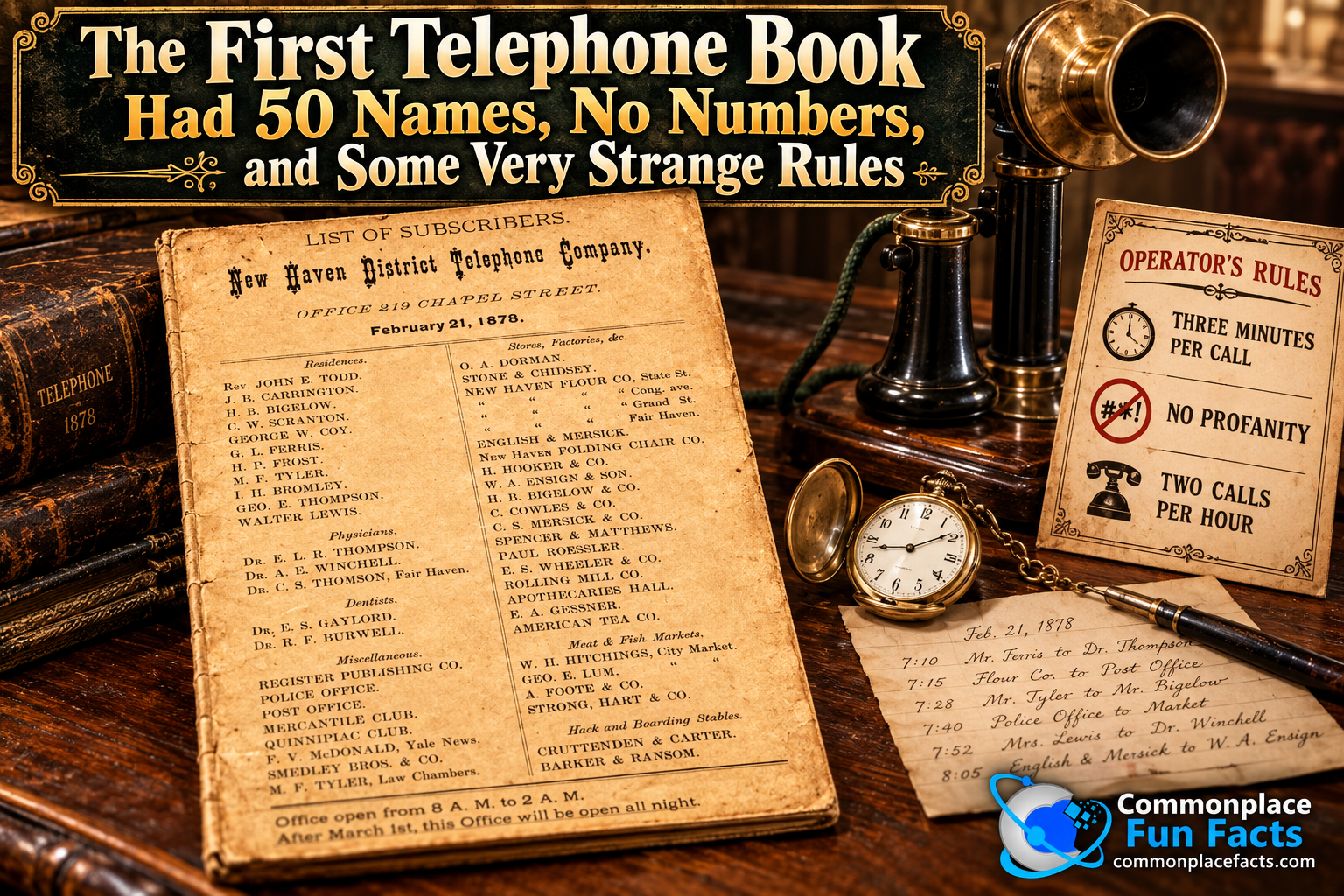

If you open a restaurant menu and don’t see any prices, that’s usually a pretty good indication that you’re in for an expensive meal. But what should you conclude if you open a telephone directory and discover that it doesn’t contain any telephone numbers? In 1878, it meant you were holding the world’s first telephone book.
Today, this would be considered a fairly significant quality-control issue. In 1878, however, it was perfectly normal. The world’s first telephone directory contained exactly 50 listings, not a single telephone number, and nobody considered the omission particularly troublesome.
On February 21, 1878, the New Haven District Telephone Company of New Haven, Connecticut, published what is generally recognized as the world’s first telephone directory. It was a single sheet of paper or cardboard containing the names of the company’s subscribers. There were no telephone numbers because, at the time, telephone numbers weren’t necessary.
If you wanted to call someone, you simply asked the operator to connect you by name.
But the story gets better. Within nine months, the company produced a proper 40-page telephone book. In addition to listing hundreds of subscribers, it contained detailed instructions explaining how to use the telephone, how to conduct a conversation, and what sort of behavior the company would tolerate.
Among the rules: conversations were limited to three minutes, subscribers generally couldn’t make more than two calls per hour without permission, and anyone using profanity was supposed to be reported to the telephone office.
Apparently, the first telephone companies anticipated the need for customer-service policies long before they had enough customers to justify them.
Contents
Before the Telephone Book, There Was a More Fundamental Problem
To understand why the first telephone directory had no numbers, we need to revisit the telephone’s earliest days.
Alexander Graham Bell received his famous telephone patent in March 1876. As we’ve previously explored in “Who Invented the Telephone? The Messy Truth About Bell, His Rivals, and Impeccable Timing,” the invention’s history was considerably more complicated than the version presented in elementary school textbooks.
Regardless of the controversies over who deserved credit, Bell and his associates had demonstrated something extraordinary: human speech could be transmitted electrically through wires.
There was, however, a small commercial problem.
Early telephones generally connected one location directly to another. If you wanted to speak regularly with somebody across town, you needed a telephone at each end and a wire connecting them.
That worked reasonably well if you had one person you wanted to call. But what if you wanted to speak with your doctor, your business partner, the post office, your lawyer, and your butcher?
Running a separate wire to each of them would become expensive and unwieldy. And if all those people wanted to communicate with one another, the number of potential connections would grow at an alarming rate.
The telephone was a brilliant invention, but it still needed something resembling a practical business model.
Enter George Coy.
Meet George Coy, the Man Who Made Telephones Useful
George Willard Coy was a Civil War veteran and telegraph-office manager in New Haven, Connecticut. He understood electrical communication, knew something about the practical difficulties of operating a network, and possessed enough entrepreneurial imagination to recognize a business opportunity when one came along.

On April 27, 1877, Coy attended a demonstration by Alexander Graham Bell at New Haven’s Skiff Opera House. According to the National Park Service’s history of the first telephone exchange, Bell demonstrated a three-way telephone connection involving New Haven, Hartford, and Middletown.
Bell also discussed the possibility of creating telephone exchanges for business and commercial communication.
Coy recognized the potential immediately. Instead of connecting every telephone directly to every other telephone, why not connect all subscribers to one central office? An operator at that office could then connect callers to whichever other subscriber they wanted.
It seems obvious today, but many revolutionary ideas become obvious approximately five minutes after somebody else figures them out.
In November 1877, Coy obtained a Bell telephone franchise covering New Haven and Middlesex Counties. He joined forces with Herrick P. Frost and Walter Lewis, who provided financial backing, and the three established the District Telephone Company of New Haven in January 1878.
Now they needed a switchboard.
The World’s First Commercial Telephone Switchboard Was Built From Some Unusual Materials
Modern telephone networks are marvels of electronic switching, fiber optics, computers, and complex infrastructure.
Coy’s first commercial switchboard relied upon materials that sound suspiciously like the contents of a Victorian junk drawer.

Accounts describe the apparatus as being constructed from carriage bolts, handles taken from teapot lids, and wire normally used in women’s bustles.
Bustles, for anyone unfamiliar with nineteenth-century fashion, were frameworks worn beneath women’s skirts to support an exaggerated silhouette. They were an important component of fashionable clothing, although their manufacturers probably never imagined they would also help make the telephone commercially practical.
The company’s records indicate that all the furnishings of the original office, including the switchboard, were worth less than $40.
The equipment could theoretically accommodate 64 subscribers, although only two conversations could take place simultaneously. Connecting a single call required the operator to make six separate connections.
It was not exactly the communications infrastructure of the future.
Except, of course, that it was.
January 28, 1878: The World’s First Commercial Telephone Exchange Opens
On January 28, 1878, the New Haven District Telephone Company officially opened its exchange in a rented storefront in the Boardman Building at the corner of Chapel and State Streets.

The company began with 21 subscribers paying $1.50 per month for service.
That price may sound modest, but it was a meaningful expense in 1878, especially for technology whose practical value was still uncertain. Most people had managed to conduct their affairs without a telephone and weren’t yet convinced that arranging for strangers to interrupt them electronically represented an improvement.
Coy himself initially struggled to find customers.
In a detailed history published in the January 1907 issue of Popular Science Monthly, Fred De Land reported that Coy mailed 1,000 circulars describing the advantages of telephone service.
He received one subscription.
That subscriber was the Reverend John E. Todd, pastor of New Haven’s Church of the Redeemer. Todd’s name consequently appeared first on the company’s original subscriber list.
One customer from 1,000 solicitations is not the kind of response rate that inspires confidence among investors. Coy nevertheless kept trying, hired someone to solicit subscriptions personally, and gradually persuaded New Haven residents that this talking-machine business might actually have a future.
Within a few weeks, the company had enough subscribers to create a new problem.
How were customers supposed to know whom they could call?
February 21, 1878: The World’s First Telephone Directory
On February 21, 1878, the New Haven District Telephone Company published a single-sheet list of its 50 subscribers.

The University of Connecticut’s Archives & Special Collections documents the publication and provides access to a reproduction of the historic directory.
It wasn’t much to look at by modern standards. There were no hundreds of pages, no elaborate alphabetical listings, and no advertisements for personal-injury attorneys promising to fight for every penny.
It didn’t even list the names alphabetically.
Most importantly, there were no telephone numbers.
Instead, the directory simply identified people, businesses, and offices that possessed telephone connections.
The subscribers represented an interesting cross-section of early telephone adopters. They included merchants, physicians, dentists, the post office, the police, and a handful of private residences.
Only 11 of the 50 listings were residences, and four of those belonged to people associated with the telephone company itself.
In other words, a substantial portion of the residential telephone market consisted of people with a financial interest in persuading everyone else that residential telephones were a good idea.
Business use was the more obvious attraction. A physician could be summoned quickly. A merchant could check on an order. A customer could communicate with a supplier without sending a messenger across town.
And anyone consulting the directory could discover whether a particular establishment belonged to the tiny but rapidly expanding club of people who could be reached by telephone.
How Did You Make a Telephone Call Without a Number?
The procedure was remarkably straightforward.
You consulted the directory, identified the subscriber you wanted to reach, contacted the telephone exchange, and asked the operator to connect you.
The operator identified the appropriate line and physically made the connection through the switchboard.

There was no keypad, no rotary dial, no area code, and certainly no cheerful automated voice explaining that your call was important and would be answered in the order received.
The operator was the interface.
This arrangement worked reasonably well while the subscriber list was small. The operator could learn which lines belonged to which customers and use that knowledge to route calls.
The first New Haven operators were young men. The 1907 historical account identifies Louis H. Frost, son of company treasurer Herrick Frost, as the original operator, with additional employees joining as business expanded.
As telephone exchanges became larger, however, relying on names became increasingly cumbersome. Operators had to learn new subscribers, identify similar names, and remember which connections belonged to which customers.
Eventually, assigning numbers to subscribers offered an obvious advantage.
But the circumstances surrounding the introduction of telephone numbers deserve their own story. We’ve already explored the wonderfully unexpected role of a public-health scare in “How Did a Measles Outbreak Lead to the Use of Telephone Numbers?”
For now, it is enough to recognize that the world’s first telephone directory didn’t have telephone numbers because the entire system was designed to work without them.
It wasn’t an oversight. It was the operating procedure.
The First Telephone Directory Became Obsolete Almost Immediately
There was another problem with the original telephone directory: it was becoming outdated almost as quickly as the ink dried. The telephone company’s success meant that every new subscriber created another reason to replace a directory that had barely had time to become useful.
According to Fred De Land’s 1907 account, the February 21 directory listed 50 stations. A second list appeared on March 9, with approximately 125 subscribers. By April 8, another directory identified 227 subscribers, including 42 residences.
The company was growing so quickly that each new list seemed to demonstrate the inadequacy of the previous one.
For a business struggling to attract customers only months earlier, this was a rather encouraging inconvenience.
Coy’s telephone network was no longer merely a scientific novelty. It was becoming a practical community service.
Subscribers could contact merchants, doctors, newspaper offices, and one another. The company also began offering increasingly specialized information services.
In March 1878, Coy advertised that subscribers could call to obtain weather information, including temperature and barometric readings. Later that year, his network helped transmit election returns from polling places.
The telephone had become a means of obtaining information almost immediately, not merely a device for conducting conversations.
That distinction would become increasingly important over the next century and a half.
November 1878: The Telephone Book Finally Becomes a Book
By November 1878, New Haven’s telephone system had expanded enough to justify something more substantial than a single sheet.
The renamed Connecticut District Telephone Company published a 40-page booklet titled The Telephone Directory.
This telephone book was a proper publication. It contained an alphabetical list of 391 subscribers, plus 16 additional names that arrived too late for inclusion in the main telephone directory. There were also advertisements, a business directory, and articles discussing telephone technology and related electrical inventions. In the space of nine months, New Haven’s telephone directory had evolved from a single sheet of names into a publication with enough material to keep readers occupied even when they weren’t making telephone calls.
It also contained something its February predecessor had lacked: detailed instructions for using the telephone.

These instructions survive because an original copy of the November directory was preserved. In 2008, Christie’s auctioned the historic booklet and published an extensive description of its contents. It sold for $170,500.
Those contents reveal a society still learning how to behave around this unfamiliar new technology.
The telephone had created an entirely new kind of social interaction: two people could have a conversation without standing in the same room, seeing each other’s faces, or even knowing whether the other person was ready to speak.
Someone needed to establish rules.
And telephone companies, having discovered a promising new industry, were apparently delighted to take responsibility.
Rule No. 1: You Must Know How to Say Hello
One of the directory’s first challenges was teaching people how to begin a telephone conversation.
The instructions advised callers to begin with “Hulloa!”—one of several spellings of a greeting already in use. In fact, Thomas Edison had recommended “Hello” as a telephone greeting in August 1877, while Alexander Graham Bell reportedly preferred the nautical greeting “Ahoy!” Apparently, even the inventors of the telephone couldn’t agree on how people should answer one.
When the conversation ended, the caller was supposed to say, “That is all!” The other party would respond, “O.K.”
This may sound overly formal today, but telephone conversation was an entirely new social experience. Ordinary face-to-face discussions came with familiar signals: eye contact, gestures, changes in posture, and the reassuring ability to see when someone was walking away.
Telephone calls eliminated most of those signals.
Without established verbal conventions, both parties could easily become confused about whether a conversation had started, whether the other person had finished speaking, or whether the connection was still active.
The telephone company therefore provided a script.
It is comforting to know that the earliest telephone users were instructed to end their calls with an official-sounding acknowledgment. Today, that might be mistaken for the farmer from Babe giving instructions to his pig.
Rule No. 2: Learn Which End of the Telephone to Use
The November directory also offered surprisingly detailed instructions about how to speak into the telephone.

Subscribers were told to speak clearly and position the instrument near their mouths without restricting the movement of their lips and jaws.
This advice addressed a genuine technological problem. Early telephone instruments differed substantially from the familiar combined handset that became standard in later decades.
Some required the user to move a single receiver between mouth and ear. Others had different signaling arrangements, including push buttons and bells for attracting the operator’s attention.
The November directory therefore contained separate directions for different types of telephone equipment.
The basic problem was simple enough: if you wanted someone to hear you, you had to speak into the appropriate part of the device. If you wanted to hear the response, you had to listen through it.
Unfortunately, humans are remarkably creative when presented with unfamiliar equipment.
Some callers shouted. Others spoke into the wrong part. Still others apparently tried to speak and listen simultaneously, a procedure the technology did not handle especially well.
The company cautioned against both parties talking at once.
Nearly 150 years later, technology has solved most of the mechanical difficulties. The human tendency to interrupt remains stubbornly resistant to innovation.
Rule No. 3: You Have Three Minutes. Make Them Count.
Perhaps the most remarkable rule in the November 1878 directory concerned the length and frequency of telephone calls.
Subscribers were not supposed to occupy a line for more than three minutes at a time without permission from the central office.
They also weren’t permitted to use the system more than twice in an hour without authorization.
There was a practical reason for these restrictions. The telephone exchange had limited capacity, and prolonged conversations could prevent other subscribers from using the service.
Remember, Coy’s original switchboard could serve dozens of customers but accommodate only two conversations simultaneously. As the network expanded, efficient use of its resources became essential.
The rules were therefore a form of traffic management.
Nevertheless, the idea of requiring permission to speak on the telephone for more than three minutes has a certain appeal. Imagine how many modern conference calls would end before someone had finished explaining the purpose of the meeting.
The company was not merely selling access to a communications network. It was attempting to regulate how much communication constituted a reasonable amount.
By that standard, the modern unlimited calling plan would have seemed less like technological progress and more like the collapse of civilization.
Rule No. 4: Watch Your Language
The November directory also included instructions concerning subscriber behavior.
Among them was a warning against profanity or other improper language, with subscribers encouraged to report violations to the telephone office.
This raises some entertaining practical questions.
What happened if a customer reported that another subscriber had sworn? Did the operator investigate? Was the offending caller reprimanded? Did somebody at headquarters maintain a ledger of citizens who had used language unbecoming a respectable telephone subscriber?
The surviving rules establish the company’s expectations, but they don’t tell us how enthusiastically those expectations were enforced.
Still, the policy illustrates something important. Telephone companies quickly discovered that connecting people electronically didn’t eliminate the need for social conventions. It simply created new opportunities for people to disregard them.
Privacy was also a concern. Operators could become aware of conversations, and subscribers sharing lines or using poorly understood equipment could hear things not intended for them.
The company therefore cautioned customers against careless use of the instruments and urged them to behave appropriately.
Modern communications platforms wrestle with similar questions involving privacy, acceptable language, harassment, and misuse.
The technology has changed somewhat.
The arguments have proven remarkably durable.
The World’s First Telephone Book Also Had Advertising
By November 1878, the telephone directory had another feature that would eventually become a major commercial enterprise: advertising.
The booklet included a business directory and advertisements for various merchants and services.
That made perfect sense. A telephone directory was not merely a list of people who owned a new gadget. It was a guide to businesses that could now be contacted quickly and conveniently.
A merchant with a telephone enjoyed a competitive advantage over one without it. Customers could place orders, request information, arrange deliveries, or summon services without leaving home.
Appearing in the directory advertised that convenience.
The later distinction between residential white pages and commercial yellow pages had not yet taken its familiar form, but the underlying commercial opportunity was already apparent.
Telephone directories would eventually become enormous publications containing residential listings, business advertisements, specialized categories, and enough paper to create difficulties for anyone responsible for carrying them to the front porch.
In November 1878, however, the entire business could still fit into a booklet approximately the size of a small pamphlet.
The Telephone Company Was Already Thinking About Everything
One of the more interesting details in the November directory is that it contained instructions for using the telephone system to summon messengers.
That may seem odd until we remember that New Haven’s early telephone service grew partly out of Coy’s experience with telegraph and messenger operations.
The telephone did not immediately replace every other form of communication. Instead, it worked alongside existing systems, making those systems faster and more convenient.
You might telephone an office to request a messenger, who would then physically carry something to its destination. The call could be instantaneous, even if the delivery still required a person to walk across town.
That combination of new and old technology is surprisingly familiar.
Today we can use an app to summon a driver, arrange a delivery, order groceries, or request a repair technician. In 1878, the telephone already offered a recognizable version of the same idea.
The customer no longer needed to travel to the service provider. Communication could bring the service provider to the customer.
The device itself was revolutionary, but the changes it created in ordinary habits may have been more consequential.
From 50 Names to Telephone Numbers and Modern Networks
The growth of the telephone network quickly made the original system impractical.
As more customers subscribed, operators could no longer rely entirely on remembering names and connections. Telephone numbers became increasingly useful, exchanges became more sophisticated, and switching technology evolved.
What began as a small central office in New Haven eventually became part of a vast international system.
But the path from Bell’s early experiments to modern telecommunications was anything but straightforward.
In rural America, some communities even built their own telephone networks using existing fences. We examined that particularly resourceful approach in “Barbed Wire Telephone: How Farmers Turned Fences Into Phone Lines.” Apparently, once people realized that speech could travel through a wire, they became considerably less particular about what sort of wire it was.
Meanwhile, the idea of reproducing speech through technology had roots reaching back before Bell’s telephone. Joseph Faber’s extraordinary mechanical talking head, discussed in “Euphonia: The Creepy Talking Head That Helped Inspire the Telephone,” demonstrated that nineteenth-century inventors had been experimenting with artificial speech long before commercial telephone service existed.
Coy’s contribution was different.
He helped transform a fascinating electrical invention into a practical network that ordinary businesses and households could actually use.
And once the network existed, something as unremarkable as a directory became essential.
Whatever Happened to the World’s First Telephone Exchange?
The New Haven exchange grew rapidly and underwent several reorganizations. The company eventually became Southern New England Telephone, a major regional telecommunications provider.

Its original building, however, enjoyed a less impressive career.
The Boardman Building received National Historic Landmark recognition in 1964 because of its role in the development of commercial telephone service.
Then, in 1973, the building was demolished. Its landmark designation was withdrawn the same year.
It takes a special kind of historical irony to recognize a building as nationally significant and then demolish it less than a decade later. Evidently, the future sometimes arrives with remarkably little interest in preserving the past.
Fortunately, the records, photographs, and surviving telephone directories remain.
They document the beginning of a communications revolution that changed how people conducted business, maintained relationships, obtained information, and organized their daily lives.
From the First Telephone Book to the Last
For much of the twentieth century, telephone books were fixtures of everyday life. They arrived at homes and businesses, provided essential contact information, and accumulated in closets and drawers until somebody finally decided that three editions from 1997 were probably enough.
Then the internet arrived, followed by smartphones and searchable digital contact lists.
Today, most people carry more telephone numbers in their pockets than the first New Haven telephone exchange could have imagined serving in a lifetime. We can call people on the other side of the world, conduct video conversations, send messages, and access vast amounts of information without consulting a printed directory or speaking to an operator.
And yet there is something wonderfully elegant about the original 1878 arrangement.
You looked at a list. You found a name. You asked the operator to connect you.
No password. No software update. No complicated menu of options. No recorded announcement explaining that the company’s office hours have recently changed.
Of course, you might have to wait until one of the exchange’s two available conversations ended, you weren’t supposed to monopolize the line, and the company expected you to refrain from profanity.
Progress always comes with trade-offs.
The World’s First Telephone Directory Got the Important Part Right
George Coy’s first telephone directory seems almost comically inadequate by modern standards. Fifty names on one sheet, no telephone numbers, listings grouped by occupation rather than alphabetically, and no instructions for managing the flood of unsolicited calls that would eventually follow. To someone accustomed to modern telephone directories, it looks rather like a publishing project that ran out of resources before anyone thought to finish it.
But its purpose was not to provide telephone numbers.
Its purpose was to tell people whom they could reach.
And in that respect, the first telephone directory was doing exactly what every directory, contact list, address book, and communications app has attempted to do ever since.
It connected people.
The remarkable thing is how quickly the rest of the industry developed around that simple idea. Within months, there were hundreds of subscribers, a 40-page book, advertisements, specialized services, operating instructions, time limits, and rules governing acceptable behavior.
The world’s first telephone directory had no telephone numbers because nobody needed them.
By the time telephone books disappeared from everyday life, they had become so large that people could use them as furniture.
Somewhere between those two developments lies the entire history of modern telecommunications.
And just to think, it all began with 50 names, no telephone numbers, and the revolutionary possibility of contacting your butcher without having to put on your coat and walk across town.
You may also enjoy…

First White House Phone Number: 1 Easy Way to Remember
Ever have trouble remembering your phone number? You wouldn’t if you had the first White House phone number.

Barbed Wire Telephone: How Farmers Turned Fences Into Phone Lines
Discover how farmers in rural America turned fences into barbed wire telephone networks, connecting entire communities in the late 1800s with ingenuity, frugality, and a surprising bit of electrical know-how.

The Rise and Fall of the Telephone Booth
Explore the rise and fall of telephone booths, from essential communication hubs to modern relics, including how they worked, how much money they generated, and what remains of them today.


Leave a Reply