
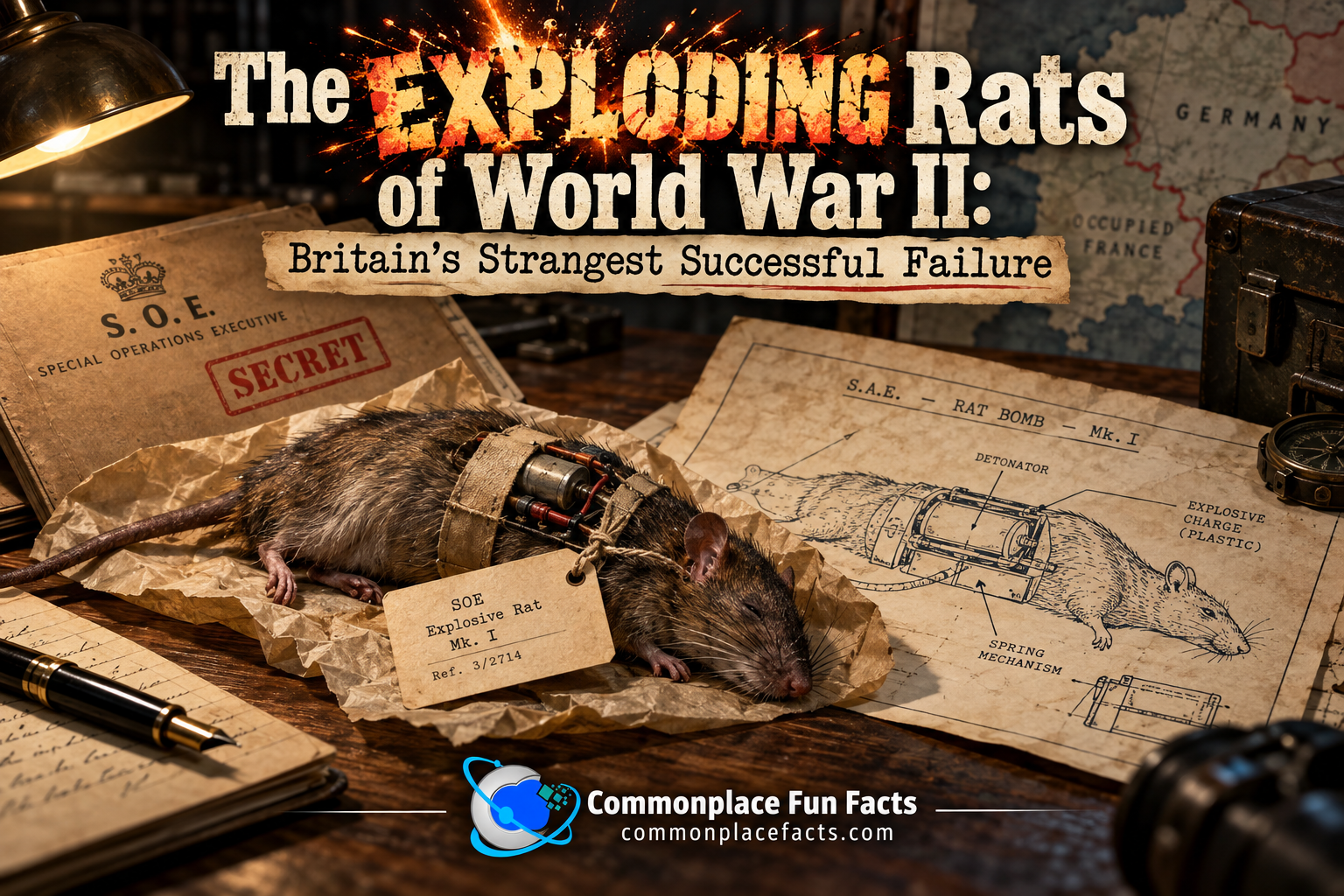

In 1941, a British intelligence officer approached a supplier with a somewhat unusual request. Posing as a student, he wanted approximately 100 rats for what he described as laboratory experiments. The explanation sounded innocent enough, although the experiments he actually had in mind were unlikely to advance medical science, win anyone a Nobel Prize, or receive an enthusiastic endorsement from the local animal welfare society.
Britain was fighting for survival against Nazi Germany, and Prime Minister Winston Churchill had instructed his intelligence services to find creative ways to make life miserable for the occupying forces. Sabotaging factories, disrupting transportation, and destroying industrial equipment were all on the agenda. Apparently, so was finding a military application for dead rodents.
The assignment fell to the Special Operations Executive, a secret organization whose responsibilities included devising ways to blow things up in places where the Germans would strongly prefer things remain unexploded.
Its agents and inventors were already developing an impressive assortment of unconventional weapons. Explosives disguised as everyday objects, concealed firearms, and ingenious sabotage devices were all part of their repertoire. But someone had apparently decided that ordinary household objects weren’t quite unusual enough.
Which brings us to exploding rats.
The British intended to turn the unfortunate creatures into miniature bombs, smuggle them into German-occupied territory, and use them to sabotage vital industrial equipment. The plan was ingenious, deeply unpleasant, and dependent on several assumptions about how German workers would react upon encountering a dead rat.
On paper, at least, it had considerable potential. Unfortunately, things did not go according to plan. What happened next transformed one of Britain’s strangest wartime inventions into something its creators could scarcely have anticipated.
What followed would become one of the more peculiar episodes in the history of British intelligence. It also demonstrated that, under the right circumstances, a failed military operation could create an entirely different kind of headache for the enemy.
Contents
Meet the Special Operations Executive: Churchill’s Department of Creative Destruction
To understand how the British government became involved in the business of weaponizing deceased rodents, we need to meet the Special Operations Executive, better known as the SOE.
The SOE was established in July 1940, at one of the darkest moments of World War II. France had fallen to Nazi Germany, much of continental Europe was under Axis control, and Britain faced the increasingly unpleasant possibility of having to fight Hitler’s forces largely on its own.

Conventional military operations were proving difficult. The Germans controlled enormous amounts of territory, and Britain lacked the resources to launch an immediate campaign to liberate occupied Europe.
Churchill, however, had no intention of allowing the Germans to enjoy their conquests in peace. He wanted an organization capable of operating behind enemy lines, supporting resistance movements, sabotaging industrial facilities, destroying communications networks, and generally making life as difficult as possible for the occupying forces. In July 1940, he reportedly gave Hugh Dalton, the Minister of Economic Warfare, a wonderfully concise instruction: “And now go and set Europe ablaze.”
The National Army Museum’s history of the SOE describes the secret organization as an underground army whose agents operated throughout occupied Europe and Asia, carrying out sabotage, organizing resistance fighters, and disrupting enemy operations.
The organization’s personnel included soldiers, engineers, scientists, linguists, technicians, and ordinary civilians who possessed skills that suddenly became extremely useful when combined with clandestine warfare.
Some parachuted into enemy territory to organize resistance networks. Others operated secret radio stations, forged documents, transported intelligence, or arranged attacks on railroads, bridges, factories, and military installations.
Still others worked in secret research facilities, developing an astonishing assortment of equipment intended to help agents accomplish their missions. Their creations included miniature firearms, concealed communications equipment, disguised explosives, ingenious escape devices, and seemingly ordinary household objects that could produce remarkably large explosions. Long before James Bond began collecting gadgets from Q, the SOE had made the development of unconventional weapons a legitimate government occupation.
Its inventors were constantly searching for new ways to conceal weapons in objects that would attract little attention. Eventually, someone apparently looked at a dead rat and thought, “You know what would make that better?”
Why Would Anyone Want an Exploding Rat?
The proposed explosive rat was not quite as ridiculous as it initially sounds. Admittedly, that is a fairly low standard, but there was a genuine military objective behind the idea.
Much of Europe’s industrial infrastructure depended on steam-powered machinery. Factories, power plants, and railroad locomotives relied on boilers to produce the steam necessary to operate their equipment.
These boilers were essential to the German war effort. Industrial facilities manufactured weapons, processed materials, and supported transportation networks, while steam locomotives moved soldiers, ammunition, food, and supplies across occupied territory.

Damaging a critical boiler could shut down valuable equipment, interrupt production, and require expensive repairs at a time when Germany needed its industrial system operating efficiently. The difficulty was getting explosives close enough to the machinery to do any serious damage. Factories were guarded, railway facilities were monitored, and unauthorized visitors wandering through a German industrial installation carrying explosives were unlikely to receive a warm welcome from the management.
But rats were another matter.
Rats were common around industrial buildings, warehouses, railway yards, and places where coal was stored. A dead rat discovered near a furnace would be disgusting, certainly, but not particularly surprising.
More importantly, somebody finding a dead rat in a pile of coal would probably want to dispose of it with as little effort as possible. What better place to dispose of an unwanted carcass than a blazing furnace that happened to be conveniently located a few feet away?
That was the theory, anyway.
The SOE hoped that workers would discover the disguised devices and toss them into the furnace, where the heat would initiate the explosive mechanism. If the resulting blast ruptured a pressurized boiler, the damage could be far greater than the relatively small charge concealed inside the rat. The entire operation depended on persuading an unsuspecting worker to perform the final step in the sabotage mission without realizing he had been recruited into it. In effect, the British intended to outsource the delivery of their bombs to the Germans themselves.
It was an ingenious concept, provided everyone behaved precisely as expected. Military plans have occasionally encountered difficulties with that particular requirement.
How Britain Turned Dead Rats Into Weapons
Once the basic concept had been established, the SOE faced a practical problem: obtaining a suitable supply of rats without attracting unwanted attention. As revealed in wartime records released to the public in 1999, an intelligence officer solved the problem by pretending to be a student conducting laboratory experiments. Rats were commonly used in scientific research, making the request considerably less suspicious than an order for 100 dead rodents addressed to a secret military establishment. The supplier apparently had no reason to suspect that the intended research involved industrial demolition.
One wonders whether the supplier ever received a follow-up inquiry about the results of these supposed experiments.
“Did your research go well?”
“Quite well, thank you. We believe the subjects have considerable potential in the field of industrial demolition.”
The SOE’s technicians prepared the carcasses by removing their skins, concealing plastic explosive inside, and sewing them back together. The goal was to preserve the outward appearance of an ordinary dead rat while transforming its interior into a sabotage device. This required a certain amount of delicate craftsmanship, although it was probably not the sort of accomplishment anyone would have been eager to describe at a dinner party.
The finished objects were supposed to be convincing enough that a worker encountering one near a coal supply would see nothing more remarkable than a dead rodent.
The original British instructions survive in the National Archives under reference HS 7/49. A reproduction of the SOE’s wartime explosive-rat illustration shows how seriously its technicians approached what must have been one of the less glamorous assignments in the history of weapons development.

The diagram is a fascinating reminder that actual military technicians devoted time and expertise to this project. Someone had to develop the design, prepare the carcasses, determine how the explosives would be concealed, and produce instructions for their intended use. Presumably, someone also had to explain the proposal to whoever approved the expenditures. Military research has produced many unusual funding requests, but “supplies for explosive-rat development” deserves a place near the top of the list.
The Plan Was Simple. Almost Suspiciously Simple.
The intended operation involved smuggling the prepared rats into German-occupied territory, where resistance agents would place them among coal supplies or near furnace rooms. The rats would not have to navigate enemy installations on their own, which was fortunate, since the SOE had apparently not yet mastered the art of training dead animals to perform reconnaissance missions. The saboteurs simply needed to leave the disguised devices where unsuspecting workers were likely to discover them and hope that events unfolded as planned.
First, someone had to notice the dead rat. Then that person had to decide to dispose of it rather than ignore it, bury it, or toss it somewhere harmless. Neither development could be guaranteed, but both were essential to the operation’s success.

Next, the worker had to choose a burning furnace as the final resting place for the unfortunate animal. Even then, the explosion would have to occur under circumstances capable of damaging valuable machinery. That was a remarkably impressive series of assumptions to build into a military operation, particularly when the entire concept depended on a worker’s willingness to throw a dead rat into a fire. The British could design the explosive device, but they had no way to guarantee that the enemy would cooperate in its delivery.
Still, the potential advantages were attractive. A properly placed device might cause significant industrial damage, while the saboteur could be safely elsewhere when the explosion occurred.
And unlike a suspicious-looking parcel or an abandoned suitcase, a dead rat had the advantage of being an object that most people would prefer not to examine too closely.
For once, the rat’s unpleasant reputation was supposed to work in its favor.
Then the Germans Found the Rats
Unfortunately for the SOE, the operation encountered a serious problem before any of the devices could be used.
The Germans intercepted the first shipment.
The precise date and location of the interception are not firmly established in the widely available accounts. What is clear is that the captured consignment exposed the existence of the British scheme before resistance agents could deploy the devices as intended.
From the standpoint of conventional sabotage, this was a complete disaster.
The enemy had discovered the weapon. The element of surprise was gone. The intended industrial targets remained undamaged, and the Germans now possessed examples of the devices that could be examined and used to train personnel to recognize similar threats.
It must have been a discouraging moment for the technicians who had spent their time perfecting the art of turning dead rats into bombs. Imagine explaining to a superior officer that your highly confidential sabotage project had been defeated because the enemy had discovered the weapons before anyone could use them. Worse, the captured devices gave German authorities an opportunity to examine the concealed explosives and understand the intended method of attack. By any conventional measure, the operation appeared to have failed.
But the Germans reportedly responded in a way that transformed an unsuccessful sabotage mission into something entirely different. Having discovered one shipment of explosive rats, they now had to consider the possibility that many more were already scattered across occupied Europe.
The Nazi Rat Hunt Begins
Discovering a shipment of explosive rats presented German authorities with an uncomfortable question: was this the only consignment, or had the British already distributed hundreds of similar devices throughout occupied Europe? From the German perspective, the intercepted shipment might have represented just one small part of a much larger sabotage campaign. They had no reliable way of knowing whether other explosive rats were already lurking in factories, warehouses, railroad facilities, and power plants.
From their perspective, the intercepted shipment might have represented just one small part of a much larger campaign. Other explosive rats could already have been placed in factories, railroad facilities, warehouses, power plants, and military installations.
Every coal pile suddenly became a possible hiding place for sabotage equipment, and every dead rat became a potential security concern. Since rodents were plentiful around industrial facilities, the Germans faced the deeply irritating prospect of investigating a threat that could be almost anywhere. Something that had previously been an ordinary housekeeping problem was now potentially a matter for military intelligence.
British SOE records reported that the discovery had an “extraordinary moral effect” on the enemy. Captured examples were reportedly exhibited at German military schools, while searches were organized for additional devices believed to have been distributed across the continent.
Consider the absurdity of the situation.
Somewhere in occupied Europe, a German officer responsible for protecting important industrial facilities might have found himself discussing the need for increased security against dead rodents.
Previously, finding a dead rat near a boiler was an occasion to summon the cleaning staff. Now it was potentially a matter for military intelligence.
And the problem was not easily solved. The Germans could examine suspicious carcasses, warn industrial workers, and distribute information about the captured devices, but none of those precautions could establish whether the British had actually planted additional explosives.
The enemy had to guard against a possibility rather than a confirmed attack.
In that sense, the most effective feature of the British weapon was not its explosive charge. It was the uncertainty created by its discovery.
There is, however, an important qualification. Our most detailed account of the widespread German reaction comes from British SOE records, rather than a comprehensive collection of surviving German security reports. The British certainly believed their invention had caused considerable disruption, but the precise extent of the German search effort is difficult to measure independently.
That distinction matters. There is a difference between establishing that the Germans took the threat seriously and proving exactly how many soldiers, investigators, or industrial workers spent their days checking dead rats for explosives.
Nevertheless, the contemporary British assessment leaves little doubt that the SOE regarded the enemy’s reaction as an unexpectedly favorable outcome.
A Successful Failure, According to the People Who Invented It
The SOE’s retrospective evaluation of the exploding-rat operation was remarkably enthusiastic for a project that had failed to accomplish its original objective.
No confirmed German industrial boiler was destroyed by the captured shipment. The devices had been intercepted before operational use, and the original plan was abandoned.
Yet British officials believed that their discovery had produced something more valuable than a successful explosion. The enemy had invested attention, security precautions, and investigative effort into protecting itself against a weapon that Britain had not managed to deploy.
The psychological effect extended beyond the small number of explosive devices actually prepared. Once the Germans understood what an explosive rat looked like, they had to confront the possibility that ordinary rats might conceal identical dangers.
That is the unfortunate thing about discovering that an apparently harmless object can be a bomb. The knowledge tends to make every similar object considerably less reassuring. It is a principle that modern security professionals understand quite well, although relatively few have had to establish formal inspection procedures for dead rodents.
The SOE concluded that the trouble caused by the discovery had been more valuable than the damage the rats might have inflicted if the original plan had worked. Whether the German response was actually as extensive as British intelligence believed is another question. Nevertheless, in a war involving millions of soldiers and vast industrial economies, the possibility that 100 dead rats could cause a significant security scare was a rather extraordinary result.
Did Exploding Rats Actually Destroy German Factories?
As with many unusual wartime stories, later retellings have occasionally improved upon the original account.
Some later accounts suggest that explosive rats actually destroyed industrial boilers in German-occupied Europe. One claim, associated with a biography of SOE equipment officer J. Elder Wills, credits the devices with damaging nine boilers in Belgian factories. There is a rather substantial problem with that version: it is difficult to reconcile with the wartime SOE account describing the interception of the first shipment before the devices could be used. Without reliable contemporary evidence confirming the alleged attacks, the Belgian-boiler story is best regarded as unverified rather than an established wartime achievement.
It is an understandable embellishment. A story about British intelligence destroying German factories with dead rats sounds considerably more dramatic than a story about Germans becoming anxious because they thought British intelligence might destroy their factories with dead rats.
But the second version is unusual enough without inventing explosions.
We have encountered a similar problem in our examination of the USS O’Bannon and its legendary World War II potato attack. That story also features an unconventional weapon, an enemy supposedly thrown into confusion, and a historical record that becomes substantially more complicated when someone bothers to investigate it.
Military history has an understandable fondness for stories in which ordinary objects become devastating weapons. Potatoes, rats, and other unlikely candidates make for excellent anecdotes.
Unfortunately, excellent anecdotes and documented historical events are not always the same thing.
In the case of the SOE’s exploding rats, the evidence supports the existence of the devices, the interception of the shipment, and the British assessment of the resulting German reaction. It does not establish that the rats successfully destroyed German industrial equipment.
And that is perfectly fine. Their actual history remains wonderfully peculiar without any assistance from imaginary boiler explosions.
Not the Only Strange Idea to Come Out of Wartime Britain
The exploding rats were only one example of the unconventional thinking that characterized the SOE’s equipment-development programs.
Secret British laboratories worked on explosives disguised as innocuous objects, weapons small enough to conceal in ordinary possessions, and specialized equipment intended to help agents move unnoticed through hostile territory.

Some devices were created for practical and immediate operational needs. Others were experimental ideas whose effectiveness depended on circumstances that might never materialize.
That mixture of ingenuity, desperation, and occasional absurdity was an unavoidable part of clandestine warfare.
And the British were hardly alone in recruiting the animal kingdom for unconventional warfare. Across the Atlantic, an American dentist named Lytle Adams persuaded the U.S. government to investigate a scheme involving live bats carrying miniature incendiary bombs. The idea was to release them over Japanese cities, where they would roost inside buildings and set everything ablaze. The program, later designated Project X-Ray, experienced a few technical difficulties, including a 1943 mishap in which some of the bats managed to set fire to buildings at an American military airfield instead. Between Britain’s exploding rats and America’s incendiary bats, World War II was apparently a particularly bad time to be a small mammal with no interest in military service.
The men and women operating behind enemy lines faced extraordinary dangers. They needed equipment that would allow them to communicate secretly, evade capture, destroy enemy facilities, and accomplish tasks without the support of conventional military forces.
The organization was not simply a collection of eccentric inventors amusing themselves by turning household objects into weapons. Its agents carried out missions that contributed to Allied success, often at terrible personal cost.
The SOE assisted resistance movements, disrupted German transportation networks, and helped prepare occupied territory for Allied military operations. Many of its agents were captured, tortured, or executed.
The exploding-rat episode belongs to the lighter side of that history, but the organization that produced the devices was engaged in very serious work.
It also reminds us that unconventional warfare often depends on convincing an enemy to make certain assumptions. A disguised explosive works because the target assumes that an apparently harmless object is actually harmless. A successful deception works because the enemy assumes that false information is true.
And the exploding rats created trouble because the Germans reportedly assumed there might be far more of them than actually existed.
Interestingly, this was not the first time an unconventional military creation had produced results entirely unrelated to its apparent purpose. As we discovered in the story of the USS Recruit, the wooden battleship built in Manhattan during World War I, a weapon that cannot perform its apparent military function can still accomplish something useful. Recruit was incapable of sailing, yet it helped the Navy attract recruits. The explosive rats never detonated, yet the SOE believed they had managed to distract and alarm the enemy. There may be a lesson here about the importance of defining success before someone asks whether your battleship can float or your bomb has actually exploded.
The Dead Rats That Refused to Stay Buried
The Special Operations Executive was dissolved in January 1946, after World War II had ended. Its wartime activities, however, would continue to attract attention for decades as historians gained access to previously classified records.

In October 1999, the public release of additional SOE records brought renewed attention to some of the organization’s more imaginative wartime inventions. Among them was the explosive rat, a device that might otherwise have been dismissed as a fanciful story invented decades after the war. The surviving wartime equipment documentation establishes that British intelligence genuinely developed the weapon, complete with technical drawings and instructions for its intended use.
The records also preserve the SOE’s unusually favorable assessment of an operation that had failed to achieve its original purpose. Exactly how much effort the Germans devoted to investigating the threat remains uncertain, but British intelligence certainly believed the reaction justified the experiment. As military achievements go, it was an unusual distinction: developing a weapon that apparently caused more trouble after the enemy captured it than it would have caused if the original scheme had worked.
The Rat Race That Nobody Expected to Win
World War II produced some of the most extraordinary technological achievements in human history. Scientists and engineers developed advanced aircraft, revolutionary computing machinery, increasingly sophisticated weapons, and eventually the atomic bomb. Somewhere amid all this scientific brilliance, British intelligence found time to investigate whether a dead rat could be made considerably more dangerous than a live one.
It was an experiment that demonstrated something about warfare that doesn’t always receive much attention: sometimes the fear of a weapon can accomplish more than the weapon itself. Whether the Germans devoted as much time and effort to searching for explosive rats as British intelligence believed remains uncertain. But the mere possibility that an ordinary dead rodent might contain explosives introduced a complication that German security officers probably hadn’t anticipated when they joined the military.
Churchill had challenged the SOE to set Europe ablaze. Instead, its technicians managed to make the Germans nervous about their coal piles. It wasn’t quite the victory anyone had envisioned, but it did establish a peculiar distinction in the annals of military history.
Normally, discovering a dead rat meant there was one less rat to worry about. Thanks to British intelligence, the Germans reportedly had to consider the alarming possibility that the dead ones were the dangerous ones.
You may also enjoy…

Bat Bombs: The Wild WWII Weapon That Almost Changed History
Discover the bizarre WWII bat bombs project, led by dentist Lytle Adams, where bats were equipped with incendiary bombs to burn enemy cities. Learn how this wild war experiment unfolded.

Spy and Military Animals: The Weird, Clever, and Occasionally Horrifying History of Weaponizing Animals
Spy animals and military animals: discover spy pigeons, military dolphins, anti-tank dogs, and other strange but true animal missions.

The Great Panjamdrum — the Hilarious and Horrible Failed Weapon of WWII
The Great Panjamdrum was an ambitious yet chaotic World War II weapon intended to clear beaches for D-Day. Despite initial design optimism, extensive trials revealed major flaws, including uncontrollable trajectories and dangerous explosions. Ultimately, the project was abandoned after its disastrous final demonstration, leading to no effective military application.



Leave a Reply