

revised:
There are certain names in American history that sound as though they were generated by a committee trying to reassure nervous schoolchildren. The Era of Good Feelings is one of them. It sounds less like a period of political history and more like a line of scented candles sold beside artisanal soap and regretfully expensive throw pillows.
It was, however, a real phrase. Americans used it to describe the presidency of James Monroe, whose two terms from 1817 to 1825 were supposed to mark a calmer, more unified national mood. The Federalist Party was collapsing, Monroe was popular, partisan rage seemed to be taking a brief nap, and the country was trying very hard to pretend that all of its major problems had been solved.
They had not.
As it turns out, an era can be called one thing and still contain a great many other things, including bitter rivalries, wounded egos, presidential ambition, and one spectacular White House argument that nearly turned into a fireplace-tools incident.
Which brings us to President James Monroe and his Secretary of the Treasury, William H. Crawford.
Contents
The Era of Good Feelings Was Already on Thin Ice
The phrase “Era of Good Feelings” was always doing a little more work than it should have been. Yes, Monroe was popular and very nearly received a unanimous vote from the Electoral College. Yes, the old party divisions had weakened after the War of 1812. Yes, the nation enjoyed a brief stretch of postwar nationalism in which people liked to talk about unity and common purpose and other uplifting concepts normally doomed by actual human behavior.

At the same time, the country was still the country. Sectional tensions were simmering. The Panic of 1819 hit like a bucket of cold water. The Missouri question exposed deep fractures over slavery. Monroe’s cabinet itself was less a harmonious team than a holding pen for ambitious men who all had one eye on the presidency and the other eye on each other.
That cabinet included John Quincy Adams, John C. Calhoun, and William H. Crawford, which is a bit like saying your department retreat included three people who each quietly believed they should be running the company by Thursday.
Crawford, in particular, was no minor figure. He had served in multiple major posts, including senator, minister to France, secretary of war, and secretary of the treasury. For a time, he looked like a serious contender for the presidency. He was intelligent, forceful, politically connected, and not exactly known for responding to disagreement with the serene grace of a meditating monk.
William H. Crawford Was Not Built for Calm
Crawford was one of those early American politicians who reminds us that the republic was often governed by men who treated personal insult the way modern people treat cyberattacks. He had already killed a man in a duel in 1802 during one of Georgia’s many political feuds, apparently because the state had decided ordinary mudslinging was too pedestrian and needed more pistols.
That detail matters because it tells us something important about the emotional climate of the people involved. Crawford was not a fellow who, when angered, immediately said, “Perhaps we should all step back and revisit this after lunch.” He came from a political culture in which wounded pride could escalate with alarming efficiency.
Monroe, for his part, was not exactly delicate porcelain either. He had served in the Revolutionary War, was severely wounded at the Battle of Trenton, and carried the physical reminders of that service for the rest of his life. He was older than Crawford, but not timid. This was not a man likely to be rattled merely because someone in his cabinet got theatrical.
In other words, history had assembled two men who were both entirely capable of taking offense, and then placed them in a capital city fueled by patronage, ambition, and the endless political drama of who gets appointed to what.
The Appointment Argument That Went Off the Rails
The confrontation came late in Monroe’s administration. Crawford met with the president to discuss appointments to various customs positions in northern ports. On paper, this sounds dry enough to sedate livestock. In practice, federal appointments were political gold. They distributed influence, rewarded loyalty, and reminded everybody which men actually had their hands on the levers of government.
Crawford presented recommendations. Monroe objected to several of them. Crawford, already irritated, gathered his papers and snapped, in effect, that if the president was not going to appoint qualified people, he should at least say whom he intended to appoint so Crawford could stop dealing with their supporters.
This was, diplomatically speaking, not ideal.
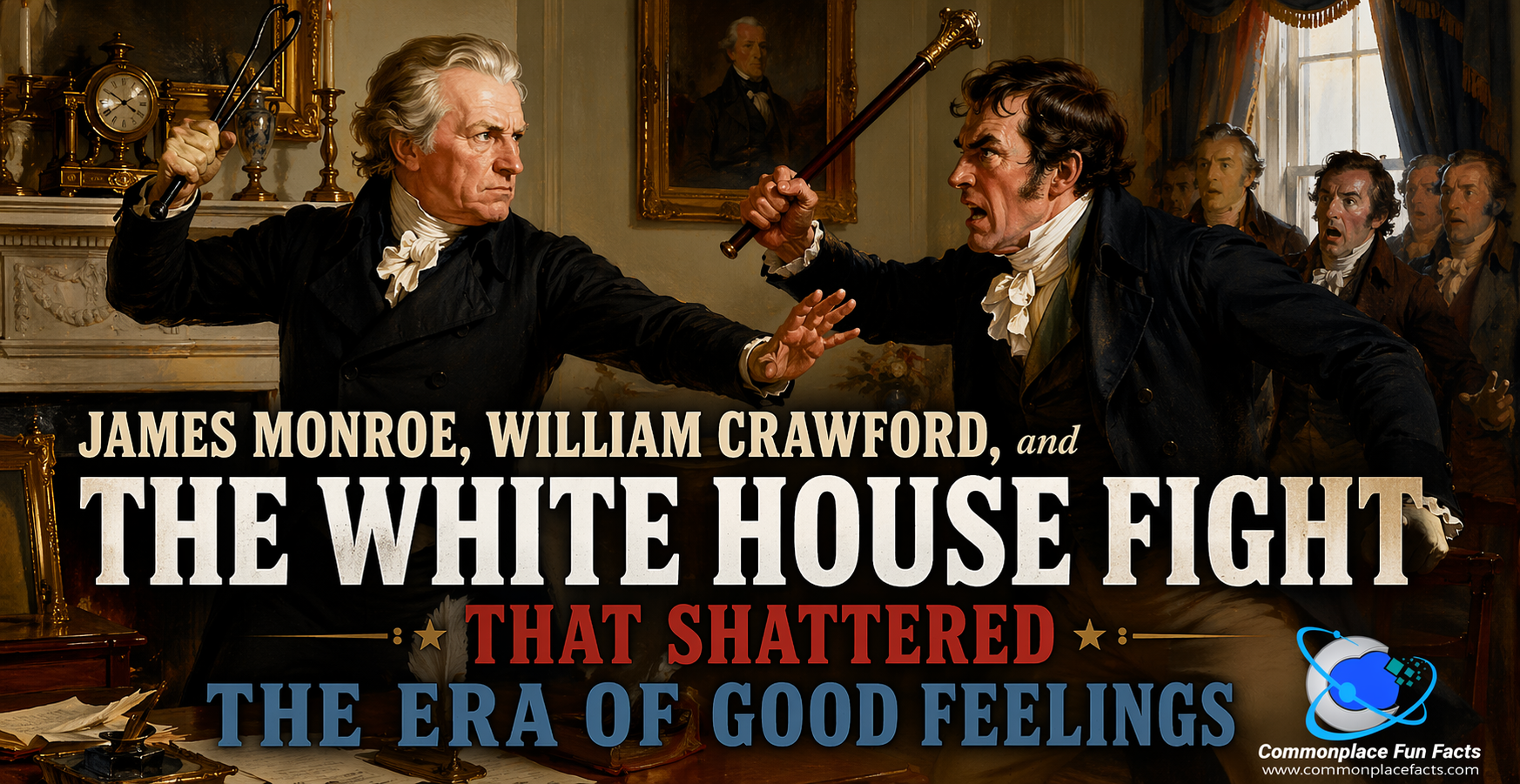
Monroe replied that Crawford’s language was improper and unbecoming to their relationship. Crawford then raised his cane as though to strike and called the president a “damned infernal old scoundrel.”
That is not a phrase one hears often in modern cabinet meetings, though it would certainly enliven C-SPAN.
Monroe responded by grabbing the tongs at the fireplace for self-defense. He fired back with an insult of his own and threatened to ring for the servants and have Crawford thrown out of the house.
There it was: the Era of Good Feelings, now featuring an elderly president with fireplace tongs and a furious treasury secretary waving a cane in the executive mansion like two men who had wandered in from entirely different genres.
Imagine Explaining This to Foreign Diplomats
One of the great pleasures of early American history is discovering how often supposedly dignified institutions were held together by men who were one bad afternoon away from behaving like offended uncles at a courthouse wedding.
Pause for a moment and imagine the scene. The President of the United States, a man who had negotiated treaties and helped shape national policy, is now armed with fireplace equipment. His Treasury Secretary, a leading presidential hopeful, is brandishing a cane and hurling insults worthy of a villain in a melodrama. Somewhere nearby, respectable government business is presumably waiting its turn.
This was not just a disagreement over personnel. It was the public collapse of a private relationship already rotten with distrust. The two men had been straining against each other for some time. Crawford’s health had declined after a stroke in 1823, but his political ambitions had not evaporated. Monroe, meanwhile, had grown tired of being pushed and second-guessed. Their quarrel was one of those rare historical moments when the polite wrapping paper finally tears and everyone gets to see the machinery of resentment underneath.
According to the later recollection preserved by John Quincy Adams, Crawford backed down, insisted he had not intended to insult the president, and left. No one was struck. No one was set on fire. The Republic staggered onward.
Still, Monroe and Crawford never met again.
So Much for the Good Feelings
There is something almost poetic about this happening during Monroe’s administration. The whole point of the Era of Good Feelings was that partisan hostility had supposedly faded. Yet beneath the surface, the country was full of rival factions pretending not to be factions, presidential candidates pretending not to be campaigning, and officials pretending not to loathe one another with the heat of a thousand suns.
In that sense, the Monroe-Crawford clash was less an exception than a very honest summary. It exposed what the phrase usually hides: the “good feelings” were often more about appearances than reality. The old party labels may have weakened, but human ambition had not. Remove one set of banners and men will simply find fresh ways to glare at each other across the room.
The famous calm of the Monroe years also came with several giant asterisks. The Panic of 1819 triggered widespread economic distress. The Missouri Compromise revealed the growing sectional divide over slavery. The election of 1824 turned into a multi-candidate brawl within the same nominal party. This was less a tranquil political paradise than a house that looked neat from the sidewalk while several rooms inside were already beginning to smoke.
The 1824 Election Was Basically a Family Feud with Better Tailcoats
Monroe’s cabinet was, in hindsight, a preview trailer for the election chaos to come. John Quincy Adams, Andrew Jackson, Henry Clay, and William H. Crawford all maneuvered for the presidency in 1824. The old party structure had decayed enough that everybody could claim to be on roughly the same side while aggressively trying to destroy everybody else’s prospects.
Crawford remained a candidate despite his serious health problems. Adams considered him dangerous and untrustworthy. Jackson considered most of Washington dangerous and untrustworthy, which at least had the advantage of consistency. Clay considered himself the obvious adult in the room, as ambitious men so often do. The result was a political contest that ended with no candidate winning an electoral majority, the decision going to the House of Representatives, Adams becoming president, and Jackson’s supporters shouting “corrupt bargain” for years afterward.
So when people talk nostalgically about the Era of Good Feelings, it may be useful to remember that it led directly into one of the ugliest and most resentful presidential transitions in early American history. That title was always optimistic. It should perhaps have been called The Brief Pause Before Everyone Started Throwing Furniture.
James Monroe: Surprisingly Ready to Throw Down
Monroe does not always get cast as one of the more colorful presidents. He tends to stand in the historical lineup as the respectable one between Madison and John Quincy Adams, a man attached to a doctrine, a period label, and a lot of portraits in which he looks like he has just heard someone misuse a semicolon.
That can obscure the fact that Monroe had plenty of steel in him. He was badly wounded as a young officer in the Revolution. He had a long public career in diplomacy and executive office. He had seen enough of politics and war to know that composure and firmness are not the same thing as softness.
The image of Monroe seizing fireplace tongs is funny, yes, but it is also weirdly fitting. It reminds us that many of the founding generation were not abstract marble busts. They were flesh-and-blood men with tempers, grudges, physical courage, and an occasional willingness to settle matters in ways that modern HR departments would describe as “not aligned with organizational best practices.”
William Crawford: The President Who Almost Was
Crawford’s side of the story is also worth remembering because he was more than a historical footnote with a cane. For years, he was considered presidential timber. He had formidable political support, especially among old-line Republican networks, and before his stroke he seemed a plausible future president. That makes the White House argument even more remarkable. This was not some obscure subordinate losing his mind. This was one of the leading political figures of the age nearly coming to blows with the sitting president over appointments.
There is a lesson there about how quickly reputations can veer from statesmanlike to absurd. One moment you are a serious national contender. The next, future generations remember that you threatened an elderly president and got countered by fireplace hardware.
History can be very rude that way.
The Best Part Is That This Is Not Even Unusual by Early American Standards
Early American political culture was full of behavior that would now trigger emergency memos, legal disclaimers, and perhaps a training video narrated by someone with a soothing voice. Duels were common. Newspaper insults were ferocious. Politicians accused one another of treason, corruption, monarchy, atheism, foreign subservience, and personal depravity with a creativity modern social media can only admire from afar.
Against that background, Monroe and Crawford’s near-brawl was outrageous, but not entirely out of character for the age. The United States in its early decades was a nation of grand ideals being administered by human beings who were, quite often, one insult away from acting like they had been raised by caffeinated badgers.
That contrast is part of what makes the story so delightful. We like to imagine the early republic as a solemn procession of wigs, parchment, and noble restraint. Then along comes a reminder that one of its presidents once found himself facing an enraged cabinet officer and reached, quite sensibly, for the hot tongs.
Final Thoughts from the Fireplace
So yes, James Monroe’s presidency is remembered as the Era of Good Feelings. It was a period of temporary political calm, national optimism, and reduced party conflict. It was also a period in which one of Monroe’s own cabinet members called him a “damned infernal old scoundrel” and nearly got himself expelled from the White House by a president armed like an especially angry blacksmith.
That seems, in its own way, extremely American.
The lesson here is not merely that history contains colorful people, though it certainly does. It is that labels can be deceiving. An era of good feelings may include panic, factional scheming, presidential rivalry, and an attempted caning. A stable administration may secretly be a jar of nitroglycerin with a nice paper label. A dignified statesman may at any moment become a man brandishing fireplace tools in defense of executive authority.
Which is why history remains so endlessly entertaining. Just when it starts sounding tidy, someone picks up the tongs.
You may also enjoy…

When Lawmakers Battle Each Other, Instead of Fighting For You
We receive countless suggestions from faithful readers, asking us to do articles about any number of topics. A few of these get filed away for further research and consideration. Some get scrapped out of hand. Others trigger referrals to helpful mental health professionals. It is a rare gem of a suggestion that sends us off…

You Say “Tomato” — I Say “Food Fight!”
At first glance, visitors might think they are witnessing a remake of the cult classic film Attack of the Killer Tomatoes. As it turns out, those who happen to be in Buñol, Spain on the last Wednesday of August will merely be witnessing what has been billed as “The World’s Biggest Food Fight.” La Tomatina dates back…

The Congressional Brawl of 1858: When Law Makers Become Wig Pullers
Discover the Congressional Brawl of 1858, a chaotic House floor melee that erupted over slavery debates but ended in laughter. Political history with a touch of humor.


Leave a Reply