

Soviet Male Mortality: Digging Into the Numbers
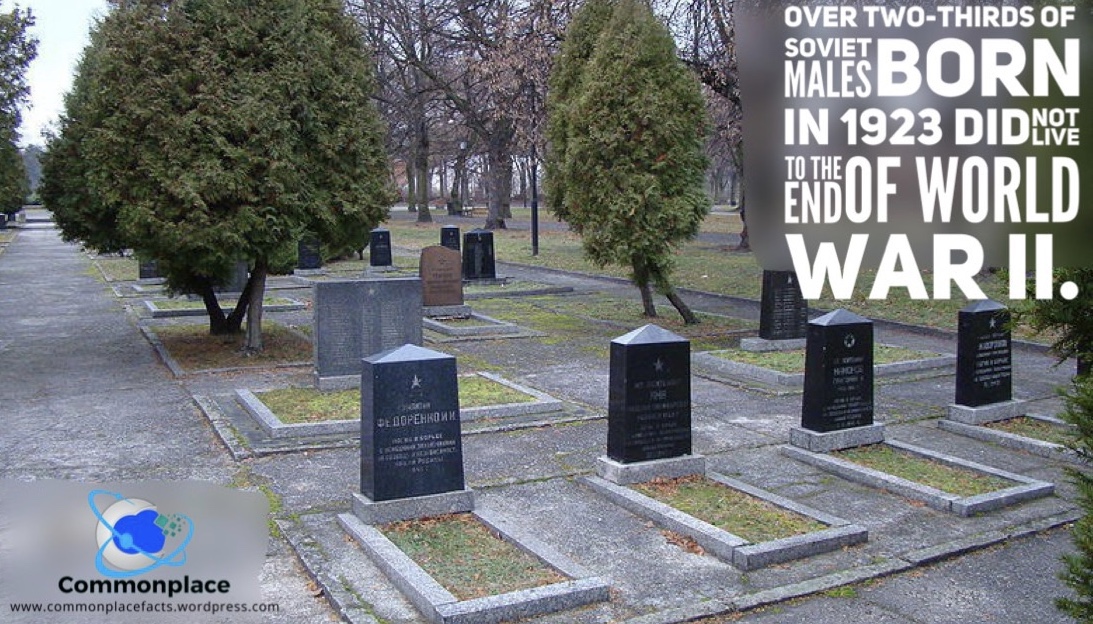
A fun fact on another site recently proclaimed that 80% of the males born in the 1923 generation in the Soviet Union did not survive World War II. This seemed like a good fact to share for Commonplace Fun Facts, but before we could do that, this information needed to be independently verified. As it turns out, the snippet of information did not stand up to scrutiny, but it wasn’t that far off.
The Census Data for the 1923 Generation
Census data shows the following with regard to baby boys born in 1923:
- Males born in the Soviet Union in 1923: 3,400,000
- Infant (0-1) mortality: 800,000
- Childhood (1-18) mortality, famine, and terror: 800,000
- Surviving to 1941: 1,800,000
- Wartime mortality: 700,000
- Surviving to 1946: 1,100,000
As you can see, only 32% of the boys born in 1923 were still alive at the beginning of 1946. A 68% mortality rate is still ghastly, even if it falls short of the 80% figure that is circulating through the internet. Interestingly, though, the primary cause of death for that generation was not World War II. One out of five died due to the violence of the Second World War. Twenty-three percent died in infancy, and an equal number died from the horrific conditions of life in the Soviet Union between 1923 and 1941.
That generation had it particularly bad. Not only did they face a major famine in 1932, but they also lived through Stalin’s Great Terror in 1937. They became adults in the year their country went to war with Germany.
World War II packed a wallop to the Soviet population. In the first six months of the war, three million Soviet troops were killed or taken prisoner. Most prisoners did not survive. In all, the Soviet Union suffered around 25 million war deaths, plus or minus a million. This, out of a total population in 1939 of just under 171 million.
To get a better idea of what these numbers actually mean, look at this powerful video that helps visualize the sheer number of deaths in World War II:
You may also enjoy…

The Great Lunik Heist: That Time the CIA Kidnapped a Soviet Spacecraft
Learn about the time the CIA kidnapped a Soviet spacecraft! The outrageous Lunik Heist of the Cold War!

How a U.S. President Enabled a Soviet General’s Coke Addiction
Georgy Zhukov was a hero of the Soviet Union, but he had an embarrassing secret. He was an addict. What made it worse was that his addiction, if known, would be especially shameful. Addiction to something as ordinary as alcohol would scarcely have raised an eyebrow. For Zhukov, it wasn’t vodka that preoccupied his waking…

The Crazy Story of Aimo Koivunen, the Soldier Who O.D.’d on Speed, Stepped On a Mine, Skied 250 Miles, and Outmaneuvered the Soviet Army
Discover the extraordinary survival story of Aimo Koivunen, the Finnish soldier who skied 250 miles under the influence of amphetamines during WWII.
You may also enjoy…

America’s First Airmail Flight Was a Spectacular Failure—30 Miles in the Wrong Direction and a Train Ride to Finish
On August 17, 1859, balloonist John Wise set out from Lafayette, Indiana, on a mission to revolutionize mail delivery. His destination was New York City, his transportation was a balloon named Jupiter, and his navigation system consisted largely of hoping the wind wanted to go in the same direction. It didn’t. What followed was five…

The Iron Riders: How Buffalo Soldiers Rode 1,900 Miles So the Army Could Decide It Didn’t Need Bicycles
In 1897, the U.S. Army sent 20 Buffalo Soldiers on a 1,900-mile bicycle expedition from Montana to Missouri. Armed with rifles, camping gear, and an apparently unlimited supply of determination, they battled mountains, mud, sand, and scorching heat. Nineteen completed the journey, proving that bicycles could serve military purposes. The Army celebrated the Iron Riders’…

William Phelps Eno: He Never Learned to Drive, So Naturally, He Wrote the Rules for Everyone Else
William Phelps Eno helped create modern traffic rules, traffic circles, and one-way streets. Even so, the Father of Traffic Safety never learned to drive.
You may also enjoy…

Mary Walton: The Woman Who Quieted New York’s Trains After Thomas Edison Couldn’t
When New York’s elevated trains became an unbearable neighborhood nuisance, boardinghouse owner Mary Walton fought back with sand, ingenuity, and a patent. She also developed an early approach to controlling industrial smoke. Thomas Edison had fame and laboratories. Walton had a basement, a mechanical mind, and very little patience for noisy trains.

Helen Duncan and the 1944 Witchcraft Trial: Because Fighting Hitler Wasn’t Keeping Britain Busy Enough
In 1944, while Britain prepared to invade Nazi-occupied France, Helen Duncan went to prison under a witchcraft law dating from 1735. Her extraordinary case involved suspicious ectoplasm, a sunken battleship, an outraged Winston Churchill, and a legal system that apparently hadn’t finished with the eighteenth century.

The Federal Tea Tasters: For 99 Years, the U.S. Government Paid People to Drink Tea—and It Took an Act of Congress to Make Them Stop
For nearly a century, the federal government employed professional tea tasters to determine whether imported tea was good enough for Americans. The program survived multiple presidents, inspired a Supreme Court decision, and required an act of Congress to abolish. Naturally, it took another 27 years to finish the paperwork.





Leave a Reply