

Manfred von Richthofen.
Even if the name doesn’t immediately ring a bell, the nickname almost certainly does. The Red Baron. The most famous fighter pilot of World War I. The man whose reputation has outlived the biplanes he flew by more than a century, outlasted an entire empire, and somehow survived being turned into a frozen pizza mascot.
That level of cultural afterlife tends to obscure an inconvenient early detail: he was not, at first, very good at flying.
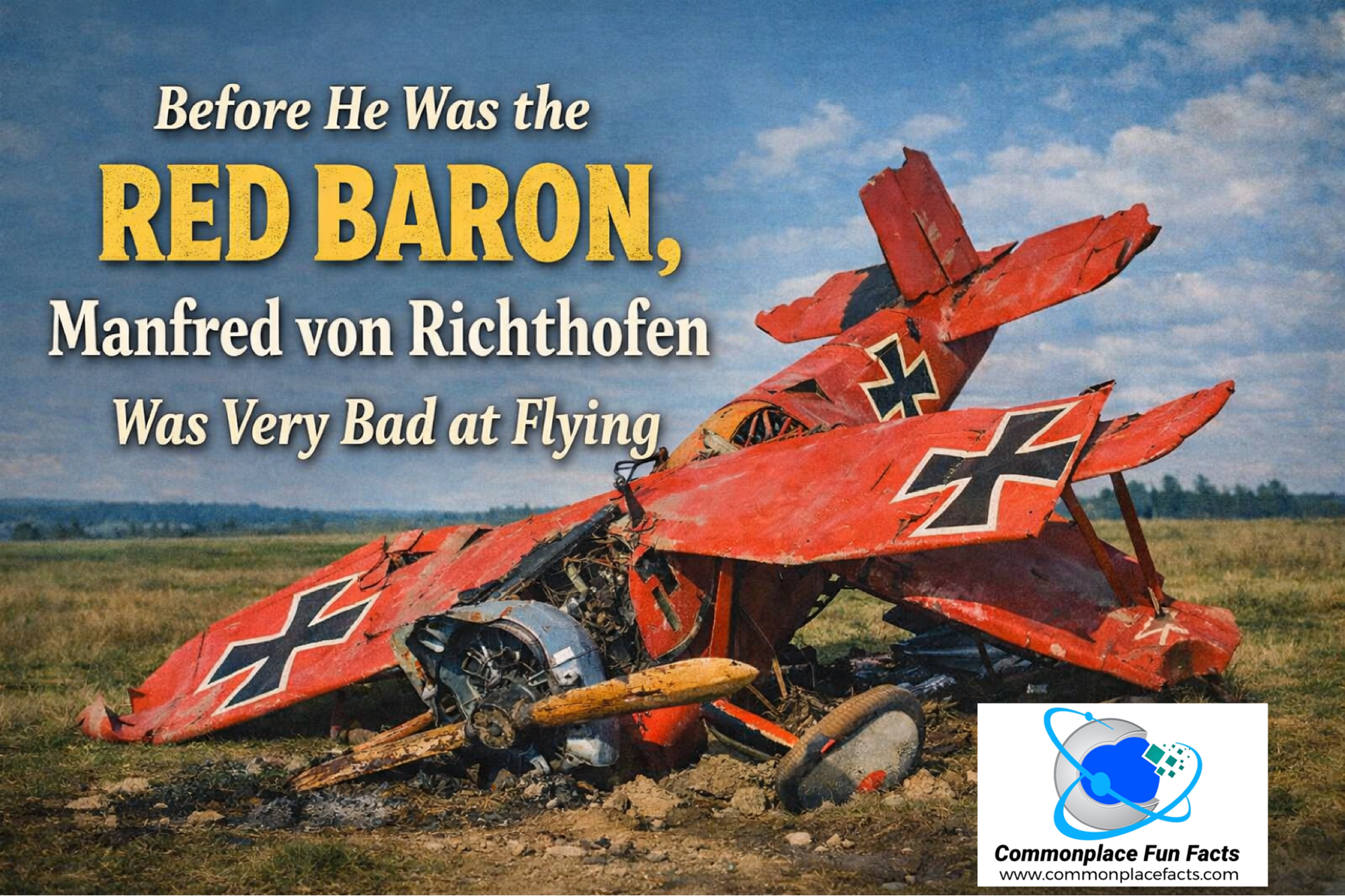
In fact, his introduction to aviation involved crashing an airplane so badly that it resembled a battered school bus and became the punchline of other people’s jokes. History, it turns out, enjoys irony.
Contents
Before the Red Baron, There Was a Very Bored Cavalry Officer

Manfred von Richthofen was 22 years old when World War I broke out in 1914. He came from Prussian nobility, which meant two things were expected of him: impeccable manners and a military career. He chose the cavalry, imagining a glamorous life of riding, charges, and heroics.
What he got instead was logistics.
The modern industrial war had little use for horse-mounted romance. Richthofen found himself riding dispatch, running errands, handling telephones, and keeping track of supplies. None of this scratched the itch of a man who had gone to war expecting adventure.
At one point, he filed a transfer request that included the immortal complaint: he had not gone to war “to collect cheese and eggs.” This is either the most polite rant in military history or the clearest sign he was absolutely done with inventory management.
Learning to Fly, Immediately Learning Gravity
In May 1915, Richthofen finally got his chance. He transferred to the air service as an observer while training to become a pilot. Aviation at this stage of the war was still a chaotic experiment involving wood, fabric, wires, and optimism.
After five months of training, he was sent up for his first solo flight on October 10, 1915. It did not go smoothly.
By his own account, he managed to get the plane into the air, experience a brief surge of confidence, and then completely lose control while landing. The aircraft flipped, smashed, and survived only barely. He emerged alive, embarrassed, and painfully aware that everyone nearby found the whole thing hilarious.
This was not the origin story most legends prefer to emphasize.
Persistence, Practice, and a Very Timely Christmas Gift
Richthofen did not quit. He flew again. And again. He practiced relentlessly, refined his instincts, and learned from a crash that could easily have convinced him to walk away.
On Christmas Day 1915, he received what passed for a holiday miracle on the Western Front: official designation as a pilot.
Three months later, in March 1916, he scored his first confirmed aerial victory during fighting over Verdun. Something clicked. The precision, focus, and calculated aggression that bored him on the ground proved deadly effective in the air.
From there, his ascent was startlingly fast.
Eighty Victories and the Cult of Precision
Over the next two years, Richthofen racked up 80 confirmed air combat victories. This was not reckless bravado or blind luck. He treated aerial combat like engineering: positioning, timing, geometry, and discipline.

He disliked unnecessary risk. He preached formation flying. He criticized pilots who chased glory at the expense of survival. This caution makes his eventual fame slightly ironic, since history prefers romantic daredevils to meticulous tacticians.
For his success, he was awarded Germany’s highest military honor, the Pour le Mérite—better known as the “Blue Max.” He accepted it politely.
The color that would define him came later.
Painting the Target Bright Red
Most pilots tried to make themselves harder to see. Camouflage mattered. Blending into the sky increased life expectancy.
Richthofen did the opposite.
He painted his aircraft red. Bright, unmistakable, unapologetic red. The logic was partly psychological: intimidation mattered. If enemies recognized him instantly, fear traveled faster than bullets. The logic was also practical. His squadron could always find him. Command remained visible. Chaos decreased.
It was bravado, yes, but controlled bravado. The kind that follows mastery rather than preceding it.
The press seized on the image. The nickname followed. The myth hardened.
The Baron Outlives the War He Didn’t
Manfred von Richthofen was killed in April 1918, shot down during a low-level chase over the Somme. He was 25 years old. His funeral was conducted with full military honors by his enemies, who recognized skill when they saw it.
His legacy, however, became something much larger than a kill count.
He has been fictionalized, romanticized, debated, reenacted, sung about, animated, commercialized, and—somewhere along the way—paired permanently with cheese.
Yet the most revealing moment of his life may not be the red plane or the final flight. It may be the first solo attempt, upside down in wreckage, listening to jokes, and choosing to climb back into the cockpit anyway.
The Red Baron did not begin as a natural-born ace. He became one. And history, for once, had the decency to remember the version that learned, adapted, and refused to stay grounded.
You may also enjoy…

Presidential Pilot: In Addition to 5 Stars, Eisenhower Had Wings
Dwight D. Eisenhower, a Kansas farm boy, became an overachiever, rising to five-star General of the Army and later President of the United States. He was also the first U.S. President who was a pilot.

Thomas Selfridge: The Aviation Legend Who Became the First Person to Die in a Plane Crash
Learn about Thomas Selfridge, the aviation legend who also became the first person to die in a plane crash.

Anne Lindbergh: The Surprising Unknown Life of an Aviation Legend
Anne Lindbergh was more than Charles’ wife — she was an aviator, best-selling author, and pioneer whose legacy deserves a flight plan of its own.




Leave a Reply