
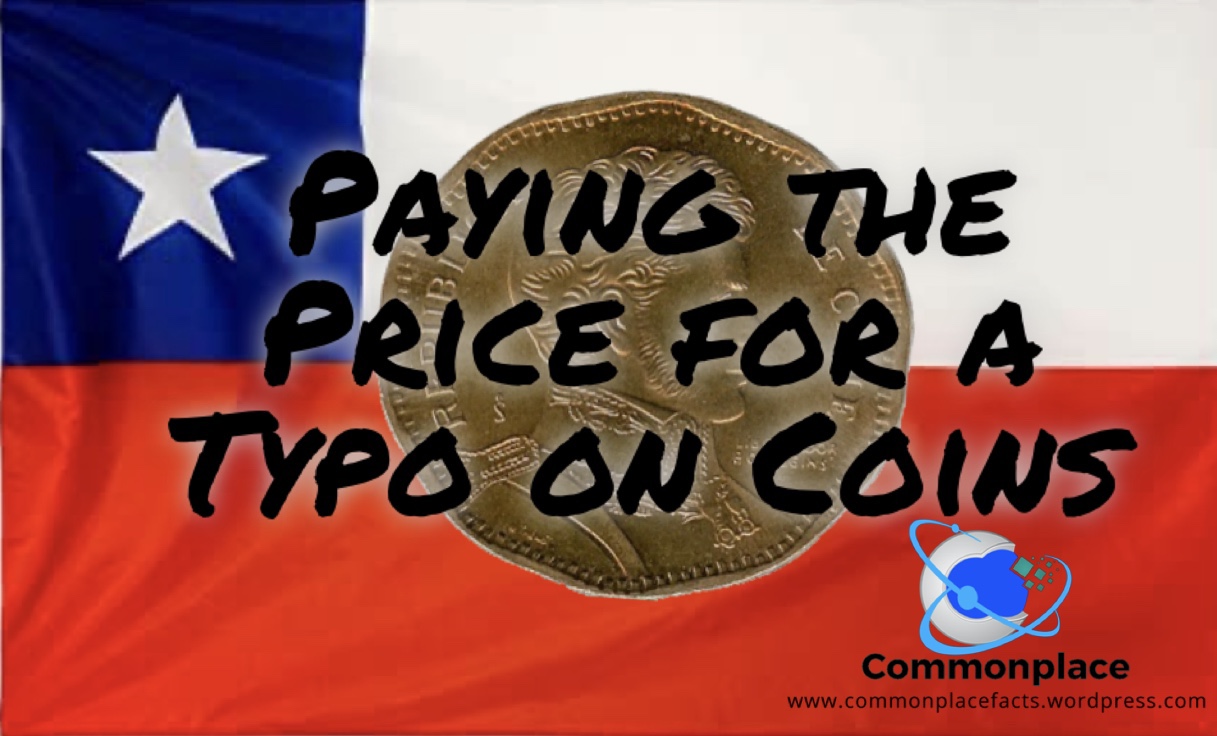

Have you heard of the Republic of Chiie? No, it’s not a new tea and coffee shop, nor is it a greenhouse specializing in the sale of Chia Pets. It isn’t even one of those fake countries like San Serriffe that get written about on April Fools’ Day. The Republic of Chiie is an actual country, at least, if you are to believe the currency it issues. On the other hand, perhaps it isn’t quite as simple as that.
We previously reported the curious case of the Australian $50 banknote that was printed 46 million times before someone discovered that it contained a misspelled word. Those who were responsible for that blunder can take some measure of comfort. In that case, the misspelled word was a bit of microscopic print and hard to read without a magnifying glass. While embarrassing, it isn’t nearly as bad as the time Chile misspelled its own name on its coins.

The South American country of Chile released new 50 peso coins in 2009 (worth about 6¢). The front of the coin bears the image of Bernardo O’Higgins, the leader in Chilean independence from Spanish rule. Around O’Higgins’ stately profile are the words “Republica de Chile.” Well, that was the intention, anyway. What it actually said was, “Republica de Chiie.”
Somehow the coin design got past all of the alleged quality control measures at the Chilean Mint. Thousands of misspelled coins entered circulation. What’s worse is that nearly a year went by before anyone noticed the problem.
Engraver Pedro Urzua explained that he unknowingly left off the bottom part of the letter “l” when, in December 2008, he was hurriedly fixing a minor deformity in the original mold for making the dies to stamp out the coin.
“I have been accused of having written the word ‘Chiie’ deliberately, but it was an error spotted by neither myself nor the entire chain of people who saw and approved it afterward,” said Urzua. He was subsequently fired for the mistake and brought a lawsuit against his former employers for denying him severance pay. Presumably, he would have been willing to accept the defective coins as compensation. Although they officially retain their face value, they are highly sought after by collectors, who will pay substantially more than 50 pesos to obtain them.
Officials remained ignorant of the error in the coins until October 2009, when a coin collector called to report the mistake. The error was corrected, but another batch of bad coins was sent to the Central Bank, anyway. Later investigation showed that Mint officials asked employees “that we not say anything to anyone” about the error, according to the Urzua.
Urzua was not the only one who paid for the mistake. The mint’s General Manager, Gregorio Iñiguez, was likewise fired.
Thanks to Dummr.com for the post that inspired the research into this article.
You may also enjoy…

A Typo on the Australia $50 Banknote: The $50 Million Proofreading Fail You Won’t Believe
The Reserve Bank of Australia introduced a new $50 banknote featuring Edith Cowan on February 15, 2018. However, the word “responsibility” was misspelled as “responsibilty” in a quotation, remaining unnoticed for six months, leading to 46 million faulty notes being circulated. Help in proofreading may be advisable.

A Patent Need for Proofreading: Hilarious Patent Errors That Made History
Proofreading mistakes can lead to embarrassing and costly errors. Discover real-life patent errors and application blunders that prove why editing is crucial!

How the U.S. Nearly Created a $1 Trillion Coin
Regardless of whether you are a coin collector, you probably would be interested in any currency with a big number on it. It might be something comparatively worthless, such as Zimbabwe’s $100 trillion bills or the valuable and massive Canadian $1 million coin. If collecting that kind of currency appeals to you, you no doubt…





Leave a Reply