

Cat Behavior and Dog Behavior: Does the Science Back Up the Stereotype?
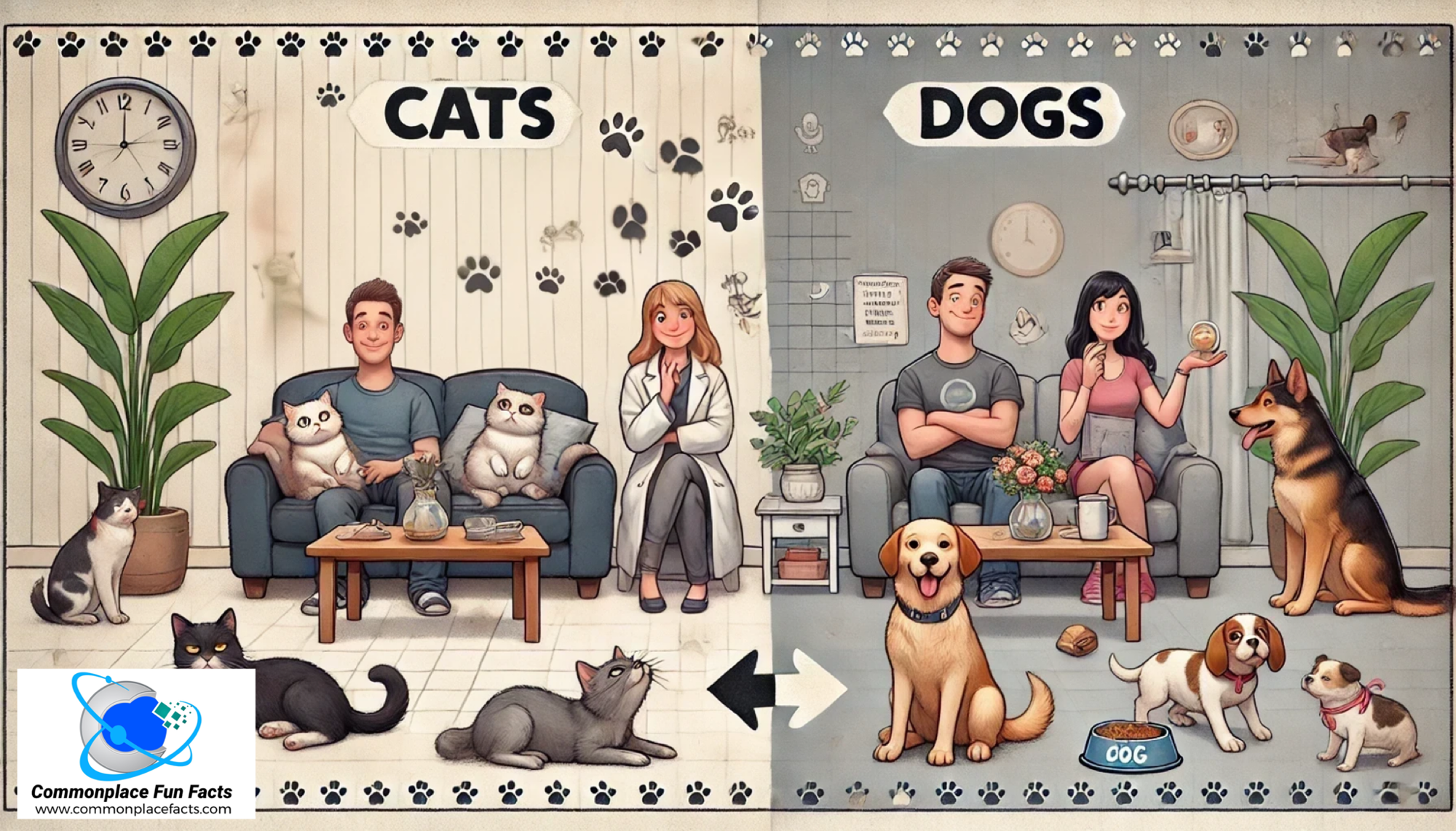
In a ground-breaking study that reveals no surprises to dog lovers everywhere, scientists have concluded that cats are heartless and couldn’t care less about their owners and are just in it for the food. Dogs, on the other hand, again show they have earned their title: man’s best friend.
The results of the study may be shocking to cat owners, who frequently persist in the delusional belief that their love for felines is reciprocated. They view their cats snuggled on the couch, seemingly oblivious to the world and exhibiting an endearing quality of aloofness. Is it really an innocent feline penchant for lounging? A recent study from Japan might have cracked the code on why cats and dogs are so different in their reactions to how we’re treated by others.
Contents
The Great Feline Indifference Experiment
Researchers from Kyoto University and the Japan Society for the Promotion of Science have been busy unraveling the mysteries of cat and dog behavior. Their objective is to figure out if there is any truth to the stereotype of cats being aloof while dogs are the epitome of loyalty. To do this, they put 36 pet cats through a series of tests designed to gauge how they react to people who treat their owners poorly.
Here’s how the experiment went down: each cat was presented with three people—a human who was their owner, and two strangers known as person A and person B. The owner would pretend to struggle with opening a lidded container and ask for help from person A. Person A had the choice to assist or ignore, while person B just sat there, twiddling their thumbs.

After the owner’s dramatic lid struggle, person A and person B would offer food to the cat simultaneously. The experiment was repeated multiple times with roles and positions swapped around, just to keep things interesting (or perhaps to test the patience of our feline friends).
The results were as clear as a cat’s disdain for anything that doesn’t involve food or a nap. The study found that cats didn’t give a whisker about who helped their owners or who just sat around. They happily accepted food from both the helpful and the indifferent, showing a level of apathy that’s nothing short of impressive. It’s almost as if cats have a built-in “meh” button when it comes to human behavior.
This nonchalance aligns perfectly with the widely held belief that cats are the ultimate independent creatures—so independent, in fact, that they can’t be bothered with the niceties of human interactions.
Dogs: The Loyal Sentinels
For comparison, the researchers pulled out data from a similar experiment conducted with dogs in 2015. Unlike their feline counterparts, dogs displayed a clear preference for those who helped their owners. Canines shunned the unhelpful and gravitated towards the kind-hearted, proving once again that dogs are the quintessential symbols of loyalty and empathy.
Hitomi Chijiiwa, a member of the research team and now a project researcher at Osaka University, noted that dogs paid close attention to the behavior of their owners and adjusted their actions accordingly. Meanwhile, cats were more concerned with their next nap or snack, showing little regard for the social dynamics of their human companions.
Of course, all of this raises a darker question: if dogs are so devoted to us and cats are so magnificently unconcerned with our social expectations, which one is more likely to eat us if we die at home? We went looking for the forensic answer in “Will My Dog Eat Me If I Die? Your Cat May Not Be the One to Worry About.” The results are not especially helpful to the dog’s reputation. The cat, meanwhile, gets a partial acquittal—although science has yet to investigate whether it arranged the death in the first place.
The Science Behind the Fluff
The study, published in the journal Animal Behavior and Cognition in 2021, provides fascinating insights into why cats and dogs react so differently to their owners’ social situations. It seems that while dogs’ ancestors might have been more attuned to human social cues, cats have their own unique approach to human interaction—a mix of ancient independence and modern-day aloofness.
For those curious about the nitty-gritty details, you can check out the study on feline behavior here and the canine comparison here.

Meet F.D.C. Willard, the Cat Who Co-Authored a Scientific Paper
F.D.C. Willard: Cuddly, Cute, and Co-Author F.D.C. Willard was 7 years old when he became a published researcher. As you might expect with someone so gifted at such a young age, there were some difficulties in coping with fame. His personality was sometimes described in less-than-flattering terms. Some called him aloof, frustratingly-independent, and almost-obsessive about cleanliness. Others went so far as to say that his behavior was rather catty. These descriptions didn’t seem to trouble Willard, however. His aforesaid aloofness might factor into this. It could also have something to do with the fact that he was, in fact, a…

Doggie Hamlet Brought to You By Your Tax Dollars
“There are more things in heaven and earth, Horatio, than are dreamt of in your philosophy.” (“Hamlet”, Act I, Scene 5) When Shakespeare wrote those immortal words, one wonders if even he could have imagined some of the strangeness that would take place in his name. Consider, for example, “Doggie Hamlet,” a theatrical production featuring animals in the starring roles and funded at taxpayer expense. In 2017, the National Endowment for the Arts (NEA) awarded a $30,000 grant for the purpose of staging an outdoor production of “Hamlet,” with animals as cast members. As is often the case with anything…

Abraham Lincoln’s Dog Fido: The Faithful Pet With a Tragic Ending
Abraham Lincoln’s dog Fido was his faithful Springfield companion, left behind when Lincoln went to Washington, and later met a tragic fate.




Leave a Reply