
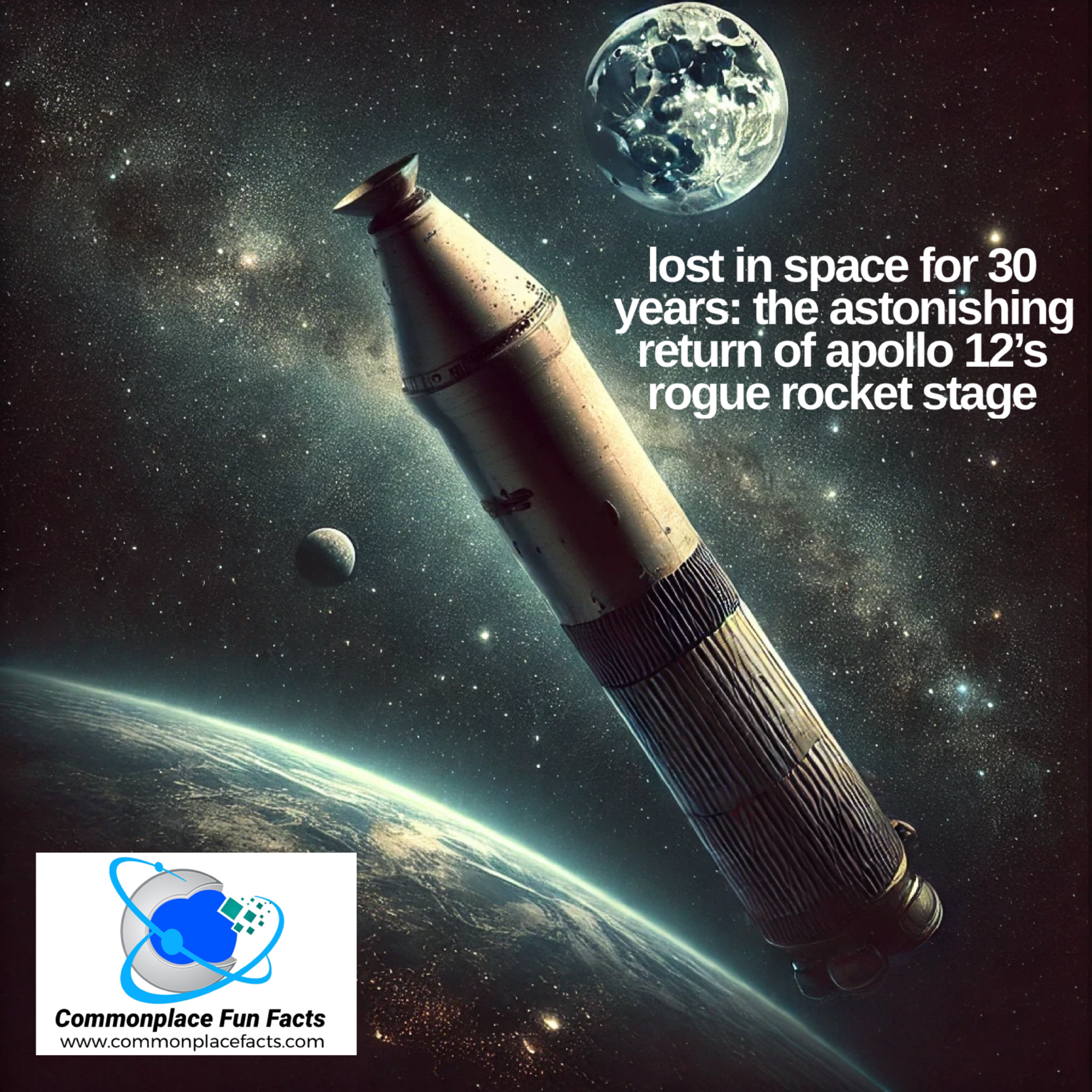

In September 2002, an amateur astsronomer stumbled upon an amazing discovery. Bill Yeung detected an a heretofore unknown large object orbiting Earth. It also appeared to be manmade, but not on anyone’s list of satellites. What on Earth—or rather, what in space—was this strange new object? The discovery shocked the astronomy world. It wasn’t a new, top-secret spacecraft; it was something far more familiar, and far more human-made: the third stage of the Saturn V rocket that launched the Apollo 12 astronauts to the Moon back in 1969.
This rogue piece of space junk had been on a wild, decades-long journey through space before deciding to pop back in for a visit. What exactly happened to this rocket stage? How did it end up on such a bizarre cosmic road trip? And why, after 30 years, did it suddenly reappear in Earth’s neighborhood?
Identifying The Space Invader
When the object was first detected by astronomers, it presented a puzzle. What was it? Was it some new asteroid? A piece of space debris? If it wasn’t naturally occurring, could it have been sent by an extraterrestrial civilization?
To solve the mystery, astronomers turned to spectroscopy—the science of analyzing light to determine the material makeup of objects. They measured the light reflected off the object and compared it to known substances. The verdict? The light reflected off this object was a dead ringer for white titanium oxide paint—the very paint used on the Saturn V rockets.
Reconstructing the Cosmic Journey
Having determined what the object was, the big question centered around why it was returning to earth after all this time. To answer that question, we need to rewind the clock to 1969. The Apollo 12 mission had just kicked off. The Saturn V rocket—an absolute beast of engineering—was doing its job in three stages. The first stage got the rocket up to 61 kilometers in about two and a half minutes. The second stage kept pushing the spacecraft higher and faster for another six minutes. Finally, the third stage was tasked with giving one last push to get the Apollo crew into orbit, and then it fired up again to perform what NASA calls the “trans-lunar injection.” This is just a fancy way of saying it flung the rocket and crew onto a path toward the Moon.
Once the Apollo astronauts were safely on their lunar road trip, NASA tried to discard the third stage by sending it into a solar orbit where it could float harmlessly through space for millennia, like a cosmic message in a bottle. The plan was to aim the rocket at the Moon’s trailing side so that the Moon’s gravity would give it a swift kick into orbit around the Sun. Simple, right? Well, not quite. Apollo 12’s third stage had a slightly different agenda.

NASA’s trajectory calculations were off by just a smidge—specifically, 40 kilometers per hour. In space, a tiny miscalculation like that is like missing your exit on a highway and ending up in another state. Instead of getting the intended solar orbit, the third stage was thrown into a bizarre, elliptical orbit around Earth, playing an interstellar game of tag with our planet and the Moon.
For the next 15 months, the third stage’s orbit was pulled and stretched by the competing gravitational forces of Earth and the Moon, like a cosmic tug-of-war. It got dragged all the way out to Lagrange Point 1—a point between Earth and the Sun where gravitational forces from both bodies cancel each other out. It didn’t stop there. Once it passed this point, the Sun took over, and the third stage was pulled into an orbit around the Sun, achieving its original mission goal—albeit a bit late and not quite as planned.
The third stage then spent the next 30 years doing laps around the Sun, occasionally getting close to Earth but never quite close enough to re-enter our orbit—until 2002, when it finally happened. This time, Earth’s gravity won the tug-of-war, and the long-lost third stage was pulled into a highly elliptical orbit around our planet once more.
“Instead of getting the intended solar orbit, the third stage was thrown into a bizarre, elliptical orbit around Earth.”
With that, the mystery was solved. The object orbiting Earth was indeed the Apollo 12 third stage, finally returning home after a decades-long space adventure. But like any good space traveler, it didn’t stay for long. After just a year in Earth’s orbit, the third stage was flung back out into space, where it’s expected to continue its cosmic wanderings until at least the 2040s. Like a well-trained boomerang, it’s bound to come back to Earth eventually. The laws of physics demand it.
The Journey Continues
So there you have it: the story of how a tiny miscalculation sent a piece of lunar history on a 30-year joyride through the solar system, only to return to Earth like the prodigal rocket stage it is. If there’s one thing we’ve learned from this tale, it’s that in the vast expanse of space, even the smallest errors can lead to the most unexpected and fascinating journeys.

The Carrington Event: When the Sun Punched Earth With the Force of 10 Billion Atomic Bombs
In 1859, Earth was hit by the Carrington Event — a solar storm so powerful it roasted telegraphs and lit up the sky. What would a repeat mean today?

Flat Earth Theory: Why Does it Persist All Around the World? (See What We Did There?)
Uncover the history of Earth’s roundness from ancient Greek philosophers to the modern Flat Earth Society. Discover how bees mastered navigation before us and why Flat Earth conspiracies persist today.

The Great Lunik Heist: That Time the CIA Kidnapped a Soviet Spacecraft
Learn about the time the CIA kidnapped a Soviet spacecraft! The outrageous Lunik Heist of the Cold War!






Leave a Reply