
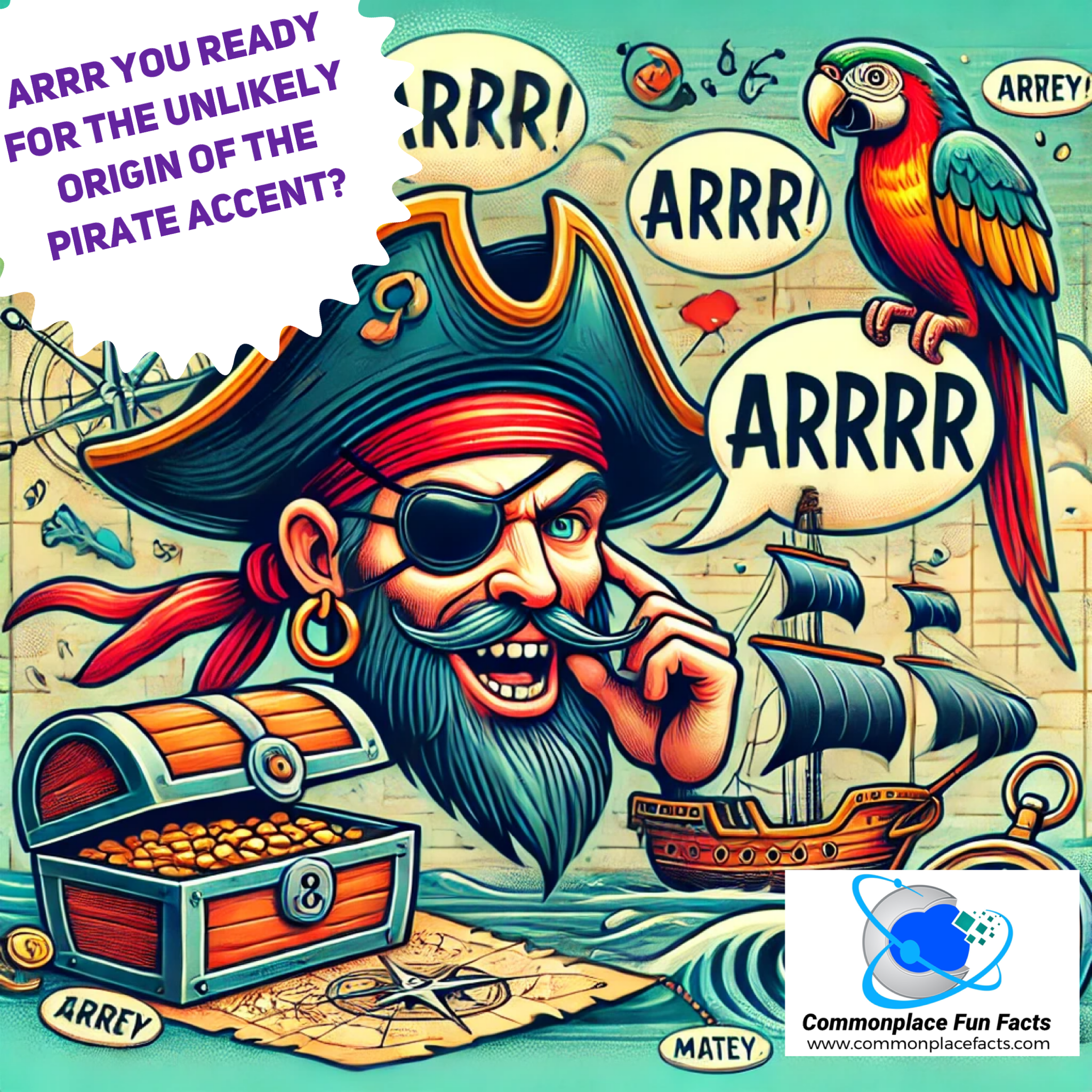

How Did the Pirate Accent Become a Thing?
Contents
September 19 is recognized as International Talk Like a Pirate Day. That, of course, means an entire day of the rolling “R’s” and colorful dialogue that represent the official lingo of pirates. Whether it’s Jack Sparrow swaggering across the deck or the infamous Long John Silver barking orders, that swashbuckling brogue is as much a part of pirate lore as eye patches and parrots. But have you ever wondered where on the Seven Seas that accent actually came from? Surely not every pirate sounded like they were from the same quirky corner of England, right? Strap on your boots, grab a flagon of grog, and let’s plunder the truth behind the origin of the pirate accent!
Avast, Hollywood! The Pirate Accent Sets Sail
We’ve all heard the pirate joke about movies being rated “arrrrrr,” but it turns out that it’s Hollywood, not history, that’s to blame for the way we think pirates sound. The accent that we’ve come to associate with every swashbuckler worth his salt really started with one man: Robert Newton.
Newton, a talented British actor and Navy veteran, starred in the 1950 adaptation of Treasure Island, based on Robert Louis Stevenson’s novel. In the film, he portrayed the iconic Long John Silver with a swagger, a sneer, and most importantly, an exaggerated West Country accent. That’s right, mates—what we know today as “pirate speak” is essentially just Newton cranking up his native dialect for dramatic effect. Newton’s portrayal didn’t just leave an impact on pirate cinema—it basically set the standard for the pirate accent.
Even though Newton himself passed away a few short years later, his version of pirate-speak has lived on, sailing through pop culture like a proud galleon. He might not have known it at the time, but he laid the groundwork for International Talk Like a Pirate Day, a day when grown adults can unleash their inner buccaneers without judgment. He became for pirates what Bela Lugosi was for vampires. How’s that for a lasting legacy?
Setting Sail from the West Country: The Real-Life Accent
To better understand Newton’s inspiration, we need to take a detour into a little geography lesson, because—news flash—that accent came from somewhere very real. The West Country is a region of England that includes places like Cornwall, Devon, Dorset, and Somerset, all hugging the coast and known for their maritime history. In fact, Bristol, which features in Treasure Island, is smack in the middle of this salty swath of coastline.
The West Country accent is characterized by its distinctive emphasis on “R’s” and a few peculiar grammatical twists, like saying “I be” instead of “I am.” (Hold the grammar corrections, folks—Old English grammar was a thing long before your app started redlining it.) Linguists have pointed out that speakers in this region replace verbs like “is” and “are” with “be” and are known to throw around a good “arrr” just as pirates do in the movies.
Turns out, there’s a reason so many of our most famous pirates hail from this corner of the world. Let’s dive into some familiar names that made this rugged coastal dialect famous.
Famous Pirates: From Devonshire to the Deck
The West Country might have inspired Newton’s pirate-speak, but it was already a haven for real pirates and privateers long before Stevenson penned Treasure Island. Take Sir Francis Drake, for instance. Born in Devonshire, this chap turned to privateering (a fancy word for government-sponsored piracy) and became one of the most famous sailors of his time. Queen Elizabeth I even knighted him after his expedition around the world.
And then there’s Edward Teach, better known as Blackbeard, who terrorized the Caribbean and American coastlines. His origins are murky, but Bristol claims him as a native son. Just picture the towering pirate shouting commands with that distinctive West Country brogue. Even though we don’t have audio recordings (thankfully, his beard might’ve set the microphone on fire), it’s not hard to imagine Newton’s version of pirate-speak echoing from Blackbeard’s ship.
There was even a pre-teen pirate by the name of John King. You can learn more about him here.
A Tower of Babel on the High Seas: Pirate Accents Beyond England
Now, while many famous pirates did indeed hail from England, that’s not to say the whole crew sounded like Robert Newton. Pirates were a diverse bunch, and their accents reflected that.
For instance, Henry Morgan and Bartholomew Roberts were both Welsh, while Anne Bonny, the fearsome female pirate, was Irish. Captain Kidd, another infamous name, was Scottish. Then throw in pirates from the Netherlands, Sweden, France, and the West Indies, and you’ve got a veritable buffet of accents.
Instead of Newton’s refined pirate-speak, the real deal would’ve been a hodgepodge of languages and dialects, each pirate bringing a bit of their homeland to the high seas. And let’s not forget that pirates were likely more linguistically sophisticated than their Hollywood counterparts, with phrases like “ye” and “be” used in ways that would make your English teacher proud—if you’re a fan of complex grammar rules, that is.
Yo-Ho-No: Pirate Slang and Fictional Flourishes
Speaking of pirate-speak, it’s time to tackle the “yo-ho-ho’s” and “shiver me timbers” that we all know and love. Most of these phrases, believe it or not, are more fiction than fact. Robert Louis Stevenson invented many of the expressions that are now synonymous with pirate life, including “shiver me timbers,” which you won’t find in any historical record of pirate conversations (though if you do, please send it to us immediately).
That’s not to say that all pirate slang is nonsense. Words like “ahoy” date back to 18th-century naval terms. “Landlubber” was a derogatory term for anyone not accustomed to life at sea, and “grog” was the watered-down rum pirates drank (named after Admiral Edward Vernon, who preferred his rum diluted—clearly a buzzkill).
The Pirate Accent’s Enduring Legacy
While the real Golden Age of Piracy ended by the 1730s, the legend of the pirate accent is still going strong today. Thanks to Robert Newton, the West Country, and a few centuries of storytelling, pirates have become pop culture icons, complete with their own exaggerated dialect. Whether it’s the latest pirate movie or your friend celebrating International Talk Like a Pirate Day, the accent continues to sail through the ages. And sure, while real pirates probably had much more diverse voices, there’s no denying the swashbuckling charm of that “arrrrr!”
So the next time someone starts talking like a pirate, you can dazzle them with your knowledge of linguistics and regional accents. Or just join in and say, “Aye, matey.”
You may also enjoy…

Fun Google Tricks To Ward Off Boredom
The Commonplace Fun Facts Department of Data, Analytics, Viewer Demographics, and User Engagement (otherwise known as DAVDAUE — yeah, we know. We’re working on a better name) tells us that a significant number of our regular readers spend their lunch breaks with us. We also know a fair number of you are sneaking visits to…

The True Story of the Pre-Teen Pirate of the Caribbean
John King, the youngest documented teen pirate in history, seized his dream of adventure after pirate Samuel Bellamy captured the ship Bonetta in 1716. Despite being only 8-11 years old, he joined Bellamy’s crew and raided ships in the Caribbean. Tragically, his life ended in 1717 when the Whydah sank in a storm.

Britney Spears Sends Pirates Fleeing
As raids by Somali pirates cause havoc and send fear rippling throughout the shipping industry, mariners have been forced to break out the ultimate weapon: Britney Spears. With over 200 documented attacks by pirates in 2018, an increasing number of resources is being devoted to keeping the shipping lines off the coast of Africa safe.…


Leave a Reply