
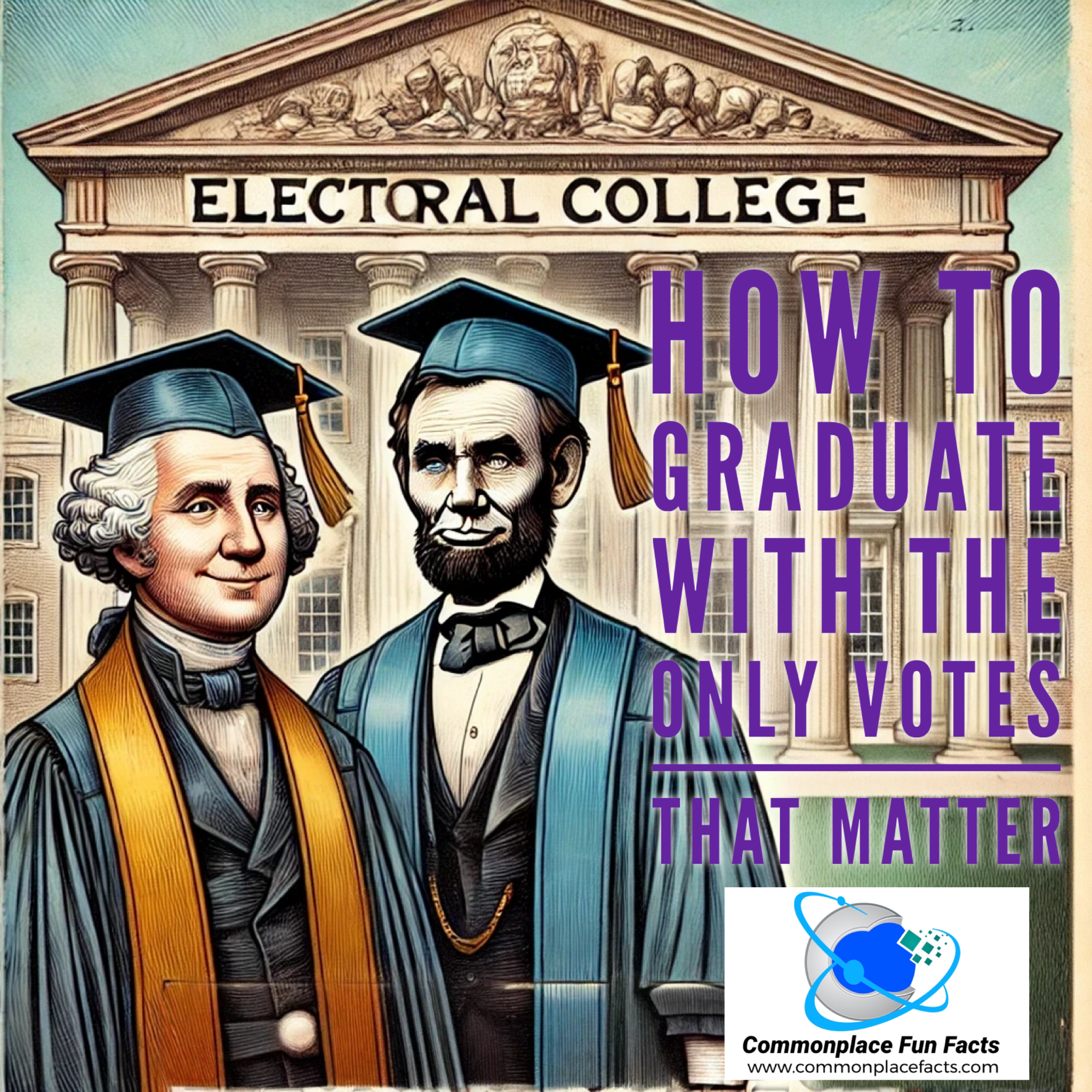

Editor’s Note: The presidential election of 2024 is still fresh on everyone’s mind. In fact, as of this writing, it is so recent that we still don’t know how Arizona will award its 11 electoral votes. This article will be updated in January 2025, after the electoral votes are certified.
The Electoral College—America’s favorite Rube Goldberg machine for picking presidents. It’s equal parts brilliant compromise and head-scratching anachronism, a system designed to ensure that no one, not even the Founding Fathers, completely understood how it works. But here we are, over two centuries later, still entrusting our highest office to a group of electors whose votes technically matter more than the rest of ours combined. Democracy at its quirkiest, right?
The Electoral College wasn’t just some slapdash idea cooked up in the sweltering halls of the Constitutional Convention. No, it was born from deep suspicion—our Founding Fathers weren’t exactly thrilled with the idea of letting the rabble have too much say in government.
Join us in a wild ride through the Electoral College’s greatest hits and misses. From the candidates who walked away with landslide victories to those who barely limped into office with fewer popular votes than their opponent, we’ll break down the percentage of electoral votes each winner received. And because we know you love the weird stuff, we’ll sprinkle in some choice Electoral College trivia along the way—faithless electors, dead candidates, and the occasional vice-presidential drama. Buckle up, because the only votes that really matter are about to get very interesting.
Contents
The Electoral College: The Only Votes That Really Matter
The USA’s Founding Fathers were suspicious of unchecked democracy. This sentiment was expressed by Alexander Hamilton in Federalist No. 68:
Talents for low intrigue, and the little arts of popularity, may alone suffice to elevate a man to the first honors in a single State; but it will require other talents, and a different kind of merit, to establish him in the esteem and confidence of the whole Union, or of so considerable a portion of it as would be necessary to make him a successful candidate for the distinguished office of President of the United States.

They were also concerned about the “Another argument states that the Electoral College prevents the “tyranny of the majority,” where a few mega-cities or densely-populated states would ignore or trample on the rights of the rest of the country.
Consequently, the USA’s chief executive is not elected by popular vote. Each state is awarded a number of votes in the Electoral College equal to the number of that state’s senators and U.S. representatives. In 1961, the 23rd Amendment to the Constitution gave Washington, D.C.,a say in the process, as well. As a result, the District of Columbia has three electoral votes.
Does an Elector Have to Vote for Whoever Won the State’s Popular Vote?
Technically, the popular vote doesn’t matter at all. In principal, electors Regardless of the popular vote, those who are designated as electors by a state may vote for any candidate — even if it is someone who wasn’t on the ballot. This is known as a “Faithless Elector” scenario.
A Faithless Elector is a rogue who goes off-script and refuses to vote for the candidate who won his or her state’s popular vote. As of the 2020 election, there have been 165 instances of faithlessness: 90 for president and 75 for vice president. While these rebel votes might sound like the stuff of political drama, they’ve never actually swung an election. Nearly all have been symbolic gestures, casting their votes for third-party candidates, fictional characters, or non-candidates instead of throwing their support behind a major opposing party. It’s political theater at its finest.
Monroe Loses Out on Unanimity — Not for the Reason You’ve Been Told
Everyone remembers the big wins and dramatic losses, but the quirks? Those are where the real fun lives. Take James Monroe’s near-unanimous reelection in 1820, for example. Out of 231 electoral votes, Monroe snagged 230. That last, lonely vote? It was cast against him by William Plumer, a New Hampshire elector, former senator, and part-time buzzkill. Instead of voting for Monroe, Plumer went rogue and cast his ballot for Secretary of State John Quincy Adams.
There’s a persistent myth that Plumer did this out of some noble desire to preserve George Washington’s status as the only unanimously elected president. But no, Plumer wasn’t playing the role of history’s hype man. He simply thought Monroe was, to put it bluntly, meh. In Plumer’s opinion, Monroe was a lackluster president, and Adams seemed like a better choice for the job. No grand gesture here—just one man throwing shade at Monroe’s résumé.
And Plumer didn’t stop there. He also refused to vote for Monroe’s running mate, Vice President Daniel Tompkins. According to Plumer, Tompkins was “grossly intemperate,” lacked the gravitas for the job, and pretty much ghosted his only official duty as President of the Senate, being absent three-quarters of the time. Harsh, but Plumer wasn’t wrong. Instead, he cast his vice-presidential vote for Richard Rush, which, as a fun bit of foreshadowing, accidentally predicted the 1828 National Republican ticket of Adams and Rush. Nostradamus, eat your heart out.
As for Adams, he was less than thrilled about this unexpected show of support. He described Plumer’s vote as a “surprise and mortification,” taking it as an insult to the Monroe administration rather than the compliment Plumer probably thought it was. Awkward.
The Candidate Who Had the Discourtesy to Die
The election where it happened the most was in 1872, 63 faithless electors refused to vote for Horace Greeley. It wasn’t because they were feeling particularly defiant, but because Greeley had inconveniently died between Election Day and the Electoral College convening. (See “What Happens if a Candidate Dies During the Election Process?” ) Fortunately for the stability of democracy, Ulysses S. Grant had already locked up enough votes to win reelection, so no harm, no foul.
Much Ado About an Undesirable VP
Then there’s the 1836 election, which gave us perhaps the most dramatic example of collective faithlessness. Virginia’s entire 23-man delegation straight-up abstained from voting for Richard M. Johnson, the Democratic vice-presidential nominee. Why? Let’s just say they weren’t fans of his colorful personal life. This faithless move caused Johnson to fall one vote short of an Electoral College majority, tossing the vice-presidential race to the Senate for a contingent election. In the end, party loyalty prevailed, and the Senate elected Johnson anyway. Meanwhile, the presidential race was unaffected since Virginia’s electors dutifully supported Martin Van Buren as pledged.
Nixon: The Faithless Elector Magnet
And for a truly unique twist, let’s talk about Richard Nixon, the Electoral College’s version of a faithless-elector magnet. In each of his three presidential campaigns—1960, 1968, and 1972—Nixon managed to attract at least one elector who said, “Nah, I’m voting for someone else.” Oklahoma, North Carolina, and Virginia all gave him their states, but each included a rogue elector who decided to write in another name. Was it a trend? A curse? Or just the Electoral College being its usual weird self? You decide.
So, while faithless electors make for fascinating trivia, they’re more like political footnotes than game-changers. Still, they add just the right amount of chaos to remind us that the Electoral College is anything but predictable.
Some states have laws that require electors to vote in accordance with the state’s popular vote. At least 22 states leave it entirely up to the elector to vote his or her conscience.
It Takes a Majority — Except When It Doesn’t
Barring any faithless elector scenarios, it is possible to win the presidency in the Electoral College with about 23% of the popular vote, if you play the map strategically. Read this article from NPR for more details on how to accomplish this.

It is a case of “majority rules” when we get to the Electoral College, however. (See “When Does the Winner of the Election Become the President-Elect?”). Well… most of the time. One man became president with fewer than one-third of the electoral votes, and five presidents took office without a single electoral vote.
George Washington is in a league all his own. The nation’s first president was the only one to be unanimously elected by the Electoral College. Not content with that distinction, he doubled down and did it twice.
On the other end of the scale is John Quincy Adams. In 1824, he managed to get just 32% of the electoral votes. Incidentally, that’s almost exactly the same as his percentage of the popular vote. His opponent, Andrew Jackson, secured 38%. At first glance, it would appear that Jackson won. Remember, however, that to win in the Electoral College, a candidate must receive a majority of the votes, not merely a plurality. Other candidates received enough votes to prevent either of the top two contenders from gaining an outright majority. As a result, the election was thrown to the House of Representatives. Adams was elected, despite getting less than one-third of the electoral and popular vote.
We also have five presidents — John Tyler, Millard Fillmore, Andrew Johnson, Chester A. Arthur, and Gerald Ford — who served as president despite getting no electoral college votes. Those cases had nothing to do with faithless electors, however. These men were vice presidents who assumed the presidency upon the death or resignation of their successors and then chose not to seek an elected term or failed in the attempt.
Electoral College Class Rankings
As has already been mentioned, George Washington is at the top of his class in Electoral College vote percentages. He is not the only one to come out of a presidential election with high marks from the Electoral College. Here is a list of the percentages in electoral vote history:
| Rank | # | President | Year | Percentage |
|---|---|---|---|---|
| 1 | 1 | George Washington | 1789 | 100.00% |
| 1 | 1 | George Washington | 1792 | 100.00% |
| 3 | 5 | James Monroe | 1820 | 99.57% |
| 4 | 32 | Franklin D. Roosevelt | 1936 | 98.49% |
| 5 | 40 | Ronald Reagan | 1984 | 97.58% |
| 6 | 37 | Richard M. Nixon | 1972 | 96.65% |
| 7 | 3 | Thomas Jefferson | 1804 | 92.05% |
| 8 | 16 | Abraham Lincoln | 1864 | 90.99% |
| 9 | 40 | Ronald Reagan | 1980 | 90.89% |
| 10 | 36 | Lyndon B. Johnson | 1964 | 90.33% |
| 11 | 32 | Franklin D. Roosevelt | 1932 | 88.89% |
| 12 | 34 | Dwight D. Eisenhower | 1956 | 86.06% |
| 13 | 14 | Franklin Pierce | 1852 | 85.81% |
| 14 | 32 | Franklin D. Roosevelt | 1940 | 84.56% |
| 15 | 5 | James Monroe | 1816 | 84.33% |
| 16 | 31 | Herbert Hoover | 1928 | 83.62% |
| 17 | 34 | Dwight D. Eisenhower | 1952 | 83.24% |
| 18 | 18 | Ulysses S. Grant | 1872 | 81.95% |
| 19 | 28 | Woodrow Wilson | 1912 | 81.92% |
| 20 | 32 | Franklin D. Roosevelt | 1944 | 81.36% |
| 21 | 9 | William Henry Harrison | 1840 | 79.59% |
| 22 | 41 | George H. W. Bush | 1988 | 79.18% |
| 23 | 7 | Andrew Jackson | 1832 | 76.57% |
| 24 | 29 | Warren G. Harding | 1920 | 76.08% |
| 25 | 18 | Ulysses S. Grant | 1868 | 72.79% |
| 26 | 30 | Calvin Coolidge | 1924 | 71.94% |
| 27 | 26 | Theodore Roosevelt | 1904 | 70.59% |
| 28 | 42 | Bill Clinton | 1996 | 70.45% |
| 29 | 4 | James Madison | 1808 | 69.71% |
| 30 | 42 | Bill Clinton | 1992 | 68.77% |
| 31 | 7 | Andrew Jackson | 1828 | 68.20% |
| 32 | 44 | Barack Obama | 2008 | 67.84% |
| 33 | 27 | William H. Taft | 1908 | 66.46% |
| 34 | 25 | William McKinley | 1900 | 65.32% |
| 35 | 24 | Grover Cleveland | 1892 | 62.39% |
| 36 | 11 | James K. Polk | 1844 | 61.82% |
| 37 | 44 | Barack Obama | 2012 | 61.71% |
| 38 | 25 | William McKinley | 1896 | 60.63% |
| 39 | 16 | Abraham Lincoln | 1860 | 59.41% |
| 40 | 4 | James Madison | 1812 | 58.99% |
| 41 | 15 | James Buchanan | 1856 | 58.78% |
| 42 | 23 | Benjamin Harrison | 1888 | 58.10% |
| 43 | 20 | James A. Garfield | 1880 | 57.99% |
| 44 | 8 | Martin Van Buren | 1836 | 57.82% |
| 45 | 33 | Harry S. Truman | 1948 | 57.06% |
| 46 | 46 | Joe Biden | 2020 | 56.88% |
| 47 | 45 | Donald J. Trump | 2016 | 56.50% |
| 48 | 35 | John F. Kennedy | 1960 | 56.42% |
| 49 | 12 | Zachary Taylor | 1848 | 56.21% |
| 50 | 37 | Richard M. Nixon | 1968 | 55.95% |
| 51 | 39 | Jimmy Carter | 1976 | 55.20% |
| 52 | 22 | Grover Cleveland | 1884 | 54.61% |
| 53 | 43 | George W. Bush | 2004 | 53.16% |
| 54 | 3 | Thomas Jefferson | 1800 | 52.90% |
| 55 | 28 | Woodrow Wilson | 1916 | 52.17% |
| 56 | 2 | John Adams | 1796 | 51.45% |
| 57 | 43 | George W. Bush | 2000 | 50.37% |
| 58 | 19 | Rutherford B. Hayes | 1876 | 50.14% |
| 59 | 6 | John Quincy Adams | 1824 | 32.18% |
| – | 10 | John Tyler | No presidential election win. | |
| – | 13 | Millard Fillmore | No presidential election win. | |
| – | 17 | Andrew Johnson | No presidential election win. | |
| – | 21 | Chester A. Arthur | No presidential election win. | |
| – | 38 | Gerald R. Ford | No presidential election win. |
You may also enjoy…

Got Questions About Your Options in the Election?
As we write this, pundits are still analyzing the performances of President Joe Biden and former President Donald Trump in the first presidential debate of the 2024 election cycle. For some inexplicable reason, we are seeing a sudden surge in readers who are finding their way to Commonplace Fun Facts after searching such terms as…

You Can Reign in Hell (Michigan)
In Paradise Lost, John Milton paints a word picture of Satan being cast into Hell. The fallen angel, in making his choice of eternal rebellion, declares, “Better to reign in hell than serve in heav’n.” (Paradise Lost, Book One, lines 254-263). We sincerely hope none of our readers will follow his example. There is, however,…

Colorado’s Constitution Requires Voters to Approve Nuclear Explosions
It’s probably safe to say that you wouldn’t want a nuclear explosion in your backyard. All things being equal, you likely would prefer that your neighborhood remain free of nuclear fallout. Would it be too much of an exaggeration to suggest that you’d like to keep nuclear detonations in your state to a bare minimum?…



Leave a Reply