
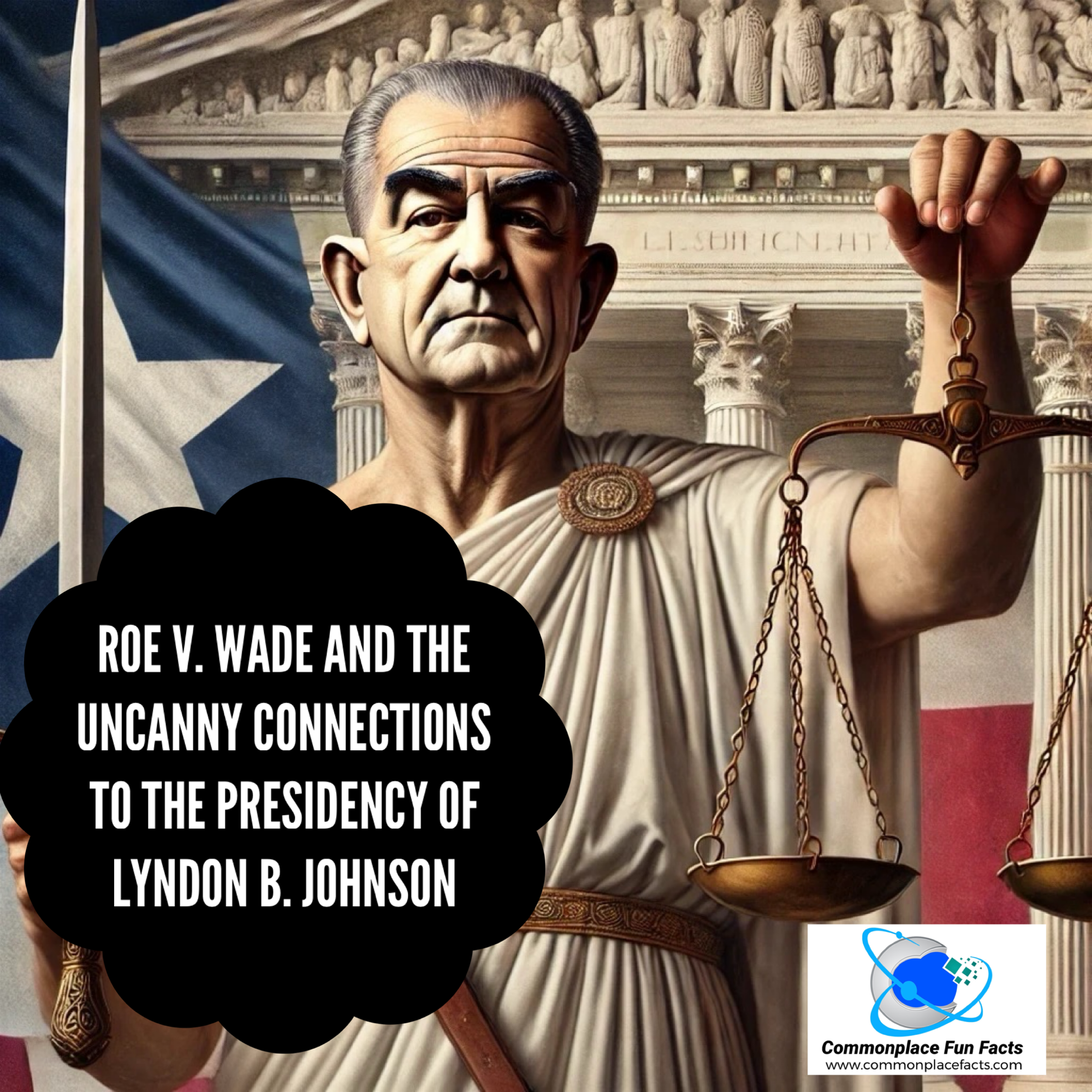

Lyndon B. Johnson, Roe v Wade, and the Peculiar Parallels of History
When Lyndon B. Johnson died on January 22, 1973, the world paused to remember a president whose legacy was as towering as his Texan drawl. We remember a man who was unexpectedly thrust into the presidency because of the assassination of John F. Kennedy.
Of course, no one can look back at that tragic event without recalling the sobering scene of LBJ being sworn in aboard Air Force One as Kennedy’s blood-splattered widow looked on in shock.
We also remember the peculiar circumstances surrounding the capture of JFK’s killer and how he, in turn, was brutally shot to death by Jack Ruby. This is just one more twist of fate that has spawned no shortage of conspiracy theories and speculation about how Johnson came to power.
Perhaps because of all of the wild theories, we have overlooked a very real thread of fate that seems to weave through Johnson’s presidency. More of a coincidence than a conspiracy, there can be no question that LBJ was indelibly and eerily connected to one of the most famous Supreme Court cases of all time: Roe v. Wade.
Contents
Sarah Tilghman Hughes: A Trailblazer With a Presidential Cameo

When Lyndon Johnson raised his hand aboard Air Force One on November 22, 1963, it was history being made in several ways. For one thing, Sarah Tilghman Hughes, the federal judge who swore him in, was the first woman to ever administer the oath of office to a U.S. president. The moment, captured in a now-iconic photograph, was solemn, urgent, and surreal, with Hughes standing shoulder-to-shoulder with power and grief.
But Hughes was far more than a footnote in presidential lore. A Baltimore-born trailblazer, Hughes had clawed her way into the male-dominated world of law in the 1920s, working as a policewoman to fund her night law school classes. By 1935, she was Texas’ first female state district judge. In 1961, thanks to support from fellow Texan and now-Vice President LBJ, she secured a federal judgeship. That happened only after a battle that tested Johnson’s legendary political maneuvering skills — and patience.

Her connection to Johnson was personal, professional, and, at times, strained. When JFK’s Attorney General, Robert F. Kennedy, resisted Hughes’s nomination for a federal judgeship, citing her age (and, one suspects, her gender), Johnson went to bat for her. The maneuvering behind her appointment involved political threats, the Speaker of the House wielding leverage to influence senate votes, and Johnson nursing a bruised ego when things didn’t move quite the way he wanted them to. Yet, in a twist only Johnson’s larger-than-life story could offer, it was Hughes he summoned to administer the oath on that fateful day in Dallas, cementing her place in history.
She is remembered for more than her role in swearing in Johnson. Seven years later, she would be part of a three-judge panel that presided over the original Roe v. Wade case. Her court ruled that Texas’ restrictive abortion law violated constitutional rights. That decision set the stage for the U.S. Supreme Court to take the case three years later.
Henry Wade: The Reluctant Icon of a Landmark Case

You might have wondered who “Roe” and “Wade” were. Sarah Roe was the name assigned by the court to Norma Leah Nelson McCorvey to protect her privacy. She became pregant at the age of 21 and attempted to get an abortion but was unable to do so legally under Texas law. She later repented of her involvement in the case and became a leading figure in the right to life movement. In 1970, however, she was the central figure for what would become the defining abortion rights case for the next fifty years.
What about “Wade”? That would be Henry Wade. He was the a Texas district attorney whose career spanned 36 years. Wade was the epitome of law-and-order conservatism. When McCorvey, under the pseudonym “Jane Roe,” challenged Texas’ abortion law, it was Wade’s office defending the ban. Though his assistant argued the case, Wade’s name was forever etched into history as the respondent in Roe v. Wade.

It wasn’t the first time his name received national attention, however. His office prosecuted thousands of cases, but one of them caught the attention of the whole world. LBJ had been president for only two days when the man responsible for thrusting him into the presidency was gunned down. Care to guess the name of the prosecutor who brought charges against Jack Ruby for killing Lee Harvey Oswald? That’s right… it was Henry Wade.
Johnson, Justice, and the Cosmic Coincidences of History
What are the odds that the beginning of LBJ’s presidency had such strong connections to two people who played such a key role in one court case? As you reflect on that, we should also mention one other thing.
Although the case began in 1970, it takes time for the wheels of justice to turn. It would be another three years before it would work its way through the U.S. Supreme Court. The offical decision in Roe v. Wade was announced by the Court on January 22, 1973. As dramatic as that decision was and as much as it impacted American society and politics for the next fifty years, it did not get nearly the amount of publicity that you might expect.
The reason for its rather muted announcement was because of something else that happened the same day that pretty much monopolized the headlines. The newspapers and television stations were busy reporting the big story that Lyndon B. Johnson had just died.
A Legacy Shaped by Timing
Johnson’s life was one of contradictions: a Southern politician who championed civil rights, a man of immense power who wrestled with insecurities, a figure who loomed large yet struggled to connect with the public. The timing of his death, on the very day Roe v. Wade was decided, feels almost poetic. It’s as if history wanted to remind us that Johnson’s legacy, like the nation he served, was shaped by the push and pull of progress and tradition, justice and resistance.
So, as we reflect on Roe v. Wade and its enduring impact, let’s not forget the peculiar role of Lyndon B. Johnson in the story. He may not have argued the case or signed the ruling, but his life, his allies, and his era were strangely, irrevocably tied to the forces that brought it to fruition. History, it seems, has a way of reminding us that we’re all connected in some way.
You may also enjoy…

The Strange Case of Ernesto Miranda and How He Ended Up Dying For the Right to Remain Silent
It was Ernesto Miranda’s case before the U.S. Supreme Court that enshrined the constitutional right to remain silent. Find out how that ultimately contributed to Miranda’s unsolved murder.

The Hilarious Parliamentary Blunder That Saved Habeas Corpus in 1679
Discover how a miscounted vote in 1679 — involving one oversized lord counted as ten — accidentally secured the Habeas Corpus Act. A hilarious parliamentary blunder that shaped one of Britain’s most important legal protections.

How a Stolen Election Propelled LBJ to the White House
The 1948 Senate election in Alice, Texas, is a significant case of electoral fraud, where Lyndon B. Johnson benefitted from an outright stolen election. Discover how this impacted Johnson’s political trajectory to the presidency.
Leave a Reply