
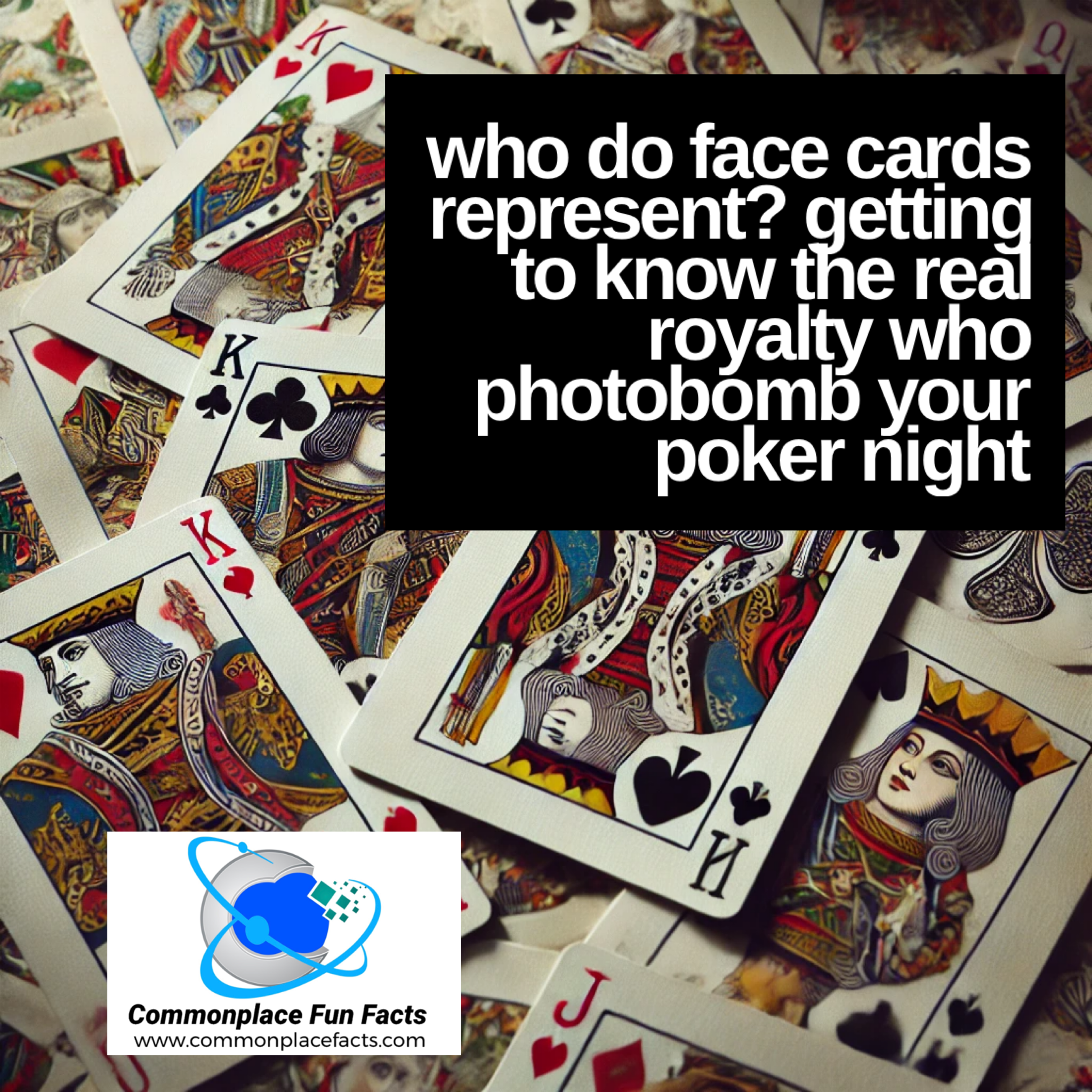

Who Do Face Cards Represent?
Ever shuffled a deck of cards and wondered who those fancy-faced folks are? Who are the kings in a deck of cards? Are they historical VIPs or just some anonymous monarchs who photobombed your poker night? Turns out, the French once gave these royal regulars some real identities—so grab a deck of playing cards and let’s deal you in on their stories.
Contents
The Usual Suspects: Kings, Queens, and Jacks
In the 15th century, French card makers decided their face cards needed star power. They assigned each one a historical or mythological figure, making your standard deck a Renaissance-era celebrity lineup.
The Kings: Crowned Conquerors
- King of Spades: King David — The slayer of Goliath, sweet-psalmist, and ruler of ancient Israel. He built an empire, but his family drama could fill an entire season of reality TV. Hero, poet, and all-around Renaissance man—centuries before the Renaissance.
- King of Hearts: Charlemagne — The “Father of Europe” and Holy Roman Emperor (742–814). He united Western Europe and kick-started the Carolingian Renaissance, all while rocking a beard that screamed “authority.”
- King of Diamonds: Julius Caesar — Roman general, statesman, and part-time dictator (100 BC–44 BC). Famous for conquering Gaul, crossing the Rubicon, and coining the phrase “Et tu, Brute?” during a very unfortunate staff meeting.
- King of Clubs: Alexander the Great — The Macedonian king (356 BC–323 BC) who conquered most of the known world before his 33rd birthday. He named 20 cities after himself, proving that modesty wasn’t his strong suit.

The Queens: Ladies of Legend
- Queen of Spades: Pallas Athena — Greek goddess of wisdom, warfare, and crafts. Athena was the original strategist—probably unbeatable at chess and Risk. She also popped out of Zeus’s head fully armed, setting the bar impossibly high for dramatic entrances.
- Queen of Hearts: Judith — A biblical heroine from the apocryphal Book of Judith. Known for charming her enemy, Holofernes, then promptly separating his head from his shoulders. A true queen of both hearts and headshots.
- Queen of Diamonds: Rachel — A beloved matriarch from the Hebrew Bible. Rachel was known for her beauty, patience, and complicated family life—think of her as the protagonist of the earliest soap opera.
- Queen of Clubs: Argine — Likely an anagram of “regina” (Latin for queen). Unlike her fellow face cards, Argine isn’t from history—she’s a linguistic Easter egg. Leave it to the card makers to slip in a pun while dealing you a royal flush.
The Jacks: Knights, Knaves, and Wildcards
- Jack of Spades: Ogier the Dane — A legendary knight from Charlemagne’s court, known for being both a fierce warrior and a loyal friend. Think of him as a medieval hype man who also happened to wield a sword.
- Jack of Hearts: La Hire — A French military commander and close ally of Joan of Arc. His real name was Étienne de Vignolles, but “La Hire” (meaning “wrath”) suited his battlefield vibes. Basically, he was Joan’s ride-or-die… literally.
- Jack of Diamonds: Hector — The Trojan prince and hero from Homer’s Iliad. Known for his bravery, Hector was Troy’s MVP until Achilles, well… had other plans. The original “fight for your city” guy.
- Jack of Clubs: Lancelot — The legendary Knight of the Round Table and Arthurian heartthrob. Famous for his sword skills and his, um, complicated friendship with King Arthur. (Awkward.)
But Wait—It’s Not Canon
Before you start bragging that the face cards in your poker hand includes Julius Caesar and Joan of Arc’s bestie, here’s the deal: these identities were a French invention. When the English took over card-making, they kept the designs but ditched the names. As mass production took off, the faces became less about history and more about symmetry.
So today’s king of hearts isn’t necessarily Charlemagne—he’s just “generic guy with a crown.” Still, it’s fun to imagine that you’re holding a little piece of history with every deal. Then again, there are those people who think that the who Middle Ages thing was a hoax in the first place, so who knows?
The King of Hearts: The “Suicide King” Mystery
Ever notice that the king of hearts looks like he’s impaling his own head? That’s not a design for the next slasher movie—it’s the result of centuries of sloppy printing. Originally, he held an axe behind his head. Over time, the axe morphed into a sword, and voila: instant medieval melodrama.
The Bottom Line
So, were the face cards based on real people? Short answer: kind of. The French named them after heroes, legends, and biblical figures, but the English let those identities fade into the shuffle.
Still, next time you play poker, remember: your cards have history, even if they’ve gone a bit incognito. Besides, imagining that you’re betting with Alexander the Great, Athena, and Lancelot makes losing your chips feel slightly more dignified.
You may also enjoy…

Not in the Cards to Repeat a Shuffle
Photo credit: By Alan Cleaver (Flickr: Shuffling the deck) [CC BY 2.0], via Wikimedia Commons In a deck of 52 cards, there are 80,658,175,170,943,878,571,660,636,856,403,766,975,289,505,440,883,277,824,000,000,000,000 possible combinations. To give you an idea of how many that is, here is how long it would take to go through every possible permutation of cards. If every star in…

Escape From POW Camp? It Might Be In the Cards
Escape maps were printed on Bicycle playing cards and distributed to Allied prisoners of war during World War II. The deck of cards was created specifically to help Allied prisoners of war escape from German POW camps. This deck of cards became known as the “map deck.” It was made by hiding maps of top-secret…

The Gambler Who Knew When to Hold ‘Em, But Not When to Fold ‘Em
When it comes to gambling, few know as much about winning as Archie Karas. Unfortunately, he knows at least as much about losing. Karas holds the distinction of one of the most impressive winning streaks in gambling history, turning $50 into $42 million — only to lose it all. This is the story of the…



Leave a Reply