
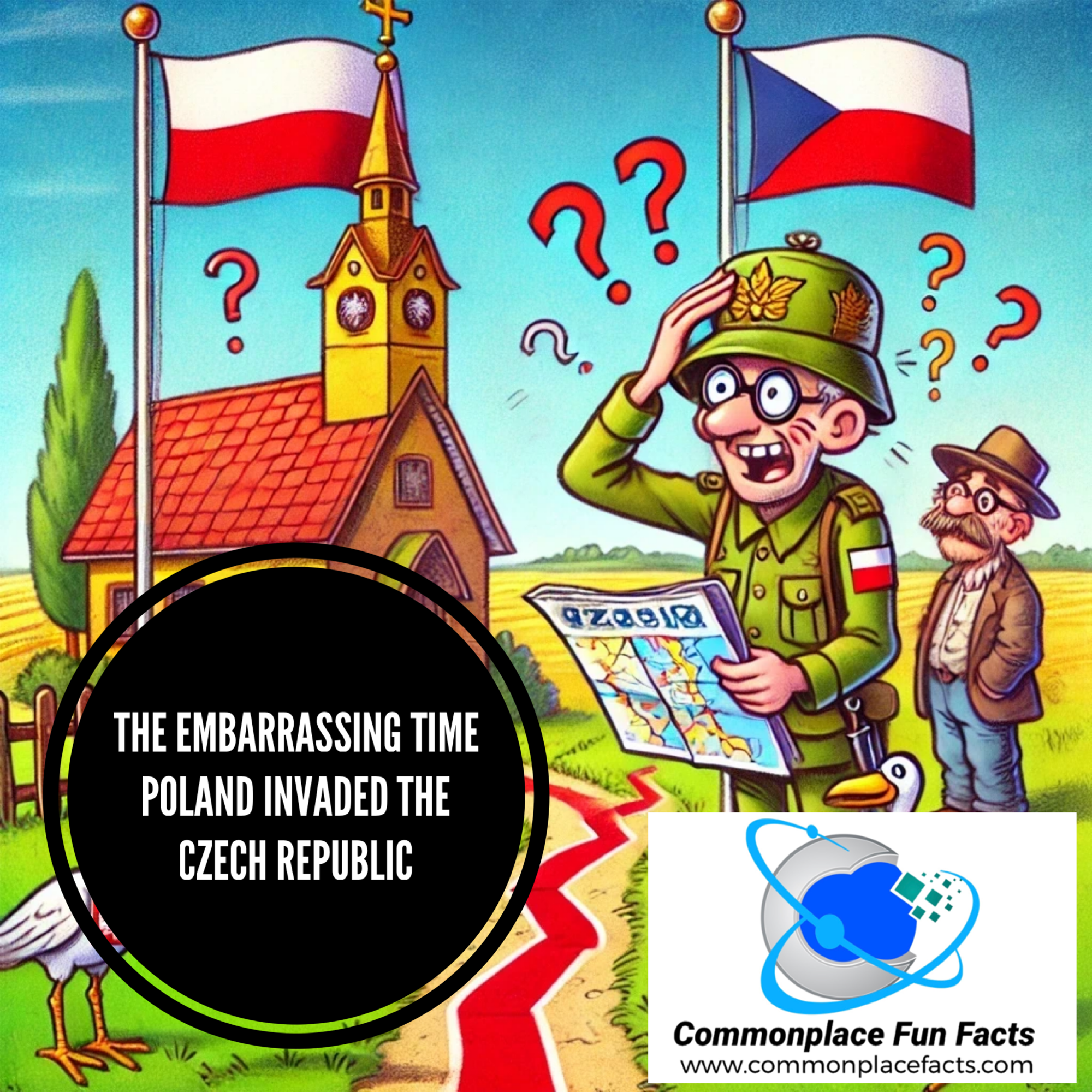

The Accidental Time Poland Invaded the Czech Republic
Accidents happen. Personally, we’re not sure how we feel about acknowledging this fact of life so soon after writing about all the times that someone screwed up while handling nuclear weapons, but that’s just something we’ll have to bring up during the next visit with our therapist.
We also know the realms of diplomacy are not immune from mistakes. We have documented such examples as the humorous times Jimmy Carter’s words were mistranslated and the horrifying possibility that the bombing of Hiroshima resulted from a mistake in translation.
Actually, now that we think about it, maybe these sorts of blunders aren’t all that uncommon after all. Nor are they chapters from the distant past. Consider, for example, the time Poland accidentally invaded the Czech Republic.
Contents
Poland: Invader of Nations, Defender of Borders (Sort Of)
When the words “Poland” and “invasion” typically appear together, it’s safe to assume Poland is the one being picked on. It has a long and storied history when it comes being on the receiving end of uninvited visits from foreign armies. In fact, the last time Poland successfully invaded anything, it was probably a really aggressive tourist taking over the best beach chair in Spain. But in the grand tradition of “Hey, why not?” moments in international relations, Poland somehow found itself as the accidental aggressor.

Poland and the Czech Republic are both part of the Schengen Area, which is basically the European Union’s version of Disneyland. Once you get in, you can move freely between its different sections—Fantasyland, Adventureland, Ruining-Star-Wars-Land, Corporate-Consolidation-Land, and of course, Bureaucratic-Nightmare-Land.
Normally, this means that citizens of each country can cross the border with ease, no passports required. But in 2020, there was this little thing called COVID-19—maybe you’ve heard of it?—which led several EU nations to temporarily close their borders to prevent the spread of the virus.
Poland was one of those nations, meaning they had to do something they historically haven’t been great at: defending their borders. So they stationed troops along the Czech border, including in the Polish town of Pielgrzymów.
The problem? Pielgrzymów is entirely in Poland… except for one church. And one house. Because international borders, much like IKEA assembly instructions, make no sense.
The Great Accidental Polish Occupation of 2020
Polish soldiers, perhaps distracted by the many exciting things Poland has to offer (polishing things, pole-vaulting, Polka dancing—who knows?), set up camp at a church they thought was in Poland. It was not.
So when Czech citizens arrived to enter their own church, they were met by Polish troops who told them, “Sorry, this is Poland now.”
To which the Czechs, very reasonably, responded: “No, it’s not.”
And the Poles, doubling down, said: “Yeah, it is. Get out.”
This, according to people who study international affairs, is called an invasion. And typically, it’s considered a big deal.
Eventually, word got back to the Czech government that Poland had just… helped itself to a little piece of Czech territory. So they sent a polite but pointed message to the Polish government:
“Hey, uh… did you just invade us?”
The Poles, having not realized what had happened, said:
“I don’t think so, but let us check.”
And upon checking, they discovered that, whoops, they totally did. Classic Poland.
The Most Polite Invasion Ever
Thankfully, cooler heads prevailed, and nobody declared war. Poland quickly apologized, the Czechs accepted, and after a few formal statements smoothing things over, everyone agreed to pretend the whole thing never happened.
This whole ordeal might be one of the most polite military invasions in history. There were no tanks, no paratroopers, and no war declarations—just a mild case of “Oops, we thought this was ours.” If only all invasions were so easy to resolve.
Bonus Round: That Time Google Maps Started a War
Believe it or not, Poland isn’t the only country to accidentally invade another one.
We have already written about those embarrassing times Switzerland kept invading Liechtenstein and the time the United States accidentally building a military fort in the wrong country. What we haven’t told you about is the great Nicaragua/Costa Rica/Google Maps Incident of 2010.
Back in 2010, Nicaragua noticed that a Costa Rican flag was flying over Isla Portillos, a small area along their border. The Nicaraguans weren’t happy about this, but they wanted to be sure before they did anything drastic. So, like any modern military force would do, they checked Google Maps.
And lo and behold, Google Maps showed that the land belonged to Nicaragua!
Nicaragua, obviously, did the only logical thing: they sent 50 troops across the river, tore down the Costa Rican flag, and declared the land theirs.
There was just one small problem—Google Maps was wrong.
Costa Rica, upon discovering that their neighbor had casually occupied their land based on an online map, was understandably furious. This led to a diplomatic crisis where, hilariously, both Google and the Nicaraguan government had to apologize.
Thankfully, no war broke out, and Google quickly corrected the map, proving once and for all that sometimes you really shouldn’t trust your GPS.
Lessons Learned
So, what can we take away from these delightful little mishaps in international relations?
1. Double-check your borders. Just like double-checking your text messages before sending them to your boss instead of your best friend, it’s important to make sure you know where you’re standing.
2. If you invade someone, apologize quickly. A simple “Oops, my bad” goes a long way.
3. Never rely on Google Maps for military decisions. Just because it gets you to the nearest Taco Bell doesn’t mean it should dictate your country’s foreign policy.
At the end of the day, the Poland-Czech incident will go down as one of the most low-stakes invasions in history. But hey, if you’re going to invade a country, might as well do it with the same energy as a lost tourist walking into the wrong Airbnb.
You may also enjoy…

The Schleswig-Holstein Question: A Diplomatic Solution So Complex That No One Remembers It
The 19th century conflict over Schleswig and Holstein, known as the Schleswig-Holstein Question, perplexed even seasoned diplomats. Lord Palmerston humorously remarked that only three men in Europe understood it, one of whom had forgotten it. This illustrates the complexity of international relations, even for professionals.

Toilets on the ISS: Clogging Up the Diplomatic Channels
How do astronauts deal with clogged toilets on the ISS? Find out here!

Shortest War Raged For 44 Minutes
What can you do with 45 minutes? You might watch an hour-long television program by skipping the commercials. You could walk three miles at an average pace. Your time could be spent whipping up a batch of chocolate chip cookies. You might choose to be truly creative and stage an accurate recreation of the Anglo-Zanzibar…




Leave a Reply