
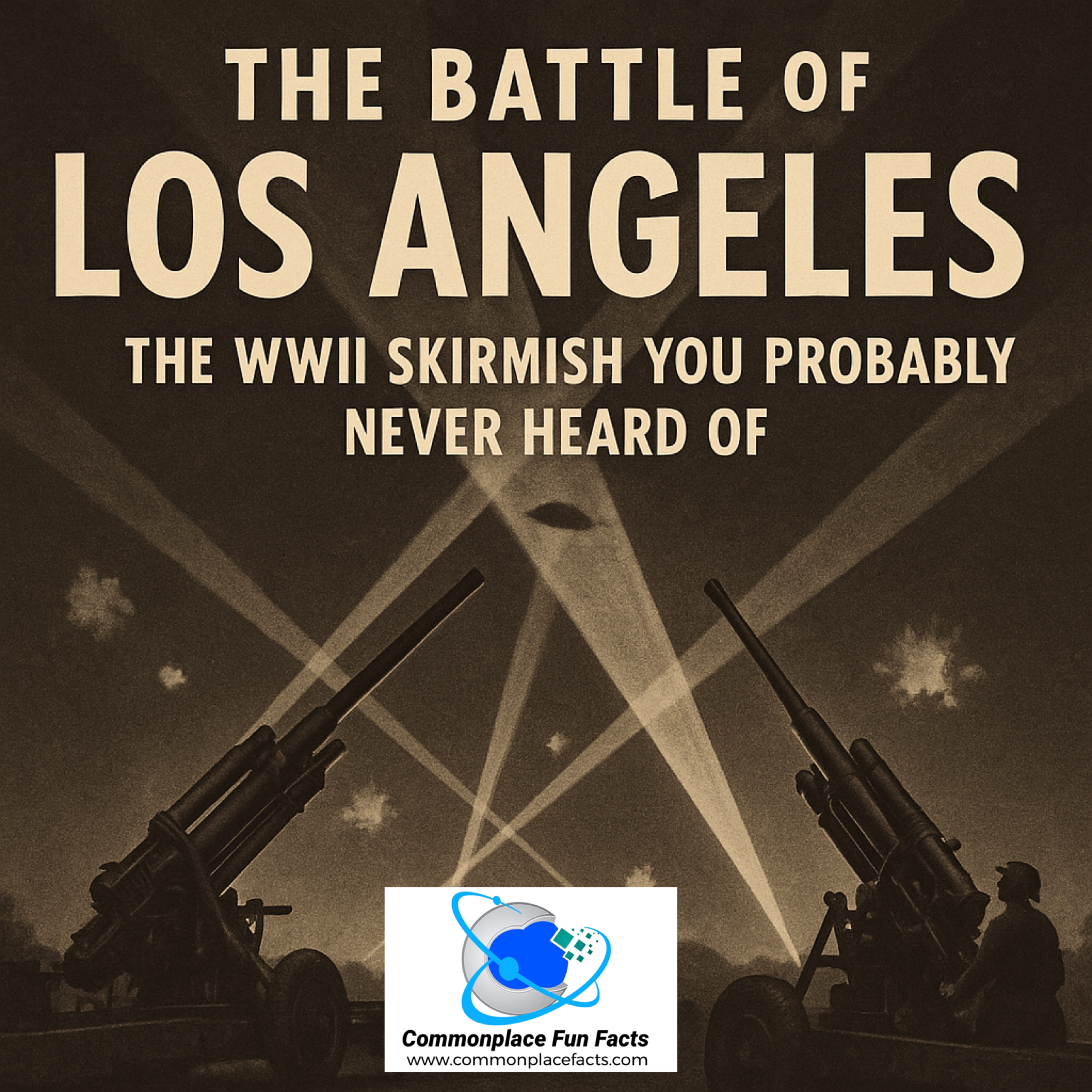

When we think about battles of World War II, certain names come to mind: Normandy. Iwo Jima. Stalingrad. But there’s one skirmish that, despite happening right in America’s own backyard, somehow managed to slip through the cracks of most history books. It didn’t take place on a distant beach or frozen steppe. No, this clash happened under the palm trees and smog-filled skies of Los Angeles, California.
Welcome to the Battle of Los Angeles—an unforgettable night when searchlights, anti-aircraft guns, and a healthy dose of collective anxiety teamed up to wage war against… well, something. Or maybe nothing. The details are fuzzy, the shells were real, and the embarrassment was monumental.
So buckle up as we dive into the night America accidentally declared war on the sky—and possibly on a runaway weather balloon. Or aliens. Or their own shadows. It’s complicated.
Contents
Setting the Stage: Paranoia, Panic, and Poor Visibility
The date was February 24-25, 1942. Pearl Harbor was still a fresh and festering wound, and Americans along the West Coast were primed for action—or at least, primed for some good old-fashioned mass hysteria. Just two days earlier, a Japanese submarine had shelled an oil refinery near Santa Barbara in the Ellwood Attack. Although the damage was minimal (one oil derrick suffered a scratch and someone’s picnic was mildly disturbed), the message was clear: danger was out there.
So when, just before 2 a.m. on February 25, air raid sirens wailed across Los Angeles, everyone did what any rational person would do—they turned off the lights, grabbed a lawn chair, and stared nervously at the sky, fully expecting a full-blown aerial assault. And the military? Oh, they absolutely brought their A-game in terms of overreaction.
Let the Shelling Begin
The blackout plunged Los Angeles into darkness, and anti-aircraft batteries opened fire. 1,400 shells were launched into the night sky in a show of firepower so intense it probably woke up people all the way in Nevada. Searchlights crisscrossed the sky, every creak of a weathervane and glint of reflected moonlight was met with a fresh volley of gunfire.
Witnesses reported seeing mysterious objects—aircraft, balloons, and glowing orbs—that seemed to float or hover over the city. Chaos and confusion reigned as the Battle of Los Angeles raged.
What Were They Shooting At?
The short answer: probably nothing. The slightly longer answer: maybe a weather balloon — because that’s the official answer to any kind of inexplicable airborne sighting, isn’t it?
According to later military investigations, a weather balloon launched earlier that evening likely triggered the first wave of sightings. As anti-aircraft shells exploded in the sky, reflections and smoke created visual anomalies, which in turn fed into a feedback loop of terror and enthusiastic overkill. It’s basically the historical version of seeing a shadow in your room at night and hurling your bedside lamp at it. Then setting your entire house on fire for good measure — but enough about that time we watched Fright Night contrary’s to Mom’s explicit instructions.
The Official Story (and Its Problems)
Initially, Secretary of the Navy Frank Knox called the event a “false alarm,” chalking it up to “war nerves” and itchy trigger fingers. But then things got weird. Well, weirder.
California Governor Culbert Olson hinted that there might have been actual enemy reconnaissance aircraft testing America’s defenses. A declassified Army memo even mentions a “single unidentified object” spotted moving slowly southward off the coast. Official reports walked a careful line between “nothing to see here” and “okay, maybe there was something, but we have no idea what.”
So naturally, conspiracy theories exploded faster than an overcooked Thanksgiving turkey.
Enter: The UFO Theories
Because it wasn’t enough for the story to involve just weather balloons and misfiring anti-aircraft guns, the Battle of Los Angeles also birthed one of America’s earliest UFO conspiracy theories.
Some witnesses claimed the object was moving too slowly for a plane, hovering like it was casually judging everyone below. Others insisted they saw glowing discs or strange lights that conventional aircraft simply couldn’t explain.
Even before Roswell and the term “flying saucer” entered the popular imagination, people were already whispering about extraterrestrial visitors. After all, if we weren’t shooting at the Japanese, maybe we were shooting at little green men who just wanted to check out the Hollywood sign.
Casualties and Collateral Damage
In terms of body count, the Battle of Los Angeles was mercifully tame, but not as low as it should have been. There were five civilian deaths attributed to the chaos—some from heart attacks induced by the terror, others from car accidents during the blackout.
No enemy bombers were shot down. No invaders parachuted into Griffith Park. The only real casualties were a few buildings damaged by the falling debris of our own anti-aircraft shells. In other words, we spent hours and thousands of dollars in ammunition fighting… ourselves.
If everything was triggered by a weather balloon, it still wouldn’t compare to the damage caused by the Cleveland Balloon Disaster of 1986.
Photo Evidence: Enter the Conspiracy Machine

One famous photograph from the night shows spotlights converging on a bright object in the sky. For decades, UFO enthusiasts have pointed to this photo as undeniable proof of an alien craft. The truth is a little less sci-fi: newspapers at the time heavily retouched the photo to make the beams and object stand out better in black-and-white print, unintentionally making it look way more dramatic—and way more saucery—than it actually was.
The Aftermath: Explaining the Unexplainable
When the smoke (literally) cleared, the U.S. military concluded that it had been a false alarm, perhaps triggered by a weather balloon and magnified by nerves, confusion, and the generally unhelpful behavior of exploding shells.
Still, the event left a mark. Public confidence in the government’s ability to tell the truth suffered a blow. After all, if they could mistake a cloud for an enemy fleet, what else might they be hiding?
Conspiracy theorists would later draw a straight line from the Battle of Los Angeles to future incidents like Roswell, Area 51, and every X-Files episode ever made. In a way, the 1942 panic paved the way for decades of alien hysteria, mistrust, and an entire subgenre of pop culture based on the premise that “the truth is out there.”
Fun Facts and Final Thoughts
- The Battle of Los Angeles remains one of the few instances in history where a major city fired thousands of shells into its own sky without a confirmed enemy present.
- Steven Spielberg’s 1979 film “1941” is loosely based on the event, turning it into a full-blown comedy about wartime panic.
- Four decades after the Battle of Los Angeles, the West German band Nena released the hit song “99 Luftballoons.” It envisions the total destruction of civilization, triggered by some balloons that were mistakingly identified as hostile.
- Metal debris recovered all over the city was not from downed planes—it was from our own anti-aircraft shells falling back down to Earth.
- Despite the chaos, many residents reportedly treated the whole thing like a strange sort of block party, gathering on rooftops to watch the spectacle unfold.
In the end, the Battle of Los Angeles teaches us an important lesson: in times of fear, humans have an impressive ability to turn a balloon, a cloud, and some unfortunate lighting into a full-scale military engagement.
And if you’re ever wondering whether human overreaction is a modern invention, rest assured—it’s as old as history itself. Sometimes, the only thing we have to fear is fear itself… and maybe our own anti-aircraft guns.
A Quick Timeline of the Madness
- February 23, 1942: Japanese submarine shells Ellwood oil refinery. Minimal damage, maximum panic.
- February 24, 1942: Military intelligence warns of a possible attack. Spoiler: they weren’t wrong—just not about what they thought.
- February 24-25, 1942, 2:00 a.m.: Air raid sirens blare. Los Angeles blacks out. Anti-aircraft guns open fire.
- 3:00 a.m.: Shooting continues. Searchlights spot… something. Or nothing. Hard to tell through the smoke and chaos.
- 4:00 a.m.: Barrage winds down. Shells, shrapnel, and confusion rain down instead.
- Morning of February 25: Officials issue conflicting statements. Public decides, en masse, that maybe flying saucers aren’t that crazy after all.
Myth vs Reality
| Myth | Reality |
|---|---|
| Enemy bombers attacked Los Angeles | No enemy aircraft confirmed; most likely a weather balloon plus mass panic |
| Anti-aircraft guns shot down a plane | No wreckage ever recovered; debris was from U.S. shells |
| Dozens killed in the battle | Five civilian deaths, none from enemy action |
| The government covered up a UFO attack | Extremely unlikely—weather phenomena and panic much more probable. Besides, when has the government been highly efficient about anything? |
So the next time you hear strange noises in the night, remember: it’s probably just the weather. Or aliens. Or your neighbors’ dog. But maybe keep the anti-aircraft guns in storage, just in case.
Stay curious, stay skeptical, and stay away from spotlights during blackouts!
You may also enjoy…

“A Cacophony of Hell” — The Terrifying Crocodile Massacre at the Battle of Ramree Island
War can be terrifying enough when humans are the only combatants. Imagine how much worse it can be when nature takes sides. Such was the case during the Battle of Ramree Island when more soldiers were slaughtered by saltwater crocodiles than by enemy bullets. Ramree Island is located off the coast of Burma. It was…

Bat Bombs: The Wild WWII Weapon That Almost Changed History
Discover the bizarre WWII bat bombs project, led by dentist Lytle Adams, where bats were equipped with incendiary bombs to burn enemy cities. Learn how this wild war experiment unfolded.

The Shocking Story of Martin James Monti: The Only American Officer to Defect During WWII
Discover the bizarre tale of Martin James Monti, the only American officer to defect to Nazi Germany during World War II. Explore his journey from a misguided youth to a convicted traitor in this shocking chapter of U.S. history.





Leave a Reply