

When Bram Stoker’s Dracula first emerged from the literary shadows in 1897, readers were introduced to the stuff of nightmares: Transylvanian castles, blood-sucking nobles, and Victorian anxiety levels that can only be described as aggressively repressed. But what happens when a book that’s already toe-deep in weirdness takes an unexpected detour through Iceland?
Allow us to introduce you to Makt Myrkranna — that’s Icelandic for Powers of Darkness — which was billed as a faithful translation of Stoker’s novel when it was published in Reykjavík in 1900. Except it wasn’t. Not even close. And the result? A weird, wonderful, and utterly bizarre retelling that’s one part Dracula, one part fever dream, and twelve parts Icelandic flair.
Contents
The Icelandic “Translation” That Wasn’t
The story goes that Icelandic publisher Valdimar Ásmundsson received permission from Bram Stoker himself to translate Dracula into Icelandic. So far, so good. Ásmundsson, a respected editor and writer, rolled up his sleeves and got to work. But instead of doing a straight translation, he apparently decided that Stoker’s original could use a few… adjustments.

By “adjustments,” we mean “complete overhaul.” Characters were changed. Plotlines were reworked. Whole chunks of the novel were sliced out like garlic bread at a vampire potluck. The result, Makt Myrkranna, bears enough resemblance to Dracula that you’d recognize it at a family reunion, but you’d also pull your spouse aside and whisper, “Is it just me, or does Uncle Vlad look different this year?”
The Weird Edits and Wild Additions of Makt Myrkranna
Let’s start with the Viking elephant in the room. In Bram Stoker’s original, Count Dracula takes a break from terrorizing real estate attorneys to wax poetic about his favorite historical psychos: the Viking Berserkers. These Norse warriors, known for going full rage-monster in battle, get a shout-out from Dracula as his kindred spirits. But Valdimar Ásmundsson? He said “Hard pass” to that subplot and left the Berserkers on the cutting room floor. Apparently, Iceland was not ready for Dracula: Viking Edition.
Another change? No animal transformations. The classic image of Dracula turning into a bat or wolf is nowhere to be found. Instead, Ásmundsson gives us a Dracula who’s strictly bipedal and very much not a shapeshifter. It’s a bit like watching a magician without the sleight of hand — just ominous staring and vaguely Eastern European accents.
But wait, there’s Freud. Yes, that Freud. In an unexpected crossover episode no one asked for, Ásmundsson sends poor Mina Harker — renamed Wilma because apparently everyone needed a new stage name — to Vienna for therapy with Sigmund Freud himself. Because when you’re battling the Prince of Darkness, what you really need is a prescription for Oedipal analysis and a strong dislike of your mother.

And if you thought Stoker’s version was subtly steamy, buckle up. In Makt Myrkranna, Thomas Harker (the Icelandic reboot of Jonathan) is not so much concerned with real estate as he is with… anatomy. The man is absolutely fixated on the buxom women of Transylvania, and he comments on their curves with the frequency of a hormonal teenager on a Red Bull binge. Whatever subtlety existed in Stoker’s original, Ásmundsson set it on fire and danced on the ashes.
The structure of the novel also gets a serious facelift. Stoker’s Dracula is famously epistolary — told through letters, journal entries, and news clippings. Ásmundsson? He starts off with Thomas’s diary, and the first half is told entirely from the first-person perspective of Harker. Halfway through, however, an omniscient narrator takes over and tells us everything in great gothic detail. The second half zooms out and fast-forwards through what Stoker took chapters to unpack. Most of the London action is crammed into the final 20% like someone procrastinating on their English homework and suddenly realizing the book report is due tomorrow.
And speaking of gothic detail, Ásmundsson really leans into the horror. In his version, Thomas stumbles across the body of a murdered peasant girl — Dracula’s handiwork, naturally — and is treated to a front-row seat at a full-blown Black Mass, complete with human sacrifice. It’s like Stoker’s Count Dracula was auditioning for the role of spooky antagonist, while Ásmundsson’s Count showed up having already sacrificed three interns and rewritten the script.
If you’re a fan of Dracula’s infamous trio of undead brides, you’re in for disappointment. In Powers of Darkness, Dracula is a one-woman man. Her name is Josephine. We’re not given much backstory, but we can only assume she’s got something special going on to be the sole recipient of Dracula’s eternal affection. Monogamy, it seems, is the new black in the Icelandic vampire scene.
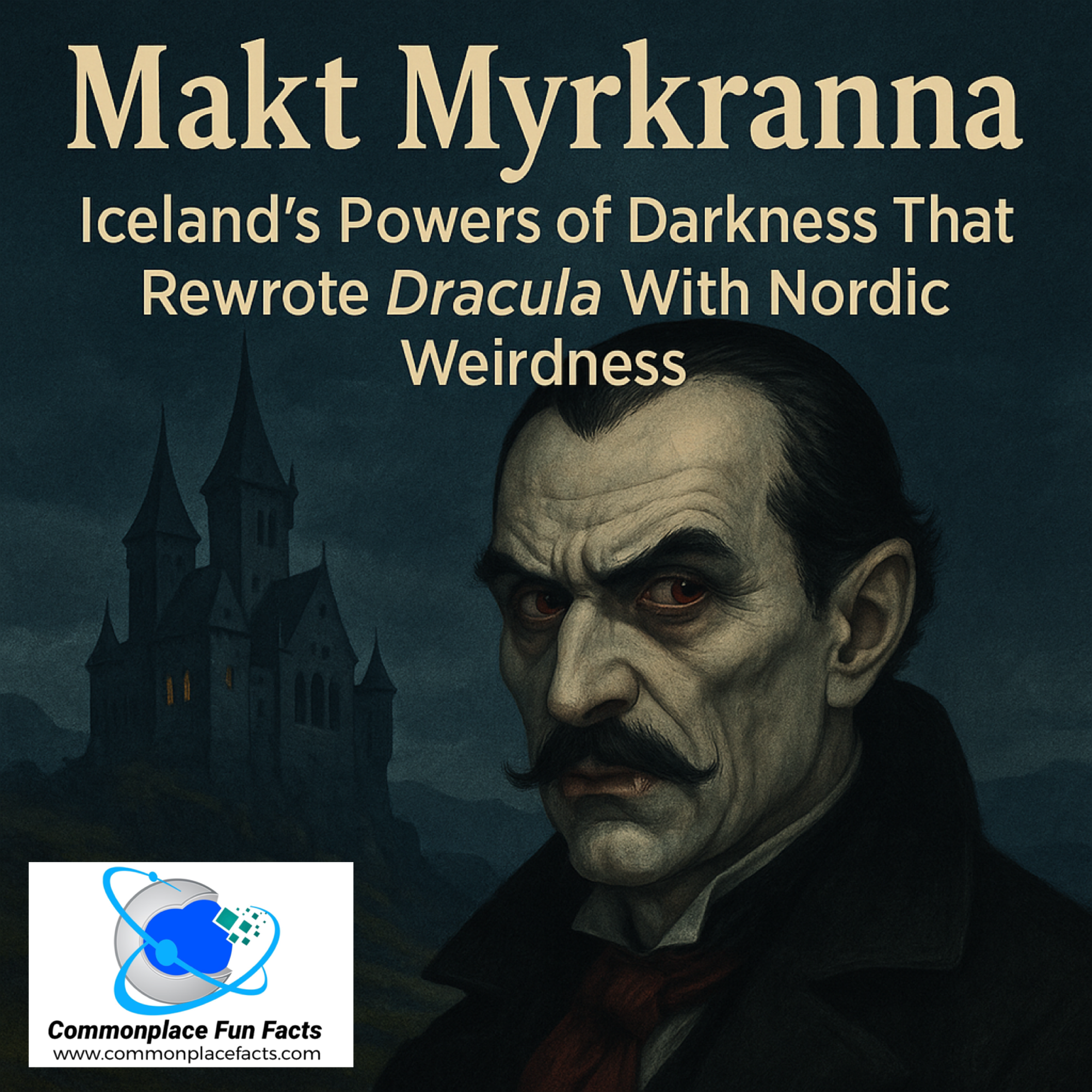
And here’s where things go full Bond villain: Count Dracula isn’t just feasting on the occasional houseguest. He’s also plotting global domination. Ásmundsson connects Dracula with various shadowy government types and outlines his whole Social Darwinist worldview. In Makt Myrkranna, Dracula believes the strong should rule the weak, and that compassion is for chumps. So basically, he’s your least favorite philosophy major at a college party — if that guy also performed human sacrifice and had a mustache like a villain in a silent film.
Don’t be too quick to skip over the mustache. You have to admit it’s pretty impressive for anyone to be able to sport a neatly-groomed patch of facial hair when that person is unable to see his reflection in the mirror. Sadly, the narrator doesn’t give us nearly as much detail about this heroic feat as we would like.
New to the Icelandic cast is Inspector Barrington — a detective character who doesn’t appear in the original but exists here to poke around Dracula’s mess in England. Think of him as Van Helsing’s CSI consultant, sniffing out clues with the gravitas of a Victorian crime drama sidekick who definitely doesn’t survive the series finale.

And about that finale: Dracula does not make it out alive. In Stoker’s original, he pulls a classic villain move — fleeing back to Transylvania while the vampire-hunting squad chases him down. But in Makt Myrkranna, Van Helsing and company confront him directly and deliver a permanent retirement plan. No bat-form escape, no cliffhanger — just a good old-fashioned mob justice ending with fangs and pitchforks.
So while Makt Myrkranna claims to be a translation, what we really have is an alternate dimension where Dracula is scarier, driven by testosterone, more politically ambitious, and way less of a team player when it comes to brides. It’s not so much a retelling as a full-on reboot — one where Bram Stoker meets H. P. Lovecraft, stops by Sigmund Freud’s office, and takes notes in a Transylvanian gentleman’s club.
In case you’re curious, it does not, alas, shed any additional light on the theory that Dracula and Sherlock Holmes’ arch-enemy Professor Moriarty are the same person.
The Plot Thickens (And So Does the Conspiracy)
For over a century, everyone assumed this was just an especially creative translation. But in 2014, Dutch scholar Hans Corneel de Roos dropped a literary bombshell: Makt Myrkranna wasn’t just a mistranslation — it was a significantly different story that seemed to draw on an earlier draft of Dracula itself. A draft that, in some places, was darker, weirder, and more explicitly political than the final version Stoker published.
This revelation led to the theory that Stoker may have sent Ásmundsson an early version of the manuscript — perhaps one that never made it to print in English. If that’s the case, the Icelandic “translation” may be the only surviving version of that original concept. In other words, Makt Myrkranna isn’t a knockoff — it’s a secret sibling or possibly a secret parent.
How Iceland Made Dracula Even Creepier
If Stoker’s Dracula was a slow-burning thriller, the Icelandic version turned the dial to 11 and yanked off the knob. It opens with satanic rituals and disturbing architecture and just keeps escalating. Dracula himself is more physically grotesque, resembling a literal monster instead of a creepy Eastern European aristocrat with questionable grooming habits.
There’s also a much heavier emphasis on eroticism and violence. The Icelandic Count leers more, touches more, and spends an inordinate amount of time fondling furniture and commenting on the curvature of stair railings. Subtle, it is not. And we didn’t need the Freud scene to help us with that.
Dracula, De Roos, and the Case of the Mysterious Icelandic Remix
It took more than a century, but in 2014, someone finally said, “Hey, wait a minute… this Icelandic Dracula is weirdly different.” That someone was Dutch scholar Hans Corneel De Roos — who, while flipping through Makt Myrkranna, noticed that it didn’t exactly match the Bram Stoker classic it claimed to translate. You know, the same way a microwave burrito doesn’t exactly match the photo on the box.
Yes, for over 100 years, Iceland’s official version of Dracula has been more like a fever dream inspired by the Count than a straight translation. Admittedly, the pool of gothic fiction fans who are fluent in English and Icelandic is distressingly small. Even so, how did we all go for a century, oblivious to this alternate-universe Dracula with a new cast, new plot, and a suspiciously uncanonical mustache?
The Fan-Fiction Theory: Dracula, But Make It Icelandic
The most obvious theory is also the most Internet-friendly: Valdimar Ásmundsson decided to write and publish his own Dracula fan-fiction. Like any good fanfic author, he slapped a “based on a true story” label on it and got away with it. This theory is a favorite on social media, where the idea of rogue fan-fiction passing as literature is both romantic and alarmingly plausible.
The Early Draft Theory: Bram Stoker, The Real Culprit?
But maybe we shouldn’t be so quick to blame Valdimar. What if Bram Stoker handed over an early draft of Dracula — the “rough cut” version with deleted scenes, bonus characters, and a little extra violence sprinkled in for flavor? There’s some tantalizing evidence that this may be the case.
For one, Makt Myrkranna includes a character named Inspector Barrington — a name that shows up in Stoker’s original notes before being deleted in favor of giving Van Helsing more screen time (and let’s be honest, more dramatic monologues). And then there’s the creepy, silent housekeeper — deaf, mute, and unnervingly unsettling — who also appears in Stoker’s preliminary sketches but not in the final cut. You could call them deleted scenes, or perhaps, bonus content for the Icelandic market.
If Valdimar was just making all of this up, it’s suspiciously consistent with material we know Stoker once considered. Either the man was psychic, or he had access to a working draft. And given that psychics weren’t officially unionized in 1900, we’re inclined to believe it’s the latter.
The Synthesis Theory: Have Your Blood and Drink It, Too
And then there’s the most diplomatic explanation of them all — the Synthesis Theory. According to this view, Valdimar Ásmundsson did have an early draft of Stoker’s manuscript, and instead of translating it faithfully, he thought, “Well this is a nice place to start,” and went full fanboy from there. He took Bram’s skeletal outline, sprinkled in a bit of his own Icelandic flair, some heavy-handed political allegory, and enough cleavage commentary to qualify for a Victorian rating of “PG-13 but morally concerned.”
So which theory is true? Did Valdimar invent his Dracula from whole cloth? Did Stoker give him an early peek behind the coffin lid? Or did the two inadvertently co-author one of the strangest remix stories in literary history?
No one knows for sure. What we do know is that the existence of makes Dracula lore even more deliciously convoluted. It’s the literary equivalent of finding out your grandmother used to be a spy, or that the quiet neighbor down the street owns a room full of swords.
Where to Read It (If You Dare)
Although Makt Myrkranna has gained a renewed interest among Dracula fans, it was not an unqualified hit when it first landed on Icelandic bookstore shelves. It received a whopping 100% negative review rate. OK, that’s a bit dramatic — there was only one review at the time. It was written by Benedikt Björnsson in 1906:
“Without doubt, for the largest part it is worthless rubbish and sometimes even worse than worthless, completely devoid of poetry and beauty and far removed from any psychological truth. “Fjallkonan” presented various kinds of garbage, including a long story, “Powers of Darkness”. That story would have been better left unwritten, and I cannot see that such nonsense has enriched our literature.”
Harsh? Perhaps, but remember that Fred Astaire’s screen test earned him the review: “Can’t act. Slightly bald. Can dance a little.”
The Icelandic version was largely ignored until de Roos’s English translation of Makt Myrkranna was published in 2017, under the title Powers of Darkness: The Lost Version of Dracula. It includes both the Icelandic text and de Roos’s analysis, giving readers a chance to sink their teeth into both the fiction and the scholarship.
So if you thought you knew Dracula, think again. There’s a version out there that’s part horror, part political thriller, and part speculative fever dream — and it’s Iceland’s gloriously gothic gift to the world.
Bonus Fun Fact: Makt Myrkranna wasn’t the only odd Dracula adaptation. The Swedish “translation” is also significantly different — and yes, it was also called Makt Myrkranna. Apparently, Dracula had a thing for Scandinavian exclusives. It might have something to do with the long hours of darkness in the winter months.
You may also enjoy…

Sherlock Holmes vs Dracula: The Compelling Theory of the Vampiric Sherlock Holmes Crossover
Could Sherlock Holmes have faced Count Dracula in 1890? Dive into this intriguing theory connecting Moriarty, Dracula, and Holmes himself. A Victorian mystery of Sherlock Holmes vs Dracula awaits!

Sink Your Teeth into these 5 Dracula Fun Facts
How much do you know about everyone’s favorite vampire? Find out with these Dracula Fun Facts.

Porphyria: The Creepy Dracula Disease That Creates Real Vampires
Porphyria is a group of genetic disorders marked by symptoms resembling vampire traits, including sunlight sensitivity, painful skin reactions, and gastric distress from garlic. This condition results from disrupted heme production, leading to porphyrin accumulation. While incurable, Porphyria can be managed through regular blood transfusions.






Leave a Reply to sopantoothCancel reply