
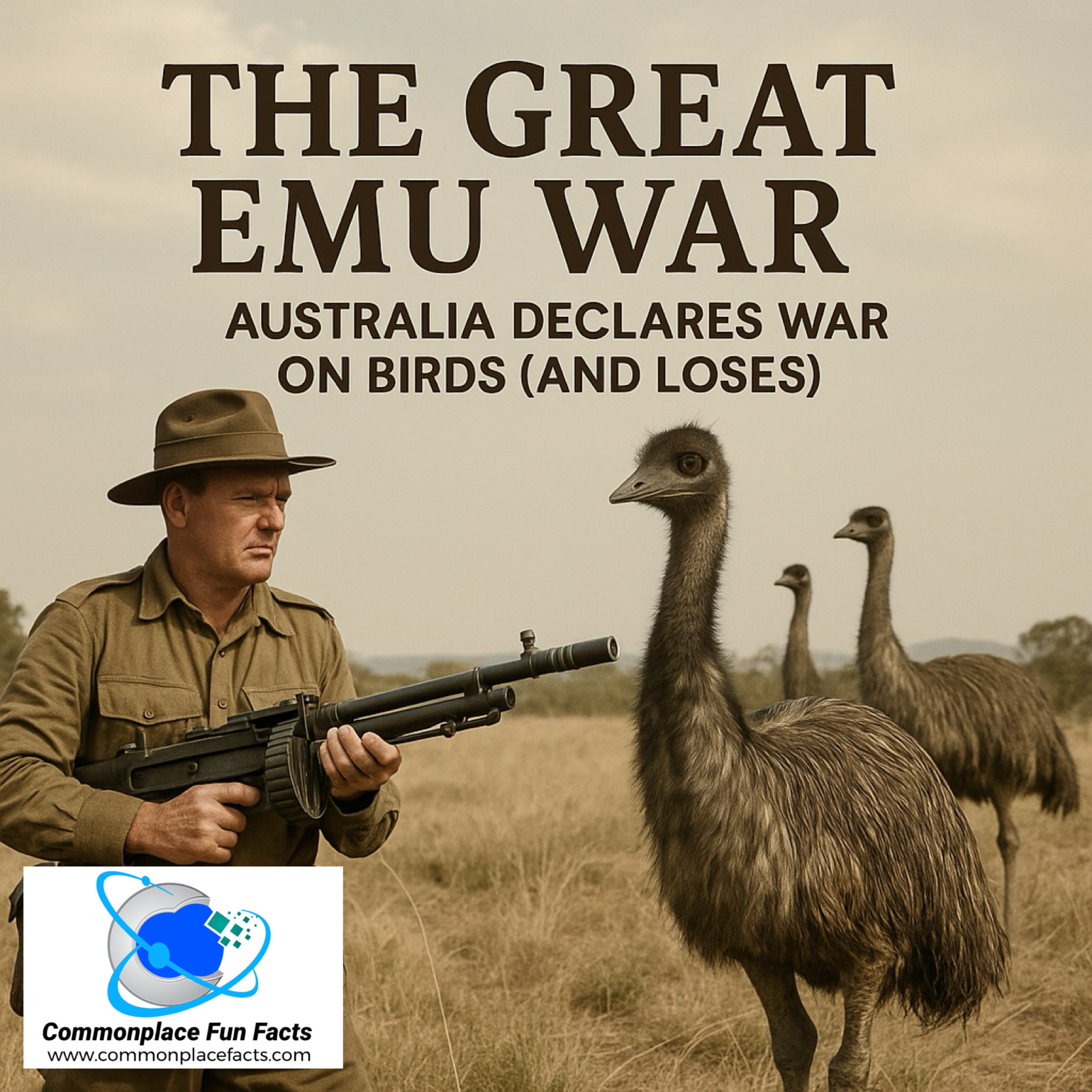

Australia’s Great Emu War — No, We’re Not Making This Up
Australia. From horrifying (yet adorably cuddly) predators and baby-snatching dingos to real-life inspirations for crocodile hunting movie legends, this place sure generates a lot of topics for us — assuming that it’s a real place and not an imaginary fabrication of a vast international conspiracy, of course.
But every so often, Australia out-Australias itself. Because while most countries spend their military budgets on things like defending borders or preparing for space lasers, Australia once turned its attention — and its machine guns — to a very specific, very feathery problem: emus. Yes, the giant, flightless birds that look like they lost a bet with evolution.
And thus begins the tale of the Great Emu War, a military campaign so spectacularly ill-fated that it makes Napoleon’s decision to invade Russia seem like a brilliant tactical maneuver. Join us for a tale of national pride, stubborn birds, and one of the most gloriously ridiculous chapters in modern military history.
Contents
Enemy at the Gates: Feathered Foes Descend
The year is 1932 — a time of global depression, rising political tensions, and in one corner of the world, a nation locked in a life-or-death struggle against…a flock of large, flightless birds.

In the aftermath of World War I, many Australian veterans were given plots of land in Western Australia to take up farming. It was a lovely idea, right up until 1932 when more than 20,000 emus decided to relocate to that same land in search of food, water, and chaos.
If you’ve never met an emu, imagine a creature roughly the size and speed of a velociraptor but without the warm and fuzzy disposition. These birds are huge, often clocking in at over 5 feet tall, with legs that could kick your soul straight into the afterlife. Farmers quickly found themselves overwhelmed as the birds trampled fences, devoured crops, and turned carefully tilled land into an all-you-can-eat buffet.
Operation Featherstorm
Faced with a feathered insurgency, the government did what only governments can do: they called in the military.

On November 2, 1932, the Australian government deployed the Seventh Heavy Battery of the Royal Australian Artillery to the front lines of this new avian battlefield. The soldiers were equipped with Lewis machine guns and 10,000 rounds of ammunition. The objective? Emu eradication.
Leading this unprecedented assault was Major G.P.W. Meredith, who probably expected this assignment to be a simple field exercise. After all, how hard could it be to shoot some birds?
The Birds Strike Back
The emus, it turned out, were having none of it.
The first battles went disastrously. The emus were not only incredibly fast—capable of hitting 30 miles per hour—but they also had a maddening tendency to scatter at the sound of gunfire. Instead of flapping about helplessly like cartoon ducks, they zigzagged across the plains with tactical brilliance that would have impressed Napoleon. But then again, Napoleon once lost a battle against some rabbits, so maybe we should choose a different example.
“If we had a military division with the bullet-carrying capacity of these birds it would face any army in the world. They can face machine guns with the invulnerability of tanks. They are like Zulus whom even dum-dum bullets could not stop.”
Even when the soldiers managed to get some birds within range, the emus proved almost absurdly durable. Reports emerged of emus taking multiple bullets and still managing to run off into the sunset, presumably while flipping a metaphorical middle feather at the troops.
Major Meredith himself summed it up best: “If we had a military division with the bullet-carrying capacity of these birds it would face any army in the world. They can face machine guns with the invulnerability of tanks. They are like Zulus whom even dum-dum bullets could not stop.”
The War That Wasn’t
After a week of humiliating setbacks, low morale, and birds behaving like Teflon-coated ninjas, the Australian military had had enough. On November 8, 1932—just six days after the official start of the campaign—the operation was halted. The soldiers had fired over 2,500 rounds of ammunition. Confirmed emu casualties? About 50.
That’s a kill ratio of 50:1—if you count bullets per bird. If you’re keeping track, that’s also roughly one dead bird per five-man platoon using automatic weapons. Not exactly the stuff of military legend.
Fallout and Feathers
The press had a field day. The operation was widely ridiculed both at home and abroad, and “The Great Emu War” entered the history books as one of the most bizarre—and failed—military campaigns ever launched. Australia, a nation with tanks, artillery, and a proud military tradition, had lost a war to birds.
The emus, meanwhile, remained triumphant, continuing their rampage until better fencing and strategic culling programs were introduced. Nature, it seems, had claimed victory once more.
Lessons Learned (Sort Of)
The Great Emu War taught us a few valuable things:
- Never underestimate the enemy—even if it’s a bird.
- Machine guns are great, but strategy is better.
- Emus might secretly be made of adamantium.
So next time someone tells you they had a rough week, gently remind them that a modern, technologically advanced nation with a fierce military once declared war on emus… and lost.
Read letters from the front — written by those who fought on the emu side — in Letters from the Emu War: Correspondence from those who claimed victory in the great emu war of 1932, by J.A. Bryden
You may also enjoy…

Rabbits: The Terror of Australia
Rabbits are so cute and cuddly that it is hard to imagine the word “terror” being associated with them. (NOTE: This would be news to Napoleon and Jimmy Carter, each of whom had horrifying encounters with rabbits, as detailed here.) Despite such rabbit horror fantasies as Night of the Lepus, and Year of the Angry…

Beware the Drop Bear: Australia’s Fluffiest #1 Death Machine
Have you heard about the legendary and fearsome Australian Drop Bear? Learn about this terrifying — and adorable — deadly menace.

The Real Crocodile Dundee: Rod Ansell’s Wild Story of Survival and Tragedy
Discover the untamed life of Rod Ansell, the real Crocodile Dundee. From heroic survival in the Outback to a tragic downfall, explore the true story behind the legend that inspired a Hollywood blockbuster.






Leave a Reply to Elisabeth. T. GCancel reply