

Let’s be honest — some of us struggle with words like “anemone” and “rural” on a good day. But humanity, being the clever and mildly sadistic species it is, decided that ordinary language wasn’t quite humiliating enough. So we invented tongue twisters — those delightful verbal slip-and-slides designed to turn your eloquence into alphabet soup.
They sound simple. They’re short. They often involve charming subjects like clams, canners, or Betty Botter’s questionable butter choices. But don’t be fooled: these innocent little phrases are traps, engineered to expose your linguistic weaknesses and turn even the most articulate among us into babbling messes. They’ve been used for centuries to train orators, refine accents, warm up actors, and, more recently, to make YouTube viewers laugh at their own verbal misfires.
So clear your throat, loosen your tongue and let us lead you on a leisurely linguistic labyrinth, where twisted turns of tricky talk tangle tongues and tickle tempers. From ancient Greek orators with pockets full of gravel to MIT engineers building nightmare sentences for science, we’ll explore the classics, trip over some international tongue breakers, and see just how far you can get before your own tongue throws in the towel and demands that you take up Sign Language.
Contents
The Verbal Obstacle Course You Didn’t Know You Signed Up For
Tongue twisters are short phrases or sentences that use similar sounds in close proximity, creating a delightful minefield for your mouth. They’re the linguistic equivalent of running through a hallway full of banana peels — great for training, but don’t expect to look cool doing it. While they may seem like party tricks or the verbal version of juggling flaming swords, they actually serve a noble purpose.
For centuries tongue twisters have been the go-to for improving speech and language skills, especially in children. They strengthen the tongue and mouth muscles, sharpen enunciation, and improve pronunciation. Basically, they’re gym memberships for your mouth, minus the monthly fee and judgmental mirrors.
A Brief (and Twisted) History

Tongue twisters might seem like a modern prank, but they’ve been tormenting tongues for centuries. Long before TikTok challenges existed, elocution teachers were using these verbal hurdles to whip consonants into shape. As early as the mid-1800s, printed tongue twisters appeared in English primers, such as J.W. Shoemaker’s 1878 Practical Elocution.
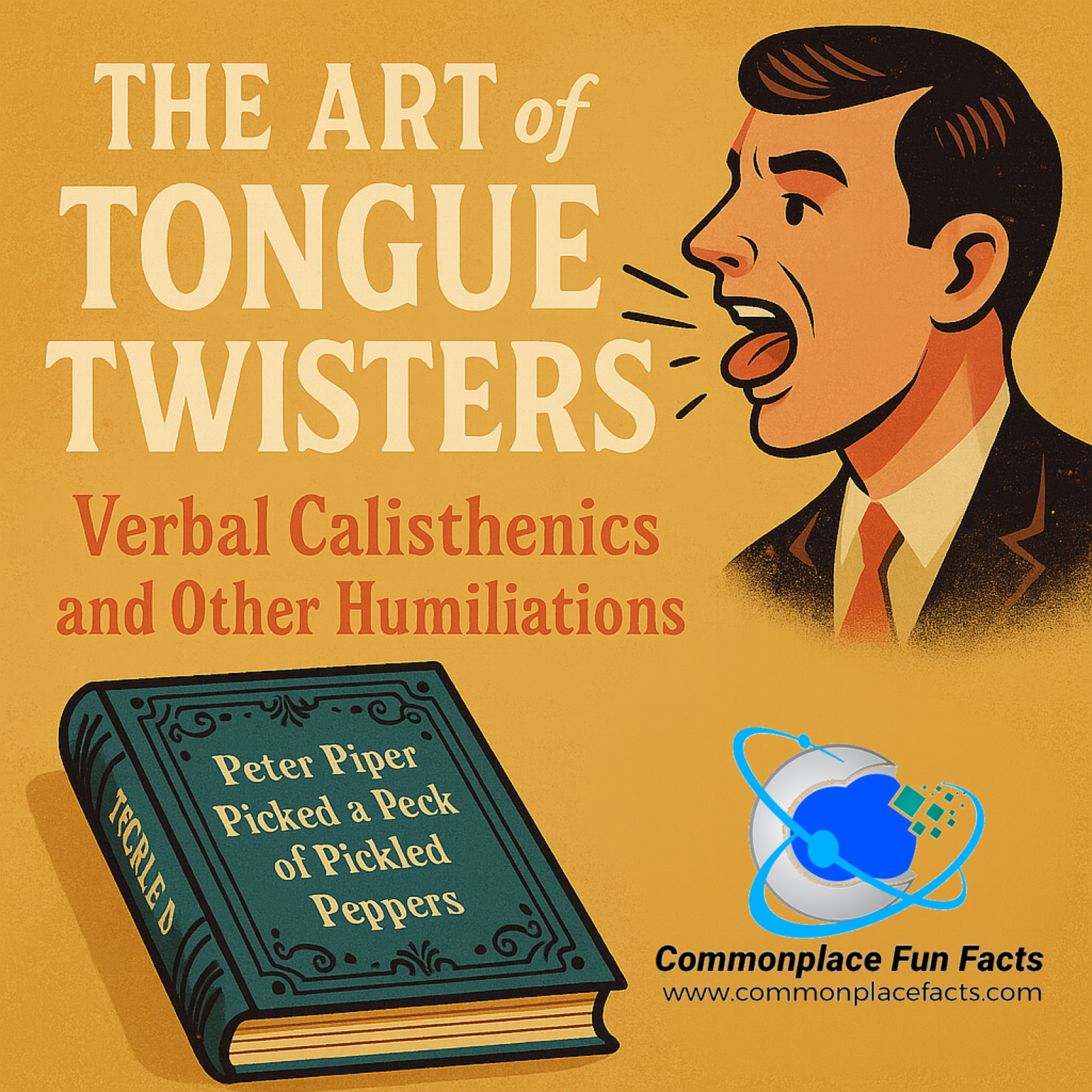
One of the earliest collections of English tongue twisters was published in the 1813 (and republished in 1836) Peter Piper’s Practical Principles of Plain and Perfect Pronunciation. It included such classics as “Peter Piper picked a peck of pickled peppers,” indicating that it probably existed in oral tradition even earlier.
And then there’s “The Butter Betty Bought” that appeared in Carolyn Wells’ 1899 collection The Jingle Book:

Betty Botta bought some butter;
“But,” said she, “this butter’s bitter!
If I put it in my batter
It will make my batter bitter.
But a bit o’ better butter
Will but make my batter better.”
Then she bought a bit o’ butter
Better than the bitter butter,
Made her bitter batter better.
So ’twas better Betty Botta
Bought a bit o’ better butter.
As for “She sells seashells by the seashore”, that appeared in mid‑19th century primers around 1855 and may have been immortalized by the 1908 song—sometimes (perhaps erroneously) credited to fossil-hunter Mary Anning, who quite literally did just that — although presumably without all the sibilant sabotage..
According to the reputable scholarly journal At Home on the Throne Bathroom Reader, the oldest known English tongue twister dates back to the 10th century. Known as “The Leofric Legend,” it goes something like: Lalay, lalay, gumaraidar, gumaraidar, gylsful and oft, weorca deorce, hlinde licgað, geond ylde. Translation: “Thine tongue shall suffer mightily, peasant.” (Roughly.)
We are dubious about this claim, however, for a few reasons (not the least of which is the choice of research material used by our writers.) For one thing, it hardly seems that the oldest known English tongue twister would consist entirely of words that do not appear in the English language. Secondly, aside from At Home on the Throne, our Fact Check Department has been unable to find any other reference to “The Leofric Legend” or this supposed forerunner of English tongue twisters. Thirdly, At Home on the Throne has broken our fact checkers’ hearts before, such as the time it claimed an Australian politician was killed by a shark. Everything about that proved to be true except for the fact that none of it happened. All of that is to say that although Lalay, lalay, gumaraidar, gumaraidar, gylsful and oft, weorca deorce, hlinde licgað, geond ylde truly makes a delightful bit of linguistic acrobatics, we must treat At Home on the Throne’s claim about it to be busted.
The Classics That Still Trip Us Up
There are some tongue twisters that have become legendary — the vocal equivalents of Mount Everest. We all know them. We all mangle them:
- “How much wood would a woodchuck chuck if a woodchuck could chuck wood?” Scientifically answered once. Seriously.
- “Red lorry, yellow lorry.” A beloved warm-up for newscasters and anyone hoping to sound sober.
- “Toy boat.” Sounds easy. Say it three times fast. We pause briefly while you wipe off your screen.
Twisters From Around the Globe
Turns out the rest of the world wasn’t going to let English hog all the mouth-mangling glory. Tongue twisters in other languages range from poetic to downright perilous.
- Finnish: “Kokoo kokoon koko kokko.” Means “Gather together the entire bonfire.” Ideal for singers. Ideal for putting out actual bonfires.
- French: “Un chasseur sachant chasser sans son chien est un bon chasseur.” Translation: “A hunter who can hunt without his dog is a good hunter.” We think. After our article about the French nursery rhymes that aren’t, we’re understandable suspicious.
- Arabic: “Zaraa zarʻa zaraa zarʻa.” Translates as “The seed sows itself.” The phrase is as self-sufficient as it sounds.
- Welsh: “Cynffon cyffwrdd a chyffon clwtllwyt yn cyffwrdd cyffon y cyfrinach.” This loosely means “A tail touching a tail, a tail of a clatter-witted tail touching the tail of the secret.” We should note that the Welsh language, where vowels go to vacation, is one massive tongue-twisters.
And then there’s the town of Llanfairpwllgwyngyllgogerychwyrndrobwllllantysiliogogogoch in Wales, which proudly hosts an annual tongue twister competition. The challenge? Say the town’s name quickly and without summoning a Welsh-speaking demon. Good luck with that.
The Scientific Side of Slips
MIT, always looking for ways to confuse humans and delight robots, gave us the tongue twister: “Pad kid poured curd pulled cod.” It’s not a grocery list — it was developed as part of a study on speech recognition. Researchers concluded this is one of the hardest tongue twisters ever constructed. Your tongue might disagree, but it’s too busy rehabbing right now.
Bonus Round: Tongue Twisters That Might Actually Break You
In the spirit of linguistic gladiators everywhere, it’s worth noting that this tongue-tangling tradition goes way back. Ancient Greek orator Demosthenes reportedly overcame his stammer by reciting complicated phrases — with his mouth full of pebbles. That’s right: public speaking with a mouthful of gravel. Fast forward a couple thousand years, and My Fair Lady‘s Eliza Doolittle tried the same thing — only with marbles, because Broadway has a flair for drama (and choking hazards).
Before you go filling your mouth with landscaping materials, why not try a few of these without choking hazards? See how far you get before your tongue starts filing for workers’ comp:
- Brisk brave brigadiers brandished broad bright blades, blunderbusses, and bludgeons—balancing them badly.
- If you must cross a course cross cow across a crowded cow crossing, cross the cross coarse cow across the crowded cow crossing carefully.
- How can a clam cram in a clean cream can?
- Imagine an imaginary menagerie manager managing an imaginary menagerie.
- Send toast to ten tense stout saints’ ten tall tents.
- Rory the warrior and Roger the worrier were reared wrongly in a rural brewery.
- Six sick hicks nick six slick bricks with picks and sticks.
- I wish to wish the wish you wish to wish, but if you wish the wish the witch wishes, I won’t wish the wish you wish to wish.
- The thirty-three thieves thought that they thrilled the throne throughout Thursday.
- The sixth sick sheik’s sixth sheep’s sick. (Officially recognized by many as the most difficult tongue twister in English — proceed with caution.)
- Can you can a canned can into an un-canned can like a canner can can a canned can into an un-canned can?
- Thirty-three thirsty, thundering thoroughbreds thumped Mr. Thurber on Thursday.
- Six sleek swans swam swiftly southwards.
If you nailed them all without twisting your lips into a pretzel, congrats — you probably proved that you are not human. Good luck completing that next CAPTCHA. If not, you’re in good company. Grab some water, give your vocal cords a pep talk, and remember: Demosthenes didn’t get it right the first time, either.
Closing Your Mouth (If You Still Can)
Tongue twisters have danced, stumbled, and somersaulted their way across cultures and centuries. From classroom warm-ups to speech therapy clinics, they continue to entertain, educate, and enrage in equal measure. So the next time you want to show off your eloquence, just remember: “Pad kid poured curd pulled cod” awaits — and your tongue may never forgive you.
Got a favorite tongue twister that made you question your ability to speak at all? Share it below! Bonus points for international ones, made-up ones, or phrases you’re convinced are tongue twisters but were actually just your Wi-Fi password.
You may also enjoy…

Prisencolinensinainciusol — The Nonsensical Hit Song that Sounds Like English to Non-English Speakers
Prisencolinensinainciusol: the Unlikely Nonsense Song Hit Italian pop star Adriano Celentano wrote a song that rose to hit No. 1 on Italy’s music charts but wasn’t in Italian. It was inspired by English, but its words weren’t from the English language. The lyrics, in fact, come from no language known to man, but the song…
English: No Suspicious Alien Activity Here! Welsh: Oes estron weithgaredd amheus yma! Klingon: pagh pIH nov activity naDev!
When Welsh Assembly Member Darren Millar asked Economy Minister Edwina Hart about unidentified flying objects, he got a surprising answer. The official response from the Welsh Government was, “jang vIDa je due luq. ‘ach ghotvam’e’ QI’yaH-devolved qaS,” which, in the language of the Klingon Empire, translates as “The minister will reply in due course, however…

Ithkuil: the Most Complicated Language in the World
Frequent readers of Commonplace Fun Facts know that we like languages. They also know that we probably need to spend more time learning the nuances of English before we delve into others. Honestly, we wish we had followed that advice before we invested countless hours trying to wrap our minds around Ithkuil. It is, by…







Leave a Reply to Commonplace Fun FactsCancel reply