
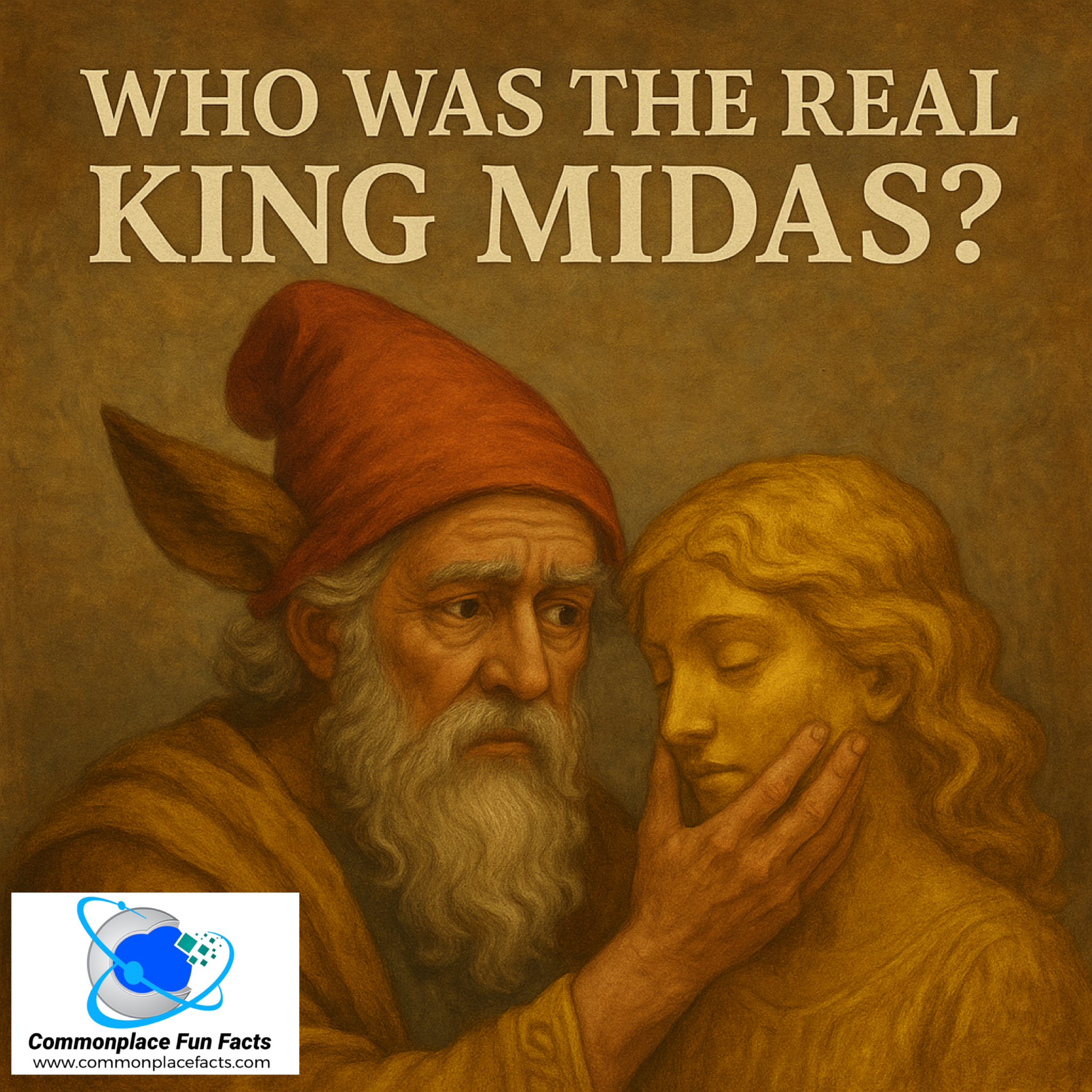

Some people leave behind a legacy of kindness, courage, or sweeping legislative reform. Others leave behind… glimmering side tables, an entire riverbed of gold dust, and at least one traumatized daughter turned into a priceless statue. Welcome to the world of King Midas—possibly the only historical figure who could’ve used a glove compartment full of wet wipes for his curse-riddled fingers.
We’ve all heard the tale: Midas, king of Phrygia, gets a wish from Dionysus, the party god with a drinking problem and zero impulse control. Shockingly, (as in “not at all shocking”), Midas’ political instincts tend toward what we’ll generously call “poor judgment.” He asks that everything he touches turn to gold. Hilarity—and tragedy—ensues. But here’s the question inquiring minds demand to know: was Midas a real person, or just a cautionary tale wrapped in shiny metaphor?
Contents
The Midas Myth in All Its Glittering Glory (and Floppy-Eared Folly)
First, let’s deal with the legend. In case you don’t know the story, it goes like this:

Once upon a time in the land of myth and questionable life choices, there lived a king named Midas. He ruled over Phrygia, loved a good feast, and apparently looked at his kingdom and thought, “You know what this place needs? Less common sense and more precious metal.”
According to the myth, Midas did a favor for the god Dionysus—rescued his extremely intoxicated buddy Silenus, which frankly sounds like a sitcom subplot waiting to happen. As a reward, Dionysus offered Midas one wish. Midas, blinded by visions of blinged-out thrones and 24-karat breakfast cereal, asked that everything he touched turn to gold. Dionysus, like a genie with no customer service department, granted the wish—no fine print, no returns.
At first, Midas was delighted. Trees turned to gold. Rocks turned to gold. His robes—solid gold. Then he tried to eat. Spoiler: gold bread is not part of a balanced breakfast. He touched his daughter—big mistake—and turned her into a very tragic, very shiny lawn ornament. Desperate, hungry, and one family member down, Midas begged Dionysus to undo the wish. The god told him to wash in the river Pactolus, which conveniently began carrying gold deposits ever since. Moral of the story? Be careful what you wish for, and never accept magical gifts from someone who drinks wine out of a goat bladder.

But wait—there’s more! Midas’s mythological résumé also includes a pair of donkey ears. After judging a musical contest between the god Apollo and the satyr Pan, Midas made the controversial (read: idiotic) decision to side with Pan. Apollo, who clearly never got the “graceful loser” memo, cursed the king with an extra-long set of animal ears. Midas did his best to hide them under a stylish Phrygian cap, but the secret got out—literally—when his barber whispered it into a hole in the ground. Reeds grew from the spot and started spilling the beans every time the wind blew. Ancient mythology: where even landscaping can’t keep a secret.
In short, King Midas’s myth reads like the result of a particularly chaotic game of Mad Libs: “This king gets rewarded by [god], but he wishes for [shiny object], ruins his [meal/daughter/life], and gets cursed with [animal feature] after losing a [talent show].” It’s part tragedy, part comedy, and all cautionary tale.
Wait—Was He Actually Real?
So much for the myth. But what about the real King Midas? Was there such a person?
Surprisingly, yes. Sort of. There was a historical figure who may have inspired the gold-plated fables. In the 8th century BC, Assyrian records refer to a powerful king named Mita of Mushki, ruling over Phrygia (in what’s now central Turkey). Mita was known for battling the Assyrians and making alliances with other regional powers. He was a real political player. He was also a real geo-political loser. His kingdom eventually fell to the invading Cimmerians, and legend has it, he drank bull’s blood to avoid capture. (Note to self: Investigate bull’s blood as a possible avenue of escape from awkward social situations and uncomfortable office parties.)
Greek historians, like Herodotus, also mention a King Midas who donated a throne to the Oracle of Delphi. And according to Julius Africanus, Midas lived until the ripe old age of 90—though how many of those years involved a cursed digestive system is not disclosed.
In 1957, archaeologists excavating the ancient city of Gordion (Phrygia’s capital) uncovered what may very well be the tomb of Midas—or at least his dad, King Gordias. Dubbed Tumulus MM (no, not a rejected James Bond villain), the tomb contained the remains of a man buried around 740 BC, along with the remnants of an absurdly lavish funeral banquet. We’re talking bronze cauldrons, fancy feasting vessels, and evidence of a last meal involving lentils, lamb stew, and a suspiciously unbalanced diet of fermented beverages. If this wasn’t Midas, it was someone close enough to borrow his bathrobe.
Digging Up the Truth—Literally
Let’s get this out of the way: no, Midas could not literally turn things into gold. If he could, we suspect inflation would’ve hit ancient Lydia a bit sooner. The stories—multiple, contradictory, and bizarre—are classics of Greek myth. In one, he ruins dinner by transmuting his bread into bullion. In another, he sprouts donkey ears as punishment from Apollo for having the musical taste of a rock. He then hides his cursed ears under a Phrygian cap, which, fun fact, later became the symbol of the French Revolution. (See? History is weirdly stylish.)
Even more recently, in 2024, archaeologists discovered a nearby burial mound (Tumulus T-26) filled with bronze artifacts, tools, and cremated remains believed to belong to the Phrygian royal family. While they haven’t found a body labeled “MIDAS, DO NOT TOUCH,” it’s strong circumstantial evidence that this royal lineage really lived, ruled, and feasted like gold-plated rockstars.
How Did the Myth Start? (Hint: It Involved a Lot of Shiny Stuff)
So how do you go from regional monarch with a flair for banquet hosting to the poster child for cursed golden finger syndrome? Like most legends, the myth of King Midas probably got a generous helping of historical exaggeration, a pinch of moral panic, and a solid coating of shiny confusion.

One very likely explanation? It was all that glittery metalwork. The Phrygians—Midas’s people—were metallurgical rock stars of their time. Archaeological digs at Gordion have turned up a treasure trove of bronze and brass artifacts so polished and radiant they could’ve been mistaken for actual gold. And let’s be honest, if you’re a wide-eyed visitor from across the Aegean and you walk into a banquet where every goblet, cauldron, and candlestick looks like it’s been dipped in molten treasure, you might just leave thinking the king had a literal golden touch.
In fact, some scholars think that Midas’s gleaming bronze—or possibly early brass—was the spark. These alloys, especially when freshly forged, can look a whole lot like gold to the untrained eye. That little detail, coupled with a reputation for wealth and maybe a bit of self-promotional Phrygian bling, could’ve set storytellers spinning.
Add in the usual Greek flair for turning “impressive” into “impossibly magical,” and boom: one misunderstood metallurgist becomes the stuff of myth. Suddenly, Midas isn’t just rich—he’s cursed. He isn’t just talented—he’s tragically flawed. And he’s definitely not drinking from a nice brass goblet—he’s starving to death because it turned into a solid ingot halfway to his mouth.
It’s the perfect blend of reality and rumor: a wealthy king with a fondness for metalwork, a foreign public dazzled by gleaming alloys, and an oral tradition just itching to turn practical craftsmanship into divine disaster. No sorcery required—just a kingdom full of high-shine cookware and an audience that hadn’t yet invented metallurgy textbooks.
It was fake news before they knew there was such a thing.
The Other Midas Myth: What’s With the Donkey Ears?
As if the golden touch debacle wasn’t enough PR trouble, King Midas also had to deal with a particularly undignified anatomical upgrade—donkey ears—under that famously fashionable Phrygian cap. And no, it wasn’t a style statement.
So where did this story come from? Some scholars suggest the donkey ears weren’t just a mean-spirited punchline. In Phrygian art, rulers and deities were sometimes shown wearing animal-themed headgear, possibly as a symbol of power or divine association. It’s possible that Greek observers saw representations of Phrygian rulers in ceremonial headdresses and assumed—because nuance wasn’t their strong suit—that those were literal ears. And just like that, a misunderstood fashion choice becomes a mythical embarrassment.
Whether metaphor, misinterpretation, or just another ancient PSA on the dangers of bad taste in music, the donkey ears myth adds one more wrinkle to the golden saga of Midas. He wasn’t just cursed with touchy fingers—he was also the original victim of a bad haircut, a gossiping swamp, and an unforgiving god with very high musical standards.
Fact Check Verdict
Was King Midas real? Mostly yes. Was he a gold-fingered disaster whose daughter needed de-statue-fying therapy? Hard no. The real Midas was likely a wealthy, powerful, and politically entangled king who got mythologized by storytellers with a taste for glitter and moral lessons. Still, his legacy lives on—in economics, idioms, and every parent who tells their kid, “Be careful what you wish for. Especially if it’s something you’d need oven mitts to survive.”
Fun Facts from the Vault
- The river Pactolus, said to have “washed away” Midas’s curse, was actually rich in electrum, a naturally occurring gold-silver alloy. Myth meets mineral deposit!
- The Phrygian cap, which hid Midas’s donkey ears, later became the symbol of liberty during the French Revolution. Viva la ear flap!
- The Midas tomb banquet included lentils, lamb, and mead. Honestly? Not a bad last meal.
- The “golden touch” trope inspired later stories, including Rumpelstiltskin, cursed treasure hoards, and the entire aesthetic of Donald Trump’s penthouse.
- Mansa Musa, the king who holds the record for being the wealthiest person in recorded history, gained his riches through salt instead of gold.
So the next time you think you’d like a golden touch, remember King Midas: real king, fake curse, and probably really bad at high-fives.
Would we still invite him to dinner? Only if he agreed to keep his hands—and musical opinions—to himself.
You may also enjoy…

The Real Sword in the Stone: How St. Galgano Went From Raucous Rogue to Saintly Sword Planter
Discover the true story of St. Galgano Guidotti, the knight who planted his sword in the stone as a symbol of peace and devotion. Explore his remarkable transformation, the Tuscan hermitage, and the history behind this real-life legend.

Henry Darger: The Mysterious and Mildly Terrifying Creator of In the Realms of the Unreal
Discover the bizarre and fascinating world of Henry Darger, a reclusive janitor who secretly created a 15,000-page epic filled with surreal battles, angelic heroines, and outsider art. Uncover the mystery behind In the Realms of the Unreal and its haunting legacy.

Treasury Heist Hoax: The Greatest Gold Theft That Never Happened
Discover the fascinating story behind the Treasury heist hoax, an elaborate April Fools’ Day prank that fooled newspapers worldwide in 1905. Learn how this hoax unraveled.




Leave a Reply