

The River Thames Frost Fairs: Making the Best of a Mini Ice Age
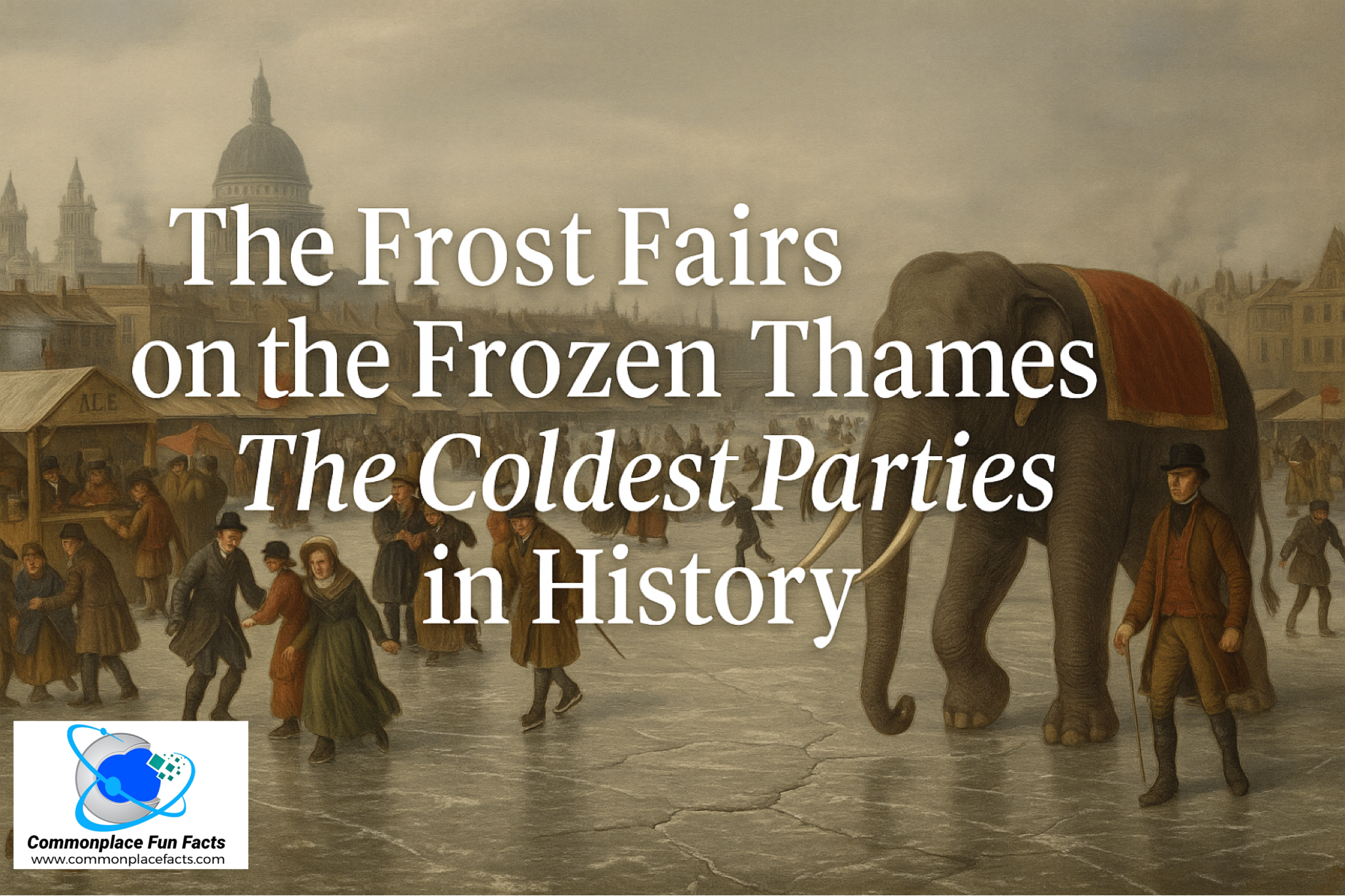
Imagine you are visiting London on a frosty January morning. You stroll down to the River Thames, expecting the usual scene of barges, muck, and the occasional whiff of Eau de Sewage—only to find London’s mighty waterway transformed into the city’s largest ice rink. We’re not talking about a little skim of ice around the edges, either. The whole river is frozen solid, thick enough to hold markets, taverns, puppet shows, and, if you hang around long enough, a full-grown elephant casually tiptoeing past Blackfriars.
Welcome to the River Thames Frost Fairs, where Londoners of the 17th and 18th centuries looked at a frozen river and thought, “You know what this needs? A roaring ox roast and a few souvenir printers.” When life hands you subzero temperatures, the only reasonable response is to throw the coolest block party in history.
Contents
A River Runs Cold: The Origins of the Frost Fairs
It is London during the 1600s. People are bundled up in layers that would make even the Michelin Man feel underdressed. The River Thames—usually a flowing artery of commerce and questionable sewage disposal—suddenly stops moving. That’s not a metaphor for traffic congestion; the river literally froze solid. This is the era of the Little Ice Age, a centuries-long cold snap that gave Europe its frosty winters, crop failures, and the occasional bonus of ice-locked rivers sturdy enough to party on.

The first officially documented “Frost Fair” hit the icy Thames in the winter of 1608. Londoners, never ones to waste an opportunity, quickly realized that a frozen river could serve as a ready-made festival ground. Imagine your morning commute route suddenly turning into a cross between a medieval carnival, a county fair, and your neighborhood street festival—minus the funnel cakes, but with a lot more roasted oxen.
Why the Thames? Well, at the time, the Old London Bridge had closely spaced piers that acted like giant ice-catchers, slowing the river’s current and encouraging it to freeze more easily. Pair that with colder winters, less industrial heat, and fewer embankments, and you had the recipe for a frozen stage set for merriment.
Cold Commerce: Markets on Ice
When life gives you ice, Londoners set up shop. Literally. During the Frost Fairs, stalls popped up along the frozen river selling everything from meat pies to toys. Blacksmiths lugged their anvils onto the ice, bakers set up ovens (because what could possibly go wrong with fire on ice?), and barbers offered haircuts in the middle of a glacier. Even printers hauled their presses out, producing commemorative keepsakes with cheeky lines like: “Printed on the River Thames, being frozen over.” Even back then, there was a compulsion to have a trinket that said, “I was there.”
Some of these keepsakes survive today, often browned and brittle with age, but still proudly declaring their origin. It’s as though the printers wanted to make sure that 400 years later, historians would know exactly how gullible people were during the winter of 1683.
Fairs, Fun, and Elephants on Ice
Perish any thought that these were your average “let’s build a snowman” winter days. Oh no. The Frost Fairs went big. Puppet shows entertained children, bear-baiting (because nothing says holiday cheer like animal cruelty) enthralled crowds, and makeshift taverns served up hot ale to keep frostbite at bay. Jugglers, acrobats, and musicians turned the Thames into an Elizabethan Cirque du Soleil—minus the health and safety regulations.
And yes, there really was an elephant. During the great freeze of 1814—the last hurrah of the Frost Fairs—an enterprising showman paraded a full-grown elephant across the ice at Blackfriars. It was the Georgian equivalent of a viral TikTok stunt: dangerous, attention-grabbing, and guaranteed to get people talking. In case you were wondering, yes, the ice held. For once, physics cooperated with publicity, and the elephant became the most famous European pachyderm since Pope Leo’s celebrated pet elephant, Hanno.
If elephants weren’t your thing, you could watch oxen being roasted whole, gamble on dice, or enjoy impromptu sporting matches. One account even mentions people bowling on the ice, proving that Brits will bowl under literally any circumstances.
When Royals and Commoners Walked on Ice

One of the charms of the Frost Fairs was the way they leveled—quite literally—the playing field. Kings, dukes, merchants, and chimney sweeps all found themselves slipping and sliding on the same icy stage. King Charles II reportedly strolled the Thames during the great freeze of 1683–84, mingling with his subjects and probably buying something ridiculous like an ice-baked pie or commemorative mug. Samuel Pepys, everyone’s favorite nosy diarist, also noted the scene with delight.
The fairs became a social mixer where classes rubbed elbows—sometimes quite literally when someone fell over and took three other people down with them. It was one of the rare occasions where Londoners of all walks of life gathered together for fun, rather than plague, fire, or political unrest.
Cold Comfort: The Perils of the Ice
Of course, skating on the Thames wasn’t all roasted oxen and elephant parades. Ice is fickle, and the Thames could be treacherous. Accounts survive of booths collapsing as cracks spread beneath them, sending unlucky vendors (and their wares) plunging into the frigid waters. At least one diarist in 1608 noted that “divers persons fell in, some were drowned, others recovered again.” Nothing kills a carnival vibe faster than unexpected hypothermia.
Even when the ice held, it wasn’t exactly smooth. Imagine centuries of sewage, debris, and London’s finest industrial runoff frozen into lumpy ridges. Walking on it was more obstacle course than ice rink, but that didn’t stop thrill-seekers from venturing out in droves.
Frost Fairs in Literature and Art
The Frost Fairs weren’t just an Instagrammable moment before Instagram was a thing—they also inspired poets, diarists, and artists. John Evelyn, a contemporary of Pepys, described the 1683–84 fair in detail, calling it “a bacchanalian triumph, or carnival on the water.” Later artists produced engravings of the bustling stalls, the smoke of roasting fires, and the tiny figures skating or stumbling across the ice. Some paintings even romanticized the fairs, showing elegant figures gliding gracefully, though one suspects the reality involved more slipping, bruises, and swearing.

Writers later looked back with nostalgia. Charles Dickens, though born too late to see a Frost Fair in person, invoked the frozen Thames in his works as part of the winter landscape of old London. To Victorians, the Frost Fairs were already legendary—a half-remembered wonder from the days when community events warmed Londoners out of their icy moods.
Why the Party Stopped: Warming and Engineering
So why don’t Londoners throw Frost Fairs anymore? Climate change, for one. Yes, the climate has changed many times, even before anyone thought to make anyone feel guilty about it. The end of the Little Ice Age in the 19th century meant milder winters. But human engineering deserves credit—or blame—as well. When the old London Bridge was replaced in 1831 with a design that allowed freer water flow, the river’s current sped up, making it less likely to freeze. Add in embankments that narrowed and deepened the Thames, and the icy days were done.
The last full Frost Fair took place in the winter of 1813–14. That one featured the famous elephant stunt, along with plenty of food stalls and printers still gamely stamping “Printed on the Thames” onto souvenirs. After that, the river occasionally froze in patches, but never again thick or long enough to sustain a carnival. The Thames retired its frosty party hat for good.
Legacy: Memories on Ice
Though gone for two centuries, the Frost Fairs left an enduring cultural mark. Today, you can find prints, coins, and pamphlets produced on the Thames preserved in museums. They stand as testament to human ingenuity, opportunism, and perhaps mild insanity—because really, who looks at a frozen sewage-laden river and says, “Perfect place for a puppet show”?
Modern Londoners sometimes joke about the idea of a Frost Fair returning. During the famously cold winter of 1963, the Thames froze at Teddington, though not in central London. People nostalgically wondered what it would be like if Frost Fairs could come back. In reality, between climate change and urban development, you’re more likely to find hipster pop-up markets on rooftops than on frozen rivers.
Conclusion: A Toast to London’s Frosty Feats
So there you have it: a slice of history equal parts chilly and charming. The Frost Fairs transformed a frozen river into the ultimate winter carnival, where kings and chimney sweeps mingled, printers marketed icebound souvenirs, and elephants took improbable strolls across ice that had no business holding them. They remind us that people have always sought joy and novelty, even in the harshest of winters. And if nothing else, the Frost Fairs prove that Londoners never let a little thing like a frozen river stop them from throwing a good party.
You may also enjoy…

Relive the Wonder of the 1893 Chicago World’s Fair
In 1893, Chicago threw a big party in honor of the 400th anniversary of Christopher Columbus’ voyage to the New World. It was a spectacular affair. For five months, people from all over the world flocked to Chicago to take in the sights, which included such things as the first Ferris Wheel, cultural exhibitions, lectures,…

Sweet Beginnings: How the 1893 World Fair Revolutionized Your Snack Drawer
The 1893 World Fair in Chicago revolutionized snacks, introducing iconic treats like brownies, Juicy Fruit gum, and Cracker Jack. Socialite Bertha Palmer inspired the brownie, while William Wrigley Jr. launched Juicy Fruit, sparking a candy branding boom. Milton Hershey’s discovery of chocolate machinery led to his chocolate empire, creating a lasting culinary legacy.

The Strange Case of Mrs. Prodgers — The Terror of London Cabmen
Caroline Giacometti Prodgers, an infamous figure in 1890s London, gained notoriety as the Terror of London Cabbies for her relentless legal battles against cab drivers, filing over 50 lawsuits. Known for her dramatic courtroom antics, she became a symbol of consumer advocacy and garnered both fear and ridicule from cabbies. Her death in 1890 was…




Leave a Reply to Herald StaffCancel reply