
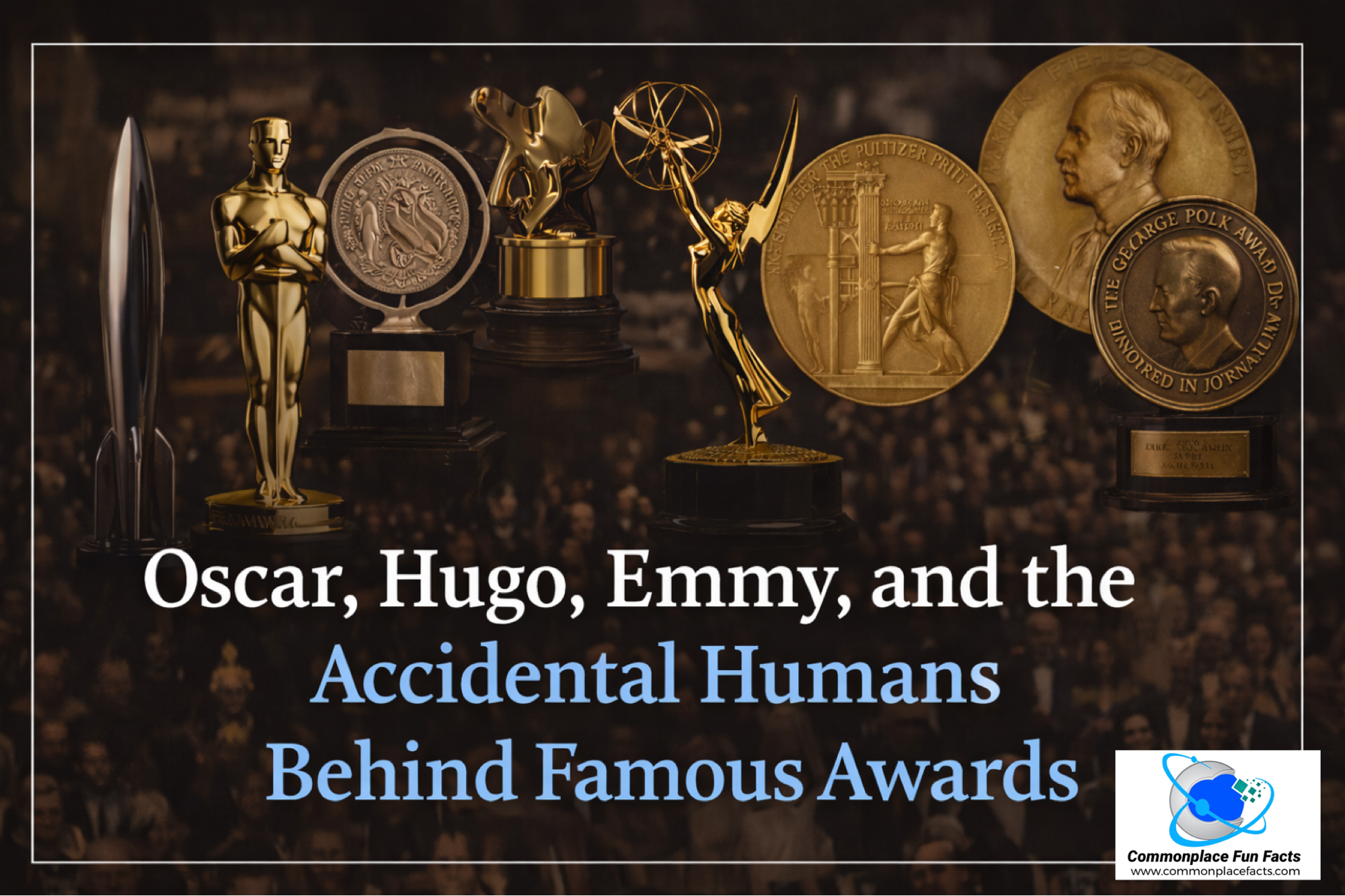

Award Names Explained: Who Was Oscar? Who Was Emmy?
Awards have a way of presenting themselves as eternal objects. They arrive fully formed, already prestigious, already unquestioned, as though they emerged from a mountain in a beam of ceremonial light while a committee nodded solemnly nearby.
Most of the time, we don’t pause to ask a very basic question: named after who, exactly?
Because beneath the gold plating, beneath the prestige, beneath the acceptance speeches written on cocktail napkins in a state of mild panic, many of the world’s most famous awards are named after actual human beings. People who existed. People who had opinions. People who were sometimes admirable, sometimes irritating, and occasionally so complicated that the award now functions as an ongoing rehabilitation project.
This is the story of those people. Or at least the parts of their stories polite ceremonies rarely mention.
Contents
Who Was Oscar? A Person Who May or May Not Have Existed
Let’s begin with the most famous award name of all—and immediately establish that it is, technically speaking, nonsense.

The Academy Award of Merit is not officially named after a person. The statuette is simply called “Oscar,” in the same way you might name a stapler or a Roomba and then slowly forget why.
The most widely accepted origin story is that Margaret Herrick, a librarian at the Academy, looked at the statue and remarked that it resembled her uncle Oscar. The Academy, upon hearing this, spent several years pretending they had never heard such a thing. Eventually, everyone collectively gave up and allowed the name to fossilize.
There may have been an uncle Oscar. There may not have been. What matters is that an offhand comment became permanent branding, which is also how most traditions start.
The result is an award that sounds personal, venerable, and intimate, but is actually named after a resemblance noticed one afternoon by someone who did not expect history to overhear.
Who Was Hugo? The Award Writers Love Despite Everything
The Hugo Awards are named for Hugo Gernsback, a man widely credited with helping invent science fiction as a recognized genre.

This is absolutely true.
It is also true that many science fiction writers regarded him as a nightmare employer who paid poorly, published aggressively, and possessed a talent for irritating people who needed to eat.
Gernsback’s contribution was structural. He created magazines devoted entirely to speculative fiction at a time when such stories were otherwise treated as literary hitchhikers. In his spare time, he also invented more than 80 gadgets that seemed to fit within the realm of the stories he published. He gave the genre a name, a home, and a readership.
He also gave writers reasons to unionize.
The irony of the Hugo Awards is that they celebrate imagination, creativity, and artistic freedom while bearing the name of a man whose business practices made those things slightly more difficult. This contradiction has never been resolved, largely because science fiction fans are comfortable holding conflicting truths at the same time.
Who Was Emmy? A Trophy Named After a Machine

The Emmy Award sounds like it should be named after someone. It is friendly. It is familiar. It could belong to a beloved aunt.
It is, instead, named after a television camera tube.
The Image Orthicon camera tube—nicknamed the “Immy”—was a breakthrough in early television technology. At some point, “Immy” was polished into “Emmy,” possibly because awards committees instinctively personalize abbreviations when unsure what else to do.
This means the Emmy is not named after a person, but after a piece of equipment that allowed television to function long enough to create awards shows about television.
It is the television equivalent of honoring the microphone while ignoring the speaker. Which, if we’re honest, would frequently improve the ceremonies.
Joseph Pulitzer and the Long Game of Redemption
Joseph Pulitzer was a newspaper publisher who helped shape modern journalism. He believed in mass circulation, bold headlines, and stories that grabbed attention with both hands.

He also helped popularize yellow journalism, which has since become the journalistic equivalent of a phase everyone insists they grew out of.
The Pulitzer Prizes exist largely because Pulitzer wanted his legacy to land somewhere slightly north of “irresponsible but influential.” He endowed the prizes late in life, tying his name permanently to journalistic excellence, ethical reporting, and literary achievement.
It worked.
Very few people associate the Pulitzer name with sensationalism anymore. Instead, it has become synonymous with seriousness, credibility, and institutional respect. This makes the Pulitzers perhaps the most successful rebranding campaign in media history.
Who Was Tony? Antoinette Perry and Why Theater Loves Its Administrators

The Tony Awards are named after Antoinette Perry, an actress, director, producer, and co-founder of the American Theatre Wing.
Perry was deeply influential in American theater, particularly behind the scenes. She organized, supported, and advocated for theatrical work at a time when the infrastructure mattered as much as the talent.
Theater, uniquely among the arts, understands the importance of honoring someone who kept the lights on.
Also, “Tony” sounds friendly. This helps when a ceremony stretches past midnight.
Alfred Nobel and the Ultimate Course Correction
Alfred Nobel invented dynamite and made a considerable fortune doing so. He also accidentally read his own obituary while still alive.

According to legend, although impossible to verify, a French newspaper mistakenly reported Nobel’s demise and described him as a merchant of death.
If true, Nobel responded to this experience the way few humans ever have: by funding a set of international prizes dedicated to peace, science, literature, and the betterment of humanity.
The Nobel Prizes are the result of one man deciding his Wikipedia page was headed in the wrong direction.
They remain the gold standard for intellectual achievement, partly because they are fueled by a uniquely powerful motivator: existential regret.
The Children’s Book Awards Named After Publishers, Not Authors
The Newbery Medal and the Caldecott Medal honor excellence in children’s literature and illustration, respectively.
Neither is named after a children’s author.
John Newbery was an 18th-century publisher who helped popularize books written for children rather than books children were merely expected to endure. Randolph Caldecott was a Victorian illustrator whose work influenced visual storytelling long before modern picture books existed.
These awards reflect a recurring theme in cultural history: the people who build the platform often outlive the people who perform on it.
George Polk and the Awards That Come With Actual Consequences
Most awards are essentially a fancy way of saying, “Congratulations, the committee enjoyed your work, and now here is a shiny object that will live on your bookshelf until your heirs donate it to Goodwill.”
The George Polk Awards have a different energy.
They’re presented annually by Long Island University, and they exist because George Polk—a CBS News correspondent—was murdered in March 1948 while reporting on the Greek Civil War. In 1949, the awards were established in his memory, which gives them a weight that most trophies can only dream of achieving.
The point of the Polk Awards is to honor serious journalism: investigative reporting, accountability work, stories that require stamina, receipts, and the willingness to make powerful people furious. These are not “nice job, everyone” awards. These are “someone took a real risk to drag the truth into daylight” awards.
Also, because the universe enjoys bureaucratic confusion, there was another “George Polk Award” given by the Overseas Press Club from 1948 to 1973, which is not the same thing as the George Polk Awards in Journalism that exist today. So if you ever find yourself in an argument about which Polk award someone won, congratulations: you have become the kind of person who needs to go outside and look at a tree for a while.
The Quiet Philanthropists: Peabody, Lilly, and MacArthur
Several major awards are named after philanthropists whose primary qualification was deciding that money should do something useful.

George Foster Peabody supported education and public service. Ruth Lilly used inherited pharmaceutical wealth to support poetry. John D. MacArthur transformed insurance money into unrestricted creative freedom.
These awards share a common trait: their names are unfamiliar to the general public, while their legacies are everywhere.
This is the best-case scenario for a benefactor.
Conclusion: Prestige Is Mostly Just Time Doing Its Thing
Awards feel timeless because repetition hardens them into ritual. Names stop sounding like names and start sounding like concepts.
Oscar stops being an uncle. Nobel stops being an inventor with regrets. Pulitzer stops being complicated.
But none of these awards emerged from a vacuum. They are artifacts of specific moments, specific people, and specific decisions—often made quickly, argued over briefly, and then accepted forever.
The next time someone thanks an award, it’s worth remembering that behind the name is a human story. Possibly an awkward one. Possibly a redemptive one. Possibly a camera tube.
Prestige, like tradition, is often just a coincidence that stuck.
You may also enjoy…

How to Hide a Nobel Prize: The Incredible WWII Story of Gold, Acid, and Survival
Learn how two Nobel Prizes were dissolved in acid during WWII to hide them from the Nazis—and how chemistry saved gold meant for peace.

IG Nobel Prize Honors the Wild Discovery That Some Mammals Can Breathe Through Their Anuses (And Other Breakthroughs In Quirky Science)
The IG Nobel Prizes celebrate quirky and humorous scientific achievements, addressing unusual questions and offering entertaining insights. This year’s winners included studies on mammal respiration, pigeon missile navigation, and plant imitation. The awards feature absurd demonstrations, while winners received symbolic prizes, highlighting the amusing side of scientific inquiry and curiosity.

The Medal of Honor: History, Facts, and Stories of America’s Highest Military Award
Discover the history, types, and remarkable recipients of the Medal of Honor. Learn about the bravery behind America’s highest military award and its enduring legacy.





Leave a Reply