
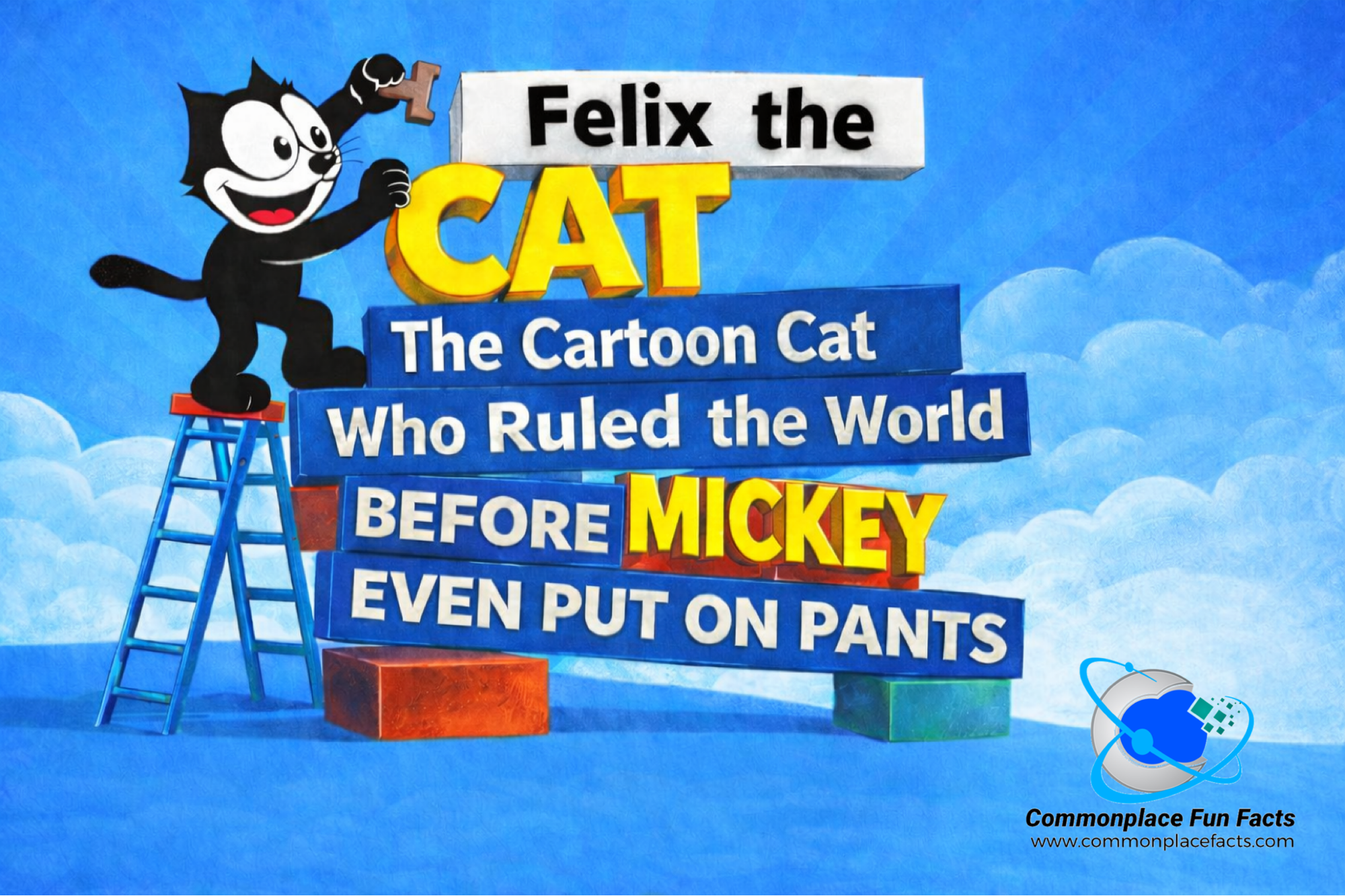

Before Mickey Mouse became the corporate rodent emperor of global entertainment, before Bugs Bunny started asking Doc what was up, and before Saturday morning cartoons trained generations of children to consume sugar and advertising in equal proportions, there was Felix the Cat.
Felix was not merely an early cartoon character. He was the cartoon character for a while. In the 1920s, this grinning black cat was one of the most famous entertainment figures on the planet. He was on movie screens, in newspapers, on merchandise, in popular culture, and, at one point, even helping engineers figure out television. That’s a fairly respectable résumé for a cat whose main qualifications were a tail, a smile, and an ability to turn existential despair into slapstick.
Today, Felix sits in that strange historical category reserved for people and things that were once wildly famous and are now remembered mostly by historians, animation nerds, and the occasional person who sees his face on an old sign and thinks, “Wait, I know that cat from somewhere.” He deserves better than that. Felix was a pioneer, a superstar, a merchandising phenomenon, a technology innovator, and one of the key figures in the development of modern animation.
In other words, he was kind of a big deal.
Contents
The Cat Arrives
Felix first emerged in 1919 in a short film called Feline Follies. At that point, he was not yet fully Felix in the polished, iconic sense. He was more like the rough draft of greatness, which is how many legends begin. The first version of the character was called “Master Tom,” a name that sounds less like a future animation icon and more like the guy who teaches martial arts classes to pre-schoolers.
The character quickly evolved. Before long, the cat had become Felix, and audiences took to him immediately. This was not terribly surprising. Silent-era animation was still finding its feet, and Felix had something many early cartoon characters lacked: personality. He was clever, expressive, mischievous, resilient, and weird in exactly the way good cartoon characters need to be weird.
He could take a bad situation, twist the laws of reality into a pretzel, and improvise a solution using whatever happened to be nearby. If nothing useful was nearby, that was fine too. In a Felix cartoon, an object could become useful simply because the gag required it. His tail could turn into a tool. A question mark could become a cane. Despair itself could probably be folded into a ladder if the scene needed one. Felix lived in a universe where matter was flexible, logic was optional, and commitment to the bit was absolute.
So Who Actually Created Felix?
Now we arrive at one of the great entertainment-history arguments: who deserves the credit for creating Felix the Cat?

The traditional answer for many years was Pat Sullivan, the owner of the studio that produced the cartoons. During his lifetime, Sullivan received the official credit, and the films were promoted under his name. If one stopped there, the story would be simple, tidy, and suspiciously convenient for the man who owned the company.
The more complicated answer involves Otto Messmer, the lead animator most often credited by later historians as the real creative force behind Felix. Messmer said he animated the first Felix films and shaped the character’s personality and style. After Sullivan’s death, more and more people in the animation world pointed to Messmer as the true artistic creator.
This is a familiar story in entertainment history. One person owns the studio, another person creates the magic, and history spends the next century arguing over who gets the halo. The safest summary is that Sullivan owned the operation and took public credit, while Messmer appears to have been the man who actually gave Felix his distinctive life on screen.
That may sound like an unsatisfying answer, but entertainment history is full of those. After all, this is an industry that can take a blockbuster earning millions and, through a bit of accounting alchemy, declare it a financial disappointment. Compared to that, turning the question of authorship into a foggy, decades-long debate is practically a warm-up exercise.
Why Felix Took Off
Felix became the first great cartoon superstar because he arrived at exactly the right time and did exactly the right things.
For one thing, he was instantly recognizable. His design was simple and bold: a black body, oversized white eyes, and a silhouette that read clearly even in the visual limitations of early film. This was practical for animators, but it was also brilliant branding. Felix was easy to draw, easy to identify, and impossible to mistake for anybody else.
More importantly, he had charisma. Lots of early cartoon characters behaved like moving doodles. Felix behaved like a personality. He reacted, schemed, sulked, improvised, and triumphed in ways that gave him the appeal of a silent-film comedian. There is more than a little Charlie Chaplin in Felix, and that’s a quality that cannot be overstated. If you are going to borrow energy from somebody, borrowing from one of the greatest screen performers of the age is not the worst plan.

Felix also benefited from the fact that animation could do things live-action film could not. A live-action star had to obey gravity, architecture, and basic human anatomy. Felix did not. He could literally reshape the world around him. His cartoons leaned into visual absurdity in ways that still feel inventive today. The medium itself became part of the joke, and Felix was the ideal guide for this strange elastic universe.
Audiences loved him because he was funny, but also because he embodied something that made animation feel new. He was not just a character who happened to be animated. He was a character who could only fully exist through animation.
Felix Becomes a Global Celebrity

By the early 1920s, Felix was everywhere. His popularity spread well beyond movie theaters. A newspaper comic strip launched in 1923, helping carry the character into homes on a regular basis. His face appeared on all sorts of merchandise, and his fame became international. This was long before media conglomerates turned cross-platform branding into an Olympic event. Felix was doing it in the age of silent film, when global fame required more than a viral tweet and an apology video.
During the same time that Jackie Coogan became the biggest child star in history (up to that point, anyway), Felix the Cat was becoming one of the earliest examples of a cartoon character functioning as a true celebrity brand. That may not sound unusual now, because modern society has been thoroughly trained to expect every fictional character to appear on shirts, mugs, breakfast cereal, streaming services, and probably one limited-edition sneaker drop. Felix was doing a version of that before most of the entertainment industry had fully grasped what was possible.
He was not just successful. He was foundational.
The Strange and Wonderful Logic of Felix Cartoons
One of the reasons Felix remains so fascinating is that his best silent-era cartoons are gloriously unhinged.
This is not criticism. It is praise.
The world of Felix the Cat does not behave like ours. It behaves like a dream after eating questionable cheese. Felix can pull ideas out of nowhere, manipulate scenery as though the environment were made of stage props, and navigate a reality that seems to have been written by a committee composed entirely of practical jokers and sleep-deprived philosophers.
That surreal elasticity was a huge part of the appeal. In Felix cartoons, a problem was never just a problem. It was an invitation for a visual gag. Hunger might become a hallucination. Desperation might become architecture. A chase scene might suddenly invent new laws of physics and then ignore them ten seconds later. The stories often feel less like narratives in the modern sense and more like a prolonged, memorable lucid dream.
That quality made Felix deeply influential. Later animated characters would refine, expand, and industrialize these techniques, but Felix helped demonstrate how animation could create a comic reality unlike anything available in live action. He was one of the earliest stars to fully exploit the medium’s potential for visual invention.
Then Sound Showed Up and Ruined Everything
As so often happens in history, a king can be dethroned by technology.
Felix ruled the silent era, but the arrival of synchronized sound changed the entertainment industry at high speed. Walt Disney and Mickey Mouse rode that wave brilliantly. Steamboat Willie in 1928 did not simply introduce a new character. It introduced a new standard. Suddenly, animation was not just about motion and gags. It was about sound, rhythm, timing, and novelty.
Felix’s studio was slower to adapt, and that delay proved costly. A silent star in a sound world can start to look like yesterday’s news with brutal speed. Felix did make the transition to sound, but not with the same impact or innovation as Disney’s productions. By the 1930s, the cat who had once dominated the field was losing ground fast.
It is one of the more dramatic shifts in entertainment history. Felix went from top of the mountain to struggling veteran in what was, historically speaking, about five minutes and a trumpet fanfare.
The Television Detour
If Felix’s story ended there, it would still be important. But Felix, being Felix, managed to remain culturally useful in wonderfully odd ways.
One of the most charming chapters in his history is his role in early television testing. Engineers needed an image with strong contrast and stable features so they could experiment with transmission and picture quality. Felix, with his bold black-and-white design, turned out to be ideal for the job. A Felix figure was used in experimental television broadcasts, making him one of the first images associated with the development of TV.
In this way, Felix was not merely a movie star. He was, in a very literal sense, part of the technical team to help television work through its awkward toddler years.
The 1950s Revival and the Magic Bag of Tricks
Felix returned to prominence in the television era through a new cartoon series beginning in the late 1950s. This revival introduced what became one of the defining elements of the later character: the Magic Bag of Tricks.
This bag could transform into whatever Felix needed, which was handy both for the stories and for anyone writing episodes on a deadline. Need a boat? The bag can do that. Need a parachute, a hammer, or something that appears to be violating three known laws of physics? The bag has you covered.
The TV show also introduced one of classic television’s catchiest theme songs:
Felix the Cat, the wonderful, wonderful cat.
Whenever he gets in a fix, he reaches into his bag of tricks.
Felix the Cat, the wonderful, wonderful cat.
You’ll laugh so much your sides will ache.
Your heart will go pit-a-pat
Watching Felix the wonderful cat.
The revived version of Felix was different from his silent-era incarnation. He was generally softer, more domesticated, and more overtly aimed at children. Some of the anarchic strangeness of the early films gave way to a cleaner, more formula-driven television style. That did not make the revival unimportant. It simply meant Felix had changed with the times, which is what old stars do when they hope to survive another generation.
Not every reinvention preserves the original spark. Then again, not every reinvention gets 260 television cartoons and a second life in pop culture. Felix did all right.
Felix and the Business of Being Famous
Another reason Felix matters is that he helped establish the economic model for cartoon fame.
He was one of the first animated characters to prove that the character itself could be the product. The films mattered, of course, but so did the comics, the licensing, the mascots, the merchandise, and the promotional uses. Felix was not just a series of cartoons. He was intellectual property before that phrase became powerful enough to make studio executives levitate six inches off the floor.

His image was used in advertising. He became associated with public landmarks. He was adopted as a mascot in various settings. He moved beyond the screen into the broader culture in a way that now feels normal but was much more novel at the time.
That matters because it helped pave the way for the entire character-based entertainment economy that followed. Felix walked so countless other mascots, sidekicks, princesses, superheroes, and talking sponge-based entities could run.
Why Felix Faded from the Center of Popular Memory
Felix remains respected, but he is no longer the household-name colossus he once was. Why?
Part of the answer is simple chronology. The entertainment world changed, and other characters became more dominant. Disney built a machine. Warner Bros. built another. Television multiplied the number of iconic characters competing for attention. Over time, Felix became less a living giant and more a revered ancestor.
Another reason is that his greatest work belongs to the silent era, which many modern audiences encounter only in fragments, if at all. Silent films can feel remote to people who have been raised on digital editing, surround sound, and plots designed to be resolved during the attention span of a squirrel with ADHD. Felix’s genius is still visible, but it sometimes requires a little historical imagination from the viewer.
That is unfortunate, because once you see the best Felix cartoons with the right eyes, it becomes obvious how much later animation owes him. He helped build the grammar of cartoon storytelling. He showed how design, movement, personality, and absurdity could fuse into a form of comedy that belonged uniquely to animation.
He was not a side note. He was one of the original architects.
Why Felix Still Matters
Felix the Cat matters for the same reason many pioneers matter: later figures became more famous by refining what he had already helped invent.

He proved that a cartoon character could carry a personality strong enough to sustain audience loyalty. He demonstrated that animation could create visual jokes beyond the limits of live action. He showed that a simple design could become a powerful brand. He helped normalize the idea that a cartoon star could leap from films to comics to merchandise to broader cultural symbolism. He even found time to assist with television experiments, because apparently being a major animation pioneer was not enough work already.
Most of all, Felix still matters because he is funny. That sounds almost too obvious, but it is worth saying. Historical significance is nice. Innovation is important. Cultural influence is admirable. None of that would have mattered much if Felix had not also been entertaining. The reason he conquered the 1920s was not because audiences sat around admiring his role in media history. It was because he made them laugh.
That smile, those eyes, that ability to improvise his way through a reality made of nonsense and inconvenience—that was the magic. Everything else came later.
Fun Facts About Felix the Cat
- Felix first appeared in 1919, which means he predates Mickey Mouse by nearly a decade. He was already a major star while Mickey was still waiting to be invented.
- The earliest version of Felix was called “Master Tom,” proving that even legendary characters sometimes begin with a name that sounds like a third-tier Victorian magician.
- The debate over who created Felix is still one of animation history’s great arguments. Pat Sullivan got the official credit for years, but many historians now point to animator Otto Messmer as the real creative genius behind the character.
- Felix became one of the first truly global cartoon celebrities, with films, comics, merchandise, and licensing deals spreading his image far beyond movie theaters.
- A Felix comic strip began in 1923, helping keep the cat in front of readers between film appearances and expanding his popularity even more.
- Felix’s bold black-and-white design made him ideal for early television testing, and a Felix figure was used in experimental TV broadcasts. Yes, one of the early stars of television was a cat made for silent cartoons. Media history is delightful.
- The later TV version of Felix popularized his Magic Bag of Tricks, a shape-shifting bag that could become almost anything he needed. It was basically cartoon convenience wrapped in fabric.
- Felix was so famous that his image was used as a mascot and promotional figure in several contexts, including one of the best-known old commercial signs in Los Angeles.
- Although Felix faded from the very center of pop culture, he never entirely disappeared. He has been revived, rebooted, merchandised, referenced, and rediscovered repeatedly over the decades.
- Without Felix, the history of animated stardom would look very different. He was one of the first characters to prove that an animated figure could become a cultural institution.
Final Thoughts

Felix the Cat is one of those figures who can seem quaint until you look more closely. Then you realize you are staring at one of the load-bearing walls of popular entertainment.
He was a silent-film icon, a merchandising pioneer, a comic-strip star, a technological test image, and an enduring character whose influence far exceeds his current level of fame. He helped define what cartoon stardom could be before the entertainment industry had fully figured out how to mass-produce it.
That alone would make him worth remembering. The fact that he did it all while grinning like he knew he was ten steps ahead of everyone else just makes him more impressive.
Felix was not merely an old cartoon.
He was the prototype for the whole circus.
You may also enjoy…

The Katzenjammer Kids: America’s Longest-Running Comic Strip and Its Very Weird History
Meet The Katzenjammer Kids: the 1897 comic strip that pioneered comics, survived a courtroom battle, and turned child misbehavior into an art form.

Meet the Phantom: the World’s First Superhero
Editor’s Note: Subsequent to the publication of this article, we were made aware of The Golden Bat, who possibly has a better claim on the distinction of being the world’s first superhero. Be sure to read Unveiling the Golden Bat: The First Superhero? While many people assume Superman was the first superhero, fandom actually owes…

Grawlix, Plewds, and Briffit: the Literary Language of Cartoons and Comic Strips
Ever hear of “grawlix” “briffit” “plewds” or “nittles”? Welcome to the weird world of comic strip and cartoon vocabulary.






Leave a Reply to sopantoothCancel reply