
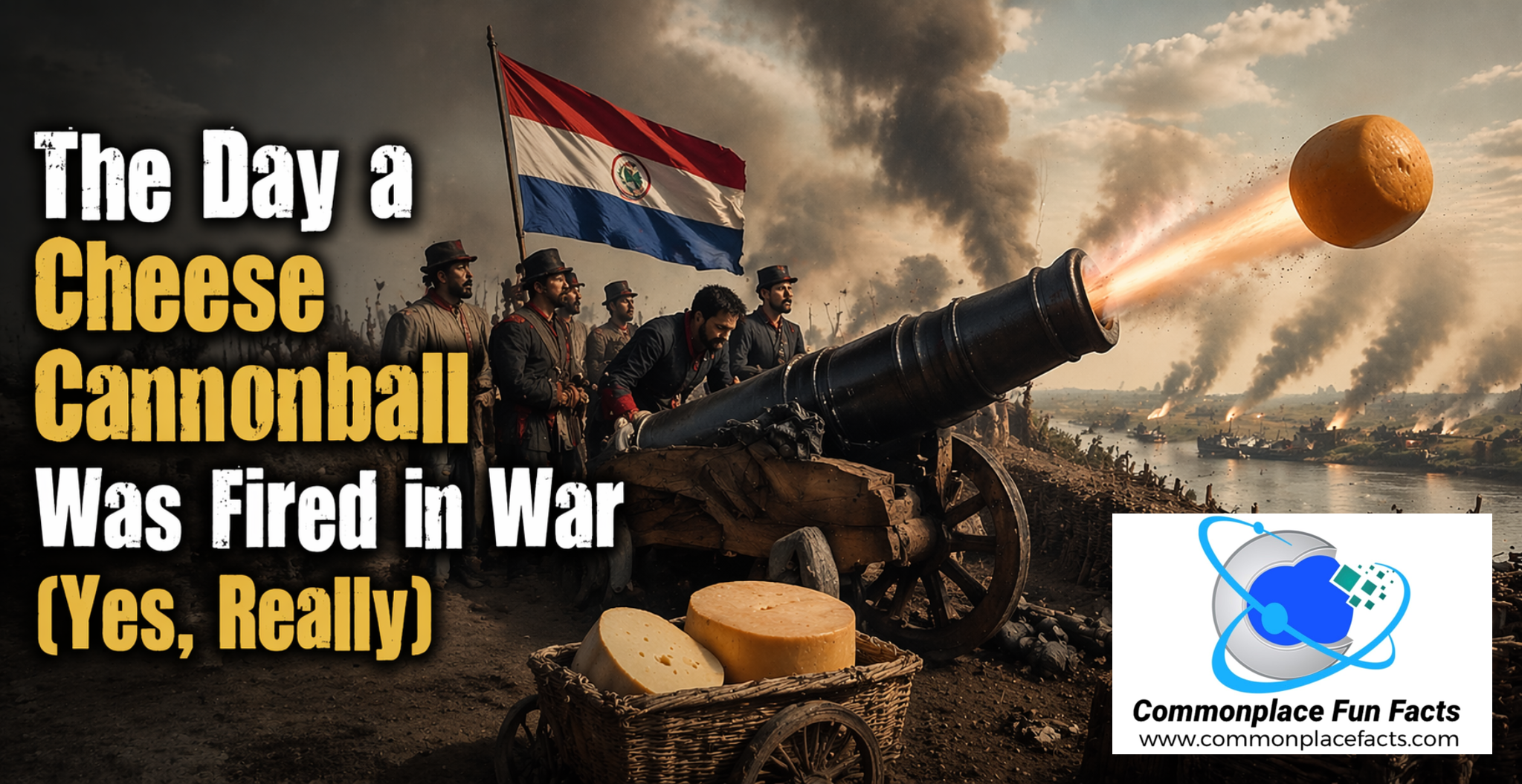

There are moments in history when you pause, reread the sentence, and briefly question whether the historian involved had access to strong drink. Then you confirm the sources and realize, no, this is simply what happened. One of those moments involves a war in the 1860s, a shortage of ammunition, and the decision—made with what we must assume was complete sincerity—to fire a cheese cannonball at the enemy.
This was not a metaphor. It was not a nickname. It was not a clever bit of satire slipped into the historical record. It was, quite literally, a cannonball made of cheese, launched with the full expectation that it would solve a problem. One imagines this was considerably more alarming for anyone on the receiving end, particularly if they happened to be lactose intolerant and suddenly found themselves under dairy-based bombardment.
As improbable as it sounds, the cheese cannonball is not an isolated curiosity. It is part of a larger story involving a war that escalated far beyond its original scope, leaders who made bold decisions with questionable outcomes, and soldiers who demonstrated that when supplies run out, creativity tends to fill the gap—sometimes in ways no one saw coming.
Contents
Setting the Stage: A War That Escalated Quickly
The story begins with a regional conflict involving Brazil and Uruguay in the mid-1860s. Uruguay, at the time, was experiencing what could generously be described as “political disagreement” and more accurately described as a civil war between rival factions.
Brazil intervened. Argentina took an interest. Paraguay, under the leadership of Francisco Solano López, decided that the appropriate response was to declare war on essentially everyone within convenient marching distance.
This chain of events escalated into what became the Paraguayan War (1864–1870), one of the most devastating conflicts in the history of South America. Entire populations were reshaped, economies were shattered, and geopolitical alliances were rewritten.
And somewhere in the midst of all that, someone loaded cheese into a cannon.
The Cheese Cannonball: Improvisation Meets Lactose
Let us address the dairy-based projectile directly, because that is why we are all here.
During one of the engagements involving Brazilian forces, supplies were running low—including ammunition. Necessity is the mother of invention, particularly in the middle of combat. Faced with this inconvenient reality, soldiers turned to what was available.

What was available, as it turned out, was cheese.
Not the soft, spreadable variety you might pair with crackers, but hardened, stale cheese—dense enough to be shaped and fired. When sufficiently dried, cheese becomes surprisingly solid. Not ideal for artillery, but certainly capable of traveling at speed and making an impression upon impact.
It was, in essence, the 19th-century equivalent of looking around the room and asking, “What here can be weaponized?”
The answer, on that day, was dairy.
No one is suggesting that cheese replaced standard ammunition or that military manuals were updated to include a section on “Edible Ordnance.” This was improvisation in its purest form—a solution born of necessity, creativity, and a willingness to test the boundaries of both physics and a healthy diet.
At this point, a reasonable person might ask whether the cheese cannonball actually did any damage, or if it was simply history’s most aggressive dairy experiment. The honest answer is that there is no reliable record of it causing any meaningful destruction. No ships were sunk, no fortifications reduced to rubble, and no battlefield outcomes appear to have hinged on the tactical deployment of aged cheddar. From a purely scientific standpoint, this is not surprising. Cheese, even when hardened to a consistency best described as “weapon-adjacent,” lacks the density and durability of iron. The most likely result is that it flew, perhaps impressively, and then did what cheese does under stress—it gave up. Its true impact, therefore, was not on the battlefield, but on posterity, where it continues to hold the prestigious title of history’s most memorable misuse of a snack.
War, But Make It Improvised
The cheese cannonball was not an isolated example of unusual problem-solving. If anything, it was emblematic of the broader logistical challenges faced during the conflict.
Supply lines were inconsistent. Infrastructure was limited. Communication was slow. When something ran out, the solution was not to file a requisition form and wait for delivery. The solution was to make do.
This led to a kind of battlefield ingenuity that would be admirable if it were not occurring under such grim circumstances. Equipment was repurposed. Materials were adapted. And occasionally, lunch was converted into ammunition.
The War That Got Out of Hand
While the cheese anecdote is amusing, the broader conflict was anything but lighthearted.
Francisco Solano López, Paraguay’s leader, pursued a strategy that might best be described as “ambitious to the point of catastrophe.” By declaring war on multiple neighboring countries, Paraguay found itself facing Brazil, Argentina, and Uruguay simultaneously.
To put it succinctly, this did not go well.
The resulting war was devastating. Paraguay suffered catastrophic losses, particularly among its male population. By the end of the conflict, the country was left economically shattered and demographically altered in ways that would take generations to recover.
Readers of our earlier look at how two-thirds of Soviet males born in 1923 did not survive to the end of World War II may recall the sobering demographic imbalance created by war, revolution, and political upheaval. That situation was severe enough to reshape families, economies, and entire generations. And yet, as stark as those numbers were, Paraguay in the aftermath of the Paraguayan War managed to take demographic catastrophe to an entirely different level—less “concerning trend” and more “did anyone check if the country is still there?”
Estimates vary, but many historians agree that Paraguay may have lost as much as 60–70% of its total population, with male losses being especially devastating. The postwar census data paints a picture that is difficult to overstate: in some areas, there were as many as four women for every man, and in extreme cases, the imbalance was even more pronounced. While the Soviet example illustrates how conflict can distort demographics, Paraguay demonstrates what happens when that distortion becomes so extreme that it fundamentally reshapes the structure of society itself. At that point, it is no longer simply a statistic—it is a national reboot, conducted under the least ideal circumstances imaginable.
It is one of those sobering reminders that history can contain both absurd details and profound tragedy within the same narrative.
Naval Battles… on Rivers
One of the more distinctive features of the war was its geography. Much of the fighting took place along major rivers such as the Paraguay and Paraná.

Instead of sweeping ocean battles, the conflict featured ironclad ships maneuvering through narrow waterways, engaging in combat that was as much about positioning and navigation as it was about firepower.
Rivers became strategic highways, choke points, and battlegrounds all at once. It turns out that when geography limits your options, creativity tends to follow.
One of the most decisive moments of the war came during the Battle of Riachuelo in 1865, a naval engagement that demonstrated just how critical control of these waterways could be. Brazilian forces, after a chaotic and near-disastrous start, managed to regroup and launch a counterattack that effectively crippled the Paraguayan fleet. It was the kind of battle where timing, river currents, and sheer stubbornness mattered just as much as cannons and armor. By the time it was over, Paraguay had lost its best chance to dominate the rivers, and with it, much of its strategic momentum.
From that point forward, the rivers were less of a contested frontier and more of a logistical lifeline for the Allied forces. Troops, supplies, and reinforcements moved along these muddy corridors, turning what might look like an inconvenient geographical limitation into a decisive advantage. In a war defined by improvisation, the ability to control the waterways proved far more effective than any single clever idea—no matter how memorable that idea might have been.
Disease: The Enemy No One Planned For
As with many 19th-century conflicts, disease played a significant role. Cholera spread rapidly through military camps, claiming thousands of lives.
Armies that had prepared for combat found themselves unprepared for the far less dramatic but equally deadly threat of illness. It is a recurring theme in history: the most dangerous adversary is often the one no one can see.
When Confidence Outpaces Planning
Early in the conflict, many officers approached the war with a sense of confidence that, in hindsight, appears optimistic at best.
There were bold offensives, elaborate uniforms, and a general expectation that things would proceed according to plan. As events unfolded, it became clear that plans have a tendency to unravel, particularly when they involve multiple nations, difficult terrain, and limited resources.
The result was a series of decisions that, while understandable in context, often proved costly.
The Human Cost Behind the Curiosities
It is easy to focus on the unusual details—the cheese cannonballs, the improvised tactics, the moments of ingenuity that feel almost comedic. Those are the stories that catch the eye and linger in the imagination, if only because they sound like they wandered in from a different, far less serious conflict.
But those details exist within a much larger and far more sobering reality. The Paraguayan War stands as one of the deadliest conflicts in the history of the Western Hemisphere, with an estimated 400,000 to 500,000 lives lost across all sides. Paraguay alone may have lost the majority of its population, including a devastating proportion of its male citizens. Entire communities were erased, and the nation that emerged afterward was, in many ways, forced to rebuild itself from the ground up.
The humor, such as it is, comes not from the suffering, but from the human tendency to adapt, improvise, and occasionally make decisions that sound improbable on paper. The cheese cannonball is memorable precisely because it sits at the intersection of desperation and creativity—an absurd detail embedded within a story that was anything but.
A Final Thought on Cheese and History
So, what are we to make of the cheese cannonball?
On one level, it is a curious anecdote—a reminder that history is full of moments that defy expectations. On another level, it is a small window into the realities of war: the shortages, the improvisation, and the willingness to try something unconventional when conventional options are no longer available.
It is also, undeniably, a story that ensures you will never look at a block of stale cheese in quite the same way again and may help explain why some people have taken extraordinary measures to protect their cheese, even in the face of horrifying disasters.
History is often presented as a series of grand strategies and decisive moments. Sometimes, however, it is also a story about people doing the best they can with what they have—even if what they have happens to be cheese.
You may also enjoy…

How Thor Bjørklund Revolutionized Kitchens with the Cheese Slicer
In what was surely one of the most important leaps forward in human technological advancement, Thor Bjørklund of Norway invented the cheese slicer in 1925.

Can Cows — and Cheese — Contribute To Safer Smoking?
We already reported the alarming practice of attempting to make cigarettes safe by using filters made from asbestos. If you are looking for a safer and all-organic way to introduce carcinogens into your body, look no further than your closest dairy farm. Cows — more precisely, the cheese made from their milk — can allow…

Dr. Joseph Nash McDowell: The 19th-Century Doctor Who Turned Medicine Into a Cannon-Filled, Ghost-Haunted Adventure
Discover the eccentric life of Dr. Joseph Nash McDowell, a 19th-century physician known for body-snatching, building a cannon-armed medical school, and preserving his daughter in a haunted cave. Explore the fascinating mix of medical brilliance and bizarre oddities.





Leave a Reply