
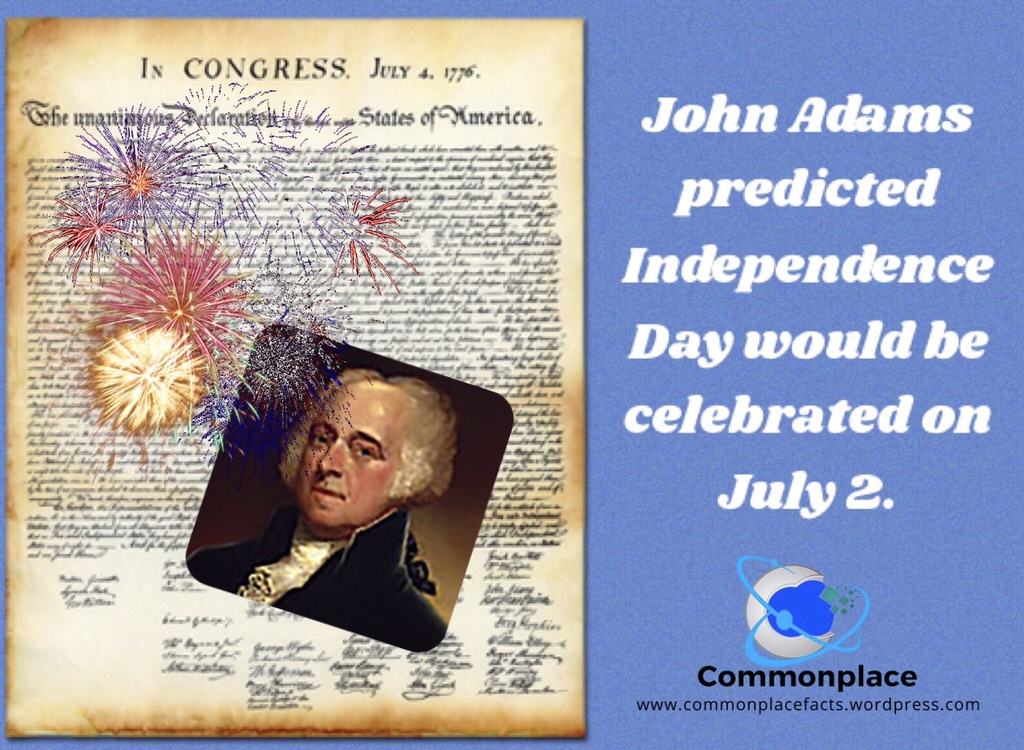

John Adams Predicted the Fourth of July—Except for One Tiny Calendar Problem
John Adams knew exactly how Americans would celebrate independence. He imagined fireworks, parades, bells, bonfires, public gatherings, and enough patriotic enthusiasm to make every neighborhood dog reconsider its life choices.
And he was right. Spectacularly right. Impressively right. The sort of right that makes a Founding Father want to lean back in his chair and say, “I told you so,” assuming the chair had not already been requisitioned for some committee meeting.
There was just one small problem.
John Adams picked the wrong date.
The date Adams had in mind was not July 4, 1776. It was July 2, 1776. That was the day the Continental Congress approved the resolution declaring that the American colonies were no longer part of Great Britain. In other words, July 2 was the day Congress actually voted for independence.
July 4 was the day everyone agreed on the wording of the breakup letter.
And yes, that is a dramatic oversimplification, but only slightly. History, like most committee work, is often less “lightning bolt of destiny” and more “let’s circle back after edits.”
Contents
The Resolution That Started the Fireworks
The road to American independence did not begin with a beautifully engrossed parchment, a dramatic signing ceremony, or Nicolas Cage stealing anything from the National Archives. It began with a resolution introduced on June 7, 1776, by Richard Henry Lee of Virginia and seconded by John Adams of Massachusetts.
Lee’s resolution stated, in plain and unmistakable terms, that the colonies were done with British rule: “Resolved: That these United Colonies are, and of right ought to be, free and independent States, that they are absolved from all allegiance to the British Crown, and that all political connection between them and the State of Great Britain is, and ought to be, totally dissolved.”
That is not exactly the sort of language one uses when hoping to remain on friendly terms with the king. It was less “we need some space” and more “please consider all previous correspondence violently canceled.”
After weeks of debate, political maneuvering, hesitation, and the sort of procedural wrangling that proves Congress discovered paperwork before it discovered consensus, the Continental Congress approved the resolution on July 2, 1776.
That was the moment the colonies officially voted to become independent states.
John Adams Makes a Prediction for the Ages
John Adams understood immediately that something enormous had happened. That evening, he wrote to his wife, Abigail Adams, and made one of the most famous predictions in American history: “The Second Day of July 1776, will be the most memorable Epocha, in the History of America.—I am apt to believe that it will be celebrated, by succeeding Generations, as the great anniversary Festival. It ought to be commemorated, as the Day of Deliverance by solemn Acts of Devotion to God Almighty. It ought to be solemnized with Pomp and Parade, with Shews, Games, Sports, Guns, Bells, Bonfires and Illuminations from one End of this Continent to the other from this Time forward forever more.”

That is a magnificent sentence. It has everything: religion, patriotism, fireworks, public entertainment, and the unmistakable energy of a man who has just helped commit treason and is feeling pretty good about it.
Adams envisioned an annual national celebration filled with “Pomp and Parade,” shows, games, sports, guns, bells, bonfires, and illuminations. In modern terms, he predicted Fourth of July parades, fireworks displays, backyard cookouts, municipal ceremonies, competitive hot dog consumption, and that one neighbor who begins setting off explosives sometime around June 19.
He got the entire vibe exactly right.
He just missed the date by two days.
So Why Do We Celebrate Independence Day on July 4?
The answer is the Declaration of Independence.
After Congress voted for independence on July 2, the delegates still had to approve the formal document explaining why they were doing it. That job had been assigned to a committee consisting of Thomas Jefferson, John Adams, Benjamin Franklin, Roger Sherman, and Robert Livingston.
Jefferson did most of the drafting, with Adams and Franklin offering edits. One likes to imagine Franklin sitting there with spectacles low on his nose, making helpful suggestions while silently improving the prose and possibly inventing bifocals during the dull parts.
On July 4, 1776, Congress formally adopted the Declaration of Independence. That date appeared on the document. That date was printed and distributed. That date became attached to the public announcement of American independence.

And that, dear reader, is how July 4 beat July 2 in the championship round of historical branding.
July 2 was the legal and political turning point. July 4 became the date everyone remembered, celebrated, printed on banners, and eventually used as an excuse to place small flags in desserts. Marketing matters. Even in the 18th century.
The First Independence Day Celebrations
Americans did not wait long to start celebrating. On July 4, 1777, while the Revolutionary War was still very much underway and the final outcome remained uncertain, Philadelphia marked the first anniversary of the Declaration of Independence.
The celebration included ringing bells, firing guns, lighting bonfires, decorating ships, holding public dinners, giving speeches, and setting off fireworks. In other words, the basic ingredients of the modern Fourth of July were already present: noise, lights, food, patriotism, and a general willingness to alarm livestock.
It is worth pausing over that. The United States was not yet a secure nation. The war was still raging. British forces were still a very real threat. The future was uncertain. And yet Americans still gathered to celebrate the anniversary of independence.
This was not merely a party. It was a public act of defiance. Fireworks in 1777 were not just entertainment. They were a bright, loud, smoky way of saying, “Yes, we are still doing this.”
John Adams Was Wrong About the Date but Right About Everything Else
John Adams never quite got his July 2 celebration. The nation he helped create politely ignored his preferred date and chose July 4 instead, because apparently even Founding Fathers could lose an argument to typography.
Still, Adams’ larger prediction was astonishingly accurate. He foresaw that American independence would be remembered not only with solemn reflection but also with public joy. He understood that national memory needs ceremony. He knew that people would need bells, bonfires, games, parades, and illuminations to mark the day.
He grasped something important about the American character: we are perfectly capable of combining deep historical meaning with grilled meat, marching bands, and explosives purchased from a roadside tent called something like “Patriot Thunder Barn.”
That may not have been exactly what he meant, but it is difficult to argue with the results.
The Date Changed. The Celebration Did Not.
Every July 4, Americans celebrate the adoption of the Declaration of Independence. Strictly speaking, Adams thought we should be celebrating two days earlier. Strictly speaking, he had a point. Strictly speaking, nobody wants to move the fireworks show to July 2 because the calendar has already gone to the trouble of making July 4 look official.
But Adams’ vision endured. The “Pomp and Parade” arrived. The “Guns, Bells, Bonfires and Illuminations” arrived. The public celebrations arrived. The national anniversary festival arrived.
John Adams may have been off by forty-eight hours, but in the grand tradition of American history, we have decided that is close enough for government work.
You may also enjoy…

The 1876 Centennial Exposition: The Weird Ways America Celebrated Its 100th Birthday
Step back in time and discover the weird, fascinating, and surprisingly modern ways America celebrated its 100th birthday at the 1876 Centennial Exposition—from telephones to towering machines.

The 1976 Bicentennial: Tall Ships, Freedom Trains, Beards, and Patriotic Weirdness
Explore America’s 1976 Bicentennial celebrations, from tall ships and Freedom Trains to painted fire hydrants, patriotic beards, coins, Disney parades, and small-town weirdness.

Compare Jefferson’s Declaration of Independence With the Final Version
You probably learned that Thomas Jefferson was the principal author of the Declaration of Independence. Although he was responsible for most of the document’s content, the version that was approved contained 86 revisions. Compare Jefferson’s draft with the final version and decide for yourself which is better. Editor’s Note: Original spelling and punctuation have been…
Leave a Reply