
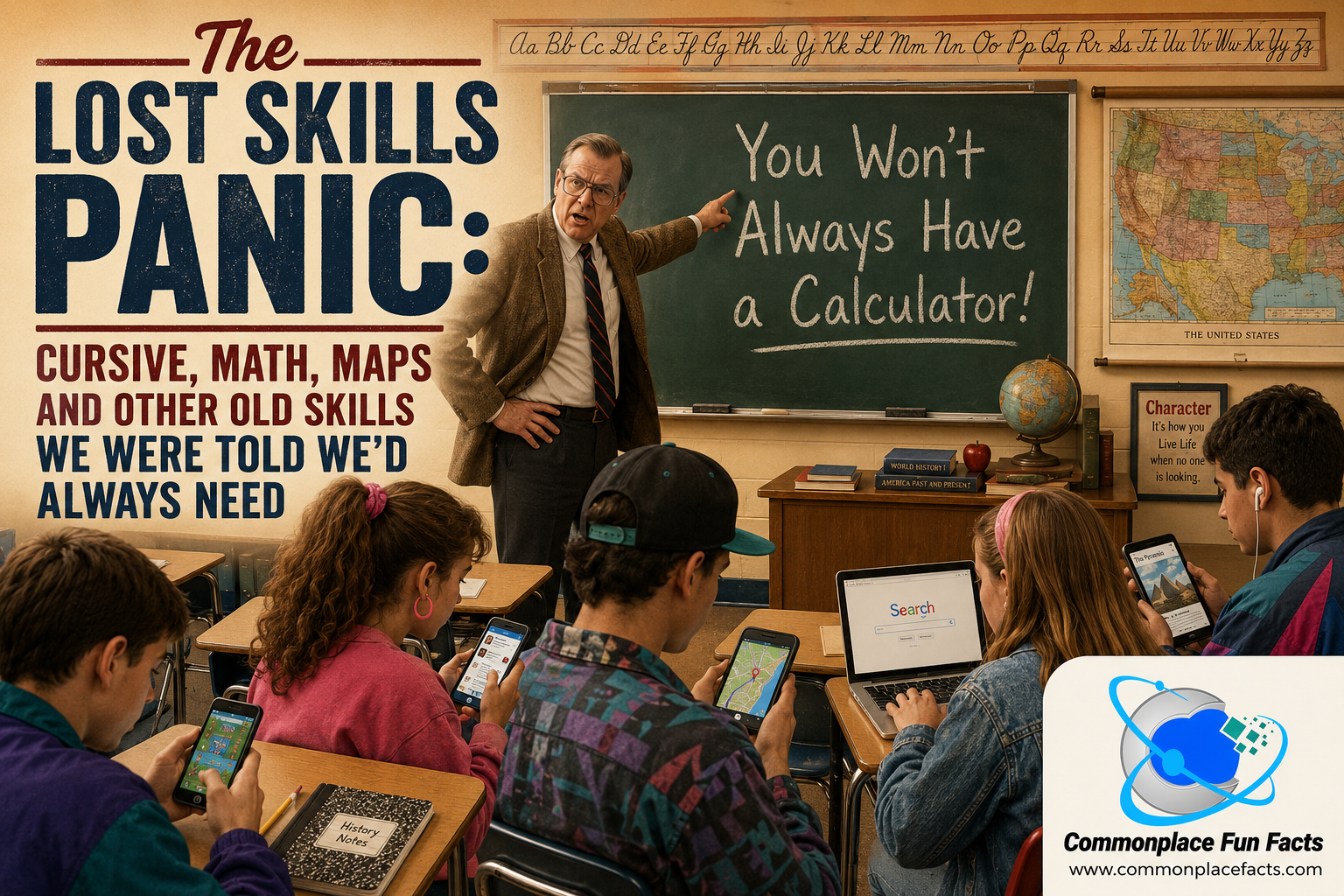

Every generation receives at least one solemn warning from the previous generation about the latest dangerous shortcut. The warning is usually delivered with the gravity of a medical diagnosis, a weather alert, or a school principal discovering someone has snuck bubble gum into an assembly.
“Don’t rely on calculators,” we were told. “You won’t always have one with you.”
“Learn cursive,” they said. “You’ll need it your whole life.”
“Know how to read a map,” they insisted. “You can’t trust machines to tell you where to go.”
And then, with the serene indifference of history, calculators became standard classroom equipment, cursive retreated from daily life like a Victorian ghost, and most of us began taking directions from a glowing rectangle that occasionally sends us through a subdivision, a parking lot, and possibly a living room because it knows a “faster route.”
This raises a fair question: were the warnings wrong?
Not entirely. That would be too easy, and also unfair to every adult who ever stood over a child’s homework and said, “Show your work,” with the weary authority of someone who had personally survived fractions. Some of the warnings were genuinely wise. Some were wildly overblown. Some were correct, but for reasons no one explained very well at the time.
The real question is not whether old skills disappeared. Many did. The better question is whether losing them actually hurt us. Did we lose something essential when we stopped memorizing phone numbers, writing in cursive, using paper maps, doing long division by hand, or consulting a twenty-volume encyclopedia that occupied an entire shelf and could injure a small dog if dropped?
Let’s examine the evidence, or at least poke it with a stick and see what falls out.
Contents
The Difference Between Losing a Skill and Losing a Civilization
Before we start holding a candlelight vigil for the card catalog, we need a way to judge these vanished or fading skills. Not every old method deserves preservation simply because it is old. Some things disappear because they have been replaced by something better. Others disappear because they are inconvenient, even though they were quietly doing something useful in the background.

So here is a simple test.
First, is the skill still practically necessary for everyday life?
Second, even if the skill itself is no longer necessary, did learning it build some deeper ability—memory, discipline, spatial reasoning, patience, fine motor control, judgment, or problem-solving?
Third, does society still need at least some people who can do it?
That last question matters. Not every person needs to read medieval Latin, repair a carburetor, navigate by stars, or decipher nineteenth-century handwriting. But if almost no one can do those things, society becomes a little more dependent on tools, specialists, and systems that may not always be available when needed.
In other words, the loss of an old skill is not automatically a disaster. Sometimes it is just progress wearing comfortable shoes. But sometimes the old skill was carrying more weight than we realized.
Cursive: The Educational Hill Everyone Is Somehow Still Willing to Die On
Few subjects generate more oddly intense debate than cursive handwriting. This is impressive, considering cursive is mostly a system of connecting letters and pretending the capital “Q” is not a typographical prank.

For years, students were told they had to learn cursive because they would use it constantly as adults. That part of the warning did not age well. Today, most adult writing is typed. Emails, texts, forms, legal documents, school assignments, medical records, banking, shopping lists, and even passive-aggressive neighborhood association complaints have largely gone digital.
The result is that many people no longer write in cursive except when signing their names, and even signatures have become less “beautiful expression of identity” and more “motion performed by a finger on a dirty glass rectangle while a cashier watches.”
So was the warning wrong?
Partly.
The argument that everyone needs elegant cursive handwriting for ordinary adult life is much weaker than it once was. The world has moved on. You do not need to write like a Civil War general composing a battlefield dispatch in order to function in modern society.
But here is where the issue gets more interesting: writing cursive and reading cursive are not the same skill. The former may be optional. The latter still matters.
Historical documents, family letters, church records, court papers, diaries, census materials, military records, recipes, journals, and handwritten notes are full of cursive. The National Archives still relies on citizen archivists to transcribe historical documents and make them searchable. Its own guidance notes that transcribing records helps make them more accessible to everyone.
That means the serious concern was never really that children would fail to produce graceful loops on college-ruled paper. The serious concern was that future generations might be cut off from handwritten records of the past.
And that is not imaginary. If a person cannot read cursive, a handwritten letter from 1910 becomes less a family treasure and more a decorative encryption project.
Interestingly, cursive has been making a comeback. As of 2026, the National Education Association reported that more than half of U.S. states require or strongly encourage schools to teach students to read and write cursive. That does not mean cursive is returning as the supreme communication method of the republic. It means people are beginning to recognize that total abandonment may have been a little hasty.
The verdict: the panic over cursive writing was overdone. The concern over cursive literacy was not.
Calculators: The Tiny Machines That Were Supposed to Destroy Math
Few childhood phrases were more familiar than this one: “You won’t always have a calculator with you.”
This was usually said by adults who could not have known that future humans would voluntarily carry pocket computers everywhere, including into bathrooms, restaurants, churches, airplanes, and bed, where they would use them to calculate tips, check sports scores, watch raccoons steal cat food, and argue about whether a movie released in 1988 was technically a Christmas film.
Today, the calculator warning sounds quaint. Not because arithmetic no longer matters, but because calculators are now everywhere. Phones have calculators. Computers have calculators. Watches have calculators. Search engines have calculators. Even standardized testing has adapted. The National Assessment of Educational Progress provides calculators for mathematics assessments, including four-function calculators at grade 4 and scientific calculators at higher grades when needed.
So were the adults wrong?
Again: partly.
The warning was wrong if it meant students should avoid calculators because calculators are unreliable novelties. That ship has sailed, hit a reef, been mapped by GPS, and uploaded to a maritime accident database.
But the warning was right if it meant students should understand numbers before outsourcing all calculation to a machine.
A calculator can produce an answer. It cannot tell you whether the answer makes sense unless you already have some number sense. If you enter bad information, misunderstand the problem, or misplace a decimal point, the calculator will cheerfully assist you in being wrong with impressive speed.
The National Council of Teachers of Mathematics still identifies procedural fluency as an essential component of mathematical proficiency. That does not mean endless punishment by worksheet. It means students need to know what operations mean, how procedures work, and whether an answer is reasonable.
The problem is not using calculators. The problem is using calculators before understanding what they are doing.
A student who understands arithmetic and uses a calculator is efficient. A student who does not understand arithmetic and uses a calculator is pressing buttons with hope, which is also how many office printers are operated.
The verdict: calculators did not ruin math. But they did make it easier to hide weak math behind correct-looking answers.
Paper Maps: The Lost Art of Being Confidently Wrong
Before GPS, travel required maps. Real maps. Paper maps. The kind that unfolded to the size of a bedsheet and then refused to return to their original shape once they had tasted freedom.

Reading a map required understanding scale, direction, roads, symbols, distances, and the difference between “north” and “the way I happen to be facing.” It also required the ability to remain married while one person drove and the other person said, “I think we missed the turn,” approximately seven miles too late.
Then came GPS. Suddenly, maps were replaced by turn-by-turn directions. The blue dot knew where you were. The voice knew where you should go. You no longer needed to understand the broader geography. You just needed to obey.
Was the warning warranted?
More than many people want to admit.
GPS is wonderful. It saves time, reduces stress, helps emergency responders, makes travel easier, and prevents countless marital arguments, or at least redirects them toward the accuracy of the app. But navigation is not only about arriving. It is also about building a mental map of the world.
A 2020 study published in Scientific Reports found that people with greater lifetime GPS experience showed worse spatial memory during self-guided navigation. The authors concluded that habitual GPS use can negatively affect spatial memory when people later need to navigate without GPS.
That is a fancy way of saying that if you always let the machine think about where you are, your brain may stop filing the paperwork.
The practical concern is not that everyone needs to keep a Rand McNally atlas in the glove compartment and mutter about “proper navigation.” The issue is that people still need basic wayfinding ability. They should understand directions, landmarks, routes, distances, and alternatives. This matters when phones die, signals fail, roads close, disasters happen, or the app confidently insists that the fastest route goes through Mrs. Smethels’ parlor.
The verdict: GPS did not make map-reading useless. It made map-reading less frequently practiced, which is not the same thing.
Spellcheck and Autocorrect: Now We Can Be Wrong Faster
Once upon a time, spelling required memory, repetition, and dictionaries. Actual dictionaries. Books. Large ones. The kind that could settle an argument and serve as a booster seat.

Then came spellcheck. Then autocorrect. Then predictive text, which bravely attempts to finish our thoughts before we have fully formed them, much like an overeager committee member with a laptop.
The warning was that spelling tools would make people worse spellers.
Was that warranted?
Yes, but with a catch.
Spellcheck reduces visible spelling errors. That is good. Fewer misspelled words in public is a benefit to society, like functioning traffic lights and fewer people using speakerphone in grocery stores.
But spellcheck can also conceal weakness. It can correct mistakes without teaching the user why the word was wrong. Autocorrect goes one step further by introducing mistakes no human being intended, thereby creating a whole new category of technological humiliation experienced by everyone who has ever tried to text, “Sorry for the inconvenience,” only to have autocorrect turn it into, “Sorry for the incontinence,” which may be accurate in some meetings but is rarely the message one intends to send.
The modern skill is not spelling every word perfectly from memory. The modern skill is editing. It is knowing when the machine is wrong, when the suggested word changes the meaning, and when the intended word has unfortunately become something else entirely.
The verdict: spellcheck did not end spelling. It made proofreading more important, because now we are not only correcting ourselves. We are supervising software with confidence issues.
Phone Numbers: The Memory Palace Was Replaced by Contacts
There was a time when people memorized phone numbers. Parents, grandparents, best friends, schools, workplaces, doctors, neighbors, pizza places, and that one number from childhood that remains permanently etched into the brain despite the fact that you cannot remember why you walked into the kitchen.
Now, most of us outsource that information to our phones. We tap a name, and the phone does the rest. This is efficient. It is also mildly terrifying when the phone dies and you realize your emergency plan consists of “find a charger” and “look concerned.”
Were the warnings right?
Only in limited circumstances.
Most people do not need to memorize dozens of numbers anymore. That is exactly the sort of thing computers are good at. A contacts app is better than the human brain at storing hundreds of names, numbers, addresses, email addresses, birthdays, and pictures of people whose names we should definitely remember but do not.
But total dependence is risky. Everyone should probably know a few critical numbers and facts without needing a device: an emergency contact, a spouse or parent, a home address, medical information, and anything needed to function if a phone is lost, stolen, dead, or resting peacefully at the bottom of a lake.
The verdict: we do not need to memorize everyone’s number. But knowing none of them is probably a poor life strategy, somewhere between “ignore the check engine light” and “trust gas station sushi.”
Phone numbers are only one small example of a much larger shift: we no longer have to remember nearly as much as people once did. For most of human history, memory was not a charming mental party trick; it was the storage system. People memorized speeches, family histories, legal principles, religious texts, travel routes, poems, recipes, and practical knowledge because there was no glowing rectangle waiting patiently to do it for them.
As we discussed in our article on memory palaces and ancient memory techniques, earlier generations developed elaborate methods for turning the brain into a walkable filing cabinet. Today, we can outsource much of that work to phones, search engines, calendars, contact lists, and cloud storage. That is wonderfully convenient, but it also means our memories get less exercise. The danger is not that everyone must memorize epic poetry again, although Homer would probably appreciate the company. The danger is that we mistake easy access for actual knowledge and then discover, usually at the worst possible moment, that the information was not in our heads at all. It was in a device with 3% battery.
Latin: Dead Language, Surprisingly Persistent Corpse
For centuries, Latin was considered an essential part of a serious education. It was the language of law, theology, medicine, scholarship, science, and people who wanted to make ordinary ideas sound expensive.
Eventually, Latin faded from the core curriculum. Students stopped declining nouns, conjugating verbs, and discovering that ancient Romans apparently spent a lot of time discussing farmers, sailors, girls, tables, and whether someone was carrying water to the gate.
Were the warnings about losing Latin justified?
For most people, no. A person can live a full, productive, educated life without knowing Latin. The grocery store does not require it. Neither does online banking, job training, plumbing, aviation, software development, or assembling a bookshelf whose instructions were clearly translated from one language into another by way of a confused raccoon.
But Latin is not useless. It remains valuable for certain fields and interests. It helps with legal terminology, medical terminology, theology, classical literature, history, language structure, and vocabulary. It also helps explain why some institutions continue to put Latin phrases on seals, diplomas, and buildings, apparently because English would make them sound too approachable.
A knowledge of Latin is also helpful if you need to use an ATM at the Vatican.
The verdict: Latin is not a universal necessity. It is a specialized tool. We do not need everyone to know it. We do need enough people who can understand the documents, traditions, and technical vocabulary that still depend on it.
Encyclopedias and Card Catalogs: The Good Old Days of Slow Searching
Before search engines, knowledge required effort. If you wanted information, you consulted encyclopedias, library indexes, bibliographies, and card catalogs. Research involved walking, searching, writing things down, and occasionally discovering that the book you needed had already been checked out by someone who was clearly your academic enemy. At other times, you discovered that the book you needed would tax not only your ability to understand it but also your upper-body strength if you hoped to retrieve it from the top shelf without suffering a skull fracture.
Today, the internet has changed everything. Information that once required an afternoon in a library can appear in seconds. This is a miracle, provided one remembers that “appears in seconds” is not the same thing as “is true.”
The warning was that instant information would make people intellectually lazy.
Was that fair?
Sometimes.
Search engines are astonishingly useful, but they changed the skill set. The old skill was finding information in a limited physical system. The new skill is evaluating overwhelming amounts of information in a limitless digital system. That is not easier. It is just difficult in a different costume.
Students no longer need to flip through index cards to find a source. Good. There is no moral virtue in wooden drawers. But they do need to know how to judge credibility, compare sources, recognize junk, distinguish evidence from assertion, and resist the temptation to trust the first result merely because it arrived first, looked confident, and came with a pop-up advertisement for suspicious pharmaceuticals.
The verdict: losing card catalogs was not tragic. Losing research discipline would be.
Checkbooks and Cash: Math, Money, and the Vanishing Art of Knowing What You Spent
There was a time when writing checks and balancing a checkbook were basic adult skills. You recorded deposits and withdrawals, compared them to your bank statement, and eventually discovered a mysterious $17.42 discrepancy that would haunt your evening like a financial poltergeist.
Today, many people rarely write checks. Banking apps track balances. Debit cards, credit cards, autopay, electronic transfers, and digital wallets have replaced much of the old paper system.
Was the warning right that people still needed those old skills?
Only partly.
The physical act of writing checks is less important than it used to be. But the underlying skill—tracking money—is still essential. In fact, it may be more important now because digital spending can become invisible. A tap here, a subscription there, a delivery fee, a streaming service, an app renewal, and suddenly your bank account has been nibbled to death by tiny invisible bites.
Balancing a paper checkbook may no longer be necessary for everyone. Understanding cash flow, recurring charges, fraud alerts, fees, and whether your account balance reflects reality absolutely is.
The verdict: the checkbook faded. Financial awareness still matters, and anyone who says otherwise probably has nine subscriptions they forgot about.
Artificial Intelligence: The New Calculator Panic, Now With Better Grammar
Which brings us to the current educational panic: artificial intelligence.
Students now have access to tools that can brainstorm topics, summarize articles, clean up awkward sentences, explain confusing concepts, generate outlines, and, if asked irresponsibly, produce an entire paper with the smooth confidence of a student who definitely did not read the book but has strong feelings about its “themes.”

The warning is familiar: if students rely on AI to write papers, they will never learn how to write, think, research, organize arguments, or express ideas in their own voice.
Is that warning warranted?
Yes. Also no. Which is deeply annoying, but that is the magic of Commonplace Fun Facts.
The warning is overblown if it treats AI as uniquely corrupting, as if no previous student ever copied from an encyclopedia, borrowed too heavily from a study guide, bought a term paper, or discovered that changing every third word in a paragraph was not, technically speaking, scholarship. Students have been looking for shortcuts since the first teacher assigned the first essay and the first student stared into the middle distance, wondering whether illness could be convincingly faked.
But the warning is serious if AI becomes a substitute for the work that writing is supposed to teach. A school paper is not merely a container for information. It is a tool for thinking. The point is not just to produce five paragraphs with a thesis statement, three supporting arguments, and a conclusion that begins “In conclusion.” The point is to learn how to gather evidence, weigh sources, organize thoughts, explain ideas, and discover whether your argument collapses the moment it is exposed to daylight.
Used well, AI can help with that process. It can act like a calculator for language: useful for checking, clarifying, suggesting, and accelerating work the student already understands. It can help a student get unstuck, test an outline, identify weak transitions, or ask, “Does this argument make sense?” without requiring the student to wander the halls looking for a teacher who has not yet been emotionally defeated by the copier.
Used badly, AI can produce the appearance of learning without the inconvenience—or any of the benefit—of learning. That is the real problem. A student who uses AI to improve an argument is learning. A student who uses AI to avoid having an argument is outsourcing the very skill the assignment was meant to build.
This is the same pattern we saw with calculators, GPS, spellcheck, and search engines. The tool is not the villain. The danger is dependency without understanding.
A calculator is fine if you understand the math. GPS is fine if you still know where you are. Spellcheck is fine if you can still recognize nonsense. AI writing tools are fine if the student remains the author rather than the customer.
The old warning was, “Don’t use this tool, or you’ll lose the skill.” The better warning is, “Use the tool in a way that preserves the skill.”
That means students still need to learn how to write without AI, just as they still need to understand arithmetic before using a calculator. They need to draft, revise, struggle, organize, delete, rethink, and occasionally stare at a blinking cursor while questioning every life choice that led to the assignment. That unpleasant little ritual is not a bug in the writing process. It is the writing process.
The verdict: AI will not automatically destroy writing any more than calculators destroyed math. But if schools treat finished text as the goal instead of independent thought, then AI will make it easier than ever for students to submit polished work that has never passed through their own brains. That would not be progress. That would be academic karaoke.
So Were the Warnings Right?
The answer is deeply unsatisfying, which means it is probably correct: sometimes.
The warnings were wrong when they treated every new tool as the source of destruction for the next generation. Tools are not new. Human history is basically the story of people inventing things to avoid doing other things the hard way. The wheel was a labor-saving device. So was the plow. So was the printing press. So was the dishwasher. Nobody looks at a dishwasher and says, “But what if people forget how to stand in front of a sink in despair?”
The warnings were also wrong when they confused inconvenience with virtue. Doing something slowly is not automatically better. A card catalog is not morally superior to a search engine because it involves more drawers. Long division by hand is not holier than using a calculator. A paper map is not more noble than GPS simply because it can be folded incorrectly in twelve different directions.
But the warnings were right when they noticed that tools can weaken the habits those tools replace.
If calculators replace number sense, that is a problem.
If GPS replaces spatial awareness, that is a problem.
If spellcheck replaces proofreading, that is a problem.
If digital records replace paper but no one understands the systems preserving those records, that is a problem.
The danger is not progress. The danger is dependency without understanding.
Keep the Skeleton, Not the Whole Dinosaur
The practical answer is not to preserve every old skill exactly as it was. That way lies educational clutter, cultural nostalgia, and possibly mandatory slide-rule instruction, which would cause immediate rioting among algebra students and most adults.
Instead, we should preserve the underlying competence.
Students do not need to spend endless hours doing arithmetic by hand after they understand the concept. But they do need number sense.
People do not need to carry paper maps everywhere. But they should understand direction, distance, landmarks, and basic navigation.
Students may not need to write flawless cursive. But they should be able to read common cursive well enough to access historical and family documents.
Adults do not need to memorize every phone number. But they should know a few essential contacts and facts without relying entirely on a device.
Everyone does not need Latin. But society needs enough people who can read old texts, legal phrases, inscriptions, theological sources, and historical records without waving a phone at them and hoping translation software gets inspired.
That may be the best rule for dealing with obsolete skills: keep the skeleton, not the whole dinosaur.
We do not need to preserve every method in its old form. We do need to understand what the method taught, what it protected, and what happens when nobody can do it anymore.
The Real Lesson of Lost Skills
The adults who warned us about calculators, cursive, maps, spelling, and all the rest were not always right. Some of their predictions were charmingly inaccurate. The calculator did not vanish. Cursive did not remain essential to daily business. GPS did not cause society to collapse, though it has made many of us suspiciously dependent on a blue dot.
But they were not fools, either. They understood something important: when a tool becomes common enough, people stop practicing the skill it replaces. That is not always bad. In fact, it is often the whole point. But it does mean we should be honest about the trade-off.
Progress gives us convenience. Convenience gives us speed. Speed gives us efficiency. Efficiency gives us time to do other things, such as complain that no one knows how to do things the old way.
The old warnings were not entirely wrong. They were often misfiled. The danger was not that we would stop doing everything by hand. The danger was that we might stop understanding what the tools were doing for us.
So maybe the best approach is neither stubborn nostalgia nor blind dependence. Use the calculator, but know whether the answer makes sense. Use GPS, but look around. Use ChatGPT, but double-check the information it provides to confirm accuracy, and do not let it drive unsupervised. Let old methods retire when they deserve it, but do not throw away every useful habit just because a newer tool showed up wearing a shiny hat.
The future probably does not belong to people who refuse new tools. It belongs to people who understand them well enough to use them wisely—and who still know what to do when the battery dies.
What do you think? Which old-school skills were you told you absolutely had to learn? Which ones turned out to be unnecessary? And which “obsolete” skills do you still think everyone should know? Let us know in the comments. We promise not to judge, unless your answer involves voluntarily balancing a checkbook with a fountain pen by candlelight, in which case we may have follow-up questions.
You may also enjoy…

Bad Handwriting Responsible for Up to 61% of Prescription Errors
It is a standing joke that physicians have horrible handwriting. It turns out this may not be such a laughing matter. A number of studies have found that sloppy handwriting is just as deadly to patients as the disease for which they sought treatment. The quality of physician handwriting is a widespread problem. A 2002…

Major Metric Malfunction Means Missed Mars Mission and Millions of Moolah
Hopes were high when the Mars Climate Orbiter launched from Cape Canaveral on December 11, 1998. The robotic space probe was designed to study the climate, atmosphere, and surface changes of Mars and to act as a communications relay for the Mars Polar Lander. For the next ten months, all went according to plan as…

Taking a Bat to Library Pests
Librarians have long fought against three primary antagonists: people who talk too loudly, those who do not return their books on time, and book-eating bugs. Stern words and fines can take care of the first two offenders, but when it comes to the third problem, the guardians of the world’s books need to look to…






Leave a Reply