
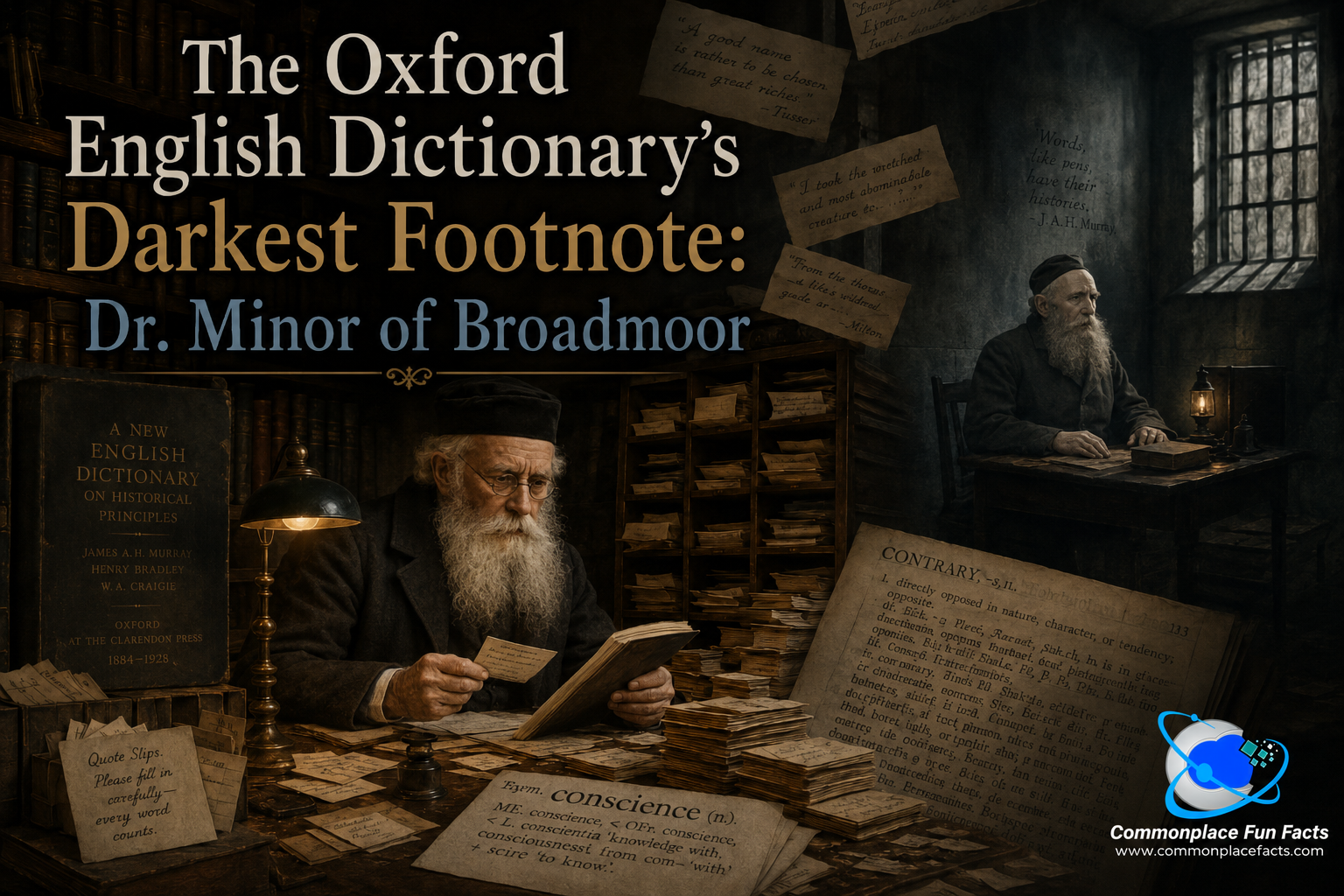

The Oxford English Dictionary looks like the kind of book that has never done anything improper in its life. It is sober. It is scholarly. The massive multi-volume set sits on library shelves with the quiet confidence of something that knows the difference between affect and effect and is silently judging the rest of us for guessing.
But behind that dignified exterior is a story full of ambition, delay, obsession, murder, madness, and enough handwritten slips of paper to make an archivist weep softly into a cardigan.
The OED did not emerge fully formed from an Oxford tower, lowered by angels wearing tweed. It was assembled over decades by editors, scholars, volunteers, readers, assistants, and one American doctor confined in a criminal lunatic asylum after killing an innocent man during a delusional episode.
That doctor was William Chester Minor. His life was tragic, disturbing, brilliant, and deeply complicated. He did not write the dictionary, despite what some headlines would dearly love you to believe. What he did was, in some ways, even more remarkable. From inside Broadmoor Asylum, he became one of the OED’s most valuable contributors, sending thousands of carefully selected quotations that helped prove how English words had been used across centuries.
In other words, one of the most authoritative books in the English language owes part of its existence to a man who spent much of his life behind locked doors, surrounded by old books, private torment, and the kind of meticulous paperwork that makes Victorian scholarship both inspiring and faintly alarming.
Contents
Before the Oxford English Dictionary, English Was Already a Problem
English has never been a tidy language. It is less a polished marble statue than a junk drawer with grammar. Over the centuries, it absorbed words from Latin, French, Greek, Norse, German, Hindi, Arabic, Algonquian languages, and practically any other language that made the mistake of standing too close.
By the nineteenth century, English had become enormous, unruly, and full of words that appeared in print, changed meaning, disappeared, came back wearing a fake mustache, and then showed up in poetry.
There had, of course, been English dictionaries before the OED. Robert Cawdrey’s A Table Alphabeticall appeared in 1604. Samuel Johnson’s famous Dictionary of the English Language arrived in 1755 and was a towering achievement. Johnson gave English a kind of literary authority, along with the memorable definition of oats as “a grain, which in England is generally given to horses, but in Scotland supports the people.” Even dictionaries can include not-so-subtle editorial comments.
But Johnson’s dictionary, brilliant as it was, did not do what the OED would later attempt. It did not try to track every word through its full historical life. It did not aim to show a word’s earliest recorded appearance, its shifting meanings, its spellings, pronunciations, etymology, and usage across centuries.
That would require something much larger. Something more systematic. Something so ambitious that only Victorians, with their majestic confidence and dangerous access to stationery, would have attempted it.
The Philological Society Decides to Fix Everything
The story began in 1857 with the Philological Society of London, a group of language scholars who had noticed that existing English dictionaries were missing quite a lot. Their original idea was relatively modest: collect words that had been overlooked by major dictionaries and publish a supplement.
This was a reasonable plan. Naturally, it did not survive contact with scholars.
Within months, the project expanded into something far more dramatic: a complete historical dictionary of the English language. Not merely a list of words. Not merely definitions. A full documentary record of English from its earliest recorded uses onward.
This is how academic projects behave when left unsupervised. One minute someone says, “Perhaps we should collect a few missing words,” and the next thing you know, civilization is 70 years into a dictionary and still somewhere near the letter S.
The early leaders included Richard Chenevix Trench, Herbert Coleridge, and Frederick Furnivall. These men understood that English needed a dictionary built on evidence, not just authority. A word should not be defined merely because one learned gentleman in a chair believed he knew what it meant. The dictionary should show how the word had actually been used.
This was the revolutionary idea behind the OED: every word would have a paper trail.
A Dictionary Built on Evidence, Not Vibes
The OED was designed as a historical dictionary. That means its editors were not simply interested in what a word meant at the moment. They wanted to know where it came from, how it had been spelled, how it had been pronounced, when it first appeared, and how its meaning evolved over time.

To do that, they needed quotations. Lots of quotations.
Suppose you are defining the word awful. Today, it usually means something bad. A bad meal is awful. A bad haircut is awful. A committee meeting scheduled at 4:30 p.m. on a Friday is both awful and undeniable proof that civilization is a fragile arrangement.
But historically, awful could mean full of awe, inspiring reverence, or worthy of deep respect. See “Words That No Longer Mean What They Used To” for more examples of the capricious nature of the English langauge. To show how words change, dictionary editors needed examples from books, letters, journals, plays, sermons, newspapers, and other printed sources. Each quotation helped establish how the word was used at a particular moment in time.
The OED wanted to give each word a biography. Not just a snapshot, but a life story.
That kind of dictionary could not be built by one person. It could barely be built by a team. It required an army of readers.
James Murray and the Scriptorium of Slips
The person most associated with the first edition of the OED is James Augustus Henry Murray, a Scottish schoolmaster, philologist, and self-taught linguistic powerhouse. He became editor in 1879, after Oxford University Press agreed to publish the dictionary.

He also bore a remarkable resemblance to Albus Dumbledore, which is not especially relevant to the history of lexicography, but is difficult to ignore once noticed.
Murray did not come to the project as a polished university aristocrat gliding through Oxford on a cloud of Latin quotations. His formal schooling ended early, but his appetite for language was enormous. He became a formidable scholar through sheer work, talent, and the kind of intellectual stamina normally associated with monastery scribes, tax-code authors, and people who alphabetize their spice racks.
To manage the dictionary, Murray built a corrugated iron structure known as the Scriptorium. The name sounds like a medieval chamber where monks illuminated manuscripts by candlelight. In reality, it was a shed. A very important shed, yes, but still a shed. History is full of moments where civilization advances because someone looked at a backyard structure and said, “This will do.”
Inside the Scriptorium were shelves, pigeonholes, assistants, books, and mountains of quotation slips. Each slip contained a word, a quotation showing its use, and information about the source. These slips were sorted and filed so editors could build dictionary entries from actual evidence.
It was crowdsourcing before the internet, but with fewer pop-up ads and more handwriting.
The OED’s Public Appeal: Please Send Words
Murray and the editors issued appeals to English-speaking readers, asking volunteers to read books and send in quotations. The instructions were specific. Readers were not just supposed to send unusual words, although unusual words are exactly the sort of thing that attracts people who volunteer for dictionary work. They were also asked to document ordinary words, old words, new words, obsolete words, technical words, and words used in peculiar ways.

The appeal went out to scholars, clergy, teachers, doctors, lawyers, colonial officials, amateur readers, and anyone else willing to spend leisure hours copying quotations onto slips of paper. It was a vast distributed reading project.
Imagine a Victorian version of Wikipedia, except every edit had to be mailed, sorted by hand, and reviewed by a man with a beard that looked like it had footnotes.
The project attracted more than a thousand contributors. Some sent only a few slips. Others became regular suppliers. A few became indispensable.
One of the most indispensable was Dr. William Chester Minor.
Enter Dr. William Chester Minor
William Chester Minor was born in Ceylon, now Sri Lanka, to American missionary parents. He was sent to the United States as a teenager, later studied medicine at Yale, and became a surgeon in the Union Army during the American Civil War.

His war service exposed him to scenes of tremendous violence and suffering. The exact relationship between his wartime experiences and his later mental illness cannot be neatly pinned down, and history should be cautious about pretending it can diagnose people across centuries with the confidence of a television doctor in the final seven minutes of an episode.
What is clear is that Minor’s mental health deteriorated severely. He suffered from paranoid delusions. After leaving the army, he eventually traveled to England, apparently in the hope that a change of scene might help him.
It did not.
In February 1872, while living in London, Minor shot and killed George Merrett, a brewery worker who was on his way to work. Minor believed, wrongly, that Merrett was an intruder who had broken into his room. Merrett was an innocent man. He had a wife, Eliza, and children. Any telling of Minor’s story that skips quickly past Merrett in order to get to the charming dictionary bits is doing a very shabby thing while wearing literary shoes.
Minor was found not guilty by reason of insanity and committed to Broadmoor Criminal Lunatic Asylum in Berkshire.
Broadmoor: Confinement, Books, and Time
Broadmoor was a secure psychiatric hospital for people who had committed serious crimes while mentally ill. Minor’s confinement there lasted decades.
Because he had a U.S. Army pension and was considered manageable within the institution, Minor was given relatively comfortable quarters. He had access to books. Over time, he built a substantial personal library, especially of older works. He read deeply in sixteenth- and seventeenth-century literature, the exact sort of material the OED needed.

Minor’s days were marked by contradiction. He was brilliant, educated, methodical, and useful. He was also profoundly ill and tormented by delusions. He could spend daylight hours producing careful scholarship, then suffer terrifying episodes at night.
This is part of what makes his story so difficult and so compelling. He was not a literary mascot. He was not a cute eccentric in a footnote. He was a wounded, dangerous, intelligent, suffering human being whose mind could produce both chaos and order.
The OED gave him purpose. It gave his reading structure. It gave his isolation a channel into the outside world.
And he was very, very good at it.
What Dr. Minor Actually Contributed to the Oxford English Dictionary
Here is the crucial correction: Dr. Minor did not write the Oxford English Dictionary.
He did not sit in Broadmoor drafting definitions for aardvark, abandon, and zyzzyva while the Oxford editors nodded appreciatively from afar. His contribution was not definition writing. His contribution was evidence.
Minor read old books and identified useful quotations showing how words had been used. He copied those quotations onto slips and sent them to Murray’s team. He developed a particularly helpful method. Rather than merely sending random interesting words, he indexed his reading so that when Murray needed examples for a particular word, Minor could often locate and supply them quickly.
That made him extraordinarily valuable.
A historical dictionary stands or falls on its evidence. A definition without examples is an assertion. A definition supported by dated quotations becomes a documented history. Minor supplied the raw material from which editors could trace usage, meanings, and changes over time.
His work was especially useful because he concentrated on older texts. The OED needed to know not just how English was spoken in Victorian drawing rooms, but how it appeared in Renaissance drama, early modern theology, obscure travel writing, legal texts, scientific works, and literature that most normal people could enjoy ignoring.
Minor did not merely read. He mined.
The Editor Learns Where the Quotations Are Coming From
For years, Murray knew Dr. W. C. Minor as a prolific and valuable contributor. Minor’s address was associated with Broadmoor, but the full reality of his situation was not immediately understood by the editor.
According to the famous version of the story, Murray eventually visited Minor and discovered that his treasured contributor was not a retired country gentleman or private scholar, but a patient at Broadmoor.
It is a moment almost too cinematic to resist: the great editor traveling to meet one of his finest volunteer readers, expecting perhaps a book-lined study and tea, only to find that the address belongs to a secure asylum. Victorian scholarship rarely gets a plot twist, so when it does, it tends to go all in.
Murray did not reject Minor after learning the truth. He respected the work. He continued to correspond with him. He visited him. He understood that Minor’s illness and crime were real, but so was his contribution.
History often wants people sorted into clean boxes: hero, villain, genius, monster, victim, benefactor. Minor refuses to stay in one box. He was responsible for a terrible act. He was mentally ill. He caused real grief. He also helped build one of the greatest reference works ever created.
That does not balance the scales. It simply reminds us that human beings are often inconveniently larger than our labels for them.
The Last Chapters: Murray, Minor, and the Dictionary That Outlived Them
As the years passed, Minor’s condition worsened, and his work for the dictionary gradually faded. Murray, however, did not forget him. The editor who had once discovered that one of his most valuable contributors was writing from Broadmoor eventually became one of Minor’s advocates, joining efforts to have the aging doctor removed from the asylum.
In 1910, the matter reached Winston Churchill, then serving as Home Secretary. Churchill authorized Minor’s discharge from Broadmoor and his return to the United States. This was not “freedom” in the cheerful sense of fresh air, clean paperwork, and a celebratory stroll to the nearest pub. Minor was deported back to America and remained under psychiatric care, first at St. Elizabeths Hospital and later in Connecticut.
Minor died in 1920. Murray had died five years earlier, in 1915, still working on the great dictionary and still nowhere near seeing the whole thing finished. Neither man lived to see the finished monument. Murray gave it his life’s labor. Minor gave it thousands of quotations from behind locked doors. The dictionary outlived them both, which is either inspiring or a reminder that large academic projects are basically immortal vampires with footnotes.
From Dictionary Footnote to Book and Movie
The story of Murray and Minor eventually escaped the dictionary files and became famous in its own right through Simon Winchester’s 1998 book The Professor and the Madman. The title is memorable, although modern readers may fairly note that “madman” is doing a lot of nineteenth-century heavy lifting there. The book brought wide attention to the strange, tragic, and deeply human partnership between James Murray, the editor trying to tame the English language, and Dr. William Chester Minor, the brilliant contributor sending quotation slips from Broadmoor.
The story was later adapted into the 2019 film The Professor and the Madman, starring Mel Gibson as Murray and Sean Penn as Minor. As with most historical films, it should not be treated as a documentary, courtroom exhibit, or substitute for reading the book. Hollywood has never met a complicated true story it did not want to comb its hair, dim the lighting, and give a dramatic speech near a window. Still, the movie helped introduce the broader public to one of the strangest chapters in the making of the Oxford English Dictionary.
The Dictionary That Took Longer Than Planned, Because Of Course It Did
When Oxford University Press agreed to publish the dictionary, the project was expected to take about ten years. This was adorable.
The first fascicle, covering A to Ant, appeared in 1884. That alone should have been a warning sign. If your dictionary project takes five years to reach ant, you are not exactly sprinting toward zebra.

The full first edition was not completed until 1928. By then, Murray was dead. Minor was dead. The original Victorian confidence had aged into a multigenerational scholarly campaign.
The finished work was immense: a monument to language, evidence, patience, and the belief that every word has a history worth chasing down a hallway while carrying a stack of paper slips.
And unlike many monuments, the OED was not built out of stone. It was built out of reading.
The OED Was Crowdsourcing Before Crowdsourcing Had a Hoodie
One of the most fascinating things about the Oxford English Dictionary is that it was not merely an Oxford achievement. Oxford edited it. Oxford published it. Oxford got the branding, which is how branding works and why nobody calls it “That Giant Philological Society Word Situation.”
But the OED depended on a huge network of contributors. Scholars helped. So did amateurs. So did readers across Britain, America, and beyond. Women contributed. Colonial readers contributed. Specialists contributed examples from technical fields. People outside the formal university structure helped build the evidence base.
This matters because the OED’s authority came not from one person declaring what English ought to be, but from thousands of people documenting what English had actually done.
English is a democracy in the most chaotic sense: it goes where people take it, whether or not the grammar police have cleared the route. The OED tried to follow that movement with evidence.
That is why Minor’s role fits the larger story so well. He was not inside the academy. He was not part of Oxford society. He was confined in an institution, separated from ordinary public life. And yet his reading reached the Scriptorium. His slips entered the files. His evidence helped shape the dictionary.
The OED was not written by one man in one room. It was assembled by a network. Some of that network looked respectable. Some of it looked eccentric. Some of it was tragic. All of it mattered.
The Moral Problem of a Fascinating Story
Minor’s story has often been told with a sensational hook: murderer helps write dictionary. It is a compelling phrase, in the same way a bear in a courtroom would be compelling. One does want more information.
But the danger is that the phrase can flatten everyone involved.
George Merrett becomes merely “the murdered man,” a plot device who exists so Minor can become interesting. Eliza Merrett becomes a widow in the background. Minor becomes either a monster or a quirky genius. Murray becomes the kindly editor who sees past scandal. The OED becomes a curiosity cabinet.
The real story is harder and better.
Merrett was a real person whose life was cut short. Minor was a real person whose illness caused suffering to others and to himself. Murray was a real editor trying to complete an almost impossible scholarly task. The OED was a real intellectual achievement that required thousands of hands.
Handled carefully, the story is not just “isn’t this weird?” It is a story about how knowledge is made by broken people, brilliant people, ordinary people, and people whose lives do not fit neatly into inspirational packaging.
Which is to say, people.
Why the Oxford English Dictionary Still Matters
The OED remains one of the great monuments of English scholarship because it treats words as historical artifacts. It does not merely say, “Here is what this word means.” It asks, “Where has this word been?”

That approach changes how we think about language. Words are not museum specimens pinned in place. They move. They degrade. They improve. They pick up slang at the docks, theology in churches, legal meanings in courtrooms, military meanings in war, and embarrassing new uses wherever teenagers are allowed to communicate unsupervised.
The OED records that movement. It preserves obsolete meanings. It traces first known uses. It documents changes that happened gradually, messily, and often against the wishes of people who believed language peaked sometime shortly before their own childhood.
This makes the OED more than a dictionary. It is a history of culture disguised as a reference book.
Every word carries evidence of trade, conquest, invention, class, empire, literature, science, technology, fashion, prejudice, humor, and human laziness. Especially laziness. Never underestimate laziness in the history of language. It is the reason we have contractions and probably half of the statutes in the law libraries.
Conclusion: A Crime Scene, a Shed, and the Biography of English
The Oxford English Dictionary set out to write the biography of every word in the English language. In doing so, it created a biography of its own: a story of scholarly ambition, public collaboration, editorial endurance, paper overload, and one deeply troubled doctor whose careful reading helped preserve centuries of English usage.
It is tempting to imagine great works of knowledge being built in clean, noble, orderly ways by clean, noble, orderly people. The OED ruins that illusion rather efficiently.
It was built in sheds. It was built from slips. It was built by volunteers. It was built by editors who underestimated the alphabet with almost heroic confidence. It was built by people whose names became famous and people whose names disappeared into filing systems.
And, in part, it was built by Dr. William Chester Minor, a man whose life reminds us that intelligence and suffering can occupy the same mind, that useful work can come from unlikely places, and that history has absolutely no obligation to make its characters easy to summarize.
The Oxford English Dictionary may be the grandest monument ever built to the English language, which feels appropriate. English itself has always been less a language than a beautifully organized crime scene.
You may also enjoy…

Samuel Johnson’s Dictionary of Disdain
A common word of warning for those who might be inclined to argue with someone who writes or edits a newspaper is, “Never pick a fight with a man who buys ink by the barrel.” This advice is particularly valuable when applied toward anyone who has the ability to influence an entire language. A Dictionary…

The Omnificent English Dictionary In Limerick Form
Here at Commonplace Fun Facts, we love words. We also love limericks. When we stumbled across The OEDILF, we thought someone had been taking a peek at our Christmas gift wish list. The OEDILF is The Omnificent English Dictionary in Limerick Form. According to the website, the goal of The OEDILF is to produce a…

The Quest to Add Orbisculate to the Dictionary
What is the difference between a real word and a made-up word? OK, admittedly all words are made-up. We should probably ask what it takes to transform a newly manufactured word into one that shows up in dictionaries. The answer is usage. Once upon a time, someone reacted to some disgusting thing (we suspect it…




Leave a Reply