
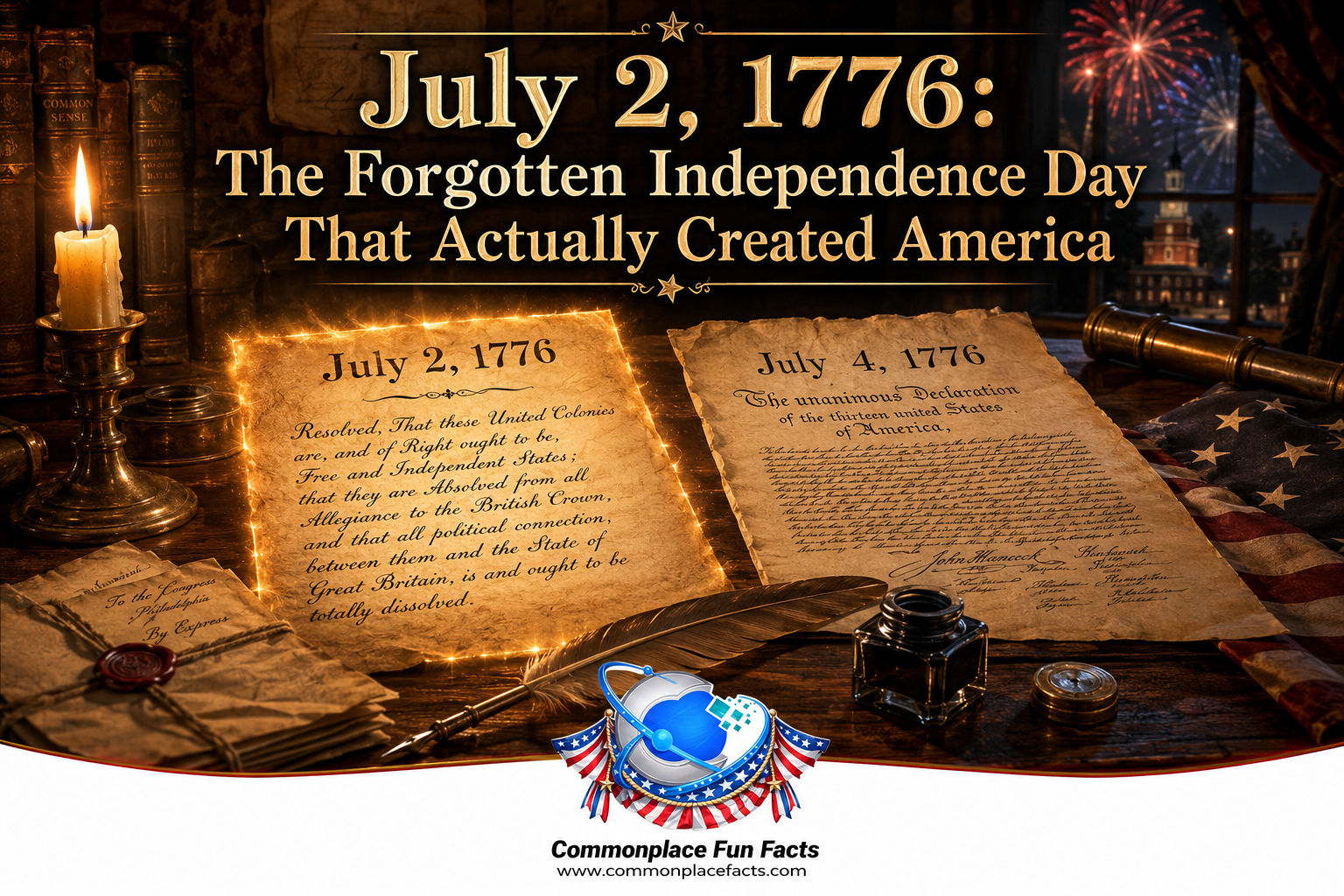

Every year, Americans celebrate Independence Day on July 4, which is fair. That is the date printed at the top of the Declaration of Independence, the date we memorize in school, the date we use for fireworks, cookouts, parades, patriotic bunting, and gently reassuring dogs that things will calm down soon.
But if we are being technical—and history is nothing if not a long argument among people who own too many footnotes—the United States actually declared independence on July 2, 1776.
July 4 was when Congress approved the final wording of the Declaration. July 2 was when Congress voted to break from Great Britain. One was the public explanation. The other was the decision itself. In modern terms, July 2 was when America quit the job. July 4 was when America posted the announcement on LinkedIn.
That distinction mattered to John Adams, who famously believed July 2 would become the great American anniversary. He was not being eccentric, at least not on that point. Adams had watched Congress do the actual thing on July 2. He assumed future generations would recognize the date when the colonies became “free and independent States.”
Instead, we chose July 4, because nothing says “republican self-government” like disagreeing about the paperwork before anyone has even finished founding the country.
Contents
The Declaration Was Not the Decision
To understand why July 2 deserves more attention, we need to separate two things that usually get mashed together into one patriotic casserole.
The vote for independence happened on July 2, 1776.
The approval of the Declaration of Independence happened on July 4, 1776.
Those are not the same thing. The first was Congress saying, “We are no longer part of the British Empire.” The second was Congress explaining why, in a document that somehow manages to be both a philosophical masterpiece and a formal complaint letter with much better sentence structure than your typical Yelp review.
The Declaration is magnificent, of course. It gave the Revolution its moral vocabulary. It announced that governments derive “their just powers from the consent of the governed.” It listed grievances against King George III. It turned political separation into a universal argument about rights, liberty, and human equality.
But the Declaration did not begin the break. It justified the break after Congress had already voted for it.
That vote came through the Lee Resolution, a compact little document that did the constitutional equivalent of kicking open a locked door.
Enter Richard Henry Lee, Holding the Match Near the Powder Keg
On June 7, 1776, Richard Henry Lee of Virginia introduced a resolution in the Second Continental Congress. Acting under instructions from the Virginia Convention, Lee proposed that the colonies formally declare independence.

The key language was simple, direct, and not especially interested in leaving room for reconciliation:
“That these United Colonies are, and of right ought to be, free and independent States, that they are absolved from all allegiance to the British Crown and that all political connection between them and the State of Great Britain is and ought to be totally dissolved.”
That sentence was the fuse.
Lee’s resolution did more than propose independence. It also called for foreign alliances and a plan of confederation. In other words, Congress had to decide three tiny matters: whether to create a new nation, how to survive a war against one of the most powerful empires on earth, and what kind of government might keep thirteen quarrelsome colonies from immediately forming a historical reenactment of a family reunion gone bad.
The independence part came first. Congress debated it, postponed it, argued over it, and generally did what legislative bodies do when faced with enormous decisions: they formed committees.
Committees are where bold ideas go to be fitted with procedural shoes.
The Committee of Five: America’s Most Important Group Project
While Congress delayed the final vote on independence, it appointed a committee to draft a statement explaining why independence was necessary. The members were Thomas Jefferson, John Adams, Benjamin Franklin, Roger Sherman, and Robert R. Livingston.
This became known as the Committee of Five, which sounds like the name of either a revolutionary drafting body or a mildly disappointing superhero team.
Jefferson did most of the writing. Adams and Franklin reviewed and edited. Sherman and Livingston served on the committee but played smaller roles in the actual drafting. Then Congress itself revised the draft, because even Thomas Jefferson had to experience the joy of group edits.
This is worth remembering because the Declaration was not written in a vacuum. It was part of a larger political process already underway. Congress had not yet taken the final vote, but it was preparing the public explanation in advance.
That may sound odd until you remember that everyone in Philadelphia knew where this was headed. The colonies were already at war. British troops were in the field. George Washington was commanding an army. Blood had already been shed at Lexington, Concord, Bunker Hill, and elsewhere. By the summer of 1776, reconciliation was beginning to look less like diplomacy and more like a hostage note written by wishful thinkers.
Still, declaring independence was not inevitable. It was not easy. It was not unanimous at first. And on July 1, it nearly stumbled.
July 1: The Vote Before the Vote
On July 1, Congress debated independence in a committee of the whole. The result was encouraging for independence, but not clean enough to move forward without trouble.
Pennsylvania opposed independence. South Carolina opposed independence. Delaware was divided. New York abstained because its delegates had not yet received authority from home to vote for independence.
That left the colonies in a wonderfully awkward position. They were trying to declare themselves independent while several delegations were either opposed, split, or waiting for permission like someone standing at the edge of a swimming pool asking whether the water is “too independence-y.”
The July 1 vote showed that independence had momentum, but it did not yet have the kind of broad consensus Congress wanted. Declaring independence from Great Britain was not the sort of thing one wanted to do with half the room muttering, “Please don’t put my name on this.”
Then came July 2.
July 2: The Day America Actually Declared Independence
On July 2, 1776, Congress took up the Lee Resolution again. This time, the pieces moved into place.
South Carolina changed its vote and supported independence. Pennsylvania shifted after some opponents abstained, allowing the delegation to vote yes. Delaware, which had been divided, moved into the independence column after Caesar Rodney arrived in Philadelphia.
New York still abstained, not because its delegates necessarily opposed independence, but because they lacked authorization. There is something deeply on-brand about New York being present at the birth of the United States and saying, “We need to check with our people before we commit to this.”
With that, Congress adopted the independence portion of the Lee Resolution. The colonies were now, in Congress’s words, “free and independent States.”
That was the legal break. That was the political rupture. That was the moment the United Colonies became, in substance, the United States.
July 4 got the headline, but July 2 was the act.
Caesar Rodney’s Ride: Delaware Becomes Dramatic
One of the best stories connected to July 2 involves Caesar Rodney of Delaware, who was not present when the independence debate reached its crucial moment.

Delaware’s delegation was split. Thomas McKean supported independence. George Read opposed it. Without Rodney, Delaware could not cast a vote in favor.
McKean sent for Rodney, who was in Delaware attending to militia duties. Rodney rode through the night to Philadelphia, arriving in time to break the tie. His vote put Delaware on the side of independence.
It is one of those episodes that sounds like it was written by a patriotic screenwriter with no interest in subtlety: an ailing delegate, a desperate ride, a divided colony, and a nation waiting on one exhausted man and his horse.
Hollywood would reject it for being too obvious, then replace it with a fictional love interest and three explosions.
But Rodney’s ride mattered. Without him, Delaware would have remained deadlocked at the critical moment. With him, the colony voted yes. In a Congress trying to present unity, that mattered enormously.
Read “Caesar Rodney: The Midnight Ride That Secured American Independence” for the dramatic details of this pivotal moment for American independence.
John Dickinson: The Founder Who Said “Not Yet”
Not everyone who hesitated over independence was a coward, a loyalist, or a powdered-wig villain quietly polishing a portrait of King George.
John Dickinson of Pennsylvania opposed immediate independence, but his position was more complicated than simple loyalty to Britain. Dickinson had been one of the great voices of colonial resistance. His Letters from a Farmer in Pennsylvania helped shape American arguments against British taxation. He was no stranger to opposing imperial overreach.
But Dickinson believed Congress was moving too quickly. He wanted the colonies to secure foreign alliances and create a stronger plan of union before formally declaring independence. In his view, announcing nationhood before building the machinery to sustain it was reckless.
This is the founding-era version of saying, “Before we jump out of the airplane, may I ask whether anyone packed the parachute?”
Dickinson did not vote for independence. He did not sign the Declaration. For that, history often gives him the side-eye.
But he later served the American cause, helped draft the Articles of Confederation, and supported the Constitution. His caution did not make him irrelevant. It made him a reminder that the Revolution was not a simple morality play in which every person instantly sorted into “hero” or “villain” columns for the convenience of future textbooks.
The decision for independence was bold. Dickinson’s warning was not absurd. Both things can be true, which is annoying because history keeps refusing to behave like a bumper sticker.
New York Abstains, Because Authorization Matters
Then there was New York.
On July 2, New York’s delegates abstained because they had not yet been authorized to vote for independence. This was not a small technicality. Delegates represented colonies. They were not freelance revolutionaries wandering Philadelphia looking for exciting paperwork to sign.
New York’s abstention meant the July 2 vote was not technically unanimous among all thirteen colonies. It was overwhelming, decisive, and historically thunderous, but not yet the tidy unanimity everyone would later prefer.
New York’s Provincial Congress approved independence on July 9. After that, Congress could present the break as the unanimous act of thirteen united states. Nothing says “we are one people” like needing an extra week to finish the consent process.
July 3 and 4: Congress Edits the Breakup Letter
After voting for independence on July 2, Congress turned back to Jefferson’s draft of the Declaration.
This is the part of the story where the nation has technically been born, but everyone is still arguing over adjectives.
Congress debated and revised the text on July 3 and July 4. Members cut portions, changed language, softened some passages, sharpened others, and removed Jefferson’s denunciation of the slave trade. That removal remains one of the great moral contradictions of the founding: a nation announcing liberty while preserving human bondage. It is not a footnote. It is part of the story.
The final Declaration was approved on July 4, 1776. That is why the date appears at the top of the document and why July 4 became the official Independence Day.
So July 4 deserves its place. It was not a clerical error with fireworks. It was the day Congress approved the words that would carry the Revolution beyond Philadelphia and into world history.
But those words explained a decision already made two days earlier.
The Declaration Was America’s Press Release
Think of July 2 and July 4 this way: the Lee Resolution was the vote; the Declaration was the explanation.
The Lee Resolution said, “We are independent.”
The Declaration said, “Here is why we are independent, and also here are twenty-seven complaints, because we have been keeping receipts.”
That is why the Declaration became so powerful. It did not merely announce a political separation. It gave that separation a moral and philosophical framework. It claimed that rights did not come from kings. It argued that legitimate governments rest on consent. It declared that people may alter or abolish governments that become destructive of their rights.
That was explosive. Not “someone threw tea in the harbor” explosive. More like “this sentence may eventually trouble every monarchy on earth” explosive.
The Declaration was written for multiple audiences. It spoke to Americans, to Britain, to potential foreign allies, and to history itself. It justified the Revolution not as a tax dispute that got out of hand, but as a necessary act of political self-defense.
It was, in short, the greatest press release ever written by a committee, which is a sentence that should not be possible.
July 4 and 5: John Dunlap Starts Printing the Revolution
Once Congress approved the Declaration on July 4, it had to be printed and distributed. The job went to John Dunlap, the official printer for Congress.
Dunlap printed broadside copies of the Declaration on July 4 and into July 5. These printed copies—now known as the Dunlap Broadsides—were sent to state assemblies, military commanders, committees of safety, and other officials.
This was how independence began to travel.
Not by television. Not by radio. Not by social media posts from @FoundingFather1776 with a suspicious number of flag emojis. Independence spread by printed sheets carried on horseback, read aloud in public places, reprinted in newspapers, and passed from hand to hand.
The Declaration had to be heard. Most Americans were not sitting in Congress. Many would encounter the document when someone stood in a town square, military camp, courthouse, churchyard, or public gathering and read it aloud.
That is how a congressional vote became a public event.
July 9: New York Gets the News and the King Loses His Statue
July 9 was another important date in the long birth of American independence.
On that day, New York approved independence, removing the lingering issue caused by its delegation’s abstention on July 2. Also on July 9, George Washington had the Declaration read to the Continental Army in New York.

This was not a quiet book club reading.
Washington’s troops were facing the very real possibility of British attack. The Declaration gave the army a clearer cause. They were no longer merely resisting parliamentary abuses or defending colonial rights within the empire. They were fighting for an independent nation.
After the public reading in New York, a crowd pulled down the equestrian statue of King George III. The lead was reportedly later used for musket balls.
As political symbolism goes, turning the king into ammunition is not subtle. But subtlety had already packed its bags and left sometime around “all political connection is totally dissolved.”
July 19: Congress Makes It Officially Unanimous-Looking
On July 19, after New York had approved independence, Congress ordered that the Declaration be engrossed on parchment. That means it was to be carefully handwritten in formal style for signing.
Congress also ordered a new title: The unanimous Declaration of the thirteen united States of America.
That title mattered. The colonies had been divided. Delegations had hesitated. New York had abstained. Pennsylvania had shifted. Delaware had needed an emergency horseback intervention. But now the public message was unity.
That was not mere vanity. Unity was survival. The new United States needed foreign allies. It needed soldiers. It needed public support. It needed to show Britain that this was not a tantrum by a few disgruntled colonies with quills and impulse-control problems.
The Declaration’s new title told the world: all thirteen are in.
August 2: The Signing Most People Picture Happened Later
Most Americans imagine the Declaration being signed on July 4. That is understandable. Paintings, school lessons, and patriotic pageantry tend to compress events. History is messy. Murals prefer clean staging.
But the famous engrossed parchment copy was not signed by most delegates until August 2, 1776. Some signed even later. The signing was not a single cinematic moment where every founder gathered around the parchment while dramatic music swelled and someone whispered, “Gentlemen, history is watching.”

History probably was watching, but it was also waiting for travel schedules, congressional attendance, state instructions, and the normal aggravations of human logistics.
John Hancock’s large signature became legendary, but even that belongs more to the later signed parchment than to the immediate July 4 printing. The Dunlap Broadsides were distributed with Hancock’s name as president of Congress and Charles Thomson’s name as secretary, not with the full set of signatures we now associate with the Declaration.
That distinction matters because the public did not immediately see the familiar list of signers. The Declaration had been approved, printed, distributed, read aloud, and celebrated before most Americans knew exactly which delegates had attached their names to the parchment copy. The names came into public view later, and that is where Mary Katharine Goddard enters the story.
By early 1777, Congress had fled Philadelphia and set up shop in Baltimore, because founding a nation also involved occasionally relocating the entire revolutionary government like a nervous traveling circus. In January 1777, Congress ordered authenticated printed copies of the Declaration to be sent to the states. On January 18, Mary Katharine Goddard, a Baltimore printer, newspaper publisher, bookseller, and postmaster, printed the broadside that became the first official version of the Declaration to include the names of most of the signers.

That was no small thing. The earlier Dunlap broadside announced independence, but it did not publish the full list of men who had signed the famous parchment copy. Goddard’s printing did. By placing her own name at the bottom — “Printed by Mary Katharine Goddard” — she publicly attached herself to the revolutionary cause right alongside a list of men who, if Britain prevailed, could expect considerably less comfortable career options than “retired founder.” It was an act of printing, yes, but also an act of nerve. The Declaration had signers; the Goddard broadside had a printer brave enough to put her own name on the receipt.
So if you want the timeline in its least mythological form, it looks like this:
- June 7, 1776: Richard Henry Lee introduces the resolution for independence.
- July 1, 1776: Congress debates independence, but several colonies are opposed, divided, or unauthorized.
- July 2, 1776: Congress adopts the independence resolution.
- July 4, 1776: Congress approves the final wording of the Declaration.
- July 4–5, 1776: John Dunlap prints the first official broadside copies for distribution.
- July 9, 1776: New York approves independence, and Washington has the Declaration read to the army.
- July 19, 1776: Congress orders the Declaration engrossed on parchment with the title emphasizing unanimity.
- August 2, 1776: Most delegates sign the engrossed parchment copy.
- January 1777: Congress orders authenticated printed copies sent to the states; on January 18, Mary Katharine Goddard prints the broadside listing most of the signers.
America was not born in a single instant. It arrived through debate, delay, revision, printing, public reading, political pressure, military danger, delayed signatures, and a great deal of paperwork.
Which, when you think about it, is extremely American.
Why July 2 Still Matters
July 2 matters because it reminds us that independence was not inevitable. It was chosen.
It was chosen by delegates who knew the risks. They understood that declaring independence could mean execution for treason if the Revolution failed. They understood that Britain was powerful, the colonies were divided, and victory was far from guaranteed.
They did it anyway.
July 2 also reminds us that the American founding was not as tidy as we sometimes pretend. The delegates disagreed. Some hesitated. Some changed their votes. Some needed new instructions. Some opposed immediate independence for reasons that were serious and principled. Some supported liberty while tolerating slavery, a contradiction so glaring that no amount of bunting can cover it.
The founding was bold, brilliant, compromised, courageous, flawed, visionary, and human. In other words, it was not carved from marble. Marble came later, mostly so pigeons would have somewhere dignified to sit.
July 4 gives us the words. July 2 gives us the decision. July 9 gives us unity. July 19 gives us the formal parchment. August 2 gives us the signatures. Together, they tell a fuller story than any single date can carry by itself.
America’s 250th Birthday and the Case for a Longer Celebration
As America marks its 250th birthday in 2026, July 2 deserves a place at the table. Not instead of July 4, but alongside it.
July 4 is still the national holiday. Keep the fireworks. Keep the cookouts. Keep the parades, the flags, the patriotic music, and the annual tradition of pretending that eating a hot dog outdoors in dangerous humidity is a civic sacrament.
But remember July 2.
Remember the day Congress actually voted for independence. Remember the Lee Resolution. Remember Caesar Rodney’s desperate ride. Remember New York’s abstention. Remember John Dickinson’s caution. Remember the revisions, the printing, the readings, the delayed signatures, and the messy process by which thirteen colonies became a nation.
The United States was not born as a perfectly polished myth. It was born in argument, uncertainty, courage, compromise, and edits.

Especially edits.
So perhaps John Adams was not wrong. Maybe July 2 should have been celebrated with pomp and parade, games, bells, bonfires, and illuminations. Maybe he simply underestimated America’s future attachment to the date printed on the final draft.
Either way, the story is bigger than one day. America’s independence was not a moment. It was a process.
And like most important processes, it took longer than expected, involved more committees than anyone wanted, and produced a final document only after everyone had argued about the wording.
Two hundred fifty years later, that may be the most American part of all.
You may also enjoy…

Calvin Coolidge’s Warning About the Declaration of Independence
Calvin Coolidge warned that America’s founding ideals depend on the spiritual roots behind the Declaration of Independence.

How Much Do You Know About the Declaration of Independence?
The United States of America celebrates its birthday on July 4. That day marks the anniversary of the Declaration of Independence and the formal separation of the colonies from Great Britain. But should July 4 really be the nation’s birthday? See how much you know about this founding document of the USA? Independence Day Is…

The First Fourth of July Was a Lot Quieter Than You Think
John Adams predicted America would celebrate July 2 with fireworks, but July 4 stole the show. Here’s how the first fourth of July celebrations unfolded during America’s early years.



Leave a Reply