
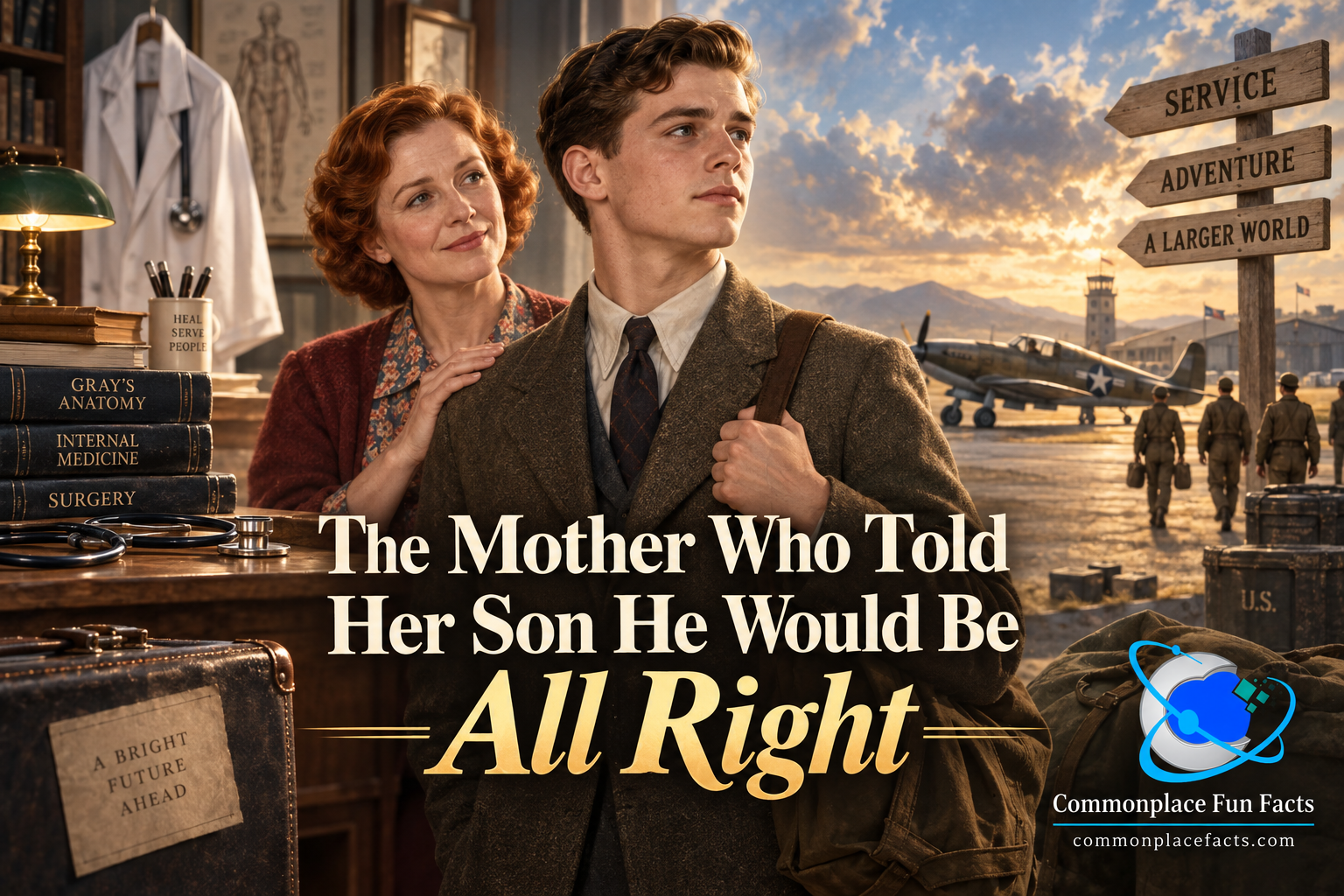

In 1892, a little girl was born in the small town of Glidden, Iowa.
There was nothing particularly remarkable about that event. Babies had been born in Iowa before. The newspapers did not dispatch correspondents. Congress did not adjourn. No one looked meaningfully toward the horizon while dramatic music played.
Her parents did, however, give her an unusual name.
We are going to hold on to that name for a while.
Not because there is anything mysterious about the woman herself. By most accounts, she lived a fairly ordinary American life. She married, raised a family, moved around the country, watched her children grow up, and eventually became a grandmother.
But one of her sons remembered her for something more specific.
He remembered her confidence in him.
And years later, on the eve of one of the most consequential events in human history, he would repay that confidence in a way neither of them could possibly have imagined when he was a boy.
Contents
A Red-Haired Mother With a Calm Disposition
The girl from Iowa grew up, married in 1912, and became a mother a little more than two years later. Her first son, Paul, was born in Quincy, Illinois, in February 1915.
The family moved several times during his childhood, living in Iowa before eventually settling for a time in Florida.
Paul would later describe his mother as red-haired and remarkably composed. She was not, apparently, a woman given to wild emotional displays. He remembered instead what he called her quiet confidence—a quality that seems to have made a considerable impression on a boy whose own future would eventually require more than the usual allotment of steady nerves.
Paul’s father was more practical.
This is another way of saying that Paul eventually developed an interest that his father considered an excellent method for shortening one’s life expectancy.
Airplanes.
The Boy Who Looked Up
Aviation in the 1920s was still new enough to seem magical and dangerous in roughly equal proportions. Young Paul became fascinated by flying at a time when airplanes were noisy collections of fabric, wire, wood, and optimism operated by people who apparently regarded gravity as a strongly worded suggestion.
According to accounts of his childhood, Paul’s mother once paid a dollar so that he could take an airplane ride at a carnival.

A dollar may not sound like much until you remember that this was the 1920s, when a dollar could apparently purchase an airplane ride, several meals, and possibly a small county.
Whether that particular flight sealed Paul’s fate is difficult to say. What is certain is that airplanes became an increasingly important part of his life.
At age twelve, he received an opportunity that would make an especially peculiar footnote to his later career.
Paul’s father was involved in the candy business, and a barnstorming pilot named Doug Davis was flying promotional missions for the Curtiss Candy Company. Davis would fly over crowds while an assistant dropped Baby Ruth candy bars attached to tiny parachutes.
Young Paul got to go along.
So one of his earliest memorable experiences in an airplane involved flying over people and dropping objects on them from above.
They were chocolate-covered objects, admittedly.
History was still easing him into the concept.
The Sensible Career He Was Supposed to Have
Paul’s father had much more respectable plans for his son.
Medicine.
Paul attended the University of Florida and later transferred to the University of Cincinnati to continue his premedical studies. The expectation was that he would become a doctor, which was a perfectly reasonable career choice for a bright young man.
There was only one problem.
Paul wanted to fly airplanes.
By then he had taken flying lessons and soloed. The experience clarified matters considerably. Medicine might be respectable. Medicine might be secure. Medicine might even make his father happy.
But medicine did not come with wings.
Eventually Paul told his parents that he intended to abandon his medical studies and join the Army Air Corps.
His father was not delighted.
Years later, Paul recalled the conversation in rather colorful terms. His father pointed out that he had already paid for Paul’s education, automobiles, and social life. If his son now wished to throw all of that away and get himself killed flying airplanes, that was his business.
It was the sort of paternal pep talk that rarely appears embroidered on decorative pillows.
Then Paul’s mother spoke.
“I know you will be all right, son.”
That was essentially it.
No grand speech. No lecture about following your dreams. No dramatic declaration that she had always known he was destined for greatness.
She simply trusted him.
Paul never forgot it.
It Turned Out Mom Had a Point
Paul entered the Army Air Corps in 1937 and earned his pilot’s wings the following year.
He proved to be exceptionally good at the profession his father had regarded as an elaborate suicide attempt.

When the United States entered World War II, Paul flew heavy bombers in Europe and North Africa. He acquired a reputation as a skilled pilot who remained calm under pressure. He flew combat missions, trained other airmen, and eventually became involved in testing one of America’s newest long-range bombers.
By 1944, military officials had noticed him.
That autumn, he was summoned to a meeting and given an assignment unlike anything he had encountered before.
He was to organize and command a new military unit.
Its mission was extraordinarily secret.
Many of the men under his command would not know exactly what they were preparing to do. Their aircraft would require special modifications. Their training would involve unusual bombing techniques. Scientists and military officers working on a project of enormous importance would occasionally appear, provide instructions, and disappear again.
Paul knew more than most.
He understood that the weapon his unit was preparing to deliver was something radically new.
Failure was not an attractive option.
His responsibility was to build the crews, select the equipment, devise the procedures, and make certain that when the order came, the mission would succeed.
The boy whose father had wanted him safely practicing medicine had somehow ended up with an assignment whose consequences would reach far beyond anything either of his parents could have imagined.
An Airplane Called Number 82
By the summer of 1945, Paul and his men were stationed on the Pacific island of Tinian.
Among the aircraft available to them was a specially modified four-engine bomber, serial number 44-86292. On Tinian, it carried the identification number 82, painted near the nose.
It did not have a proper name.
That was about to change.
Paul had personally selected 44-86292 at the Martin plant in Omaha several months earlier. On August 5, he took command of No. 82 for the mission scheduled to depart the following morning. He knew that if the operation succeeded, the airplane would become famous.
A famous airplane, he thought, ought to have a name.

He wanted something distinctive. Something nobody else would be using. Something personal.
And in that moment, according to his later recollection, his thoughts returned to the red-haired woman who had encouraged him years earlier when his father thought he had lost his mind.
The woman who had told him: “I know you will be all right, son.”
Paul ordered a crewman to paint his mother’s name beneath the pilot’s window.
And now we can finally tell you what that name was.
The Iowa girl born in 1892 was Enola Gay Haggard Tibbets.
Her son was Colonel Paul W. Tibbets Jr.
And aircraft No. 82 became the Enola Gay.
A Mother’s Name Enters History
At 2:45 a.m. on August 6, 1945, the Enola Gay took off from North Field on Tinian.
Its destination was Hiroshima, Japan.
Inside its bomb bay was a uranium weapon nicknamed “Little Boy.” At approximately 8:15 that morning, bombardier Thomas Ferebee released it over the city.
The weapon exploded about 600 meters—roughly 1,970 feet—above Hiroshima.
In an instant, much of the city was destroyed. Tens of thousands of people died that day, and the City of Hiroshima estimates that approximately 140,000 had died by the end of 1945 from the bombing and its acute effects. The precise number remains unknown. It was the first atomic weapon ever used in warfare.
The Atomic Age had existed scientifically since the Trinity test in New Mexico three weeks earlier. Hiroshima introduced it to the rest of humanity.
And written in large letters beneath the cockpit window of the airplane that delivered it was the name of a red-haired mother from Iowa.
Why He Chose Her Name
Tibbets later explained that the choice was not random nostalgia.

His mother’s support had remained with him throughout his career. In his autobiography, he remembered her as his “courageous red-haired mother” and wrote that her quiet confidence had strengthened him since childhood, especially when he abandoned medicine to become a military pilot.
In a later interview with Studs Terkel, he again contrasted his parents’ reactions. His father thought flying was madness. His mother quietly assured him he would be all right.
That was the memory that came back to him on Tinian.
Tibbets also liked the fact that her name was unusual. He later explained that he knew the airplane would become famous and wanted a name unlikely to be duplicated somewhere else in the enormous American bomber fleet.
He certainly accomplished that.
There have been thousands of military aircraft named after cities, states, girlfriends, wives, cartoon characters, patriotic slogans, and concepts that probably seemed much funnier after several months on a remote airbase.
There was only one Enola Gay.
Where Did the Name Come From?
The name had an unusual history even before it reached the side of a B-29.
Enola Gay Haggard had herself received her unusual name from literature. According to the account later associated with the Tibbets family, her father had been reading Mary Young Ridenbaugh’s 1886 novel Enola; or, Her Fatal Mistake shortly before his daughter was born and borrowed the heroine’s name for her.
The name came with an additional curiosity: Enola is alone spelled backward, an idea that figures directly in Ridenbaugh’s story. An obscure Victorian novel had therefore supplied the name of an Iowa girl born in 1892.
More than half a century later, that same name would be painted on the side of a B-29 and carried halfway around the world into history.
Names sometimes have surprisingly long careers.
We Have Actually Met Paul Before
If the story about twelve-year-old Paul dropping candy bars from an airplane sounded familiar, there is a reason.
We previously looked at the wonderfully improbable connection between the Baby Ruth candy bar and the bombing of Hiroshima. Paul Tibbets’ childhood ride with barnstormer Doug Davis put him in an airplane dropping candy attached to miniature parachutes decades before he commanded the most consequential bombing mission in history.
It is one of those connections that would be rejected by a screenwriter for being too obvious.
History, fortunately, has no editor.
The Hiroshima mission also belongs to a much larger collection of unlikely stories surrounding the Manhattan Project. American officials managed to keep the development of the atomic bomb secret from most of the country while simultaneously becoming alarmed when a science-fiction writer appeared to describe suspiciously similar technology in a pulp magazine.
Apparently the most dangerous thing you could do in 1944 was either reveal the existence of the atomic bomb or be unusually good at guessing.

How Did His Mother React?
One might reasonably wonder what it was like to wake up one morning and discover that your son had just participated in an event that changed history—and that he had thoughtfully put your name on the vehicle involved.
Paul later said his mother was not especially demonstrative. She tended to keep much of her emotion beneath the surface.
There was, however, one giveaway.
When something really amused or pleased her, according to Paul, her stomach would jiggle when she laughed.
His father later told him that when the telephone calls started coming in and the radio announced the news, his mother initially remained quiet.
Then the significance of the airplane’s name sank in.
His father reported: “You should have seen the old gal’s belly jiggle.”
It is an oddly domestic detail attached to an event of almost incomprehensible scale.
Somewhere in Miami, a mother was discovering that the strange name she had carried since 1892 had just been broadcast around the world.
The Woman and the Airplane
It is important to distinguish the woman from everything her name later came to represent.
Enola Gay Tibbets did not choose the target. She did not design the bomb. She had no role in the Manhattan Project, the military decision-making surrounding Hiroshima, or the decades of argument that followed.
Her contribution to the chain of events was far simpler.
Years earlier, when her son was deciding whether to pursue the respectable career his father had chosen for him or the dangerous career he wanted for himself, she told him she believed in him.
He remembered.
Eight years later, standing on a Pacific island beside an airplane preparing for a mission unlike any flown before, he had to choose a name.
He chose hers.
Enola Gay Tibbets lived until July 1966, more than twenty years after the Hiroshima mission. Her son went on to become a brigadier general and remained unapologetic throughout his life about carrying out the mission he had been given. The aircraft itself eventually entered the collection of the Smithsonian Institution and today sits on display at the National Air and Space Museum’s Steven F. Udvar-Hazy Center.
Millions of people know its name.
Far fewer know the woman who had the name first.
And fewer still know that long before that name became associated with nuclear weapons, Hiroshima, and the beginning of a frightening new chapter in human history, it belonged to a mother who simply looked at her son, listened to him explain that he wanted to fly airplanes, and told him:
“I know you will be all right, son.”
Paul Tibbets remembered those words.
The rest of the world remembers his mother’s name.
You may also enjoy…

How the Baby Ruth Candy Bar Influenced the Bombing of Hiroshima
The Baby Ruth candy bar, initially the Kandy Kake, emerged in 1921 after Chicago’s Curtis Candy Company revamped its recipe and branding. Named ambiguously after Ruth Cleveland, its success soared amidst intense competition. Its marketing stunts, including aerial candy drops, contributed to its rise, eventually leading to significant legal disputes with Babe Ruth.

The Glitter Conspiracy: How a WWII Secret Invention Sparked a Sparkly Crisis
What is the Glitter Conspiracy? From WWII secrecy and ultra-precise manufacturing to environmental fallout and internet suspicion, this deep dive explores how glitter became permanent, pervasive, and just suspicious enough to worry everyone.

The Sci-Fi Story That Almost Exposed the Manhattan Project —A Real-Life Security Scare
In 1944, a sci-fi story eerily described the Manhattan project’s atomic bomb before it was public knowledge, triggering a real security panic. Was it a leak, or just great research?



Leave a Reply