
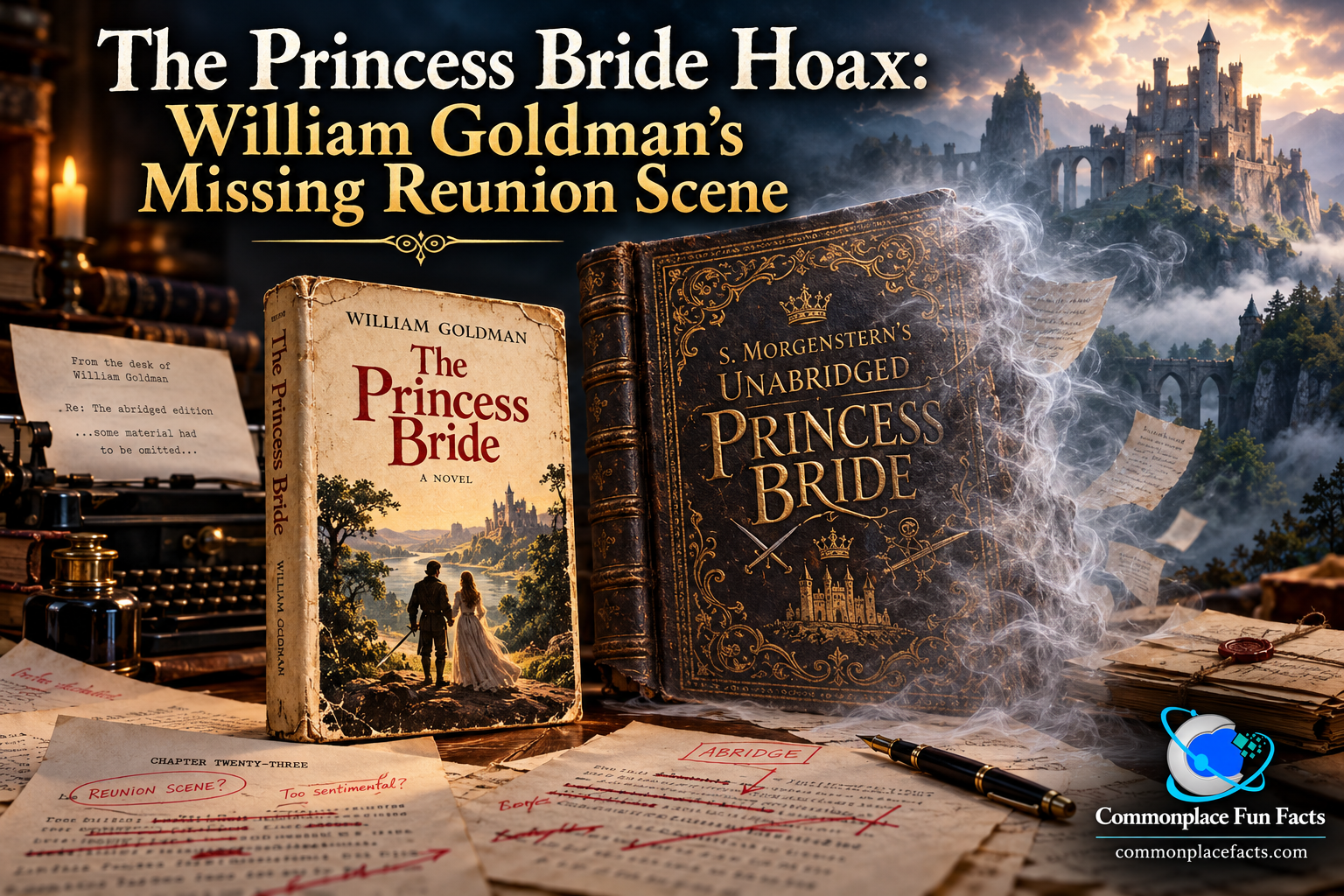

But perhaps the most inconceivable thing about The Princess Bride is that its author, William Goldman, managed to convince thousands of readers to request a scene that didn’t exist, supposedly omitted from a longer book that didn’t exist, written by an author who didn’t exist, and protected by the legal representatives of a country that didn’t exist. And when those readers actually wrote to his publisher, they received elaborate explanations involving fictional lawsuits, imaginary lawyers, and eventually an international diplomatic crisis involving NASA. Somewhere, Vizzini would have been impressed. Or possibly furious that someone had outsmarted him.
But perhaps the most inconceivable thing about The Princess Bride is that its author, William Goldman, managed to convince thousands of readers to request a scene that didn’t exist, from a book that didn’t exist, written by an author who didn’t exist, and supposedly protected by the legal representatives of a country that didn’t exist. And when those readers actually wrote to his publisher, they received elaborate explanations involving fictional lawsuits, imaginary lawyers, and eventually an international diplomatic crisis involving NASA. Somewhere, Vizzini would have been impressed. Or possibly furious that someone had outsmarted him.
Published in 1973 and adapted into the beloved 1987 film, The Princess Bride is a masterpiece of romance, adventure, and gloriously self-aware nonsense. But Goldman had another trick up his sleeve. He presented the entire novel as an abridged version of a much longer, considerably more boring work by a supposedly celebrated European author named S. Morgenstern. Then he invited readers to write to his publisher for a missing reunion scene between Buttercup and Westley. Thousands accepted the invitation, apparently reasoning that a little additional romance would be worth the price of a postage stamp.
What followed was an elaborate literary prank that continued for decades, enlisted the cooperation of real publishing employees, and proved that Goldman could make an extraordinary amount of mischief without resorting to a sword, a poison-filled goblet, or the Cliffs of Insanity. He didn’t even have to storm a castle. All he needed was an imaginary manuscript, a fictional attorney, and thousands of readers who apparently interpreted his invitation as “As you wish.”
And so began one of the most entertaining publishing hoaxes in literary history. As it turned out, true love might conquer death, but obtaining a supposedly missing chapter from William Goldman was another matter entirely.
Contents
The Princess Bride Was Supposedly an Abridgment of a Much Longer Book
When The Princess Bride appeared in 1973, Goldman presented it under the rather impressive subtitle S. Morgenstern’s Classic Tale of True Love and High Adventure: The “Good Parts” Version.

According to Goldman’s introduction, the original novel had been written by S. Morgenstern, a celebrated author from the European country of Florin. Goldman’s contribution was merely to abridge this sprawling literary masterpiece, removing the tedious material and preserving the exciting portions.
And by “tedious material,” he meant page after page of political commentary, court protocol, Florinese history, lengthy descriptions of clothing, and other subjects presumably calculated to make readers envy people who had never learned to read.
Goldman explained that he had discovered the book as a child, when he was recovering from pneumonia. His father, an immigrant from Florin, read the story aloud to him, introducing young William to the unforgettable adventures of Buttercup and Westley.
Years later, Goldman supposedly tried to share this cherished childhood favorite with his own son. Unfortunately, the boy found the book hopelessly boring.
Goldman couldn’t understand it. How could the thrilling adventure that had captivated him as a child fail to hold his son’s attention?
Then he examined the original book for himself and discovered the explanation. His father had performed an extraordinary act of literary mercy: he had simply skipped all the boring parts.
The young Goldman hadn’t heard the entire novel. He had heard a carefully selected collection of sword fights, romance, danger, adventure, and occasional giant-related complications.
Recognizing the wisdom of his father’s approach, Goldman decided to publish a new edition that would preserve only the good parts, sparing future generations the unnecessary burden of Florinese constitutional history.
It was an inspiring story about a father’s love, the power of literature, and the importance of knowing when to skip a few hundred pages.
There was just one problem.
None of it was true.
Meet S. Morgenstern, the Greatest Author Who Never Lived
S. Morgenstern was entirely fictional. So was the country of Florin, at least as a real-world nation, along with neighboring Guilder and the supposedly monumental literary heritage from which Goldman was drawing.
There was no original thousand-page manuscript. There were no tedious Florinese political discussions to remove. There was no elderly European author whose literary masterpiece had been ruthlessly shortened by an American screenwriter with a suspiciously low tolerance for exposition.

Goldman wrote the whole thing himself.
Even the autobiographical material was part of the fiction. The supposed childhood illness, the father’s reading sessions, and the son who couldn’t appreciate the classic were elements of a fictionalized version of Goldman’s own life.
In reality, Goldman had two daughters, not the son described in his introduction. In a 2011 oral history of The Princess Bride, he explained that the idea originated when he asked his young daughters what they wanted him to write about. One requested a princess; the other wanted a bride.
Goldman combined the requests, and the title was born.
The fictional abridgment provided a clever narrative device. Goldman could interrupt the story to offer observations about characters, explain why certain sections had supposedly been omitted, complain about the original author’s literary decisions, and generally behave like an editor who had developed an unhealthy personal relationship with his assignment.
The result was a story operating on two levels: the fairy tale itself and the running commentary of a narrator who insisted he was merely improving somebody else’s work.
The technique wasn’t entirely unlike the historical literary deceptions we’ve encountered elsewhere. In the story of William Henry Ireland’s remarkable Shakespeare forgeries, an ambitious young man invented an entire collection of supposedly lost Shakespeare manuscripts and eventually wrote a fake Shakespeare play.
Goldman went one better. Instead of forging a lost manuscript, he invented the author, the manuscript, the nation that produced it, and the editorial controversy surrounding its publication.
Then he invited readers to become participants.
The Missing Reunion Scene That Started Everything
Partway through The Princess Bride, Buttercup discovers that the mysterious Man in Black is actually Westley, the farm boy she has loved and believed dead for years.
This is a reasonably significant moment. The lovers have been separated by circumstances, deception, danger, and various people who would benefit greatly from attending a course on healthy interpersonal relationships.

Readers might understandably expect a heartfelt reunion, complete with passionate declarations and perhaps a few explanations concerning Westley’s recent career choices.
Instead, Goldman interrupts the story.
He informs readers that Morgenstern, for reasons known only to himself, neglected to provide a satisfactory reunion scene. According to Goldman, this omission had bothered him enough that he decided to write the scene himself.
Unfortunately, his editor supposedly refused to allow it.
Goldman’s role, he was told, was to abridge Morgenstern’s original text, not to insert entirely new material. The fact that the original author had apparently failed to provide one of the most emotionally important scenes in the entire novel was unfortunate but irrelevant. Editorial principles had to be maintained.
Goldman, however, claimed to have negotiated a compromise. Although he couldn’t include his additional reunion scene in the published book, anyone who wanted to read it could simply write to the publisher and request a copy.
He provided the publisher’s mailing address.
And, being William Goldman, he couldn’t resist turning the offer into another joke. He encouraged readers to request the scene even if they weren’t particularly interested in receiving it. After all, the publisher had agreed to pay the postage, and Goldman was irritated that the company hadn’t spent enough money promoting his work. Making the publisher pay to mail out thousands of copies of his additional scene would therefore provide a modest but satisfying measure of revenge.
There was something wonderfully appealing about this arrangement. Readers would receive a missing chapter, the author would settle a score with his publisher, and the publishing company would incur an unnecessary expense.
Everybody won, except the people responsible for the postage budget.
There was, of course, one rather substantial obstacle.
The reunion scene did not exist.
Readers Actually Wrote to the Publisher
Goldman apparently regarded the offer as another joke within his already elaborate fictional framework. The original book didn’t exist, its author didn’t exist, and the supposedly suppressed scene was yet another invention.
Surely readers would understand that.

Readers did not universally understand that.
Or, in some cases, they understood perfectly well and decided to play along.
Either way, people began writing to the publisher requesting their copies of the missing reunion scene. Actual letters. Sent through actual postal services. Addressed to actual publishing employees, who presumably had other responsibilities besides assisting a novelist in perpetuating a fictional dispute with a nonexistent author. The requests came from across the United States and even overseas, demonstrating that Goldman’s imaginary literary controversy had achieved something approaching international recognition.
The requests were sufficiently numerous that the publishers developed a system for responding to them.
In October 1987, shortly after the release of the film adaptation, the Los Angeles Times published a remarkable account of the phenomenon.
According to the newspaper, the paperback publisher had been receiving approximately 100 requests every week before the film’s release. The hardcover publisher, Harcourt Brace Jovanovich, had been receiving about half a dozen weekly requests.
Then Rob Reiner’s movie arrived in theaters in September 1987, introducing an enormous new audience to Buttercup, Westley, and their assorted companions.
The number of requests to the paperback publisher jumped to approximately 400 to 500 per week.
Think about that for a moment.
A novel published fourteen years earlier was generating hundreds of weekly requests for an imaginary scene from an imaginary edition of an imaginary book.
There are marketing departments today that would happily sacrifice a considerable portion of their budgets to achieve that level of audience engagement. Goldman accomplished it with a joke and a mailing address.
And the publisher actually answered the letters.
Enter Kermit Shog, Attorney for the Nonexistent Author
Readers who requested the missing scene did receive something in return.
Unfortunately, it wasn’t a reunion between Buttercup and Westley.
Instead, they received a letter supposedly written by Goldman himself, explaining that unforeseen legal complications had prevented the scene’s distribution.
The problem, it seemed, was a lawyer named Kermit Shog.
Shog represented the estate of S. Morgenstern, the original author, and he was furious about Goldman’s unauthorized interference with his client’s literary masterpiece.
According to the letter, Shog had confronted Goldman’s publisher, William Jovanovich, and demanded that the original, unabridged edition be published. The legal situation had become so complicated that Goldman was unable to release his additional reunion scene without risking further litigation.
The reader was assured that the scene would eventually become available, but only after the legal difficulties had been resolved.

Goldman’s fictional correspondence described meetings with lawyers, negotiations with the publishing company, and a rapidly expanding number of lawsuits. At one point, there were thirteen lawsuits, eleven of which supposedly involved Goldman personally.
At this point, occasional bursts of unsettling laughter can be heard emanating from the Pit of Despair otherwise known as the Commonplace Fun Facts Legal Department. Attorneys, it seems, have a certain professional appreciation for the brilliance of inventing a lawyer whose principal accomplishment is preventing something from happening.
In this case, however, the lawyer wasn’t merely delaying the publication of a scene. He was preventing the publication of a scene that had never been written, on behalf of the estate of a man who had never lived.
One suspects that Kermit Shog’s billable hours were equally imaginary, although they were probably quite impressive.
The important thing was that the letter gave readers something tangible. They had written to the publisher and received a response that appeared to confirm the existence of the dispute.
Rather than revealing the original deception, Goldman had expanded it.
And the legal complications were only beginning.
The Copyright Would Expire in 1978. Or Was That 1987?
Goldman’s initial response letter offered a reason for optimism.
Although litigation was delaying the reunion scene, Morgenstern’s copyright was supposedly scheduled to expire in early 1978. Once that happened, the legal obstacles would disappear, and readers could finally receive the eagerly anticipated material.

That seemed reasonable enough, provided one overlooked the fictional author, nonexistent country, and complete absence of an actual reunion scene.
But when 1978 arrived, Goldman encountered a problem.
Some readers had retained the original correspondence. They remembered the promised expiration date. And they wanted their reunion scene.
Goldman responded by adding a postscript to his letter, dated August 1978.
It turned out there had been a mistake.
The copyright wasn’t expiring in 1978 after all. According to Goldman’s revised explanation, Mr. Shog, being Florinese, had encountered some difficulty with the American numbering system. The actual expiration date was supposedly 1987, not 1978. Apparently, the distinction between those two years had escaped the attention of everyone involved in the litigation, including the lawyers whose professional responsibilities presumably included knowing what year it was.
Readers would simply have to wait another nine years.
To make matters worse, Kermit Shog had died, leaving the legal proceedings in the hands of his son, Mandrake Shog.
Apparently, fictional litigation could be inherited just like any other family business.
Goldman had now transformed what began as a joke about a missing literary passage into a continuing legal drama with a second-generation antagonist and a revised timetable.
Naturally, readers continued writing.
Then NASA Got Involved. Because Apparently This Wasn’t Complicated Enough.
By 1987, the revised copyright deadline had finally arrived. Surely this would be the moment when readers could receive the scene they had been promised fourteen years earlier. With the supposed legal complications finally behind them, there seemed to be no conceivable reason for further delay. Unfortunately, Goldman had other ideas, and his next excuse would involve an international diplomatic crisis, a strategically important mineral, and an unlikely contribution from NASA.
In May 1987, he added another postscript explaining that the United States was experiencing a diplomatic and trade dispute with Florin.
The fictional European country, it turned out, was America’s leading supplier of a substance called “Cadminium,” which NASA urgently needed.
Consequently, Florinese-American litigation had been suspended while the two countries worked through their trade difficulties.
The reunion scene was once again unavailable.
To appreciate the full absurdity, consider the sequence of events. A writer invented a European nation and one of its celebrated authors. He claimed to have abridged that author’s masterpiece, then invented an additional scene that his publisher supposedly refused to print. Readers requested the scene, prompting the invention of a lawyer who filed lawsuits to prevent its distribution.
When the original copyright deadline passed without producing the promised scene, the lawyer’s son inherited the dispute. And when the revised deadline finally arrived, a fictional international trade crisis involving NASA provided yet another reason to withhold the missing material. One begins to suspect that Goldman was less interested in resolving the dispute than in discovering how many increasingly ridiculous explanations his readers would tolerate.
By this point, Buttercup and Westley had encountered fewer obstacles to their romantic reunion than the readers attempting to obtain an account of it.
The really entertaining part is that Goldman didn’t merely describe these complications in interviews. They appeared in the letters that actual readers received from actual publishers.
The fantasy had developed its own correspondence department.
Not Everyone Was Fooled, But That Didn’t Stop Them From Writing
It would be tempting to conclude that thousands of readers simply failed to recognize an obvious joke.
But the real story is somewhat more interesting.

The 1987 Los Angeles Times article described readers who genuinely believed that Morgenstern’s original book existed. Some wrote asking where they could obtain an unabridged edition. Others inquired about Buttercup’s Baby, a supposed sequel Goldman had introduced into his fictional literary history. Interestingly, Goldman eventually did produce an actual sample chapter of Buttercup’s Baby, which appeared in the 1998 twenty-fifth-anniversary edition of The Princess Bride. The complete sequel, however, never materialized. Evidently, the publishing difficulties surrounding S. Morgenstern’s literary estate were contagious.
One reader from Pennsylvania wrote requesting the reunion scene partly because he hoped to prove to his skeptical wife that the publisher would honor the offer printed in its book.
This was a man who had turned a fictional literary controversy into a test of marital credibility.
We can only hope his wife was gracious about the result.
But other readers clearly understood that Goldman had invented the entire thing. A young reader from England acknowledged in her letter that Goldman had written the book himself and probably had no intention of providing the reunion scene. She nevertheless wanted to find out what the publisher would send.
Another reader was reportedly delighted to receive the fictional legal explanation because it amounted to several more pages of William Goldman writing.
And there lies an important distinction.
For some readers, the letter was evidence that they had been deceived. For others, it was an invitation to continue participating in the joke.
Goldman had created something rather unusual: a fictional world whose boundaries extended beyond the book itself. Readers could mail a letter to a real business and receive a new installment in a story that was supposedly happening in the real world.
It was interactive storytelling long before anyone needed a computer, an app, or a monthly subscription to participate.
Readers merely required an envelope, a stamp, and the willingness to take an obviously unreliable narrator at his word.
Our earlier examination of Reginald Bray, the British eccentric who spent decades testing the limits of the postal system, demonstrated what could happen when one determined individual treated ordinary mail service as an elaborate practical joke.
Goldman discovered a different possibility: he could persuade thousands of other people to participate in his postal experiment voluntarily.
And unlike Bray, he didn’t even have to leave his desk.
Goldman Was Astonished by the Response
When the Los Angeles Times interviewed Goldman in October 1987, the author admitted that the continuing flood of requests had surprised him.
He explained that when he originally wrote the passage, he hadn’t expected readers to take him up on the offer. The idea that people would actually write to the publisher and receive an answer struck him as astonishing.
By then, however, the joke had acquired a life of its own.
Publishing employees were fielding the correspondence, preparing replies, and mailing out Goldman’s invented legal explanations. The request volume had increased dramatically following the film’s release, and the original literary joke had become an enduring feature of the book’s relationship with its readers.
One particularly delightful detail from the newspaper’s reporting was that many readers enclosed self-addressed, stamped envelopes, even though Goldman’s original offer specified that the publisher would pay for postage.
He had encouraged them to write specifically to cost the publisher money.
They were so eager to obtain the missing scene that they voluntarily paid the expense themselves.
There cannot be many instances in literary history in which a novelist attempted to annoy his publisher through a fictional giveaway, only to discover that his readers were too considerate to cooperate properly. Goldman had devised an ingenious scheme to make his publisher pay for thousands of unnecessary mailings, but his audience apparently insisted on subsidizing the operation. Even an elaborate literary hoax can run into trouble when confronted by excessive good manners.
Did the Missing Reunion Scene Ever Appear?
No. Not as the promised standalone scene that readers were requesting.
The letter explaining its continued unavailability became the real bonus material, and Goldman continued elaborating the fictional legal troubles in later editions of the novel.
Eventually, newer editions even directed readers toward an internet address where the reunion scene was supposedly available. The electronic age, however, did not improve the prospects for Buttercup and Westley. The promised material remained another version of Goldman’s elaborate explanation for why the actual scene could not be provided.
The joke even survived the transition to the internet. Later editions directed readers to a website where the long-awaited reunion scene was supposedly available, but the promised revelation merely led to additional installments of Goldman’s increasingly elaborate publishing controversy. A published compilation of Goldman’s reunion-scene correspondence preserves the fictional legal complications, including the Shog family’s involvement and the improbable international trade dispute. Readers seeking further details can also consult this discussion of the missing scene and its later online incarnations.
The truly impressive part was Goldman’s refusal to resolve the deception in the conventional manner. He could have revealed everything in the first response and congratulated readers for falling for his joke.
Instead, he rewarded their curiosity with another installment of fiction.
The nonexistent scene became a recurring character in its own right: always anticipated, frequently discussed, and perpetually unavailable.
It was a romantic reunion governed by the principles of an exceptionally inefficient bureaucracy.
Why The Princess Bride Hoax Worked So Well
Literary hoaxes were nothing new when Goldman published The Princess Bride.
In 1835, the New York Sun persuaded readers that astronomers had discovered remarkable creatures living on the moon, including humanoid beings with wings and beavers that walked on two legs. As we explored in the Great Moon Hoax of 1835, the trick worked partly because the newspaper wrapped its fantastical inventions in the language and presentation of legitimate scientific reporting.
Goldman used a similar technique, substituting the respectable conventions of literary scholarship and publishing for the authority of scientific journalism.
He supplied a fictional source text, a famous but obscure foreign author, a plausible editorial explanation, and personal anecdotes establishing why he was uniquely qualified to prepare the shortened edition.
Then he added publishing disputes, copyright questions, lawyers, correspondence, and promises of material unavailable to ordinary readers.
Every new layer made the fictional literary history feel more substantial.
The genius was that Goldman never required readers to believe everything. They could recognize the absurdity, laugh at the narrator’s self-importance, and still enjoy treating the imaginary reunion scene as something they might actually obtain.
In other words, the joke operated whether readers believed it or not.
Those who were fooled became part of the story. Those who understood the joke could participate knowingly. And those who simply wanted a little more of Goldman’s writing received exactly that, even if it wasn’t the scene they had requested.
The book’s fictional framework had become an ongoing relationship between author and audience.
That is a rather impressive accomplishment for a passage that was supposedly missing.
The Greatest Scene That Was Never Written
William Goldman died in 2018, leaving behind an extraordinary body of work that included the screenplays for Butch Cassidy and the Sundance Kid, All the President’s Men, and, of course, The Princess Bride.
His novel remains beloved for its humor, romance, sword fights, memorable characters, and affectionate treatment of the fairy-tale tradition. The 1987 film introduced the story to generations of viewers who may never have encountered the book’s wonderfully unreliable editorial narrator.
But the missing reunion scene deserves recognition as one of Goldman’s finest jokes.
After all, most authors are happy when readers become emotionally invested in scenes they have actually written. Goldman persuaded thousands of people to become invested in a scene he merely claimed to have written.
He then convinced them to contact a publisher, which responded with an entirely new piece of fiction explaining why they couldn’t have it.
Over the following years, that explanation expanded to include a fictional lawyer, his equally fictional son, thirteen lawsuits, a copyright dispute, diplomatic complications, and a strategically important mineral that NASA supposedly couldn’t do without.
All of which raises an interesting question.
Did Goldman really omit the reunion scene, or was the elaborate business of requesting it, waiting for it, and never receiving it the reunion scene’s actual purpose?
Perhaps the missing passage was never supposed to be read. Perhaps it existed simply to demonstrate that the most entertaining parts of a story aren’t always the parts printed between the covers.
Or perhaps Goldman just thought it would be funny to make his publisher answer thousands of unnecessary letters.
Given everything else we know about the man, there’s a good chance that both explanations contain some truth.
And somewhere in the nonexistent country of Florin, one imagines that the estate of S. Morgenstern is still reviewing its legal options.
Probably at $450 per hour.
You may also enjoy…

Jonathan Swift’s Dead Astrologer Hoax: The Joke That Killed John Partridge While He Was Still Alive
Jonathan Swift’s infamous hoax convinced England that astrologer John Partridge was dead—even while he was still alive. Discover the bizarre true story behind Isaac Bickerstaff.

The Great Moon Hoax of 1835: Two-Legged Beavers, Winged Moon Men, and One Seriously Salty Edgar Allan Poe
Explore the bizarre 1835 Great Moon Hoax that captivated readers with tales of lunar beavers and bat-men—and discover why Edgar Allan Poe thought it was all a rip-off of his own sci-fi satire.

Filippo Brunelleschi’s Fat Woodworker Prank: History’s Greatest Practical Joke Explained
Discover the bizarre true story of Filippo Brunelleschi’s prank of The Fat Woodworker—one of the strangest and cruelest practical jokes in history.
Leave a Reply