
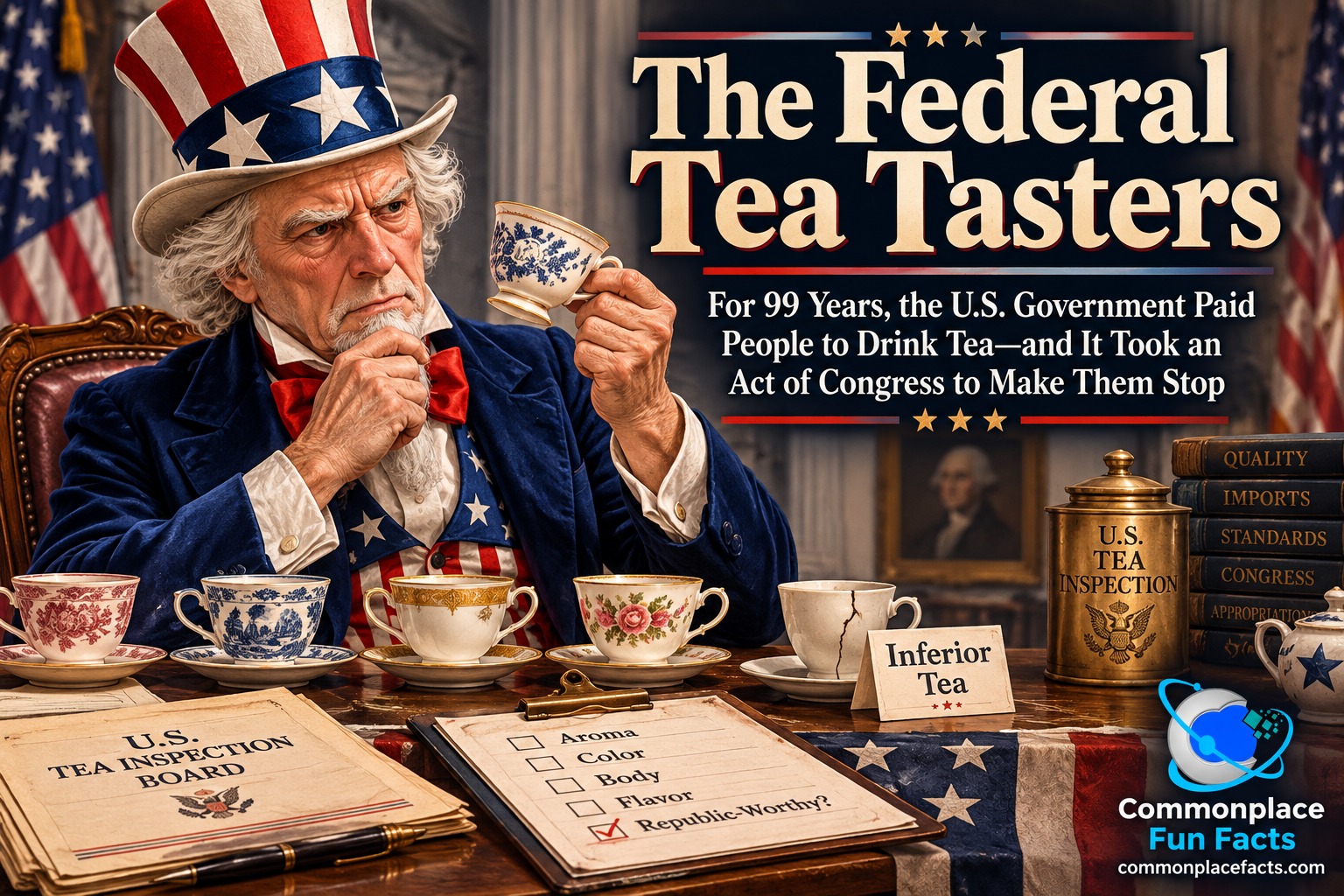

Throughout American history, the federal government has employed people to perform some rather unusual jobs. There have been officials responsible for inspecting meat, counting agricultural products, testing experimental weapons, and determining whether various substances qualify as dangerous chemicals.
But for nearly a century, the United States maintained a particularly specialized profession: federal employees whose official responsibilities included drinking tea and deciding whether it tasted good enough for the American public.
The federal tea tasters weren’t volunteers conducting an informal taste test in somebody’s kitchen. They were government employees operating under a federal law, examining samples of imported tea and comparing them with officially approved standards. If a shipment failed to measure up, the government could refuse to let it enter the country.
The program lasted from 1897 until 1996. It survived multiple presidential administrations, repeated efforts to abolish it, and increasingly awkward questions about whether taxpayers really needed to employ professional federal tea tasters.
It even produced a United States Supreme Court decision establishing important principles of federal regulatory authority. The nation owed its birth, in part, to disagreements over the taxation of tea. Yet more than a century after Americans fought a revolution over such matters, a disagreement over the quality of a cup of tea still couldn’t be resolved without involving all three branches of the federal government.
Contents
America’s Complicated Relationship With Tea
Americans have had a somewhat turbulent relationship with tea since the country’s earliest days. In 1773, a group of colonists demonstrated their dissatisfaction with British taxation by dumping hundreds of chests of tea into Boston Harbor. It was an expensive protest, although presumably less expensive than whatever it would cost to remove the resulting tea stains from the Atlantic Ocean.

As we’ve previously explored in our account of the Pine Tree Riot of 1772, colonial Americans had already shown considerable enthusiasm for confronting British authority over seemingly ordinary commodities. Tea simply became the more famous example.
Despite the Boston Tea Party, Americans never abandoned the beverage altogether. During the nineteenth century, growing international trade brought increasing quantities of tea into the United States, particularly from China and other Asian markets.
Unfortunately, some of that tea was dreadful.
The problem wasn’t merely that different consumers preferred different flavors. Imported tea sometimes contained exhausted leaves, adulterants, or other materials that reduced its quality or made it unsuitable for consumption. Some shipments were so inferior that respectable merchants had difficulty selling them.
Congress first addressed the problem with legislation in 1883 prohibiting the importation of adulterated and spurious tea. The law targeted tea containing objectionable substances or leaves that had already surrendered their useful qualities through previous brewing or processing.
That was a reasonable starting point, but it left another problem unresolved. What about tea that was technically genuine and safe to drink but tasted as though it had been prepared by someone who had only heard rumors about what tea was supposed to be?
Congress decided the nation needed higher standards.
The Tea Importation Act of 1897: Congress Develops a Discriminating Palate
On March 2, 1897, President Grover Cleveland signed the Tea Importation Act, establishing a more elaborate federal system for regulating imported tea. The legislation was enacted just two days before Cleveland left office, suggesting that America’s beverage-related difficulties were sufficiently pressing to demand attention even during the closing hours of a presidential administration.

The statute prohibited importing tea that fell below established standards of purity, quality, and suitability for consumption. Unlike the earlier law, it expressly permitted the government to reject tea because of inferior quality, even if it was otherwise genuine.
The distinction was important. The government was no longer concerned exclusively with whether tea was safe. It was also determining whether the tea was sufficiently respectable to be offered for sale.
To carry out this responsibility, Congress created a seven-member Board of Tea Experts. The members were specialists in the tea trade, appointed to recommend standards for the various categories of imported tea.
Under the original law, each board member was entitled to $50 per year for these services, along with necessary expenses. For that compensation, they helped establish the minimum standards governing a product consumed by millions of Americans.
The government didn’t expect everyone to drink premium tea, of course. That would have been both economically unrealistic and rather inconsistent with the American tradition of purchasing the cheapest available product and complaining about its quality afterward.
Instead, the Board of Tea Experts was supposed to identify the lowest acceptable standard for each major variety. Anything falling below that level could be excluded from the American market.
This was an unusually early example of national food-quality regulation. The Tea Importation Act preceded the landmark Pure Food and Drugs Act of 1906 by nine years, and the history of American food standards reveals just how unusual this arrangement was before comprehensive federal regulation became the norm.
And unlike many government programs, this one required its administrators to demonstrate an ability that couldn’t be measured entirely with paperwork.
They had to possess genuinely sophisticated taste buds.
How the Federal Government Conducted Its Official Tea Parties
The Board of Tea Experts and the federal tea examiners performed different functions. The board recommended the minimum standards, while government inspectors compared incoming shipments with the approved samples.

Originally, the program operated under the Treasury Department, which supervised customs enforcement. Over time, responsibility shifted through the federal bureaucracy until the Food and Drug Administration administered the system.
By the late twentieth century, the board generally met annually for two days to evaluate samples and recommend standards for the coming year. These recommendations covered different kinds of tea, including black, green, oolong, scented, and spiced varieties.
The process was not substantially different from the techniques used by professional tea buyers. An examiner would measure a precise amount of tea, add boiling water, allow it to steep, and assess its appearance, aroma, and flavor.
Official tasters examined both the liquid and the wet leaves. They smelled the brewed tea, observed its color, and sampled it from a spoon, often making a pronounced slurping noise designed to distribute the liquid across the palate.
Afterward, they generally spat the tea into a receptacle rather than swallowing it.
Spitting it out didn’t necessarily mean the tea was terrible. Professional tasters evaluating dozens or hundreds of samples need to avoid consuming excessive quantities of caffeine. There is only so much professional enthusiasm one can maintain while experiencing the physiological equivalent of being plugged directly into a power station.
In a 1989 account of the annual tea-tasting proceedings, the examiners were described as working around a rotating wooden table covered with cups, kettles, and carefully prepared samples.
The board members were not judging whether the tea was exceptional. They were trying to identify tea that was just good enough.
That is a remarkably specific professional ambition. Most people go to work hoping to achieve excellence; federal tea experts went to work searching for the precise boundary between acceptable mediocrity and unacceptable disappointment.
The judgments of the federal tea tasters mattered because the Tea Importation Act had teeth. Shipments falling below the required standards could be denied entry. Importers had procedures for challenging those decisions, but rejected tea ultimately had to be exported or, under the applicable statutory procedures, destroyed.
In other words, disappointing tea could receive the sort of government treatment ordinarily reserved for contraband.
Meet Robert H. Dick, the Man Who Had a Federal License to Slurp
One of the most memorable figures in the program’s final decades was Robert H. Dick, a longtime federal chemist and tea examiner who became the government’s leading authority on the quality of imported tea.
By 1989, Dick was 75 years old and in his fifty-second year of federal service. He had been the nation’s chief tea examiner for more than three decades, developing an extraordinary familiarity with a beverage that most Americans probably evaluated using the considerably less scientific standard of whether it was still hot.
Dick worked in the FDA’s Brooklyn facilities, where his office was known as the Tea Room. It contained an assortment of tea containers, pictures of ships and tea-growing regions, kettles, cups, and equipment used in the examination process.
His assistant, Faith Lim, helped conduct the daily evaluations. During particularly busy periods, the two reportedly examined as many as 300 cups of tea in a single day.
That’s an impressive workload, although it does raise questions about how the employees explained their occupation at social gatherings.
Someone else might announce that they were an accountant, a schoolteacher, or an engineer. Dick could explain that the federal government paid him to spend his days slurping tea and determining whether it was sufficiently good to permit Americans to drink it.
And, unlike most people making such a claim, he could produce the relevant statutory authority.
Of course, this raises an important question: Was Dick allowed to take the occasional coffee break? One suspects that might have required a special exemption from the Board of Tea Experts.
The volume of work was substantial. In 1989, Dick and Lim reportedly tasted more than 25,000 samples annually, while another federal tea examiner handled approximately 13,000 more in New Orleans.
By the mid-1990s, the FDA still received tens of thousands of imported tea samples each year. Although the statute contemplated examining every imported lot, declining staffing levels had made that requirement increasingly difficult to fulfill consistently.
The specialists took the assignment seriously. Dick could distinguish subtle differences in flavor, aroma, and appearance, and he understood the commercial implications of even modest changes in the government’s standards.
There was also a peculiarity built into the system. Many of the people serving on the Board of Tea Experts came from the tea industry itself. They were effectively helping to establish the minimum quality standards that their own companies and competitors would have to satisfy.
Dick expressed concern that industry representatives sometimes preferred weaker standards because higher standards increased the likelihood of having their merchandise rejected.
It was an early illustration of a familiar regulatory dilemma: asking an industry to help regulate itself can produce exceptionally knowledgeable advisers, but those advisers may also have a professional interest in keeping the rules comfortably achievable.
In the case of tea, that meant the difference between a robust, flavorful beverage and something that could just barely satisfy a federal examiner.
When Eight Packages of Bad Green Tea Went to the Supreme Court
The most consequential chapter of this story began on January 20, 1902, when eight packages of green tea arrived in New York aboard the steamship Adana.
The tea belonged to a firm whose general partner was William Buttfield. It was classified as a type known as Country green tea and was submitted for the required federal examination.
On February 7, government inspectors rejected the shipment as inferior to the applicable quality standard.
Here is what makes the dispute particularly fascinating: the tea was not shown to be poisonous, contaminated, or fraudulent. The evidence described it as genuine tea that was simply inferior in flavor and overall drinking quality.

In other words, the government wasn’t saying that the tea would kill anyone. It was saying that Americans shouldn’t have to drink something that disappointing. That clearly was before the days of public school lunch programs or the sketchy waffle place a few blocks from the Commonplace Fun Facts editorial offices.
Buttfield appealed the rejection, but the reviewing officials upheld the decision. He subsequently sought permission to withdraw the tea for sale or to export it, but the statutory deadline for removing the rejected merchandise had passed.
The government was preparing to destroy the shipment.
Understandably, Buttfield objected to losing his property merely because federal employees disliked the taste of it. He filed suit against Nevada N. Stranahan, the collector of customs for the Port of New York, challenging the government’s actions and the constitutionality of the underlying statute.
The dispute eventually reached the Supreme Court as Buttfield v. Stranahan, 192 U.S. 470 (1904).
The case presented several substantial constitutional questions. Could Congress prohibit the importation of a product that was genuine and fit for consumption simply because it was below an established quality standard? Could Congress authorize executive officials to develop those standards? And could the government refuse admission to the merchandise and enforce the statutory deadline for its removal without violating constitutional protections?
These were serious questions involving federal authority over foreign commerce, the delegation of legislative responsibilities, and due process of law.
They also arose because somebody tried to import eight packages of mediocre green tea.
On February 23, 1904, the Supreme Court upheld the statute.
Writing for the Court, Justice Edward Douglass White explained that Congress possessed extensive constitutional authority to regulate foreign commerce, including the power to establish conditions governing which products could enter the United States.
The Court also rejected the argument that Congress had improperly transferred its lawmaking authority to executive officials. Congress had determined the legislative policy of excluding inferior tea; the executive branch was carrying out that policy by establishing and administering appropriate standards.
The Court did not independently determine that the rejected tea tasted terrible. Rather, it concluded that Congress could constitutionally establish minimum quality requirements and authorize federal officials to enforce them.
That distinction is worth remembering. The Supreme Court wasn’t announcing that nine justices possessed uniquely refined palates. It was affirming the government’s authority to establish and administer standards under a law enacted by Congress.
The ruling became an important early decision in the development of American administrative law, helping define the circumstances under which Congress could authorize executive agencies to implement statutory policy.
This was hardly the last time the Supreme Court would find itself resolving an argument about food. As we discovered in our examination of whether a tomato is legally a fruit or a vegetable, the justices have occasionally been required to decide questions that would normally seem more appropriate for a grocery store than a constitutional tribunal.
Indeed, Buttfield v. Stranahan would fit comfortably alongside the cases in our collection of 11 of the strangest Supreme Court cases in American history.
The significance of the tea case, however, extended far beyond the contents of the disputed shipment. Its reasoning helped establish legal principles that would influence federal regulation long after the government stopped employing professional tea tasters.
One suspects Buttfield would have preferred a less consequential disagreement, along with permission to sell his tea.
The Federal Tea Tasters Survive Presidential Attempts to Fire Them
As the twentieth century progressed, federal food regulation expanded considerably. The Pure Food and Drugs Act of 1906 and the Federal Food, Drug, and Cosmetic Act of 1938 established increasingly comprehensive systems for addressing unsafe, adulterated, and improperly labeled foods.
That created an increasingly awkward question: Why did the United States still need a separate program devoted specifically to the taste of imported tea?

By the 1970s, the federal tea-tasting operation was attracting criticism as an example of an unnecessary government program. President Richard Nixon’s administration explored eliminating it, and the Carter administration also attempted to do away with the arrangement.
Neither succeeded.
The program continued operating while presidents came and went, government departments were reorganized, and regulatory policies changed. Whatever else might happen in Washington, the Board of Tea Experts remained prepared to assemble and discuss whether the latest shipment of oolong measured up.
President Bill Clinton renewed the effort to eliminate the program in 1993 during a review of federal advisory boards and government efficiency.
Still, getting rid of it proved surprisingly complicated. Congress had created the Board of Tea Experts by statute, and the law continued requiring federal officials to establish standards for imported tea.
Simply declining to pay for the board wouldn’t repeal the underlying legal obligation.
That problem became especially apparent in 1995, when Congress restricted federal funding for the board. The FDA was nevertheless confronted with the continuing legal duty to establish tea standards and had to consider alternative ways of carrying out the law.
It was a wonderful example of governmental efficiency: one federal action attempted to eliminate the expense of a program while another federal law continued requiring the program’s responsibilities to be performed.
For anyone who has ever wondered why changing a law sometimes requires more paperwork than implementing it in the first place, the federal tea-tasting program provides an unusually fragrant case study.
How Much Was the Federal Tea-Tasting Program Costing?
By the 1990s, the tea-tasting operation was modest by federal budget standards, but its continued existence invited legitimate questions about whether the government should be responsible for enforcing minimum flavor requirements.
At the time of its elimination, the program reportedly cost approximately $253,500 annually. Its final staff included Robert H. Dick and Faith Lim in Brooklyn, along with tea tasters working in Boston and San Francisco.
That wasn’t an enormous expenditure compared with most federal programs. Nevertheless, it was a substantial amount to spend determining whether tea tasted acceptable when the government already possessed broader authority to prevent the sale of unsafe food.
The scale of the underlying industry was considerably larger. In fiscal year 1994, the United States imported approximately 209 million pounds of tea, valued at roughly $136 million.
The government also collected inspection fees on imported tea. Congress had increased the authorized fee from 3.5 cents to 10 cents per hundredweight in 1993, but the Customs Service continued collecting the lower rate because the corresponding tariff schedule had not been updated.
As a result, the government collected approximately $70,000 annually rather than the roughly $200,000 that would have resulted from the increased rate.
Even the mechanism for collecting the tea-tasting fees had developed its own administrative complications.
By 1996, lawmakers concluded that whatever useful purpose the special standards had served in 1897, they were no longer sufficiently distinct from modern food regulation to justify the separate program.
As the congressional report accompanying the repeal legislation explained, tea was the only food or beverage subject to this particular system of mandatory lot-by-lot quality testing against standards recommended by a federal advisory board.
Coffee didn’t require a federal panel to determine whether it tasted good enough. Neither did ordinary instant tea, which was regulated under the general food laws rather than the specialized Tea Importation Act.
Congress finally decided it was time for tea to receive similar treatment.
Congress Finally Pulls the Plug on the Federal Kettle
On April 9, 1996, President Bill Clinton signed Public Law 104-128, formally titled the Federal Tea Tasters Repeal Act of 1996.

The legislation was refreshingly brief. It repealed the Tea Importation Act of 1897 and provided that the repeal would take effect immediately.
With that signature, the Board of Tea Experts ceased to exist as a matter of law, and the specialized federal system for grading imported tea came to an end.
After 99 years, the United States government was officially out of the business of deciding whether imported tea was sufficiently enjoyable.
That didn’t mean Americans were suddenly left defenseless against unsafe tea. The FDA retained its authority under the Federal Food, Drug, and Cosmetic Act to regulate imported tea under the ordinary rules governing food safety, adulteration, labeling, and other applicable requirements.
The change was more specific. The federal government would no longer insist that imported tea satisfy a special, annually established standard of flavor quality before it could enter the country.
Consumers would instead be left to determine for themselves whether a particular brand tasted good, bad, or like something that had been swept from the floor of a nineteenth-century warehouse.
The government could still protect them against hazardous products. Avoiding regrettable shopping decisions was now largely their own responsibility.
As for the tea tasters themselves, their highly specialized federal occupation had finally reached its end. Dick, who had spent much of his career evaluating imported tea, retired shortly after the law was repealed.
A government job that had survived nearly a century of political and administrative change had finally been eliminated by an act of Congress.
Or so one might reasonably have believed.
The Board of Tea Experts Makes One Final Appearance—in 2023
The story should end in April 1996. Congress repealed the law, President Clinton signed the legislation, and the federal tea-tasting program ceased to exist.
But there was one last administrative detail.
On September 19, 2023, the Food and Drug Administration published a final rule removing the Board of Tea Experts from its list of standing advisory committees.
That’s right. Twenty-seven years after Congress abolished the Board of Tea Experts, the FDA formally updated its regulations to remove the board’s name.
To be clear, the board had not secretly continued meeting throughout those intervening decades. It had legally ceased to exist in 1996. The 2023 action was an administrative cleanup, not a second abolition.
Still, there’s something irresistible about a federal regulatory notice announcing that a government committee abolished during the Clinton administration should finally be removed from the official list of committees.
The FDA explained that the change was a technical amendment to bring its regulations into conformity with existing law. Because the board had already been abolished, the agency concluded that ordinary notice-and-comment procedures were unnecessary.
That was probably a sensible decision. After all, it would have been difficult to solicit meaningful comments from a board that had not existed for nearly three decades.
The paperwork had finally caught up with reality.
The Government’s Last Cup of Tea
The federal tea-tasting program is easy to dismiss as one of those peculiar government operations that continued long after its original justification had become questionable. By the time Congress repealed the statute in 1996, the United States possessed extensive food-safety laws that could protect consumers without employing specialists to evaluate the subtleties of tea flavor.
But that perspective overlooks an important part of the story.
When Congress enacted the Tea Importation Act in 1897, the country had no comparable comprehensive federal food regulatory system. Imported products could be adulterated, deceptively marketed, or so inferior in quality that ordinary consumers had little practical means of determining what they were purchasing.
The tea standards were part of an early effort to address those problems. They also represented a partnership between government and commercial experts, combining trade knowledge with federal enforcement authority.
That arrangement helped produce an important Supreme Court decision about the permissible scope of federal regulation and the authority Congress could assign to administrative officials.
Over time, however, the regulatory environment changed. The distinction between protecting consumers against dangerous food and protecting them against unappealing food became increasingly important.
In 1897, Congress decided that Americans needed federal protection against inferior tea. In 1904, the Supreme Court confirmed that Congress had the constitutional authority to provide it. In 1996, Congress decided that Americans could be trusted to choose their own tea without a specialized federal advisory board overseeing the process.
And in 2023, the FDA finally updated its paperwork to reflect what had happened in 1996.
It is a fitting conclusion to a story that began with the creation of a government program devoted to deciding whether a product was worth drinking.
For nearly a century, federal employees measured, brewed, sniffed, slurped, and sometimes rejected the nation’s imported tea. Their judgments could prevent entire shipments from entering the country, and one particularly disappointing batch of green tea helped shape American constitutional law.
Today, consumers are free to buy tea of whatever quality they prefer, subject to the ordinary food-safety rules. If the resulting beverage tastes like hot water strained through a lawn mower bag, they have nobody in Washington to blame for its flavor.
And somewhere, one imagines, the last federal tea tasters would have taken a sip, politely spat it into a receptacle, and declared, “That’s not my cup of tea.” For 99 years, such a pronouncement was more than a matter of personal preference. It could be a matter of federal policy.
You may also enjoy…

Hoarding for the Apocalypse: The World’s Strangest Strategic Reserves and Stockpiles
Governments stockpile more than oil. From raisins and cheese to helium, pork, and Oreos, a tour of the world’s strangest strategic reserves.

The Pine Tree Riot: Before Colonists Dumped Tea, They Fought Over Trees
Before the Boston Tea Party, New Hampshire colonists fought the Crown over white pine trees in the forgotten 1772 Pine Tree Riot.

The 11 Strangest Supreme Court Cases in American History: Tomatoes, Stolen Airplanes, and Terrified Chickens
Explore 11 of the strangest Supreme Court cases involving tomatoes, stolen airplanes, baseball, homegrown wheat, nervous chickens, and other legal oddities.






Leave a Reply