
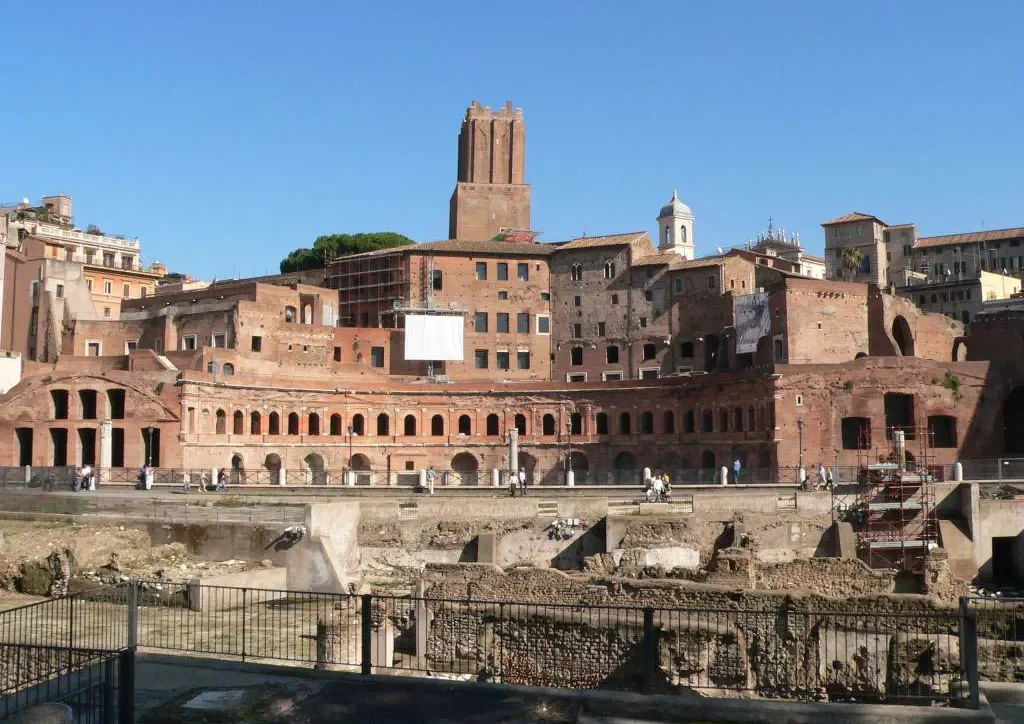

Trajan’s Market: The Roman Shopping Mall That Set The Standard
Before America gave the world the food court, the escalator, and the thrilling human drama of trying to remember where you parked, ancient Rome was already experimenting with the basic idea of the shopping mall.
Trajan’s Market, that first Roman shopping mall, was built in Rome in the early second century A.D. It is often described as one of history’s first great shopping complexes. It was not a mall in the modern suburban sense, of course. No Orange Julius. No teenagers loitering near a fountain. No kiosk employee trying to rub lotion on your hands before you could make eye contact with the escape route.
Still, the concept was surprisingly familiar. The complex contained more than 150 shops and offices arranged on multiple levels, with merchants selling goods such as spices, clothing, food, and other everyday necessities. In other words, it was a place where Romans could conduct business, run errands, shop, socialize, and presumably complain that everything used to be cheaper under the Republic.
Trajan’s Market was probably built between A.D. 100 and 110 as part of Emperor Trajan’s massive building program. The architect most often associated with the project was Apollodorus of Damascus, Trajan’s brilliant engineer and designer, who had the sort of résumé that makes everyone else at the imperial office party quietly set down their wine cup and feel inadequate.
The market formed part of Trajan’s Forum, a sprawling civic and commercial center that showed off Rome’s wealth, power, and commitment to making public architecture as intimidating as possible. It officially opened around A.D. 113, giving the empire a monumental complex where commerce, administration, and propaganda could all hold hands and pretend this was perfectly normal.
Like many ancient Roman structures, Trajan’s Market refused to remain just one thing. During the Middle Ages, it was modified with additional floors and defensive features, including the Torre delle Milizie, or “Tower of the Militia,” because apparently even shopping centers eventually need a fortress phase. A convent later occupied part of the site in the 16th century. In 1885, the Italian state took over the property and converted it into the Goffredo Mameli barracks.
In the early 20th century, those later additions were removed so archaeologists could restore and study the remains of the ancient complex. What survived is one of the most impressive examples of Roman urban planning — and a reminder that long before department stores, anchor tenants, and abandoned mall YouTube videos, people were already gathering in large commercial spaces to buy things they probably did not need.
You may also enjoy…

Elagabalus: The Unbelievable Tale of Rome’s Teenage Emperor and His Wild, Weird, and Wicked Life
Discover the outrageous story of Emperor Elagabalus, Rome’s teenage ruler who worshipped a meteorite, redefined gender, and turned the empire into his personal circus. A wild, witty look at history’s most eccentric emperor and his glittering reign of chaos.

How the Romans Did Math When Roman Numerals Ruled the World
Discover how the Romans did math using Roman numerals, counting boards, and clever tools that powered engineering feats from aqueducts to amphitheaters. A fun, insightful look at the surprising math behind an empire.

The Lost Roman Concrete Recipe: Secrets of Ancient Durability Explored
Discover why ancient Roman concrete remains unmatched in durability compared to modern methods. Learn the secrets the lost Roman concrete recipe and its fascinating history.



Leave a Reply