
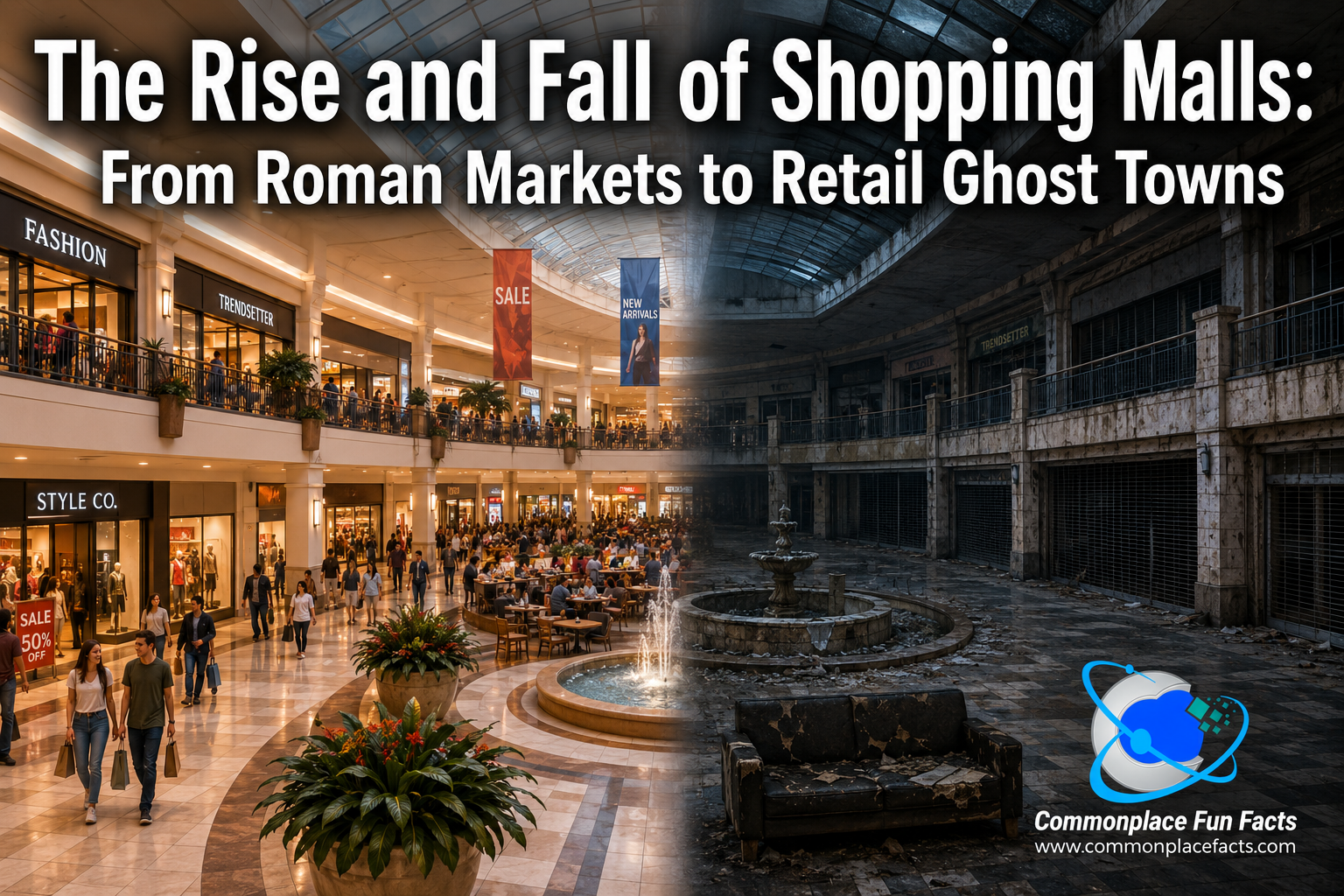

There was a time when the American shopping mall was not merely a place to buy pants. It was a climate-controlled civilization. Shopping malls had food, music, fountains, plants, benches, escalators, arcades, movie theaters, suspiciously shiny floors, and teenagers orbiting the premises in slow, restless packs like migrating wildebeests with better hair gel.
If you wanted to see a movie, buy a cassette, eat a slice of pizza the size of a legal brief, get your ears pierced, try on sunglasses you had no intention of purchasing, and pretend you were “just looking” while standing inside Spencer Gifts under the glow of deeply questionable novelty lamps, the mall was your place.
It was shopping, yes. But it was also courtship, employment, rebellion, boredom management, air conditioning, and a public square with better pretzels. The mall was where America went when it wanted community but did not want weather.
Then, almost as suddenly as it rose, the mall began to decline. Anchor stores closed. Fountains dried up. Food courts emptied. Escalators stopped escalating, which is basically their one job. Across the country, once-bustling malls became half-vacant monuments to a retail age when people willingly drove twenty minutes to buy socks in person.
But the story of the mall is older, stranger, and more interesting than “Amazon killed it,” although Amazon did show up holding a suspiciously large shovel. The roots of the shopping mall go back centuries, possibly all the way to ancient Rome. Its modern form was born from suburban idealism, architectural ambition, and America’s sacred belief that every human activity should come with free parking. Its fall came from overbuilding, changing habits, dying department stores, online shopping, and the awkward discovery that you can only have so many indoor town squares before some of them become indoor ghost towns.
Contents
The Romans, Naturally, Got There First
As with roads, aqueducts, concrete, stadium seating, imperial overreach, and making everything more complicated than strictly necessary, the Romans were early to the idea of concentrated commerce. One of the most famous ancient ancestors of the shopping mall is Trajan’s Markets in Rome, built in the early second century near Trajan’s Forum.

Trajan’s Markets was a large, multi-level complex that included shops, storage areas, administrative offices, and public spaces. It curved into the slope of the Quirinal Hill, with rows of small rooms facing onto ancient streets and corridors. Today, tourists can walk through it and imagine Roman merchants doing business without the benefit of barcode scanners, loyalty rewards, or a teenage employee saying, “Yeah, we might have that in the back,” with no intention of checking.
It is often called the world’s first shopping mall. That description is useful, but it needs a small historian-shaped asterisk attached to it. Trajan’s Markets was not a mall in the modern sense. There was no Orange Julius. No Macy’s. No kiosk selling phone cases to people trying desperately not to make eye contact. Scholars increasingly describe the site as a multifunctional imperial complex rather than a simple retail center.
Still, the basic idea was there: multiple sellers, arranged together, in a designed space that combined commerce with civic life and administration. Rome did not invent the mall as Americans knew it in 1987, but it did demonstrate that people have always enjoyed grouping merchants together so customers could shop efficiently, compare goods, and complain about prices in a centralized location.
That impulse never really went away. Markets, bazaars, arcades, and shopping streets appeared in cultures around the world. Humans are social creatures. We gather, we browse, we trade, and eventually someone sells us a decorative candle called “Autumn Regret.”
Before the Mall, There Was the Arcade
The modern shopping mall did not spring fully formed from the forehead of J.C. Penney. It evolved from earlier commercial spaces, especially covered shopping arcades. These gave shoppers the luxury of browsing indoors, protected from rain, mud, horses, and whatever else nineteenth-century streets were contributing to the sensory experience.

In the United States, one of the most important early examples was the Westminster Arcade in Providence, Rhode Island. Built in 1828, it is widely described as America’s first enclosed shopping mall. Architecturally, it looked less like a suburban mall and more like someone asked ancient Greece to design a place to buy gloves. With its Greek Revival columns and enclosed interior shops, it gave Americans an early taste of shopping as an indoor architectural experience.
Then came another important step: the shopping center designed for the automobile. In 1923, Kansas City’s Country Club Plaza opened as a planned shopping district built to accommodate customers arriving by car. That was a significant development, because nothing says “modern retail” quite like deciding the customer should first cross a moat of asphalt.

The Plaza was not an enclosed mall, but it helped point the way toward the suburban retail model. Shopping no longer had to be centered downtown. Stores could follow people outward, into new residential districts, where land was cheaper, roads were wider, and planners looked at open fields and thought, “This could use 3,000 parking spaces.”
Enter Victor Gruen, the Man Who Accidentally Invented the Retail Aquarium
The modern enclosed shopping mall arrived in 1956 with Southdale Center in Edina, Minnesota. Designed by Austrian-born architect Victor Gruen, Southdale is widely recognized as the first fully enclosed, climate-controlled shopping mall in the United States.

That last phrase matters: fully enclosed, climate-controlled. Southdale was not just a collection of stores. It was an environment. Minnesota winters could do whatever Minnesota winters do, which is mostly remind everyone that nature is hostile and has poor customer service. Inside Southdale, shoppers could stroll beneath a roof, surrounded by storefronts, plants, fountains, art, and department-store anchors. The weather had been defeated. Commerce had been housebroken.
Gruen’s vision, however, was more ambitious than “put stores in a box and surround it with Buicks.” He wanted the mall to serve as a suburban civic center. Southdale was supposed to be part of a larger planned environment that could include housing, offices, medical services, schools, and public gathering spaces. Gruen imagined something closer to a walkable European town center adapted to American suburbia.
America heard this noble civic vision and responded, “Excellent. We shall keep the shopping and the parking.”
The result was one of the great ironies of twentieth-century architecture. Gruen wanted to reduce the emptiness of car-dependent suburbia by creating places where people could gather. Developers copied the retail portion of his idea while leaving behind much of the broader civic vision. The mall became less a town center than a commercial island, surrounded by parking lots and accessible mainly by car. Gruen later grew disillusioned with the monster his idea had become, which is understandable. It is one thing to design a community hub and another to watch it reproduced nationwide with more jewelry kiosks.
Why the Mall Exploded
The enclosed mall spread because postwar America was almost perfectly designed to produce it. After World War II, millions of Americans moved to suburbs. Highways expanded. Car ownership rose. Downtown department stores began losing customers to suburban shopping centers. Air conditioning became more common and more expected. Families wanted convenience, safety, and a place where they could shop without fighting downtown traffic or parallel parking, the cruelest of all municipal rituals.
Malls offered a powerful package. They were clean, controlled, predictable, and private. They had anchor stores at either end, usually big department stores such as Sears, JCPenney, Macy’s, or local chains. Those anchors drew customers, who then walked past smaller specialty shops on the way. It was not accidental. It was retail choreography. You came for school clothes and left with earrings, a pretzel, a poster, and possibly a regrettable belt buckle.
The growth was dramatic. By 1975, there were 16,400 shopping centers accounting for 33 percent of retail sales, and by 1987, there were 30,000 shopping centers accounting for more than 50 percent of all retail dollars spent. That includes shopping centers broadly, not just enclosed malls, so we should not pretend every one of those was a two-story temple of escalators and soft pretzels. Still, it shows how much American retail shifted away from traditional downtown shopping and toward planned commercial centers.
The enclosed mall was the glamorous version of that shift. It turned shopping into an outing. It made consumption feel social, even festive. It gave the suburbs a destination that was not school, church, work, or someone’s split-level ranch house with a suspicious amount of shag carpeting.
Peak Mall: America Moves Indoors
By the 1970s, 1980s, and early 1990s, the mall had become one of the defining spaces of American life. If downtown Main Street belonged to an earlier generation, the mall belonged to the children of suburbia. It was Main Street under glass, with better lighting and worse music.

For teenagers, the mall was especially important. It was one of the few places where young people could exist semi-independently without actually going anywhere dangerous. Parents could drop them off, secure in the knowledge that the worst likely outcome was overpriced nachos or a purchase from a music store that would alarm grandparents. The mall offered freedom with guardrails, rebellion with a food court, and romance under the watchful eyes of security personnel named Gary.
The cultural footprint was enormous. Malls appeared in movies, television shows, music videos, and teenage memory. They were backdrops for first jobs, first dates, first breakups, first truly terrible fashion decisions, and first discoveries that minimum wage does not go far when there is a record store nearby.
The mall also served other groups. Senior citizens used it for walking. Parents used it for errands. Children visited Santa there, because apparently the North Pole subcontracted heavily to regional retail centers. Community groups held events. Local performers played in center courts. Beauty pageants, craft fairs, charity drives, school concerts, and car displays all found a home beneath the skylights. The mall was private property, but it functioned like public space, provided your public life did not interfere with the lease terms.
This is what made the mall more than an economic phenomenon. It was an ecosystem. It had rituals, landmarks, smells, sounds, and social rules. Every mall had its zones: the department stores, the fountain, the arcade, the food court, the movie theater, the uncomfortable bench where someone’s husband/father waited with the exhausted look of a man reconsidering several life choices.
The mall was such a complete little universe that, in at least one case, someone decided to move in. In 2003, artist Michael Townsend and his friends built a secret apartment inside a Rhode Island mall, proving that the line between “third place” and “technically trespassing” can be thinner than mall security would prefer: the hidden mall apartment of Michael Townsend.
The mall was where people went to buy things, but it was also where they went to be seen buying things, thinking about buying things, avoiding buying things, and claiming they were “just browsing,” which remains one of the great polite lies of civilization.
The Anchor Store Was the Mall’s Gravitational Field
Economically, the classic mall depended on the anchor store. The big department stores drew the crowds. Smaller stores benefited from the traffic. The entire structure was designed around movement. Park near Sears, walk past twenty shops, meet someone by the fountain, eat something fried, wander into the other anchor, and somehow emerge three hours later with a bag from a store you did not know existed that morning.
The anchor stores were often given favorable lease terms because their real value was not just rent. They supplied customers. Inline tenants paid for proximity to that traffic. The food court captured the hungry. The movie theater captured the bored. The arcade captured quarters with the efficiency of a casino designed for eighth graders.
When everything worked, it worked beautifully. Malls became major sources of sales tax, jobs, and local identity. A successful mall could define an entire commercial district. Developers built roads to them. Restaurants clustered around them. Hotels and offices followed. The mall did not merely sit in the suburb. It bent the suburb around itself.
But this model also created a vulnerability. If the anchors weakened, the mall weakened. If the foot traffic fell, the smaller stores suffered. If the smaller stores left, the mall looked emptier, which made people less likely to visit, which made more stores leave. Retail decline is not always a cliff. Sometimes it is a slow-motion escalator to nowhere.
Too Much of a Good Thing, Then Too Much of a Mediocre Thing
The first problem was overbuilding. America did not merely build malls. America built malls like it had discovered a constitutional right to climate-controlled retail. If one mall was good, two were better, and three were apparently necessary so every suburb could have its own fountain-based teenage ecosystem.

For a while, this seemed to work. Population was growing. Suburbs were expanding. Consumer spending was strong. Credit cards were available. People still needed physical stores because the alternative was ordering from a catalog and waiting long enough to reconsider the purchase, which is bad for retail but excellent for personal responsibility.
But eventually, malls began competing with other malls. Newer malls drained traffic from older malls. Regional malls competed with strip centers, power centers, lifestyle centers, outlet centers, and big-box stores. Walmart, Target, Best Buy, Home Depot, Costco, Kohl’s, T.J. Maxx, and other retailers changed shopping patterns. Consumers could get lower prices, easier parking, and fewer encounters with perfume counters, which attacked passersby like fragrant artillery.
The mall was no longer the obvious destination for everything. It became one option among many, and often not the most convenient one. The same suburban geography that helped create the mall also helped create its competitors. Once retail spread into every available roadside parcel, the mall’s specialness faded. The indoor Main Street was surrounded by an army of outdoor alternatives with larger carts.
The Department Stores Started Sinking
Then the anchor stores began to fail. This was not a minor inconvenience. It was like discovering that the foundation of your house was made of cheesecake.
Traditional department stores had problems of their own. They were squeezed by discount chains, specialty retailers, off-price stores, fast fashion, online competition, debt, changing tastes, and the general difficulty of persuading people that they needed to visit three floors of merchandise when they only wanted socks.
Sears, once so powerful that it could sell Americans practically anything short of a replacement personality, declined dramatically. JCPenney struggled. Macy’s closed stores. Regional department-store chains disappeared through mergers, bankruptcies, and liquidation. Bon-Ton, Elder-Beerman, Carson’s, Younkers, and other familiar names vanished from malls across the country.
When an anchor closed, it left behind an enormous vacancy. These spaces were not little storefronts that could be rented to a candle shop and a tax preparer. They were vast boxes, often 100,000 square feet or more. A dead anchor store became a billboard for decline. Nothing says “retail confidence” like a darkened three-story department store with paper over the doors and one lonely mannequin still visible in the gloom, staring into the middle distance as if it knows too much.
Anchor closures also affected leases. Some smaller tenants had clauses allowing them to reduce rent or leave if anchor stores closed or occupancy dropped. Even without those clauses, the logic was obvious. Fewer anchors meant fewer shoppers. Fewer shoppers meant weaker sales. Weaker sales meant more vacancies. More vacancies meant the mall began to feel less like a destination and more like a place where someone might film a documentary with ominous piano music.
The Internet Did Not Kill the Mall Alone, But It Did Bring Snacks to the Funeral
It is tempting to blame the internet for everything. This is convenient because the internet is already guilty of so much. But the mall was showing signs of trouble before online shopping became the default method for buying everything from groceries to replacement vacuum belts to one oddly specific cable that arrives in a padded envelope large enough to transport a ferret.
E-commerce accelerated the decline, but it did not create all of it. The mall had already been weakened by overbuilding, competition from big-box stores, changing consumer habits, and department-store decline. Online shopping made those problems worse by removing many of the reasons people had to visit physical stores in the first place.
The growth of e-commerce is real. According to the U.S. Census Bureau, e-commerce accounted for 16.9 percent of total retail sales in the first quarter of 2026. That still means most retail sales happen offline, which is worth remembering before declaring every store dead and replacing the national anthem with a doorbell camera notification. But the online share is large enough to reshape expectations.
Consumers became used to wider selection, price comparisons, home delivery, easy returns, and the dangerous ability to buy something at midnight because they briefly became convinced their life required a panini press. Shopping no longer needed a trip. It needed a screen.
The COVID pandemic then gave online shopping another enormous push while temporarily turning indoor public spaces into places people avoided unless absolutely necessary. Some malls recovered. Others did not. The pandemic did not invent the dead mall, but it did speed up the autopsy in several cases.
The Dead Mall: America’s Most Melancholy Ruin
Every civilization leaves ruins. Rome left aqueducts. Egypt left pyramids. Medieval Europe left castles. America is leaving abandoned food courts with one surviving vending machine and a fountain that looks as if it has been dry since the Clinton administration.

The dead mall has become its own genre of cultural fascination. Photographers, YouTubers, urban explorers, and nostalgia enthusiasts wander through half-empty malls documenting silent corridors, closed gates, faded signage, broken escalators, and skylights still pouring cheerful natural light onto scenes of retail despair. The effect is eerie because malls are recent ruins. They are not ancient enough to feel distant. Many of us remember them alive.
A dead mall is not just an abandoned building. It is abandoned memory. It is the place where someone had a first job, where someone waited for a movie, where someone bought a prom dress, where a shy, awkward nerdy boy who would grow up to become a blogger of obscure historical trivia convinced himself something meaningful had happened because he accidentally made eye contact with the cute girl who was way out of his league and she did not immediately look repulsed.
That is, of course, a random, hypothetical example, and definitely not some kind of weird confession or anything.
That is why dead malls feel different from other vacant commercial spaces. An empty office building is bleak. An empty warehouse is industrial. An empty mall feels personal. Its architecture was designed for crowds, motion, music, light, and impulse. When those things disappear, the building seems confused, like a stage after the actors have left but the set is still waiting for Act Two.
So How Bad Did It Get?
By the early twenty-first century, the classic enclosed mall was clearly under pressure. The decline was uneven. Some malls died quickly. Some limped along for years with a strange combination of national chains, local stores, seasonal Halloween shops, churches, gyms, and that one jewelry repair kiosk that definitely was not a front for a Mafia money-laundering operation. Others stayed strong because they were in wealthy areas, had better management, attracted luxury retailers, or became entertainment destinations.
In other words, the mall did not die. It split into classes. The best malls became stronger. The weaker malls became weaker. The middle got squeezed, which is also a pretty good summary of several other American trends, but let us not wander too far into the weeds or we will have to buy hiking boots from a vacant Sears.
The Mall Today: Dead, Alive, or Just Wearing a New Name Tag?
The current state of the mall is complicated. It is not enough to say malls are dead. Some are very much alive. A 2023 analysis by Coresight Research argued that American malls remain an important retail format, noting that malls represented a relatively small share of brick-and-mortar retail space while still accounting for a larger share of consumer expenditures in retail goods, food services, and retail-adjacent categories. The good malls still matter.
But many traditional enclosed malls cannot survive by doing exactly what they did in 1988. The formula of department stores, apparel chains, a food court, and a place to buy novelty T-shirts is no longer enough. Successful malls increasingly add restaurants, entertainment, fitness centers, medical offices, grocery stores, coworking spaces, hotels, apartments, public events, and outdoor gathering areas.
This is where the story becomes wonderfully ironic. The future of the mall may be to become less like the classic mall and more like what Victor Gruen originally imagined: a mixed-use civic center where people can live, work, eat, exercise, see a doctor, attend an event, meet friends, and perhaps buy socks if the mood strikes.
Some dead malls are being demolished. Others are becoming medical centers, office campuses, schools, churches, distribution hubs, housing developments, or open-air town centers. The old retail boxes are being carved up and repurposed. Former department stores now house gyms, entertainment venues, call centers, apartments, and occasionally things so practical that they would have horrified the teenage mall culture of the 1980s.
There is a lesson here, and for once it is not merely “avoid the pretzel place if the cheese sauce looks tired.” The mall succeeded when it met real social and economic needs. It declined when the model became too rigid, too common, and too dependent on retail patterns that changed. It may survive where it becomes flexible again.
The Mall Is Dead. Long Live the Mall.
The shopping mall’s story is not simply rise and fall. It is rise, overbuild, cultural domination, slow collapse, nostalgia, redevelopment, and possible reincarnation as something with apartments and a better coffee shop.
From Trajan’s Markets to the Westminster Arcade, from Country Club Plaza to Southdale Center, from the fountain to the food court to the dead mall video tour, the same basic human impulse keeps returning. People like places where commerce and social life overlap. They like browsing, gathering, eating, watching, wandering, and occasionally buying something they cannot justify but will defend anyway.
The classic enclosed mall may never again occupy the place it held in American life during its peak. The teenage mall ecosystem has mostly migrated elsewhere, although no one should rule out its return if someone successfully combines boba tea, vintage stores, retro arcades, and enough seating to make loitering feel like a civic duty. Department stores will not regain their old dominance. The internet is not going back into its box, no matter how firmly the mall security guard asks.
But the deeper idea behind the mall is not dead. Concentrated commerce, shared space, shelter from weather, food, entertainment, services, and social life remain powerful attractions. The successful mall of the future may look less like a sealed retail container and more like a neighborhood. It may have apartments where an anchor store once stood, medical offices where housewares used to be, restaurants where the old food court limped along, and public gathering spaces where the fountain once served as the official meeting point for every teenager in a five-mile radius.
In a strange way, the mall may survive by becoming what its inventor hoped it would be before America stripped the idea for parts and paved the rest. Victor Gruen wanted a civic center. The country built shopping machines. Now that the machines are breaking, developers are rediscovering civic space, mixed uses, walkability, and community.
The Romans would probably understand. They might admire the scale, question the parking lots, and ask why the food court has three places selling chicken. Then they would look for the fountain.
You may also enjoy…

How Circuit City Self-Destructed: Lessons from the Fall of a Retail Giant
Discover how Circuit City, once a consumer electronics giant, spiraled into failure through mismanagement, poor decisions, and missed opportunities. Learn the key lessons from their downfall.

Howard Johnson’s: The Rise, Fall, and Fried Clams of America’s Forgotten Restaurant Empire
Discover the rise and fall of Howard Johnson’s, the original restaurant franchise empire that shaped American roadside dining—then vanished. Fried clams, orange roofs, and nostalgia await.

Meet Mr Delicious: The Fast-Food Mascot So Unappetizing, He Bankrupted an Entire Chain
In the golden age of fast food, Rax Roast Beef rose to fame with its simple, no-frills approach. But a misguided attempt at diversification and a bleak mascot, Mr Delicious, led to its downfall. The chain filed for bankruptcy and now only five locations remain, serving as a cautionary tale about losing sight of one’s…





Leave a Reply