
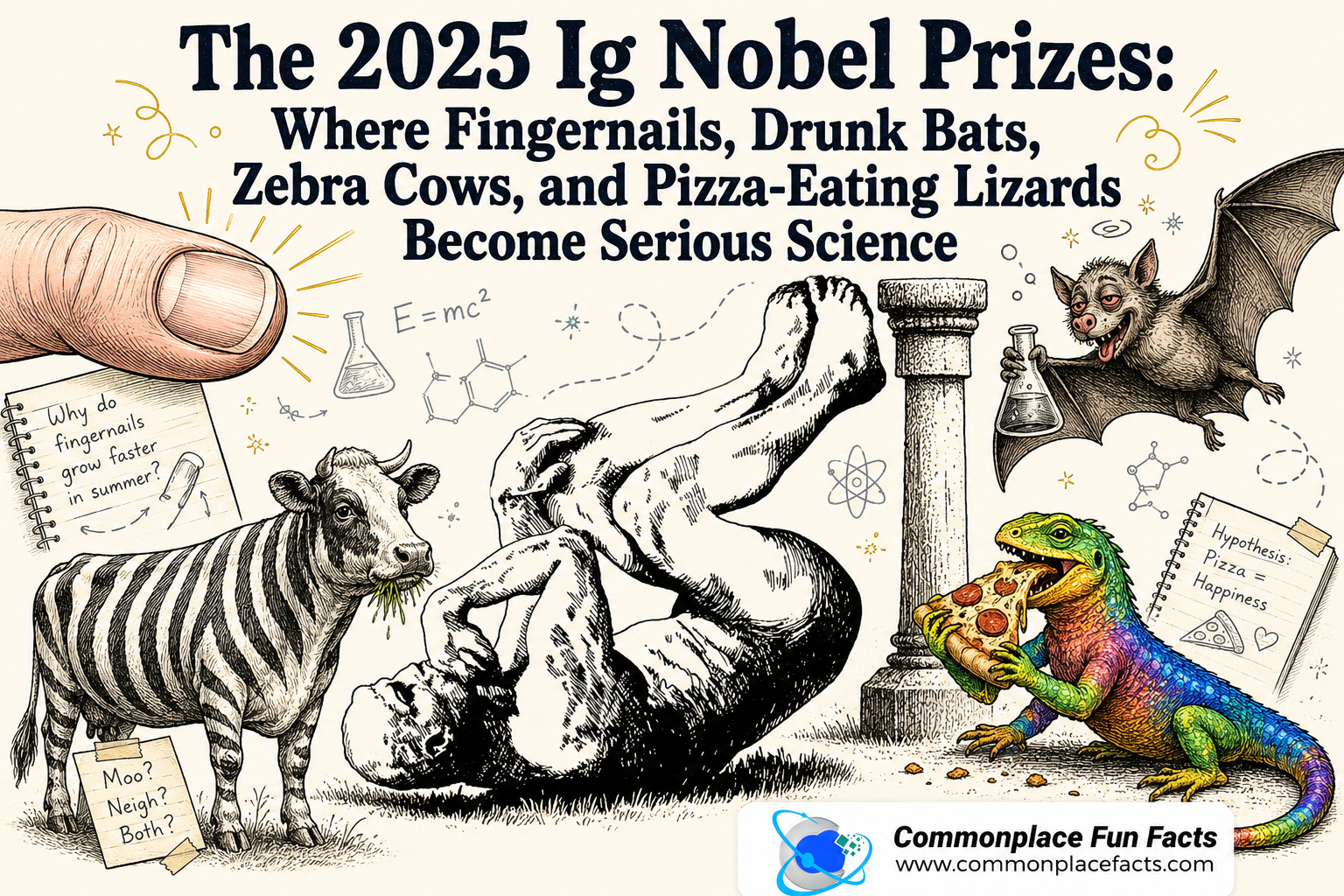

Fingernails. Drunk bats. Zebra-striped cows. Pizza-eating lizards. Diets of Teflon. The chemical properties of cacio e pepe. These sound like the sorts of ingredients our friends at Rocket Cat Productions might combine into a mind-bending tale involving the reanimated corpses of fast-food employees, high school chemistry teachers, and at least one government agency insisting everything is perfectly normal.
In this case, however, they are not plot points from a gloriously deranged science-fiction comedy. They are merely a glimpse into the strange, scientific, and genuinely hilarious world of the Ig Nobel Prize.
The Ig Nobels, awarded by the delightfully dangerous minds at Improbable Research, celebrate research that “first makes people laugh, then makes them think.” This is scientific recognition for the researchers who look at the universe and say, “Yes, curing disease is important, but has anyone checked whether painting cows like zebras keeps the flies away?”
We have previously reported on some of the groundbreaking research honored with an Ig Nobel Prize, including the question of whether cracking your knuckles leads to arthritis, the discovery that some animals can breathe through the anus, and whether constipation can be a factor in mating prospects. The nice thing about Ig Nobel Prizes is that they are the gift that keeps on giving. Whenever we need a topic for a new article, we need only take a look at the latest batch of award recipients and wait for science to make eye contact.
The 2025 Ig Nobel Prizes were awarded at the 35th First Annual Ig Nobel Prize ceremony. The event honored studies involving fingernail growth, narcissists being told they are smart, lizards eating pizza, babies reacting to garlic-flavored breast milk, zebra-striped cows, Teflon diets, alcohol-aided language skills, smelly shoe racks, drunken bats, and the physics of cacio e pepe sauce.
In other words, it was a good year for science. A strange year, yes. But good.
Contents
Literature Prize: Thirty-Five Years of Fingernail Watching
The 2025 Ig Nobel Prize in Literature went to the late Dr. William B. Bean of the United States, who spent 35 years carefully recording and analyzing the growth rate of one of his fingernails.

Not all heroes wear capes. Some carry calipers.
Bean published multiple studies on nail growth over the decades, beginning with “A Note on Fingernail Growth” in 1953 and continuing through “Nail Growth: Thirty-Five Years of Observation” in 1980. That is the sort of long-term research commitment that makes grant committees nervous and manicurists spiritually fulfilled.
There is something wonderfully admirable about this. Most of us cannot keep a houseplant alive for 35 days. Bean maintained a scientific relationship with one fingernail for 35 years. He tracked it through aging, illness, time, and whatever personal questions arise when a man realizes he has become history’s most attentive nail watcher.
Of course, nail growth is not trivial. Fingernails can reflect health, nutrition, circulation, injury, aging, and disease. The body leaves clues in strange places, and sometimes science requires someone patient enough to stare at the end of his finger until the data surrender.
Still, one imagines the family conversations were memorable.
“Dad, I won the state wrestling championship!”
“I’m proud of you, son. Now wait while I see what that pride does to my fingernail growth.”
Psychology Prize: Tell a Narcissist He Is Smart and Watch the Peacock Inflate
The Psychology Prize went to Marcin Zajenkowski and Gilles Gignac for investigating what happens when people — including narcissists — are told they are intelligent.
The study, “Telling People They Are Intelligent Correlates with the Feeling of Narcissistic Uniqueness,” examined how IQ feedback affects temporary state narcissism. Or, in less academic terms: what happens when you hand someone a compliment and they immediately begin shopping for a throne?
The result will not shock anyone who has ever attended a faculty meeting, corporate retreat, or family holiday meal. Being told you are intelligent can make people feel more unique. With narcissistic personalities, the effect is especially interesting because it touches one of the great mysteries of human behavior: how some people can convert a modest compliment into a full internal coronation ceremony.
This research is funny because it confirms what everyone suspects. It is useful because it helps psychologists better understand how feedback, self-image, and personality interact. Compliments are not just compliments. They are tiny emotional fertilizers. Applied carefully, they encourage growth. Applied recklessly, they produce a man who refers to himself as a “thought leader” without irony.
Nutrition Prize: Lizards at the Pizza Buffet
The Nutrition Prize went to Daniele Dendi, Gabriel H. Segniagbeto, Roger Meek, and Luca Luiselli for studying the extent to which rainbow lizards at a seaside resort in Togo chose to eat certain kinds of pizza.

This is the sort of sentence that makes you check whether you accidentally opened a rejected screenplay for Jurassic Park: Room Service.
The study examined opportunistic foraging behavior in rainbow lizards. These reptiles were not ordering delivery under fake names, as far as science currently knows. They were taking advantage of available human food sources, which is exactly the sort of thing animals do when humans enter the environment and begin leaving edible evidence of poor decisions.
The broader point is important. Wildlife behavior changes around people. Animals adapt to tourism, restaurants, garbage, dropped food, and the strange ecological niche known as “vacationers who think the floor is a plate.” The pizza-loving lizards are funny, yes, but they also remind us that human environments reshape animal diets in ways we rarely notice.
Also, somewhere in Togo, a lizard has probably developed opinions about four-cheese pizza. We are awaiting the study that quantifies the extent of animal cruelty associated with exposing a rainbow lizard to pizza with pineapple toppings.
Pediatrics Prize: Garlic Milk and the Baby Food Critic
The Pediatrics Prize went to Julie Mennella and Gary Beauchamp for studying what a nursing baby experiences when the baby’s mother eats garlic.
Their 1991 study, “Maternal Diet Alters the Sensory Qualities of Human Milk and the Nursling’s Behavior,” explored how garlic in a mother’s diet affected the smell of breast milk and the behavior of nursing infants.
This may sound like the setup for the world’s most uncomfortable cooking show, but it is actually important developmental science. Babies encounter flavors before they can speak, chew, or complain that the restaurant has changed the fries. Breast milk can carry sensory traces of maternal diet, giving infants early exposure to the flavors common in their family’s food culture.
In other words, a baby’s first culinary education may begin long before the first suspicious spoonful of mashed peas.
There is also a lovely democratic principle at work here: even infants are food critics. They may not have vocabulary, but they have facial expressions, appetite, and the ability to communicate displeasure almost as loudly and clearly as Gordon Ramsay.
Biology Prize: Cows Dressed as Zebras, Because Nature Apparently Has a Dress Code
The Biology Prize went to Tomoki Kojima and colleagues in Japan for testing whether cows painted with zebra-like stripes could avoid being bitten by flies.

This study is glorious because it begins with a question that sounds like it escaped from a child’s notebook: “What if we made cows look like zebras?”
And then, because science is wonderful, someone actually did it.
The researchers painted cows with black-and-white zebra-style striping and observed whether biting flies bothered them less. The answer, surprisingly, is yes.
This built on earlier research into why zebras have stripes, including evidence that the patterns may interfere with how flies visually locate and land on animals.
The practical implication is not silly at all. Biting flies cause stress, reduce productivity, and can spread disease among livestock. If visual patterns can reduce fly attacks without relying as heavily on insecticides, that matters. It is animal welfare, agriculture, and optical trickery in one convenient cow-shaped package.
Also, the cows looked fabulous. That should count for something.
Chemistry Prize: The Teflon Diet, or Why Your Frying Pan Should Not Be a Food Group
The Chemistry Prize went to Rotem Naftalovich, Daniel Naftalovich, and Frank Greenway for testing whether eating Teflon — more formally, polytetrafluoroethylene, or PTFE — could increase food volume and satiety without adding calories.
We previously explored the accidental creation of Teflon and its fascinating history. Now, diet culture has reached the point where someone looked at nonstick cookware and thought, “This might be a nice side to my burger.”
The researchers explored whether a nondigestible, nonfibrous material could act as a volumizer in food, helping people feel full without contributing calories. The concept was also patented as a method for increasing satiety.
Now, before anyone starts shaving a frying pan over a salad, this is not a recommendation. The Ig Nobel Prize is not a meal plan. It is not a medical endorsement. It is not the universe telling you that your omelet pan has untapped nutritional potential.
But as improbable research, it does raise an interesting question: how much of hunger is about calories, and how much is about volume, texture, and the physical experience of eating? Modern nutrition science has long studied satiety, fiber, water content, and food structure. This study simply approached the question by wandering into the plastics aisle, which is not where most dietitians prefer to hold office hours.
The lesson is probably not “eat Teflon.” The lesson is “satiety is complicated.” Also, “do not take nutrition advice from your cookware.”
Peace Prize: Alcohol Improves Foreign Language Skills, Which Explains Several International Incidents
The Peace Prize went to Fritz Renner, Inge Kersbergen, Matt Field, and Jessica Werthmann for showing that drinking alcohol can sometimes improve a person’s ability to speak a foreign language.

The study, magnificently titled “Dutch Courage?”, tested whether acute alcohol consumption affected foreign language performance. The researchers looked at self-ratings and observer ratings, which is important because alcohol famously improves self-ratings of almost everything. Singing. Dancing. Strategic life choices. Texting former romantic partners at 1:17 a.m.
The funny part is obvious. Many people feel more fluent after a drink because inhibition drops. The more serious point is that anxiety can interfere with speaking a second language. A small reduction in self-consciousness may help someone speak more naturally, even if the grammar still staggers slightly into traffic.
This does not mean alcohol is a study aid. It does not mean your high school Spanish teacher was holding back the secret curriculum. It does suggest that confidence and communication are closely linked. Sometimes the obstacle is not vocabulary. Sometimes it is the inner critic standing between your brain and your mouth with a clipboard.
Alcohol may briefly distract that critic. Unfortunately, it also invites several less-qualified critics to join the conversation.
Engineering Design Prize: The Shoe Rack That Met the Enemy and Found It Was Feet
The Engineering Design Prize went to Vikash Kumar and Sarthak Mittal for analyzing how foul-smelling shoes affect the experience of using a shoe rack.

Finally, a field of study for everyone who has ever opened a closet and briefly seen the face of death.
Their work, “Smelly Shoes — An Opportunity for Shoe Rack Re-Design,” treated odor not merely as a domestic nuisance but as a design problem. This is exactly the sort of thing engineers are supposed to do: identify a recurring human inconvenience, study it, and make the rest of us wonder why we were just spraying things with Febreze and hoping for mercy.
A shoe rack is supposed to organize shoes. But if the rack also concentrates odor into a localized cloud of regret, then the design has failed in one of its less glamorous duties. Function includes experience. Experience includes smell. Smell includes the terrifying interior life of gym shoes.
This is the beauty of the Ig Nobels. They remind us that “serious research” does not have to begin with cosmic mysteries. Sometimes it begins with someone asking, “Why does this hallway smell like a haunted locker room?”
Unfortunately, this study came several centuries too late to be of any value to Michelangelo, whose brilliance was offset by atrocious footwear hygiene. Read “Michelangelo and the Foul Footwear” for the smelly details.
Aviation Prize: Drunk Bats Should Not Fly
The Aviation Prize went to Francisco Sánchez, Mariana Melcón, Carmi Korine, and Berry Pinshow for studying whether alcohol impairs bats’ ability to fly and echolocate.
It does.
This may appear obvious, but science is not built on vibes. It is built on controlled observation, measurement, and occasionally giving Egyptian fruit bats ethanol so we can confirm that drunk flying mammals perform about as well as expected.
The study found that ethanol ingestion affected flight performance and echolocation. That matters because many fruit-eating animals encounter alcohol naturally through fermented fruit. For bats, precise flight and echolocation are not hobbies. They are survival tools. If alcohol interferes with those systems, it can increase the risk of collision, disorientation, or predation.
So yes, the headline sounds like a rejected Saturday morning cartoon: “Boozy Bats Lose Radar.” But the biology underneath is real. Animals interact with natural alcohol in the environment, and those interactions can affect behavior.
The takeaway is simple: friends do not let friends fly echolocation-dependent after happy hour.
On a positive note, as we have already seen, the alcohol-impaired bats will be able to make better use of their foreign language skills, so at least they will have something to do while they are grounded.
Physics Prize: The Cacio e Pepe Crisis Has Entered the Laboratory
The Physics Prize went to Giacomo Bartolucci, Daniel Maria Busiello, Matteo Ciarchi, Alberto Corticelli, Ivan Di Terlizzi, Fabrizio Olmeda, Davide Revignas, and Vincenzo Maria Schimmenti for studying the phase behavior of cacio e pepe sauce.
This is perhaps the most Italian scientific paper ever written. Somewhere, Galileo is nodding approvingly over a bowl of pasta.
Cacio e pepe is deceptively simple: pasta, Pecorino Romano cheese, black pepper, and starchy pasta water. That is it. Four ingredients. No elaborate sauce. No secret marinade. No thirty-seven-step influencer ritual involving smoked Himalayan moon salt.
And yet it can go horribly wrong.
Instead of becoming creamy and silky, the cheese can clump. The sauce can break. Dinner can become a bowl of noodles covered in hot dairy gravel. This is not merely a culinary disappointment. This is a betrayal.
The researchers studied the physical conditions that cause the sauce to remain smooth or undergo phase transition into unpleasant clumping. Their work identified how temperature, starch concentration, cheese proteins, and water interact. In practical terms, they brought soft matter physics to the dinner table and explained why your pasta sometimes looks like it lost a fight with a cheese drawer.
This is the Ig Nobel at its best. The subject is funny. The science is real. The application is immediate. A person can read about phase separation and then make better pasta, which is more than can be said for many things published in peer-reviewed journals.
Why the Ig Nobels Matter
It is easy to laugh at the Ig Nobels. That is, in fact, the first instruction. But stopping there misses the point.
The best Ig Nobel winners are not bad science. They are odd science. They are curiosity given permission to wander off the approved trail, poke something with a stick, and return with data.
That matters because curiosity does not always arrive wearing a lab coat and carrying a solemn grant proposal. Sometimes it arrives as a cow painted like a zebra. Sometimes it arrives as a baby reacting to garlic milk. Sometimes it arrives as a doctor who watches one fingernail for three and a half decades, which is either scientific discipline or a serious cry for help.
The Ig Nobels also remind us that research can be accessible. Not everyone understands quantum field theory, but almost everyone understands smelly shoes, clumpy pasta, insect bites, babies, alcohol, and the suspicion that narcissists become more narcissistic when praised.
These studies invite people into science through the side door — the one near the kitchen, the nursery, the barn, the shoe rack, and the bat enclosure with regrettably lenient beverage policies.
The 2025 Ig Nobel Prize Winners Prove Science Has a Sense of Humor
The 2025 Ig Nobel Prize winners gave us a magnificent tour through the neglected departments of human knowledge. They showed us that fingernails grow more slowly with age, compliments can inflate egos, lizards will eat pizza, maternal garlic can flavor milk, zebra stripes may help cows, Teflon should probably remain outside the food pyramid, alcohol may briefly loosen the foreign-language tongue, shoe racks must confront odor, bats should not drink and fly, and pasta sauce is a battlefield of physics.
That is a lot for one awards ceremony.
The Ig Nobels endure because they celebrate a truth too often forgotten: science is not only about grand discoveries. It is also about paying attention. It is about noticing the small, strange, funny, inconvenient, ridiculous details of the world and asking, “Can we learn anything from that?”
Usually, the answer is yes.
And sometimes the answer also involves drunk bats, pizza-eating lizards, or a cow dressed like a zebra, because science apparently refuses to waste a good setup.
You may also enjoy…

Cube-Shaped Wombat Poop and Other Scientific Breakthroughs
We at Commonplace Fun Facts are big fans of the Ig Nobel Prize and its mission to “first make people laugh, then make them think.” The list of 2019 laureates touched on many different facets of human knowledge, including the geometric dimensions of wombat dung, the differences between living and dead magnetized critters, and proving…

Piercing the Penguin Poop Projectile Predicament
If we at Commonplace ever find ourselves at a loss for something to write about, the Ig Nobel prizes are sure to be a goldmine of inspiration. One of the 2005 laureates provides just the fodder for those whose interests include a mixture of animals, mathematics, physics, and middle school boys’ toilet humor. The recipients…

Does Constipation Affect Mating Prospects?
Now that we’ve gotten your attention with that headline, it’s probably a good time to let you know you this article will not help you with your quest to find your soulmate. It won’t, that is, unless you happen to be a scorpion. Some scorpions can shed their tails when attacked. This ability is known…




Leave a Reply