
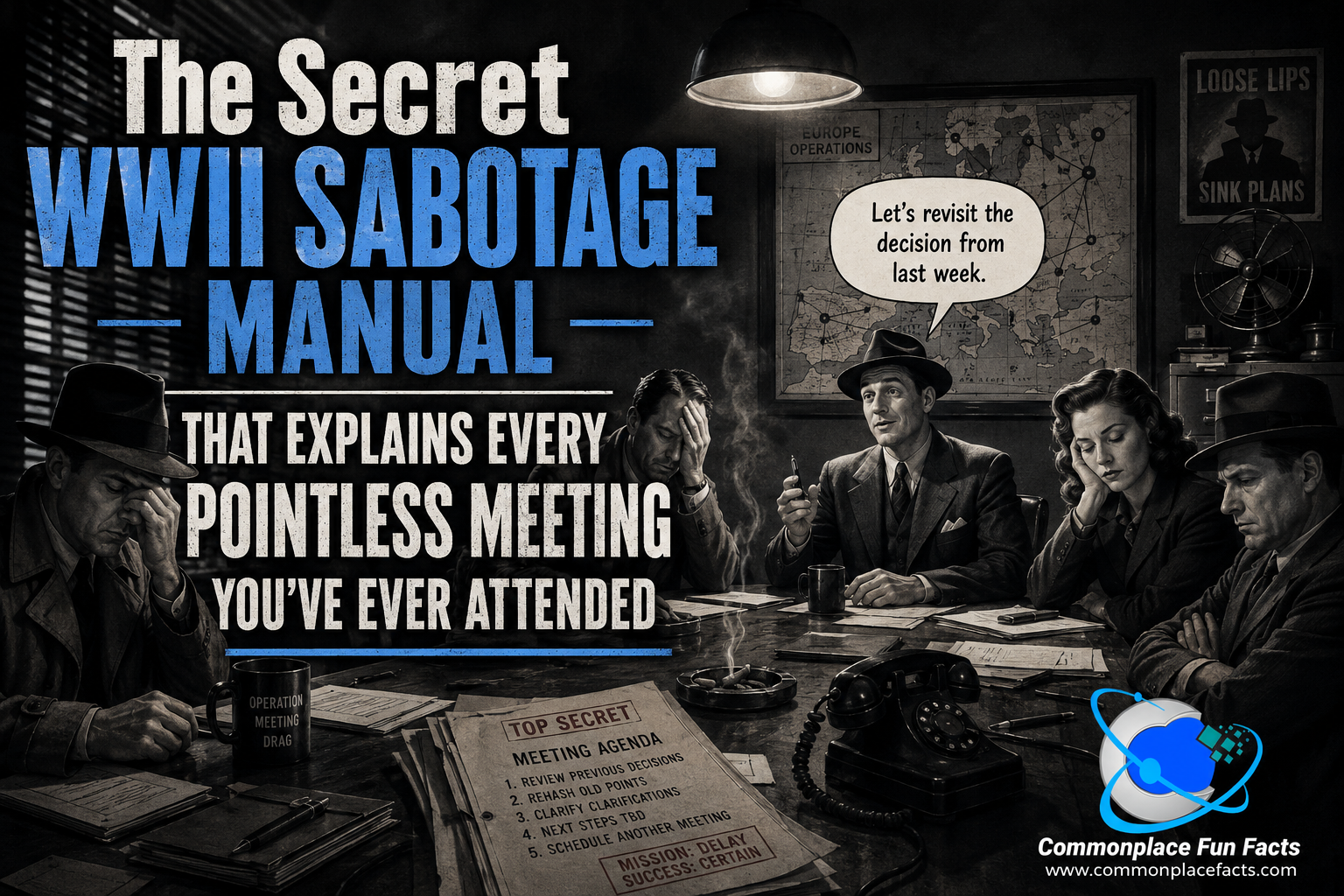

Admit it. At some point, you have sat through a pointless meeting and wondered whether someone was intentionally trying to destroy morale. You have watched co-workers make decisions so baffling that they seem less like mistakes and more like performance art. You have seen a new policy roll out with no obvious connection to logic and thought, “If they were trying to drive this place into the ground, they would be hard-pressed to come up with a better plan than this.” Perhaps, in the midst of the most hair-pulling moments of frustration, you have suspected that everyone around you is following some kind of top-secret sabotage plan, and you are the only one who hasn’t been briefed.
Perhaps you’re not wrong. The concept is not without precedent. During World War II, the United States government produced a secret sabotage manual teaching ordinary people how to disrupt enemy operations without explosives, spy gadgets, poison-tipped umbrellas, or any of the other things that make espionage look fun in movies and deeply inadvisable in real life.
The result was the Simple Sabotage Field Manual (read the pdf version here) (read a mobile edition here), a document prepared by the Office of Strategic Services, the wartime intelligence agency that later helped give birth to the CIA. It was issued in 1944 under the direction of William “Wild Bill” Donovan, whose nickname alone suggests that he would not have enjoyed a committee meeting about font sizes.
The manual was intended for use in occupied countries. Its purpose was practical: teach civilians how to interfere with the enemy’s war effort using ordinary actions that were hard to detect and easy to explain away. Some of the suggestions involved physical sabotage. Others involved the far more terrifying weapon known as bureaucracy.
And that is where things get uncomfortable. Because when you read the manual today, parts of it sound less like covert resistance against fascist regimes and more like the minutes from a staff meeting where everyone agreed to circle back, form a subcommittee, and revisit the matter after lunch. History, as usual, refuses to mind its own business.
Contents
What Was the Simple Sabotage Field Manual?
The Simple Sabotage Field Manual was published by the Office of Strategic Services on January 17, 1944. The OSS was America’s World War II intelligence agency, responsible for espionage, covert operations, propaganda, research, analysis, and generally doing the sorts of things that make historians use phrases like “cloak-and-dagger” even when everyone involved was probably also filling out travel vouchers.

The manual was designed to help ordinary civilians in enemy or occupied territory damage Axis efficiency. The key word was ordinary. This was not a handbook for elite commandos parachuting into the night with explosives strapped to their ankles, although that would certainly make for a more dramatic office training video. The manual focused on simple acts that could be carried out by regular people using materials they already had.
The manual explained that simple sabotage could include small acts of destruction, such as damaging machinery, misplacing materials, or disrupting transportation. But it also identified another category: sabotage through bad decisions, noncooperation, confusion, delay, and what the manual memorably called “purposeful stupidity.”
“Purposeful stupidity” is a phrase that deserves to be framed and hung in every conference room in America, ideally near the microphone that no one can ever get to connect.
Sabotage Without Explosions, Which Is Less Cinematic But Apparently Very Effective
When most of us hear the word “sabotage,” we imagine bridges exploding, train tracks twisted into modern art, or someone in a trench coat sneaking through a factory with a suspiciously dramatic briefcase. The OSS manual certainly included suggestions for physical damage, but its more fascinating sections were aimed at destroying efficiency without looking like you were destroying anything at all.
The brilliance of simple sabotage was plausible deniability. Anyone can make a mistake. Anyone can misunderstand instructions. Anyone can misfile a document, delay a message, ask an unnecessary question, or insist that the matter really should go through the proper channels. One person doing that is annoying. Thousands of people doing that becomes a strategic drag on an enemy government.
The manual recognized something that every modern organization eventually discovers, usually after hiring expensive productivity consultants: systems are fragile. They do not always collapse because someone attacks them directly. Sometimes they collapse because enough people add just enough friction in just enough places.
In other words, the OSS realized that civilization can be harmed by the same forces that make a worker start counting the minutes until the weekend.
The Office Sabotage Section Is Where Things Get Personal
The most famous part of the manual is its section on “General Interference with Organizations and Production.” This is where the OSS stopped talking about damaging equipment and started describing the sort of behavior that makes employees stare silently at the wall while reconsidering every career choice since high school.
Among its suggestions were these gems:

- Insist on doing everything through official channels.
- Make speeches as often as possible and at great length.
- Refer matters to committees for further study.
- Bring up irrelevant issues frequently.
- Haggle over the precise wording of communications, minutes, and resolutions.
- Reopen decisions that were already made at the last meeting.
- Advocate caution and warn against haste.
- Question whether the group actually has authority to act.
Read that list again, slowly. Now ask yourself whether the OSS was describing sabotage or merely reading the minutes from your last meeting.
The disturbing thing is not that these techniques were clever. The disturbing thing is that they still work. You do not need a bomb to stop progress. Sometimes all you need is someone saying, “Before we decide, I think we need to clarify the process.”
At that moment, hope leaves the room, usually through a side door.
The Committee: History’s Most Respectable Weapon
The manual’s recommendation to refer matters to committees is especially elegant. It sounds responsible. It sounds democratic. It sounds like something a thoughtful person would suggest while wearing glasses and holding a legal pad.
That is what makes it so dangerous.
A committee can be useful. It can gather facts, distribute work, and prevent one person from making a disastrous decision based solely on confidence and a misunderstood spreadsheet. But a committee can also become a place where responsibility goes to receive hospice care.
The OSS understood this perfectly. A large enough committee can turn any urgent problem into a recurring agenda item. Add subcommittees, minutes, amendments, revised drafts, and one person who wants to “step back and ask the larger question,” and you have achieved what enemy agents once aspired to accomplish.
All without violating the dress code.
Managers and Supervisors: The Manual Gets Alarmingly Specific
The manual also gave special attention to managers and supervisors, which is where readers may begin to feel personally attacked, professionally seen, or both.
It recommended that supervisors demand written orders, misunderstand instructions, delay delivery until everything is completely ready, assign important tasks to inefficient workers, insist on perfection in unimportant matters, and multiply procedures and approvals wherever possible.
Again, this was written as sabotage.
That point is worth lingering over, preferably not in a meeting. The OSS was not saying, “Here are some unfortunate habits that reduce productivity.” It was saying, “Here are deliberate methods for weakening the enemy.”
The difference between sabotage and bad management, apparently, is whether anyone is taking notes for intelligence purposes.
One of the manual’s most painful recommendations was to reward inefficient workers and discriminate against efficient ones. Anyone who has ever watched the office chaos generator receive a promotion while the competent person inherits three extra projects may now take a quiet moment to stare into the middle distance.
Purposeful Stupidity: The Saboteur’s Best Disguise
The manual’s writers knew that simple sabotage had to look natural. A person who openly announces, “I am here to impair the functioning of this organization,” will attract attention. A person who asks the same question eleven times while appearing deeply sincere may be promoted to project coordinator.

The manual explained that saboteurs could often get away with their actions by pretending to be stupid, ignorant, fearful, overly cautious, or dull. This is one of those historical observations that begins as a wartime intelligence note and ends as an explanation for customer service hold music.
The manual also observed that “purposeful stupidity” runs against normal human nature, which is generous of them. It suggests that people generally prefer competence unless properly motivated otherwise. This is reassuring in theory and contradicted by a distressing percentage of election results.
Still, the point is important. The OSS was not simply encouraging laziness. It was weaponizing small acts of friction. The saboteur did not need to destroy the factory. He only needed to slow the work, confuse the instructions, misplace the parts, worsen morale, and make every process slightly more irritating than necessary.
If that sounds familiar, please do not accuse your co-worker of being an Axis agent. HR tends to frown on that sort of thing, which is exactly what HR would do if HR were in on the conspiracy.
The Manual Also Had Suggestions for Everyday Life
Although the office-related sections get the most attention today, the manual ranged far beyond meetings and paperwork. It offered suggestions for transportation workers, telephone operators, theatergoers, mechanics, clerks, hotel employees, and anyone else with access to the ordinary machinery of daily life.
A quick read through the 32-page booklet raises disturbing suspicions about the extent that this conspiracy has infiltrated our lives:
- “Forget to provide paper in toilets…” (page 10). We thought this was merely the result of living in a house filled with teenage boys.
- “Jam paper, bits of wood, hairpins, and anything else that will fit into the locks of all unguarded entrances…” (page 11). In other words, the primary source of weekend entertainment when you are a student without a car at a small, liberal arts college.
- “Spill dust and dirt onto the points where the wires in electric motors connect with terminals…” (page 15). Our former mechanic had this down to a science.
- “When the enemy asks for directions, give him the wrong information.” (page 22). In other words, the experience of every American who has ever vacationed in France.
- “While loading or unloading, handle cargo carelessly in order to cause damage. Arrange the cargo so that the weakest and lightest crates and boxes will be at the bottom of the hold, while the heaviest ones are on top of them.” (page 25). The kid who bagged our groceries last week is probably a commanding general of the insurgency.
- “Post office employees can see to it that enemy mail is always delayed by one day or more, that it is put in wrong sacks, and so on.” (page 26). We thought that was part of the employee handbook.
- “Audiences can ruin… films by applauding to drown the words of the speaker, by coughing loudly, and by talking.” (page 25). If the FBI had raided the theater the last time we were there, they could have rounded up at least a dozen saboteurs.
- “Taxi drivers can waste the enemy’s time and make extra money by driving the longest possible route to his destination.” (page 22). ‘Nuff said.
What made these suggestions effective was not their drama. It was their ordinariness. A bomb makes a statement. A delayed message, wrong form, missing tool, duplicated file, or misrouted package simply makes everyone tired.
That is the genius of the manual. It understood that an organization is not only weakened by catastrophe. It can be weakened by inconvenience, one paper cut at a time.
Why the Sabotage Manual Still Feels So Modern
The reason the Simple Sabotage Field Manual still speaks to us is not because people are nostalgic for OSS field doctrine. Most of us already have enough reading material we are avoiding. The manual keeps our attention because it feels less like a historical document than a mirror.
Modern offices are not enemy-occupied industrial plants. Your monthly staff meeting is not the German war machine, although it may feel that way by slide 47. But the behaviors the OSS identified are timeless because they exploit basic organizational weaknesses.

Every organization needs procedures, but procedures can become obstacles. Every organization needs caution, but caution can become paralysis. Every organization needs documentation, but documentation can reproduce like rabbits with access to shared drives. Every organization needs meetings, but meetings can become places where decisions are placed gently on a shelf and left to molder.
The manual is funny because it is familiar. It is also uncomfortable because it suggests that some of the things we treat as normal office life are indistinguishable from sabotage when viewed from the right angle.
Bureaucracy: The Enemy Within, But With Better Stationery
To be fair, bureaucracy exists for a reason. Rules prevent chaos. Procedures protect fairness. Documentation keeps institutions from running entirely on memory, rumor, and whoever happened to be standing near the copier when the decision was made.
But bureaucracy has a dark side. It can become a machine that exists mostly to feed itself. It can transform a simple question into a form, the form into a policy, the policy into a committee, and the committee into a recurring meeting scheduled every other Tuesday until morale improves.
The OSS manual did not invent bureaucratic dysfunction. It simply recognized its power. That is why the document feels so oddly contemporary. It reminds us that workplace inefficiency does not always arrive wearing a villain’s cape. Sometimes it arrives with an agenda, a sign-in sheet, and a sincere desire to “make sure all stakeholders have input.”
A Serious Point, Briefly, Before We Return to Mocking Meetings
The Simple Sabotage Field Manual was a wartime document. Its purpose was not merely to amuse future office workers who had been trapped in a policy review session. It was part of a broader Allied effort to encourage resistance in enemy and occupied territories. For people living under hostile regimes, even small acts of resistance could carry real danger.
That matters. It is easy to read the manual today as a joke because some of its advice sounds absurdly familiar. But in its original context, the stakes were deadly serious. The OSS was looking for ways ordinary people could contribute to the war effort without needing military training or specialized equipment. Delay, confusion, misdirection, and noncooperation were not merely annoyances. They were tools of resistance.
That may be why the manual remains so interesting. It sits at the intersection of espionage, psychology, bureaucracy, and human nature. It also gives us the rare historical artifact that can be studied by intelligence historians and office workers pretending to pay attention during mandatory training.
How to Recognize Accidental Sabotage in the Wild
The manual was written for deliberate sabotage, but most modern inefficiency probably does not come from secret agents. It comes from habit, incentives, fear, poor communication, and the universal human ability to make a simple thing complicated because complicated things look more important.

You may be witnessing accidental sabotage if:
- A decision already made keeps returning from the grave like a policy zombie.
- A meeting produces another meeting, which produces a working group, which produces a draft framework for future discussion.
- Everyone agrees the problem is urgent, but no one is authorized to do anything about it.
- The least important detail receives the most passionate debate.
- The phrase “out of an abundance of caution” appears within five minutes of total paralysis.
- A process requires three approvals from people who do not understand the process.
- The person who knows how something works is not invited to the meeting about how it should work.
- Someone proposes “streamlining” by creating a new form.
None of this proves malice. It only proves that human beings, when organized into groups, can achieve levels of inefficiency that no single person could accomplish alone. Teamwork makes the dream work, provided the dream is administrative fog.
The Real Lesson of the Simple Sabotage Field Manual
The manual’s enduring lesson is not that your workplace is filled with enemy agents, although this may be a comforting explanation and should not be ruled out until after the next budget meeting.
The real lesson is that productivity is fragile. It depends on trust, clarity, competence, and the willingness to let small decisions remain small. When an organization rewards delay, overcomplication, turf protection, and performative caution, it does not need saboteurs. It has developed an immune system against effectiveness.
That is why the Simple Sabotage Field Manual remains one of the most unintentionally useful management documents ever produced by the United States government. It tells us what sabotage looks like. Then it leaves us with the awkward realization that we have seen much of it before, usually between 9:00 and 10:30 on a Tuesday morning.
So the next time someone insists that a matter be referred to a committee, reopened for discussion, routed through three additional levels of approval, and carefully reviewed for wording changes that alter nothing of substance, resist the urge to accuse them of covert wartime subversion.
At the same time, remember: you can’t necessarily rule it out.
You may also enjoy…

Before She Was a Chef Julia Child Cooked Up a Secret Recipe for a Spy Agency
Julia Child created many legendary recipes—but during World War II, she developed a top-secret shark repellent for the OSS. Discover the surprising story of her wartime invention before she became America’s favorite French chef.

The CIA’s Rectal Tool Kit: The Cold War’s Most Uncomfortable Escape Plan
The CIA’s rectal tool kit sounds like a joke, but it was a serious Cold War escape device—revealing how spycraft solved impossible problems.

Why Did the CIA Classify The Adam and Eve Story? A Look at Chan Thomas’ Enigmatic Book
Discover the bizarre story of Chan Thomas’s The Adam and Eve Story—a doomsday book so strange the CIA classified it. Explore theories of pole shifts, ancient apocalypses, and why this fringe science tale still captivates conspiracy circles today.





Leave a Reply