
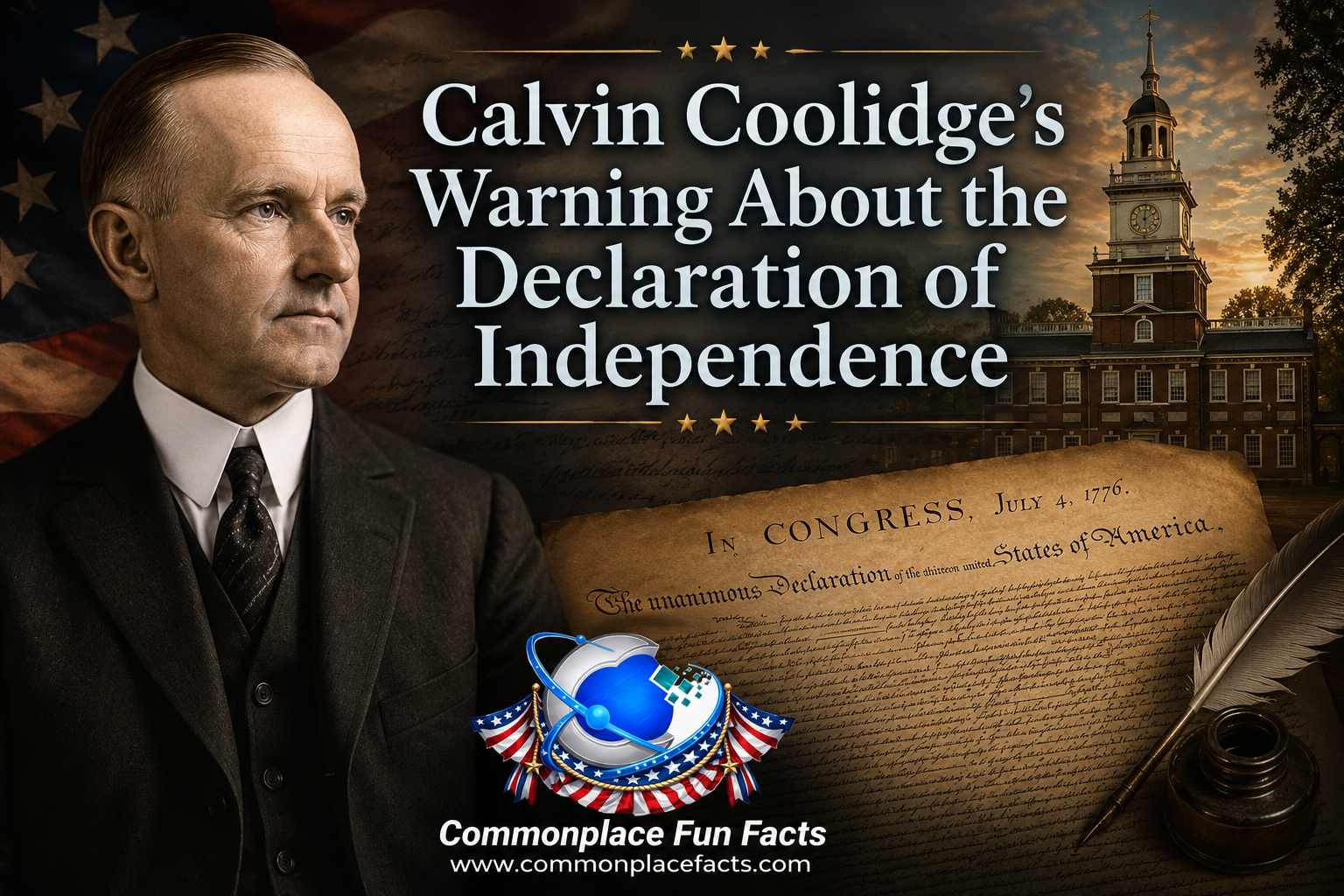

Calvin Coolidge is usually remembered as “Silent Cal,” which is one of those historical nicknames that does a man no favors. It makes him sound like a decorative houseplant in a dark suit. In reality, Coolidge could speak quite powerfully when he had something worth saying. He simply did not believe every passing thought needed to be released into the atmosphere, a discipline now regarded as suspicious and possibly unconstitutional.
Calvin Coolidge on the Spiritual Roots of the Declaration
On July 5, 1926, speaking in Philadelphia for the 150th anniversary of the Declaration of Independence, Coolidge offered one of his clearest statements about what he believed made America possible:
“A spring will cease to flow if its source be dried up; a tree will wither if its roots be destroyed. In its main features the Declaration of Independence is a great spiritual document. It is a declaration not of material but of spiritual conceptions. Equality, liberty, popular sovereignty, the rights of man — these are not elements which we can see and touch. They are ideals. They have their source and their roots in the religious convictions. They belong to the unseen world. Unless the faith of the American people in these religious convictions is to endure, the principles of our Declaration will perish. We can not continue to enjoy the result if we neglect and abandon the cause.”
That is not exactly the sort of thing one expects from a president remembered mostly for saying very little and wearing collars that looked engineered by a committee of starch enthusiasts.
Coolidge’s point was not merely that the Declaration mentioned a Creator, though it certainly does. His point was deeper: the Declaration depends on ideas that cannot be weighed, measured, taxed, regulated, or stored in a climate-controlled archive next to Ben Franklin’s spare spectacles. Equality is not a rock. Liberty is not a wagon. Popular sovereignty is not something Thomas Jefferson kept in the drawer of his writing desk between quills.

These ideas live in the realm of conviction. They require a belief that human beings possess worth beyond what the state grants them. They require a belief that government is not the source of rights but a servant assigned to protect them, preferably without getting ideas above its station, which government has historically found difficult.
Coolidge saw the Declaration as a tree. Its visible branches were political: consent of the governed, liberty, equality, rights. But its roots were spiritual. Remove the roots, and the branches may remain for a while. They may even look impressive for a season. But eventually the thing dries out, becomes brittle, and starts dropping limbs on unsuspecting pedestrians.
The Declaration of Independence Is More Than a Breakup Letter
This was Coolidge’s warning: America could not keep the fruit while destroying the orchard. The nation could not enjoy rights while forgetting why rights exist. It could not preserve liberty while abandoning the moral soil from which liberty grew. That is not a call for empty nostalgia or powdered-wig cosplay. It is a reminder that ideas need foundations.
The Declaration of Independence was not merely a political breakup letter to King George III, though as breakup letters go, it remains one of history’s more elegantly savage examples. It was an argument about reality: that rights are real, that human dignity is real, that government answers to the people, and that the people themselves answer to truths higher than government.
Coolidge understood that if those truths are reduced to slogans, the Declaration becomes a museum piece. Nice parchment. Lovely penmanship. Very suitable for gift-shop mugs. But if the convictions behind it endure, the Declaration remains what it was meant to be: not just a relic of 1776, but a living challenge to every generation that inherits it.
Silent Cal, as it turns out, had plenty to say. He just saved it for moments when the republic might actually need to hear it.
You may also enjoy…

Read James A. Garfield’s Moving Tribute on the First Memorial Day
James A. Garfield spoke at the first official Memorial Day (then known as Decoration Day) at Arlington National Cemetery. The man who would become the 20th President of the United States was a master orator whose words still echo a noble beauty over 150 years later. “If silence is ever golden,” Garfield said, “it must…

George Washington’s Prayer for the Nation
On June 8, 1783, General George Washington wrote a prayer for his young nation. This prayer is read each day at the wreath-laying ceremony at his grave at Mount Vernon. Over 237 years later, his words and request are just as timely and needed: “I now make it my earnest prayer, that God would have…

Thomas Jefferson’s Writing Desk: The Surprising Story of the Desk That Drafted the Declaration of Independence
Discover the surprising story of Thomas Jefferson’s writing desk—the small wooden box used to draft the Declaration of Independence—and the fascinating history behind one of America’s most iconic documents.




Leave a Reply