

Most disappointed customers ask for a refund. Some write an angry letter. A few vow never to return, which generally lasts until the next coupon arrives.
When we are talking about St. Louis in 1904, it’s a different story. The disappointed customers in that setting had a different way of expressing dissatisfaction.
They burned the place down.
This was the St. Louis Bullfight Riot, one of those magnificent little historical disasters that sounds as if it were written by an imaginative novelist who confused Spain with the American Midwest after eating something questionable from a World’s Fair concession stand. It had everything: a forbidden spectacle, thousands of paying customers, official intervention, no refunds, weak bulls, an angry mob, an arena made of materials that regarded fire as an invitation, and a fatal epilogue involving two bullfighters in a hotel.
It was not the finest hour for St. Louis, public safety, event planning, animal welfare, or the concept of customer service. But as history goes, it was certainly memorable.
Contents
St. Louis Was Already in Spectacle Mode
To understand why anyone thought a bullfight in St. Louis was a good idea, we need to start with the setting. The year was 1904, and St. Louis was hosting the Louisiana Purchase Exposition, better known as the 1904 World’s Fair as well as the 1904 Olympics.

The fair was enormous. It was grand. It was ambitious. It was the sort of event where cities put on their best clothes, polish the brass, hide the embarrassing relatives, and tell the world, “Please come and tell us how much you admire our awesomeness.”
Visitors came to see inventions, exhibits, architecture, international displays, amusement attractions, and all the educational wonder a person could absorb before collapsing from heat, walking, and early-twentieth-century snack options. St. Louis was selling spectacle on an industrial scale.
That atmosphere mattered. Once a city is full of tourists, money, novelty, and civic self-importance, someone will inevitably say, “You know what would improve this? Livestock violence.”
Enter Richard Norris, Promoter of Questionable Confidence
The man at the center of this particular decision was Richard Norris, manager of the Norris Amusement Company. Norris advertised a series of bullfighting events near the World’s Fair grounds. The event was not officially part of the fair, but it was very much fair-adjacent, which is the historical equivalent of setting up a lemonade stand beside a parade and pretending the marching band is there for you.
Norris built a large arena north of the exposition grounds. Reports vary slightly on its capacity, but the point is not a minor one: this was not a backyard demonstration involving one confused cow and a folding chair. It was a major attraction, promoted to thousands of people who were already in town looking for something unusual to see.

Tickets reportedly sold for one dollar apiece. That sounds harmless until you remember that one dollar in 1904 was not “I found this in the couch cushions” money. It was real money — about $35–$40 in 2026 dollars. People had paid for an experience. Not a lecture. Not a polite agricultural exhibit. They expected a bullfight.
The advertised performers included Spanish bullfighters, among them Manuel Cervera Prieto, described in contemporary accounts as an accomplished matador. The promise was simple: St. Louis would get a taste of Spain, with all the drama, danger, and cultural authenticity one could responsibly import into Missouri.
There was, however, one small complication.
The bullfight was illegal.
Admittedly, this is the sort of detail one hopes will arise earlier in the planning process.
The Legal Problem Wearing a Cape
Bullfighting was opposed by animal welfare advocates and religious organizations, and they were not exactly subtle about it. The St. Louis Humane Society and other groups objected to the planned fight and appealed to Missouri Governor Alexander Dockery to stop it.
The objections were not hard to understand. A bullfight is not exactly an animal-friendly production. It is not a petting zoo with better costumes. Traditional bullfighting involves tormenting and killing the bull, which made the whole proposal a problem for anyone who believed animals should not be stabbed for entertainment while tourists snacked on popcorn.
Governor Dockery responded by ordering local authorities to prevent the fight. On June 5, 1904, officials arrived at the arena and stopped the event before it could proceed.
Had that been the end of it, the story might have been a modest footnote: “Missouri authorities stop illegal bullfight near World’s Fair.” Interesting, yes, but not the sort of thing that makes future writers lean forward and whisper, “Oh, this is going to get stupid.”
The problem was that thousands of ticket-holders were already there.
The Crowd Arrives, and the Show Does Not
The World’s Fair itself was closed that Sunday, which may have helped funnel attention toward outside amusements. Thousands of people arrived at the Norris arena expecting to see a bullfight. Instead, they got an announcement that the authorities had stopped it.
There are moments in history when one can almost hear the collective emotional temperature shift.
The crowd had paid. The crowd had gathered. The crowd had not received the advertised spectacle. And then came the truly combustible ingredient: refunds were not immediately forthcoming.
This is where the event changed genres. It began as an exotic entertainment promotion. It became a consumer protection seminar taught entirely through property damage.
People demanded their money back. Negotiations apparently took place inside the office. The crowd grew angrier. Rocks were thrown. Windows broke. People inside the office were injured by glass and debris. Police were present, but not in the numbers necessary to manage thousands of irritated spectators who had recently discovered that their afternoon entertainment consisted of standing around while officials and promoters argued.
That is rarely a calming program.
From Refund Request to Riot
The situation escalated quickly. The mob attacked the arena and the office area. Police reportedly drew pistols to hold people back, which gives some idea of the mood. This was no longer a grumbling crowd. This was a crowd actively auditioning for a municipal cautionary tale.

Then the rioters entered the arena.
Some of the bulls were released. This should have been the moment when the story became terrifying. After all, the crowd had come to see fierce animals and professional bullfighters. Instead, the bulls apparently did not behave like the dangerous beasts promised in the advertising.
Several accounts describe the bulls as thin, weak, or unimpressive. They were not exactly charging symbols of primal fury. They were more like reluctant unpaid interns in an ethically questionable theater production.
This mattered because it deepened the suspicion that the crowd had been cheated from the start. If the bulls were not capable of delivering anything resembling a real fight, then perhaps the cancellation was not the only problem. Perhaps the advertised spectacle had always been more promotional fantasy than actual plan.
Nothing soothes an angry crowd quite like the realization that they may have paid to be lied to by a man with an arena.
The Bulls Were the Sensible Ones
One of the strangest parts of the St. Louis Bullfight Riot is that the bulls may have been the least aggressive participants.
That is not usually how bullfight stories go. Traditionally, the bull is supposed to be the dangerous one. Here, however, the humans handled most of the destruction themselves, because apparently the animals lacked commitment to the bit.
The reports of weak or nonaggressive bulls raise a fascinating possibility: Norris may not have been prepared to stage an authentic bullfight at all. Later claims from bullfighters involved in the event suggested that the whole thing may have been a sham. Maybe the plan was to advertise danger, collect the money, and then offer something watered down enough to avoid the legal consequences of a real bullfight.
If so, this was a business model with one obvious flaw: it required thousands of paying customers not to notice.
They noticed.
Then They Burned the Arena
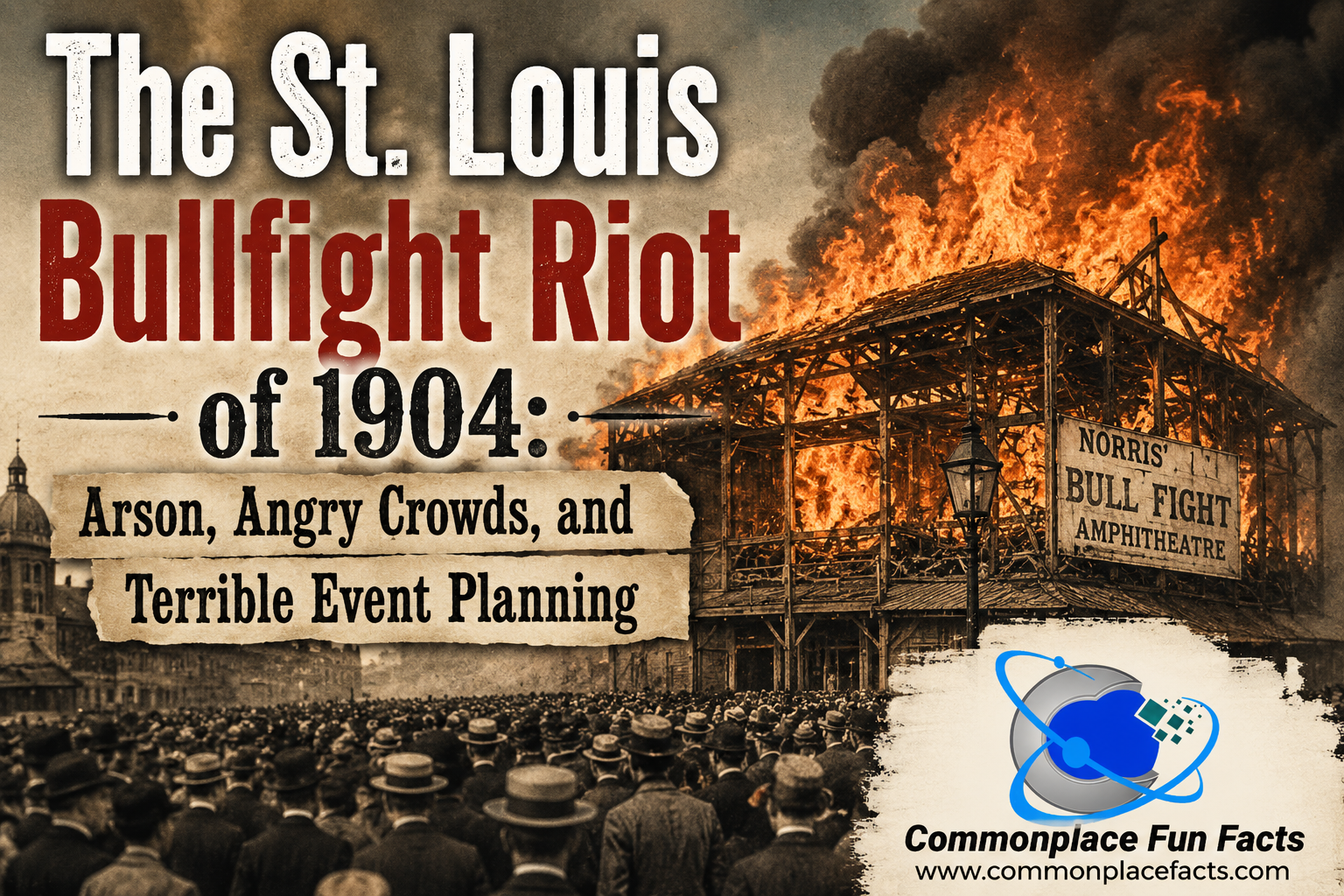
Once the crowd moved from anger to destruction, the arena did not stand much of a chance. The structure was made largely of wood, pine, tar paper, straw, and other materials that, when introduced to fire, tend to respond with enthusiasm.

Rioters set fire to straw in the bullpen area. Flames spread to the grandstand. Firefighters responded, including some from the nearby fairgrounds, but the arena burned to the ground.
The result was dramatic enough to land on front pages. The June 6, 1904, issue of the St. Louis Republic featured an image of the burning Norris Amusement Company arena, turning the failed bullfight into exactly the kind of public spectacle Norris had hoped to sell, only with more smoke and less revenue.
Several people were injured during the riot. Arrests followed. The arena was gone. The promoter’s grand attraction had lasted just long enough to become kindling.
As marketing disasters go, it was unusually well-lit.
The World’s Fair Connection
It is worth being precise about the World’s Fair connection. The bullfight was not an official Louisiana Purchase Exposition event. It took place near the fairgrounds and clearly tried to capitalize on the crowd, attention, and appetite for spectacle created by the fair.
That distinction mattered then, and it matters now. The fair itself did not schedule an official “Come Watch People Anger Livestock Until Missouri Intervenes” pavilion. The bullfight was a private amusement venture operating in the orbit of the fair.
Still, proximity has consequences. When thousands of people are in town for a major international exposition, the surrounding area becomes a magnet for side shows, attractions, schemes, and events that may or may not have been reviewed by anyone with a working knowledge of law, fire safety, or common sense.
The St. Louis Bullfight Riot was not part of the fair, but it belongs to the fair’s larger world: a place where education, entertainment, commerce, exoticism, and occasional bad judgment all jostled for space.
The Fatal Epilogue
As if the riot needed an epilogue written by a particularly gloomy novelist, the story did not end when the ashes cooled.

Just days later, the two most prominent matadors connected with the event took things to a grim new level. Manuel Cervera Prieto was shot and killed in St. Louis by Carleton Bass, another bullfighter associated with the canceled event. Bass was sometimes described as an American matador, although his biography was more complicated than the label suggests. The dispute reportedly involved money connected with the failed bullfight.
According to later accounts, Bass claimed self-defense after Cervera attacked him with a knife. A coroner’s inquest accepted the self-defense claim, and Bass was not tried for murder.
This part of the story deserves a different tone. The riot is absurd. The promotion was ridiculous. The refund dispute almost invites dark comedy. But Cervera’s death was real, and it turned the affair from a bizarre public disturbance into something tragic.
The St. Louis Bullfight Riot began with people demanding entertainment and ended with an arena destroyed and a man dead. History has a way of reminding us that farce and tragedy often share office space.
Why Did the Riot Happen?
The riot happened because several bad ideas arrived at the same place at the same time and began helping each other.
First, there was the culture of spectacle surrounding the World’s Fair. People wanted novelty. Promoters wanted money. Those two forces have built many things, not all of them advisable.
Second, there was the legal problem. Bullfighting was not a harmless exhibition in the eyes of Missouri authorities. Animal welfare advocates and religious organizations had already objected. The governor had intervened. The event was in trouble before the first ticket-holder arrived.
Third, there was the refund issue. A crowd can be disappointed and remain orderly. A crowd can be annoyed and still go home. But a crowd that believes it has been cheated is another creature entirely, particularly when the crowd is large, hot, loud, and standing near flammable architecture.
Fourth, there was the possibility that the whole spectacle was less authentic than advertised. If the bulls were as weak and unimpressive as reports suggest, then the crowd may have felt the event was not merely canceled but fraudulent. That does not excuse arson, obviously. “The livestock lacked theatrical intensity” is not a recognized defense to burning down a building. But it helps explain why the crowd’s anger became so intense.
Finally, there was inadequate crowd control. The authorities stopped the fight, but stopping the fight was only half the problem. The other half was thousands of people demanding money from organizers who apparently were not eager or able to return it.
That is not a crowd management plan. That is a fuse.
What Were the Repercussions?
The most immediate repercussion was the destruction of the Norris Amusement Company arena. The structure burned completely, which tends to limit future programming opportunities.
There were injuries, arrests, and criminal accusations. Norris and others associated with the event faced legal attention. The riot became a national embarrassment at a time when St. Louis was trying very hard to look polished, cultured, and globally significant.
The incident also reinforced the power of the animal welfare movement. The bullfight had been stopped because organized public pressure reached the governor. That is no small thing. In an era when many amusements included placing people from other countries in exhibits as thought they were zoo animals, the successful intervention showed that public morality and humane advocacy could influence official action — for animals, anyway.
But the strangest repercussion was the way the riot transformed a failed attraction into a lasting historical memory. Had the bullfight gone forward, it might be a minor curiosity. Had Norris simply refunded the tickets, it might have vanished almost entirely.
Instead, because the event collapsed into riot, fire, scandal, and death, it survives.
Sensible decisions rarely get monuments. Catastrophic foolishness gets articles.
Fun Facts From the St. Louis Bullfight Riot
The Bullfight Was Not Officially Part of the World’s Fair
It was staged near the fairgrounds and clearly tried to benefit from the fair crowd, but it was not an official World’s Fair attraction. This is an important distinction, especially for anyone trying to preserve the dignity of the Louisiana Purchase Exposition, which already had plenty to answer for without accepting custody of the bullfight riot.
The Fair Was Closed That Day
The riot took place on a Sunday, when the fair itself was closed. That likely increased interest in outside amusements. When the main attraction closes, people look for alternatives. Sometimes the alternative is a museum. Sometimes it is a private bullfight arena that becomes a pile of ashes. Weekends are unpredictable.
The Bulls May Have Been Terrible at Bullfighting
Reports that the bulls were weak or nonaggressive are among the strangest details in the whole story. The animals were supposed to be the dangerous part. Instead, the crowd appears to have handled the violence department without assistance.
The Arena Burned Very Easily
Wood, straw, pine, and tar paper are not ideal materials if your business model includes angering thousands of people. This was a lesson learned in the traditional manner: too late and with firefighters present.
The Story Has a Matador Homicide
Manuel Cervera Prieto’s death days later gives the story a grim final chapter. What began as a canceled spectacle turned into a riot, then a fire, then a fatal dispute among men connected to the event. It is almost too much plot for one historical episode, which is how history likes to remind fiction to stop being so timid.
The Real Lesson: Never Combine Bad Planning, Angry Crowds, and Straw
The St. Louis Bullfight Riot is ridiculous, but it is not random. It happened because of recognizable human failures: overpromising, ignoring legal limits, underestimating public anger, refusing or failing to provide refunds, and assuming that a crowd of thousands would remain reasonable after being denied the thing they paid to see.
That assumption was incorrect.
There is also something very American about the whole thing. A promoter tried to package an exotic spectacle for paying customers. Reformers and officials tried to stop it. The public demanded its money back. Nobody handled the transition well. Then the crowd converted a business dispute into a structure fire.
The bulls, meanwhile, appear to have contributed very little to the violence. Considering they were supposed to entertain the masses by being painfully executed, that seems very accommodating of them.
Conclusion: The Bullfight That Wasn’t and the Riot That Was
The St. Louis Bullfight Riot survives because it has the rare historical quality of sounding fake while being real. It belongs to that special category of events where every new detail makes the reader pause and ask, “Wait, there’s more?”
There was a World’s Fair. There was a private bullfight arena. There were thousands of ticket-holders. There was government intervention. There were no refunds. There were unimpressive bulls. There was a riot. There was a fire. There was a fatal shooting days later.
It is tempting to say St. Louis did not get the spectacle it had been promised. But that is not quite true.
The city got a spectacle. It just came without matadors, ended with arson, and left historians trying to explain why everyone in 1904 seemed determined to make event planning look like a contact sport.
You may also enjoy…

The West Point Eggnog Riot: The Christmas Party That Spiraled Into Chaos
Discover the wild story of the Eggnog Riot of 1826 at West Point. Learn how rebellious cadets, including Jefferson Davis, turned a Christmas Eve party into a historic melee fueled by spiked eggnog and defiance.

The Straw Hat Riot: Yes, That Was Really a Thing?
In 1922, the Straw Hat Riot erupted in Manhattan when teenage boys attacked adults for wearing straw hats beyond the designated season. This clash between youthful enforcers and defiant adults escalated into chaos, causing significant disruption. The riots highlighted societal tensions over fashion and obedience to unwritten social rules, ultimately leading to the decline of…

Harvard’s History of Rebellion and Food Fights
Student protests seem to be a phenomenon that started in the 1960s, but they are much older than that. The proud history of protests on college campuses got its start in America before there was such a thing as the United States. The subject of the protest was something that is still near and dear…



Leave a Reply