
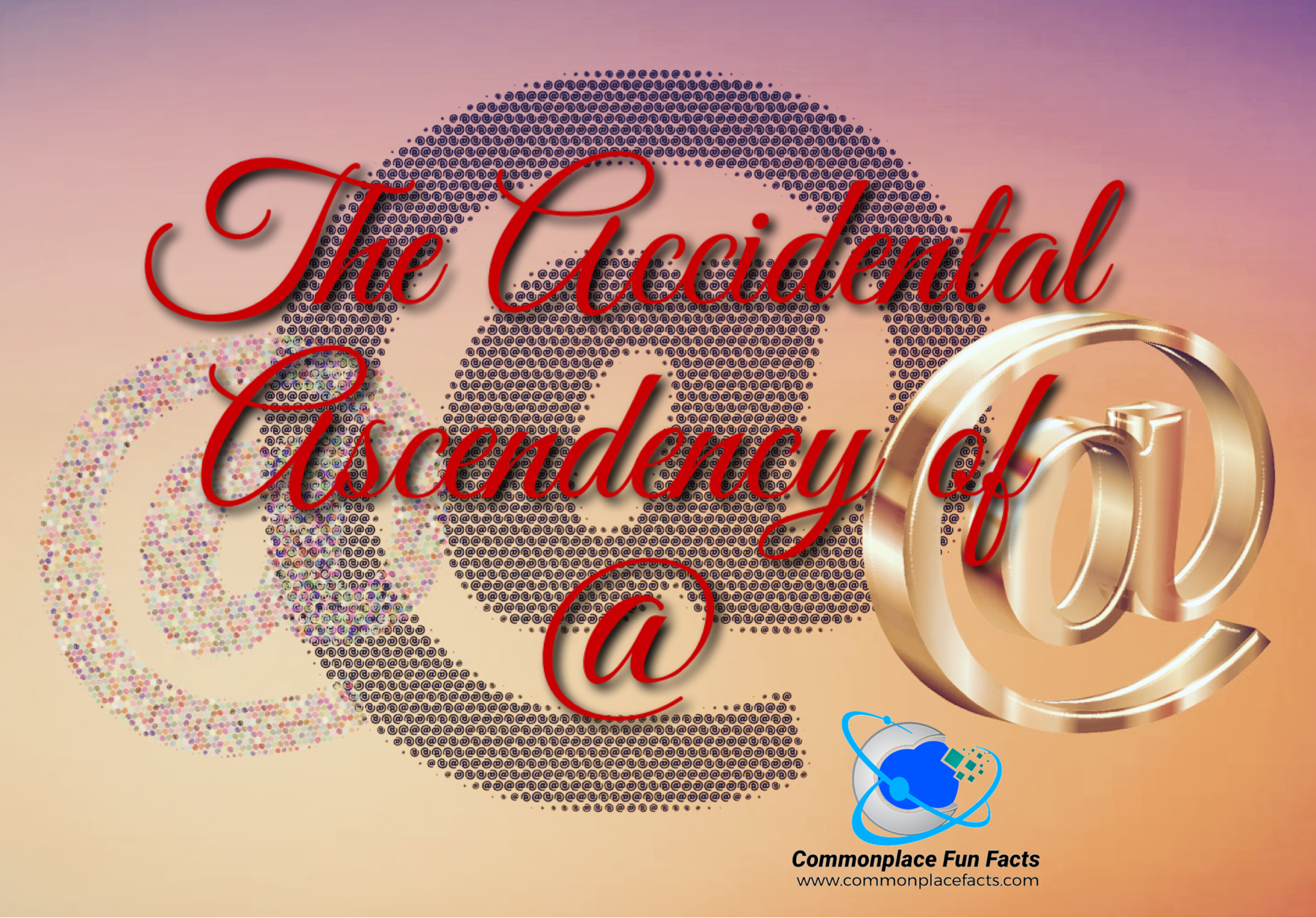

What is the Origin of @?
“@“. Some call it “at.” Others know it as “each.” The Italians refer to it as a “snail.” To the Dutch, it is the “monkey tail.” This curious symbol, known by so many names, was on the precipice of extinction until a fortunate happenstance made it essential to modern communication, appearing in more than 300 billion emails and 500 million Tweets every day.
The origin of @ is shrouded in mystery. Some believe it was a shorthand method used by medieval monks to write the Latin word “ad” (“toward”). The symbol would have been the result of combining the “a” and “d”, with the tail of the “d” curving back on itself. Others think it derived from the French word for “at” — “à.” Still others suggest it arose as an abbreviation for “each at,” with an “a” being enveloped by an “e.”

The first documented use of the symbol was in 1536 in a letter by Francesco Lapi. The merchant from Florence used @ to denote units of wine known as amphorae.
Since Lapi’s day, @ came to be used largely by merchants to show the price per item. Instead of writing, “16 chickens, at the rate of 1 shilling per chicken,” they could save time, energy, and ink by stating, “16 chickens @ 1s.”

Despite its promising start, @‘s future was by no means assured. Early typewriters did not consider the symbol significant enough to include on the keyboard. When the punch-card tabulating system was rolled out for the 1890 U.S. Census, @ failed to make the cut.
It appeared that @ was about to suffer the same fate as the lost letters of the alphabet when an accident of history plucked it from obscurity.
In 1971, computer scientist Ray Tomlinson was working on a way to improve electronic communications. Two years earlier, the first electronic message had been sent between computers (read about it here). Tomlinson wanted to be able to address a message to a particular user on another computer, instead of sending it generally to anyone who happened to be on the device.
He decided that the message needed an address. Logically, the address should include the identity of the recipient and the location of the computer. He also needed a symbol to differentiate the two elements of the address. Ideally, that symbol should not be widely used in programming, otherwise, computers might get confused.
“I was mostly looking for a symbol that wasn’t used much,” he remembered. “And there weren’t a lot of options—an exclamation point or a comma. I could have used an equal sign, but that wouldn’t have made much sense.” As he pondered the solution to his dilemma, Tomlinson’s eyes fell upon the strange symbol on the “P” key of his Model 33 teletype: @.
Tomlinson sent an email to himself, using @ as the separator between his name and the recipient computer in another room.
Little did Tomlinson suspect that he had just plucked @ from near-extinction. Today, the once-obscure symbol is used billions of times every day. Since you are reading this online, you most likely have at least two or three email addresses and at least one social media handle assigned to your name that would be meaningless without “@“.

How California Got Its Name from a Mythical Island, a Warrior Queen, and a Book Most People Have Never Heard Of
A mythical island ruled by warrior women? Find out how California got its name from a book that no one remembers.

The Original Cinderella: The Blood, the Birds, and the Butchery Disney Forgot
Discover the shocking, horrifying truth behind the Brothers Grimm’s original Cinderella — a tale filled with blood-soaked slippers, toe-less stepsisters, and vengeful pigeons. The real story is darker, stranger, and far creepier than the Disney version.

Webster Edgerly: The Bizarre Guru Behind Ralston Purina
Discover Webster Edgerly, the eccentric founder of Ralstonism, whose odd health rules and utopian dreams shaped the cereal giant Ralston Purina.


Leave a Reply