
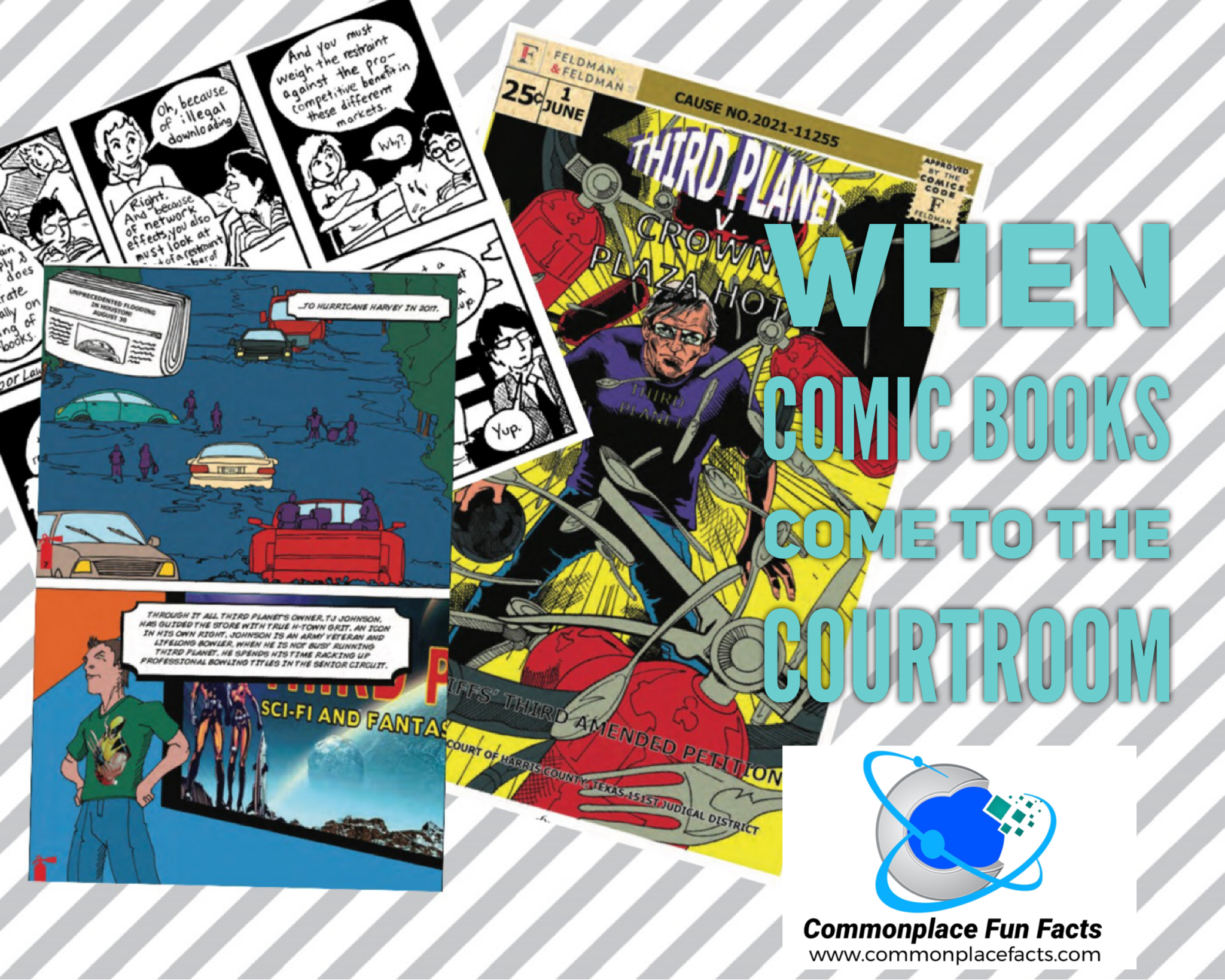

It goes without saying that legal documents tend to be boring. If they were interesting, people would actually read the fine print before signing contracts and thereby eliminate the need for the legal profession. Any exception to this rule tends to be noteworthy. It is not an exaggeration to say that such a scenario would be so extraordinary that it might even be worthy of being chronicled in a comic book.
Coincidentally, we have two such comic book scenarios to share with the Commonplace Fun Facts community. Unfortunately, neither story involves a nerdy, socially-awkward teenager who was bitten by a radioactive lawyer and is miraculously transformed into Lieutenant Litigator/Amazing Advocate/Captain Counselor/Doctor Deposition. Even so, they are at least mildly entertaining, even for those who have not lost their souls people who are not lawyers.
Combating Word Limits
The first breathtaking adventure in our courtroom comic book cacophony was the result of a lawsuit about e-books. The U.S. Department of Justice sued six publishers, claiming a conspiracy to destroy competition by underpricing their e-books.
The parties reached an agreement to settle the lawsuit. The agreement did not sit well with Bob Kohn. Kohn is an attorney and licensing expert. He wanted to persuade the court to reject the settlement by filing an amicus brief. The court was open to receiving his brief but said that it needed to be limited to five pages. Kohn’s brief was 55 pages long.
How do you reduce a 55-page argument to five pages? That would require powers and abilities that can be found only in the pages of comic books.

With the help of one of his daughter’s friends, Kohn reduced his complex legal argument to a five-page dialogue between two characters. It complied with the court’s rules because it had the standard caption and a table of authorities, and appropriate margins. It perfectly embodied the principles that a picture is worth 1,000 words and that less is more.
Unfortunately for Kohn, the court was not persuaded. The day after his creative brief was filed, the court approved the settlement.
Sometimes, comic books end in tragedy.
Comic Book Store Uses Comic Book Creatively
Third Planet Sci-Fi and Fantasy Superstore knows all about comic books. Consequently, it also knows about the age-old story of the underdog who faces unbelievable odds against a super-powered foe.
The store owners thought they were living out one of those stories when it came under attack from guests of its neighbor, the Crowne Plaza River Oaks Hotel. Allegedly, hotel guests repeatedly hurled projectiles at the store from the hotel’s upper floors. The projectiles included “all manner of items, from ceramic mugs, plates, silverware, and bottles to cinder blocks, luggage racks, and ladders….”
The situation became untenable on or about March 3, 2019, when persons unknown “launched at minimum fourteen large metal-canister fire extinguishers” from the hotel onto Third Planet’s property. The petition alleges that the impacts “irreparably damaged” the business’s roof. Then came the rain.
Third Planet’s lawsuit against the hotel started in a typical legal fashion. The hotel responded that it “could not sufficiently understand the claims and allegations against it.” This prompted Third Planet to clarify the facts of the case by “provid[ing] the facts in illustrated form.”

The resultant filing is a full-color, action-packed illustration of the Plaintiff’s complaint and legal theory. Third Planet argues that the hotel has a duty to do more to keep those on its property from launching projectiles at the neighbors. It bases its argument on theories of negligence, trespass, and nuisance.
This epic battle has been fought in the District Court of Harris County, Texas since 2021. As of this writing, the trial is scheduled for April 2023.
Leave a Reply