
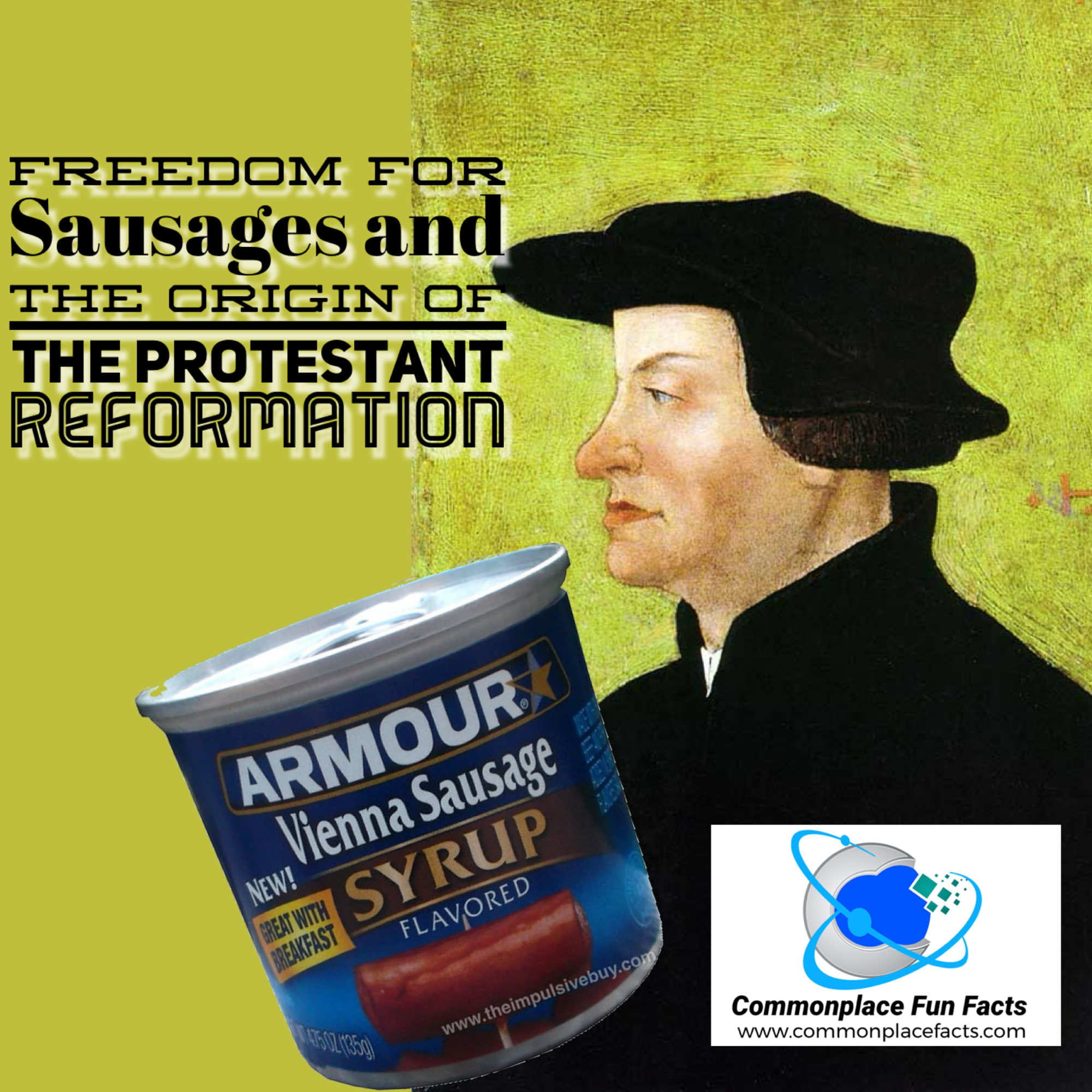

Sin, Suspicion, and The Affair of the Sausages
Sausages.
They may fill your mind with questions. What are they made of? How are they made? How will they affect my waistline or cholesterol levels?
These are all legitimate questions, but have you ever wondered what effect a sausage may have on your immortal soul?
Contents
Early Christian Crackdowns
That is the theological debate that raged for most of the history of Christianity. The first serious opposition to them occurred in AD 320. Roman Emperor Constantinus I and church leaders believed there was too much of a connection between sausages and pagan festivals. As a result, sausages were banned and remained forbidden for the faithful for the next 1,300 years.
Leo the Wise, who ruled from 886 to 912, added his voice to the subject by banning the consumption or sale of blood sausages. The penalties for violating his edict were quite severe. Anyone caught eating or selling the forbidden food ran the risk of being beaten, exiled, having his or her property confiscated, and having all body hair shaved off.
This legislation is found in the Constitutions of Leo VI the Wise as (emphasis added):
CONSTITUTION LVIII.
FOOD SHALL NOT BE COMPOSED OF BLOOD.
The Same Emperor to the Same Stylianus.
In former ages, God ordered Moses not to make use of blood as food, and it was afterwards declared by the Apostles that persons ought to abstain from nourishment of this description. And although in ancient as well as in modern times such food was considered vile and execrable, the obstinacy and perversity of men induced them to pay no attention to the provisions of the law; but, on the contrary, some of them being influenced by the desire for gain, and others by their appetites, boldly violated the law, and fed upon blood, although its use had been prohibited. It has been brought to Our ears that they now stuff entrails with blood, and use them as their daily food. As We do not think that this should be tolerated, the Divine precepts disobeyed, and the State disgraced by the use of such nutriment, which is a wicked invention due to the gluttony of mankind, We hereby forbid all persons either to use, or to sell it; and We give notice that, if anyone should, in contempt of the Divine Law, he found to have prepared blood as food, whether he sells it or buys it, he shall have all his property confiscated, and, after having been severely scourged, and disgracefully shaved, shall be exiled for life. Again, as magistrates of cities would have been able to prevent this crime if they had been sufficiently vigilant, they shall, for the reason that they have been remiss in the performance of their duty, be sentenced by the same judgment to pay a fine of ten pounds of gold.
Admittedly, the bit about making offenders as bald as a naked mole rat seems to be a bit of overkill, but we would favor something comparable to prevent heretics from poisoning pizza with pineapple toppings. But we digress…
Europe Ready for Reform

Religious opposition to the sausage continued for the next few centuries. By the turn of the 16th century, the blanket prohibition against the food had waned, but it was still considered off-limits during the season of Lent.
This was a time when people throughout Europe were questioning the status quo. On October 31, 1517, Martin Luther posted his Ninety-Five Theses on the door of the church in Wittenberg, Germany. Thus, the Protestant Reformation came into being. Fires of discontent swept through Europe. Few could have expected the prominent part sausage would play in this drama.
Five years after Luther’s Ninety-Five Theses were made public, a group of printers were hard at work in the quiet, picture postcard community of Zurich, Switzerland. Christoph Froschauer was a printer. He and his colleagues had been toiling away to print The Epistles of St. Paul. Exhausted from their labors, they sat down for a succulent sausage supper of Swiss Fasnachtskiechli and some slices of sharp smoked hard sausage.
The Affair of the Sausages
Unfortunately, this happened in March in the midst of Lent. That made the central ingredient of the meal off-limits. Froschauer’s audacity outraged those who learned of it. After a public outcry, Froschauer was arrested.
One of those in attendance at the meal was a local priest by the name of Ulrich Zwingli. Although, according to witnesses, Zwingli did not partake of any sausages, he was offended that Froschauer was deprived of his freedom over such a small thing. He took to the pulpit and preached his heart out. His sermon was entitled Von Erkiesen und Freiheit der Speisen (Regarding the Choice and Freedom of Foods). Consistent with Luther’s principle of sola scriptura that “Christians are free to fast or not to fast because the Bible does not prohibit the eating of meat during Lent.”
Zwingli Takes the Pulpit
With the eloquence of a seasoned debater, Zwingli sparred with Rome, arguing that God’s menu was not dictated by man-made laws but by the spirit of liberty found in the good book. And so, the sausage supper became a rallying cry for freedom, a reminder that salvation wasn’t served on a silver platter of rules, but on the humble plate of faith.
Zwingli persuaded the masses. The incident, known as The Affair of the Sausages, has been said to have been as foundational for the Swiss Reformation as Luther’s Ninety-Five Theses were for the German Reformation.
Sausages, Souls, and Saturated Fats
You may have started your day today with a breakfast meal that included sausages. Hopefully, your enjoyment was increased with the knowledge that you did not do harm to your eternal soul.
What you have done to your arteries, well, that’s another matter. You’ll need to talk to your doctor if you want absolution for that. Or you might choose Martin Luther’s preferred method for good health and take a spoonful of poop each day. If you’re interested in that tactic, you can read about it here.

Zeppelin Construction Took a Lot of Guts
Find out the curious link between cow intestines and zeppelin construction in World War I.

Urian the Greyhound: The Dog Responsible for the English Reformation
Meet Urian the greyhound — the remarkable dog who was responsible for triggering the English Reformation.

No Horsing Around For Harding’s Church Attendance
President Warren G. Harding enjoyed going horseback riding on Sunday mornings. At the insistence of First Lady Florence Harding, the president had to be back in time to go to church with her. It was up to his Secret Service agent, Col. Edmund Starling, to make sure the reluctant church-goer did not disappoint his wife.…

Leave a Reply