
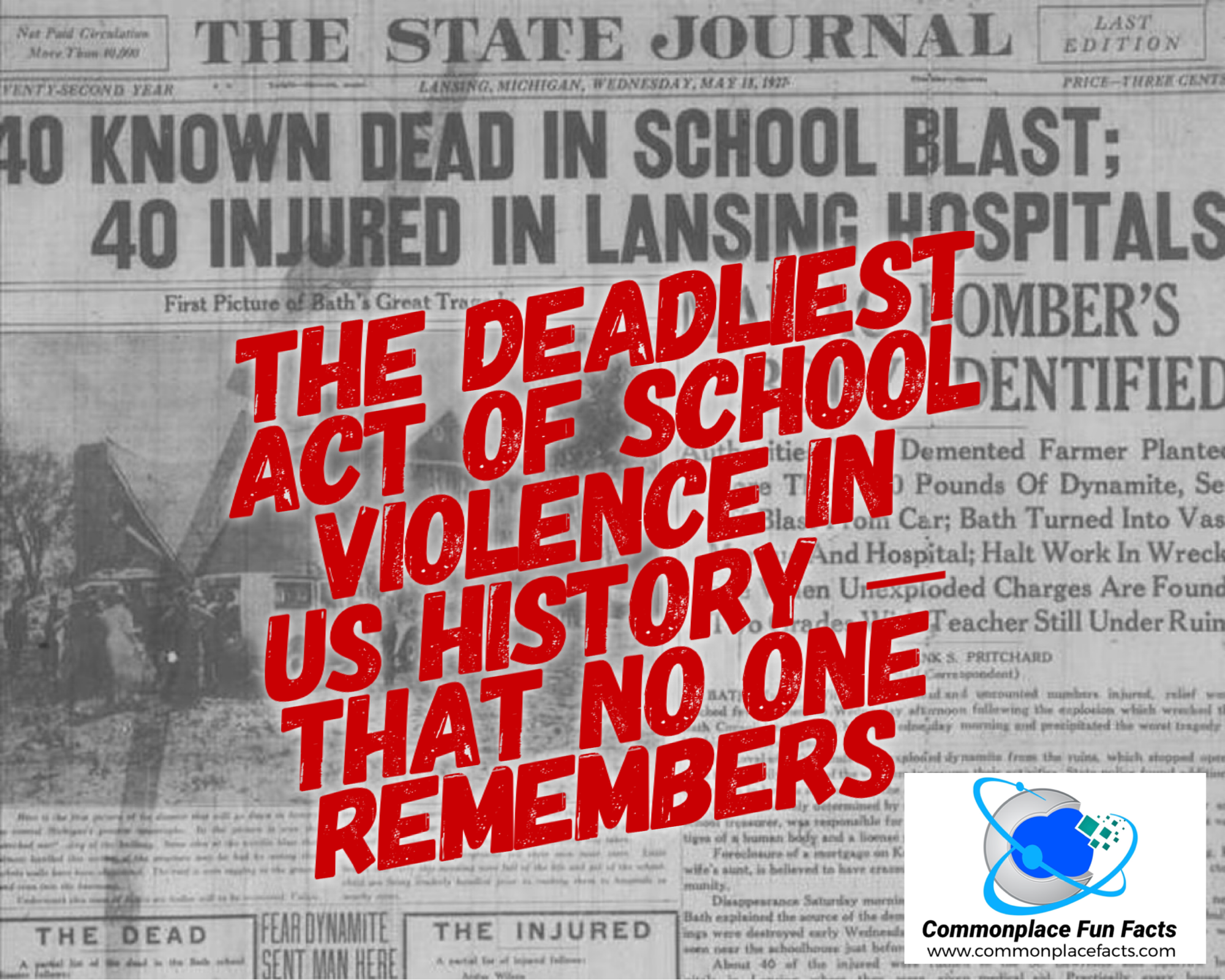

The Bath School Disaster: The Forgotten Tragedy
Editor’s Note: This article addresses subjects that may be troubling to some individuals. Reader discretion is advised.
The headlines seem all too familiar: a mentally disturbed individual who harbors some kind of grudge expresses his anger by killing innocent schoolchildren. How many times have we seen this play out? It seems to be one of the sad realities of 21st-century life.
It would be a mistake to say these tragic events are a recent phenomenon. It would also be wrong to diagnose the problem as being caused by ready access to firearms. If you want proof of these two statements, look no further than the deadliest school massacre in U.S. history. There’s a pretty good chance you never heard of it because it happened nearly 100 years ago.
Contents
The Fateful Day
Bath Township, Michigan, a small community located about 100 miles northwest of Detroit, holds a somber place in American history as the site of the worst school mass murder in the United States. In 1927, this quiet town of roughly 300 people was forever changed by a catastrophic attack carried out by a disgruntled former school board member, Andrew Kehoe.
On May 18, 1927, at approximately 9:45 a.m., a massive explosion tore through the north wing of Bath Consolidated School, killing 38 people instantly. The orchestrator of this horrific event, Andrew Kehoe, had meticulously planned his revenge against the township following his defeat in a local election. His devastating actions resulted in a total of 45 deaths and 58 injuries, leaving the community in shock and mourning.
The Prelude to Disaster

The roots of this tragedy trace back to 1922 when Bath Township opened Bath Consolidated School, an institution designed to centralize the education of children in the region. While this was seen as an educational advancement, it came at a high financial cost, leading to increased property taxes. Kehoe, a farmer and the treasurer of the township school board, vehemently opposed this tax hike and consistently accused the school superintendent, Emory Huyck, of financial mismanagement.
Kehoe’s discontent only grew when he was appointed Bath Township Clerk in 1925 but then lost the 1926 spring election. Facing the foreclosure of his farm and dealing with his wife’s tuberculosis, Kehoe’s frustration turned into a deadly plan for retaliation.
The Execution of the Plan
Leveraging his background in electrical engineering from Michigan State University and his experience as an electrician, Kehoe began secretly planting dynamite in the school over several months. He purchased two boxes of dynamite in Lansing in the fall of 1926, which was not unusual at the time due to its common use on farms. The precision with which he wired the explosives led investigators to believe he might have had assistance. This suspicion, however, was never proven.
On the day of the attack, Kehoe ignited the dynamite using an alarm clock, causing the north wing of the school to explode. First-grade teacher Bernice Sterling described the horror, saying, “I saw the bodies of my children hurled against the walls or through windows. Then I don’t remember much what happened. The explosion stunned me, and I could not do much until help came.”

As the community reeled from the initial explosion, Kehoe drove to the school with his truck loaded with more explosives. After setting his farm ablaze and killing his wife, Kehoe parked outside the school and detonated his truck bomb, killing himself, Superintendent Huyck, and three others. Police later discovered a short circuit in the wiring that had prevented even greater destruction, as an additional 500 pounds of dynamite remained unexploded in the school’s south wing.
The Aftermath and Investigation
The aftermath of the disaster was horrifying. Victims’ bodies were temporarily placed in a makeshift morgue on the school grounds, while ambulances transported the injured to Lansing hospitals. Investigators searching Kehoe’s farm found his wife’s body among the ashes, her skull crushed, suggesting she had been killed to prevent her from revealing his plans.
As the investigation unfolded, neighbors recounted suspicious behaviors exhibited by Kehoe in the days leading up to the attack. Sidney Howell, a neighbor, testified that Kehoe had warned him and three boys to leave the farm, hinting at the impending disaster. David Harte, another neighbor, noted that Kehoe had been preoccupied with stringing wires on his farm for at least ten days prior to the bombing.
A week of testimonies led to the exoneration of the school board from any wrongdoing, with the jury concluding that Kehoe acted alone. Amid the ruins of Kehoe’s home, police found a sign attached to a fence that read, “Criminals are made, not born.”
Rebuilding and Remembrance

In the wake of the tragedy, Bath Township received an outpouring of support from across the nation. School resumed on September 5, 1927, in the community hall. Warren Holmes, a Lansing architect, donated plans for a new school, and Michigan Senator James Couzens personally contributed $75,000 for its construction. The damaged section of the school was demolished to make way for a new wing, named the “James Couzens Agricultural School” in the senator’s honor.
The original school building was eventually demolished in 1975, and a memorial park was established at the site. In 1991, a Michigan Historical Marker was installed, featuring a bronze plaque honoring the victims.
The Legacy of the Bath School Disaster
The Bath School disaster remains a poignant reminder of the potential for unthinkable violence in even the most tranquil communities. Survivors, like those interviewed by NPR in 2009, continued to bear the scars of that day well into their 90s. They emphasized the importance of looking out for one another, having experienced firsthand the reality that such tragedies can indeed occur.
Author Arnie Bernstein, who chronicled the event in his 2009 book Bath Massacre: America’s First School Bombing, highlighted the relatively brief media attention the incident received. He noted that the coverage quickly shifted away when Charles Lindbergh made his historic flight across the Atlantic just three days later.
As the years pass, the memory of the Bath School disaster endures, serving as a somber chapter in American history and a testament to the resilience of the Bath Township community. Through memorials and continued recognition of the victims, the legacy of those lost and the impact on the survivors remain preserved for future generations to reflect upon and learn from.
You may also enjoy…

Was the Hiroshima Bombing the Disastrous Result of a Mistranslation?
A mistranslation during the Potsdam meetings in 1945 significantly impacted Japan’s response to Allied demands for surrender. Japanese Prime Minister Kantarō Suzuki’s ambiguous statement, using the word “mokusatsu,” was interpreted as contempt, leading the Allies to believe Japan rejected diplomacy. This misunderstanding contributed to the decision to drop the atomic bomb on Hiroshima.

Fighting Terrorism With Cupcakes
When terrorist organization al-Qaeda published its first English-language publication, Inspire Magazine, it was with the intention of equipping would-be terrorists with tools of destruction. Thanks to British intelligence agents, the only damage caused when readers followed the instructions was potential tooth decay and expanding waistlines. Inspire Magazine was designed to be a how-to guide for…





Leave a Reply