
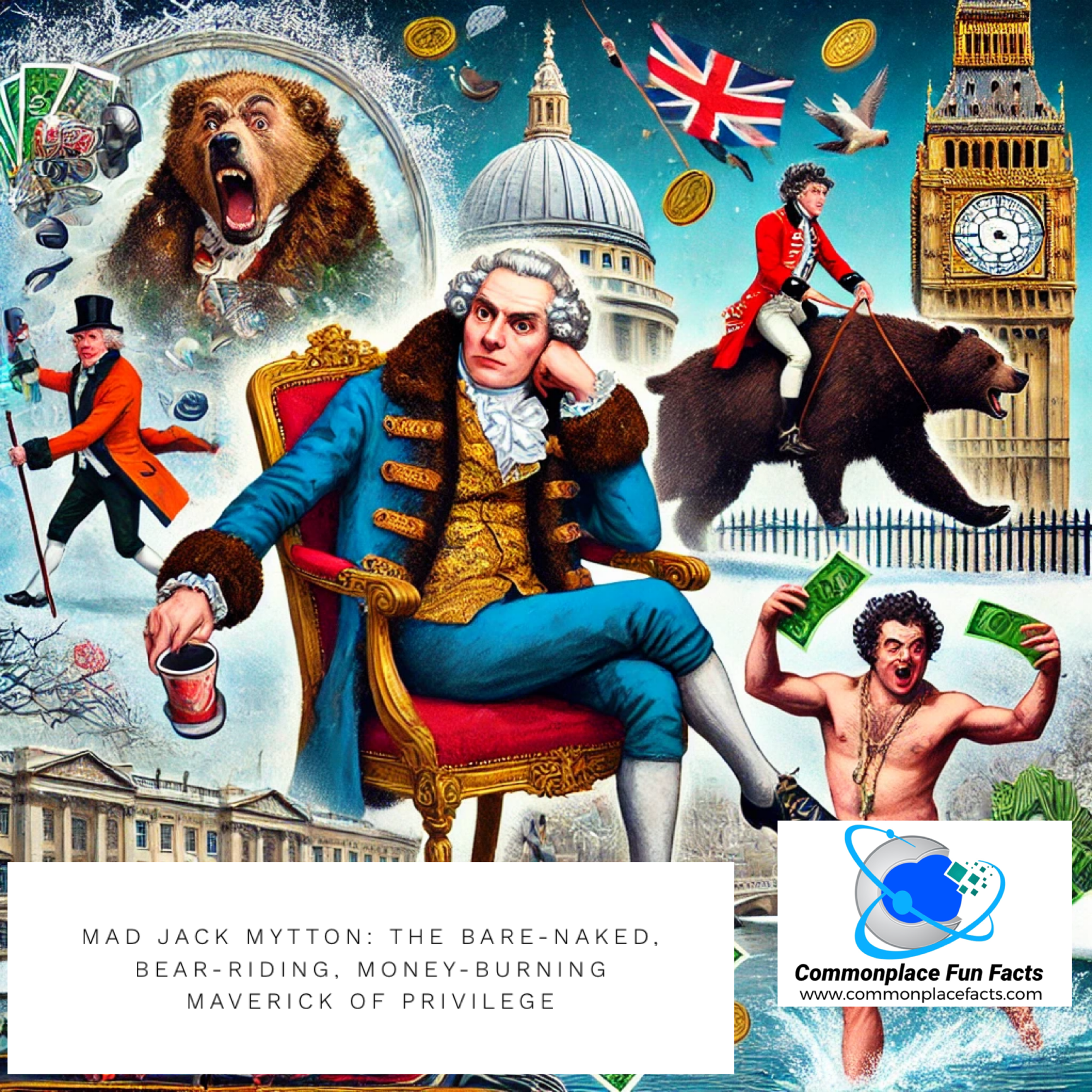


What’s the point of being outlandishly wealthy and being born into unbelievable privilege if you can’t live a little? The rest of us who are forced to exist as part of the Great Unwashed have to conform to societal expectations or we run the risk of being labeled as “weird.” If you are rich and famous enough, however, the same behavior is chalked up as “delightfully quirky.”
Imagine how outlandish someone’s behavior would have to be if, despite the societal shielding that comes with immense wealth and aristocratic birth, his antics earn him the nickname “Mad”? Waste no more time trying to imagine because we are going to introduce you to Squire John “Mad Jack” Mytton. He took “delightfully quirky” and charged it up to boss level. In so doing, he blew through more money than most of us dare to dream about.
Enter Squire Mad Jack Mytton: A Legend in the Flesh
Born near Shrewsbury, England in 1796, John “Mad Jack” Mytton didn’t just live life on the edge. He delighted in right off it, preferably while riding a horse at full gallop—or possibly, a bear, but we’ll get to that later.. Mytton’s escapades were so outlandish that they could have been penned by a novelist. Instead, they were chronicled by “Nimrod,” the pen name of Charles James Apperley, a man who might have been the first sports journalist to truly understand the appeal of a good scandal. Nimrod documented Mytton’s exploits for the Sporting Magazine, much to the delight (and occasional horror) of his readers.
Nimrod’s career as a chronicler of the wild and the weird turned out to be a lucrative move—he even had a coach named after him, not to mention breeches and a newspaper. As colorful as Nimrod might have been in his own right, he wasn’t in the same league as his buddy Squire Jack. The phrase “neck or nothing” might as well have been invented for the two of them, especially Mytton, who seemed to think that risking everything, whether in gambling or some other adrenaline-pumping activity, was just part of a well-lived life.
The Bear Necessities: Squire Mytton’s Wild Side

When trying to paint a picture of just how bonkers Jack Mytton was, you really can’t ignore the bear. Yes, you heard that right—a bear. Not content with the usual pets, Mytton kept a bear at home. In one of his more famous exploits, he decided to ride said bear around his house. Clad in full hunting attire, spurs and all, he gave the poor creature a prick, prompting the bear to do what any self-respecting bear would do—it turned around and bit him right through the leg. For you or me, that would have been a wake-up call. For Mad Jack, it was just another day.
The bear wasn’t the only unfortunate animal to suffer at the hands of Mytton’s recklessness. There was also the time he tested a new horse by making it jump a turnpike gate—while still attached to another horse and a vehicle. The result was a demolished gig and one very bewildered horse dealer.
Then there were the “practical jokes.” If you were a passenger in Mytton’s carriage, you might find yourself on the receiving end of one of these cruel jests. On one occasion, he asked his companion if he had ever been hurt by a gig overturning. When the unsuspecting man replied that he had not, Mytton immediately remedied that situation by promptly overturning the vehicle. If there’s a moral to this story, it’s probably “Never accept a ride from anyone who has ‘Mad’ as part of his name.”
Living in the Fast Lane (And Not Slowing Down for Anyone)
Squire Jack was the sort of man who would go hunting in the dead of winter wearing little more than his birthday suit if it suited him. One memorable occasion found him stark naked, chasing after ducks across a frozen pond.
Editor’s Note: If you are trying to use ChatGPT to create images for articles such as this, watch out. Apparently, ChatGPT and the Commonplace Fun Facts Editorial Department have wildly different ideas about what to do with the instructions, “Create an image of a naked crazy man running across the ice while chasing ducks; be sure to use a duck to obscure the man’s waist.” The first attempt resulted in the ducks being replaced with a goose that was demonstrating why we call a certain act “being goosed.” Subsequent attempts came with a warning that we were possibly violating the terms of use and community standards of the program. We simply mention this in case anyone at ChatGPT is suspicious about our motives. We’re not a bunch of pervs, after all.
Money was no object to him, or rather, it was an object to be spent with reckless abandon. Nimrod described him as “a perfect stranger to the science of economy,” and that might be putting it mildly. When he wasn’t blowing through his inheritance on hunting, horses, and clothes—152 pairs of breeches, to be exact—Mytton was indulging in his other great passion: alcohol. He loved hunting, but he wanted the animals to come to him, so he imported game in vast quantities. When he was advised to keep his spending to £6,000 per year (the equivalent of £644,152.85 in 2024, when adjusted for inflation), Mytton responded, “You may tell [my financial advisor] to keep his advice to himself, for I would not give a damn to live on six thousand a year.”
Parliament: A Brief (And Bored) Sojourn

In 1819, Mytton decided to add “Member of Parliament” to his list of titles, though not out of any great love for public service. Following family tradition, he stood as a Tory candidate for Shrewsbury, securing his seat by handing out £10 notes like candy—spending a cool £10,000 in the process (the equivalent of nearly a million pounds today). His career in politics was short-lived, however. After a mere 30 minutes in the House of Commons, Mytton decided that the debates were a colossal bore, and he walked out, never to return. When Parliament was dissolved in 1820, he opted not to stand for re-election, much to the relief of anyone who thought politics was already circus-like enough without adding a man who liked to ride around his house on a bear.
Madness, Mayhem, and Marriage
You might be wondering by now how someone like Squire Mytton managed to juggle all this insanity with a family life. The short answer? Not well. Nimrod, ever the diplomat, hinted that when it came to Mytton’s conduct as a husband and father, “a delicate hand is certainly required.” His first wife died young after giving birth to their only child. His second marriage produced five more children. Mytton’s treatment of his wives was far from exemplary. Accusations of cruelty abounded, including one story that he threw his first wife’s lapdog onto the fire. Nimrod, ever the loyal friend, downplayed the incident, claiming Mytton had merely tossed the dog up to the ceiling and caught it, unharmed. Another tale involved Mytton pushing his first wife into the shallow part of his lake—hardly a model of matrimonial harmony.
By his late 30s, the relentless pace of Mytton’s lifestyle had taken its toll. He was a wreck—bloated by drink, deeply in debt, and a shadow of his former self. Edith Sitwell, in her book English Eccentrics: A Gallery of Weird and Wonderful Men and Women, described him as “a poor driven drunken ghost… This half-mad hunting hunted creature.” Mytton, once the life of every party, was now just another victim of his own excesses.
The Final Act: Debtor’s Prison and the Flame that Finally Burned Out

As his debts mounted, Mytton’s situation grew increasingly desperate. He sold his estate at Dinas Mawddwy to John Bird in 1831 and fled to Calais to escape his creditors. In France, he met a young woman named Susan, who stayed with him until the bitter end. During his time in Calais, Mytton found himself plagued by persistent hiccups. Finding no acceptable remedy, he created one by setting his nightshirt on fire. As Nimrod recounts, Mytton stood naked on the floor, holding a lighted candle to his cotton shirt until he was enveloped in flames. “The hiccup is gone, by God!” he exclaimed as he reeled into bed, singed but satisfied.
In 1833, Mytton returned to England, where he was promptly confined to Shrewsbury Prison and later transferred to the King’s Bench Prison in Southwark. By now, he was a broken man—round-shouldered, tottering, and ravaged by delirium tremens, the result of too much brandy and too little sense. He died in 1834, aged just 37, and was buried in the vault of his family’s private chapel at Halston. In a fittingly bizarre postscript to his life, a 2023 investigation revealed that his coffin had what appeared to be the skin of his beloved pet bear draped over it.
Legacy of a Regency Rake
Mad Jack Mytton and his ilk were the 19th century equivalent of today’s tabloid celebrities—constantly in the public eye for all the wrong reasons. They squandered fortunes, wrecked lives (including their own), and left behind little more than a trail of chaos and the occasional bemused anecdote. Yet, for all their flaws, they were also charming, larger-than-life figures who lived by their own rules, even if those rules often led them straight to ruin. As Nimrod put it, Mytton’s “cardinal virtue was benevolence of heart; his besetting sin a destroying spirit, not amenable to any counsel, and an apparent contempt for all moral restraint.”
In other words, he lived up to his nickname.

Sir Evelyn Wood: The Unstoppable, Unbreakable, Accident-Prone Hero of the British Empire
Do you like adventure stories? If so, this has the makings of being your lucky day. Who needs fictional figures such as Indiana Jones, Crocodile Dundee, or Allan Quartermaine, when we have a real-life hero whose exploits leave those fictional guys in the dust? Gather ’round and join us on a wild ride through the…

Was He Brilliant, Lucky, or Bonkers? The Eccentric Life of Lord Timothy Dexter
In the world of eccentrics, Lord Timothy Dexter stands in a class by himself. He made several fortunes through either the keenest business instincts in history or by the wildest strokes of good luck imaginable. He was mocked for his lowbrow intellect, yet he was a successful author and self-proclaimed philosopher. More than 200 years…

The Little Man from Nuremberg
Matthew Buchinger (1674-1740) was known as “The Little Man of Nuremberg.” Buchinger was born without hands, legs, or thighs and was less than 29 inches tall. Despite his disabilities, Buchinger led a very accomplished life. He could play a half-dozen musical instruments including the bagpipes, dulcimer, hautboy, trumpet, and flute, some of which he invented…


Leave a Reply