

Have You Heard the Disturbing Cat Organ?
When is the last time you heard an aspiring vocalist belt out a song with far more enthusiasm than talent? Did you cringe and compare the experience to that of listening to a screeching cat? As it turns out, you don’t have to imagine what a musical feline’s melodious musings would sound like. Long before the age of viral internet cats tickling the ivories, there existed a musical contraption so sinister it could make even the most die-hard feline fan cringe. Enter the katzenklavier—or, for those of us who prefer things a little less German and a lot more horrifying, the “cat organ.”
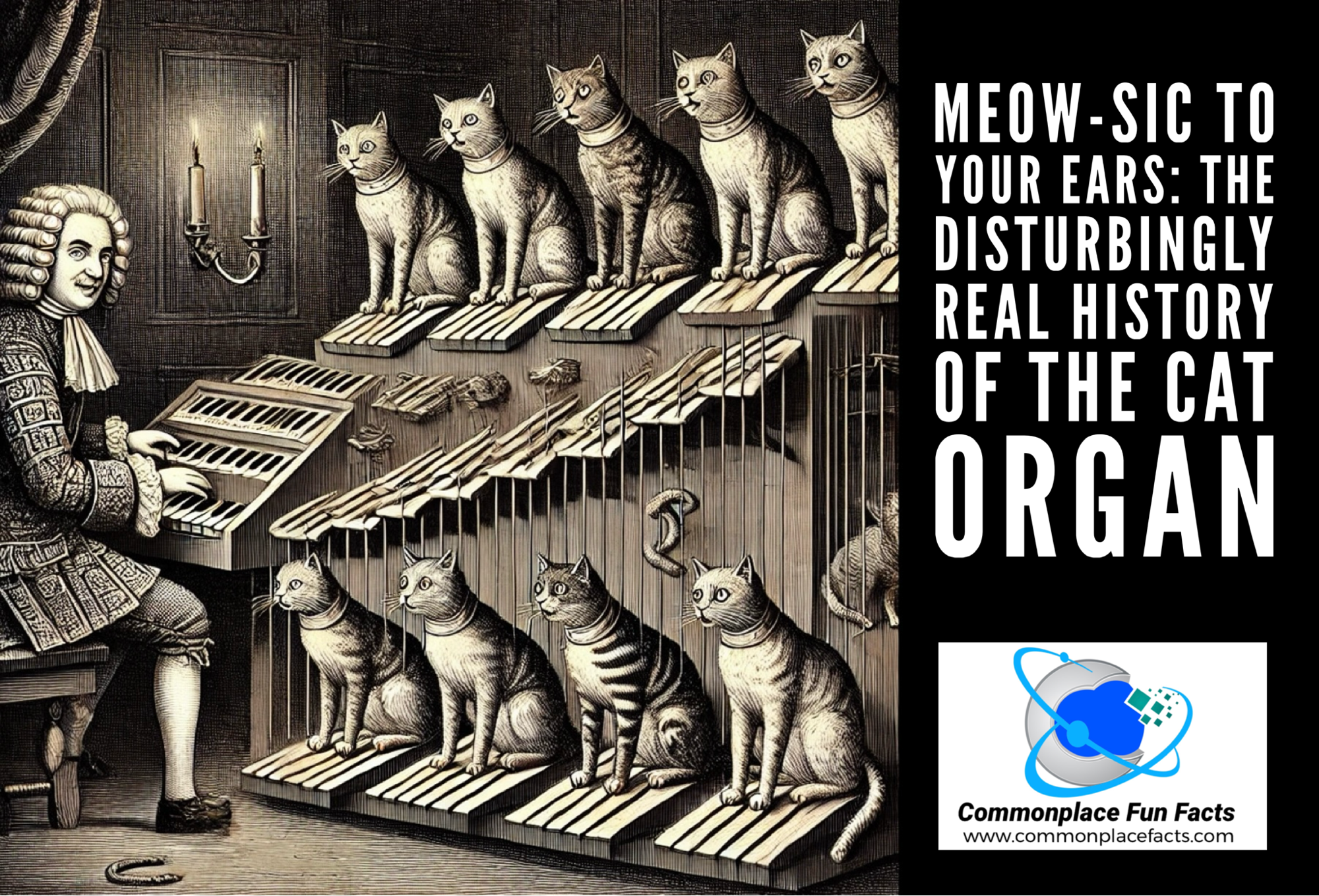
The cat organ looked a lot like it sounds: a row of eight unfortunate cats, each crammed into its own tiny cage, their tails stretched out like taut violin strings. These aren’t your regular fluffy lap-warmers; these cats are part of a twisted symphony. The mechanism? A keyboard connected to sharp nails poised above their tails. Every time a key is pressed, the nail comes down with a vengeance, causing the poor feline to emit a pitch-perfect (or more likely, pitch-pained) yowl. And just like that, you have a chorus of caterwauling, harmonized according to the tonal spectrum of their miserable meows. It’s music, but only in the most nightmarish sense of the word.
Learn about the song that uses helicopters as musical instruments
The staff of Commonplace Fun Facts are all dog people. Even so, the concept offends our sensibilities. We would much prefer to see purveyors of animal cruelty crammed into tiny cages while being subjected to sharp nails being jammed into their tails. When we heard about the cat organ, we were outraged and sent our Junior Executive Research Consultant (Hey, it’s only a coincidence that the acronym is pronounced “Jerk”) to delve into the history of this sinister contraption. His conclusion about who dreamed up this diabolical instrument? The jury is still out, but one name pops up more than others: Athanasius Kircher, a 17th-century German Jesuit scholar who apparently had more on his mind than just ecclesiastical duties.
In 1650, Kircher described the katzenklavier in a treatise, claiming it was designed to cheer up a particularly gloomy Italian prince. He wrote: “In order to raise the spirits of an Italian prince burdened by the cares of his position, a musician created for him a cat piano. The musician selected cats whose natural voices were at different pitches and arranged them in cages side by side, so that when a key on the piano was depressed, a mechanism drove a sharp spike in the appropriate cat’s tail. The result was a melody of meows that became more vigorous as the cats became more desperate. Who could help but laugh at such music? Thus the prince was raised from his melancholy.”
Presumably, Kircher only resorted to such extremes when his usual practice of pulling the wings off of butterflies failed to elicit the desired amount of glee.

Kircher wasn’t the only one with a penchant for animal-made music. His buddy, Jesuit priest Gaspar Schott, apparently tried assembling a chorus of donkeys. So, in the grand scheme of things, Kircher might have been more of an innovator than a monster. After all, this was the same man who invented the Aeolian harp and the magnetic clock, and who was one of the first to propose that germs, not bad air, caused the bubonic plague.
Despite his many achievements, the cat organ remains the stuff of legend—literally. Accounts of such an instrument existed even before Kircher was born, with one particularly festive 16th-century parade featuring a katzenklavier played by a bear. French writer Jean-Baptiste Weckerline described the scene: “The most curious was on a chariot that carried the most singular music that can be imagined. It held a bear that played the organ; instead of pipes, there were sixteen cat heads each with its body confined; the tails were sticking out and were held to be played as the strings on a piano … the corresponding tail would be pulled hard, and it would produce each time a lamentable meow”
Before you dismiss the cat organ as having absolutely no redeeming value whatsoever, there was at least one professional who thought it have some use. German psychiatrist Johann Christian Reil coined the term “psychiatry,” so he has some professional credibility. In 1803, he suggested that the katzenklavier could be used to treat daydreamers and the mentally disturbed. According to him, nothing short of a tail-pulling cat concerto would shock these folks back to reality. A melody of miserable meows, he argued, might even bring Lot’s wife out of her pillar-of-salt state and into conscious awareness.
If you’re curious about what might have been but can’t stomach the thought of subjecting your precious kitten to such horror, you can check out the modern, humane version by sound sculptor Henry Dagg. In 2010, Dagg created a katzenklavier from 16 kitty squeaky toys and performed “Over the Rainbow.” No tails were harmed in the making of this performance, so you can enjoy it guilt-free—just don’t expect any actual cats to join in.

Will My Dog Eat Me If I Die? Your Cat May Not Be the One to Worry About
Admit it. You’ve wondered, “Will my dog eat me if I die at home alone?” OK, maybe you’re wondering about your cat. Forensic science has investigated the unsettling question—and the answer may surprise pet owners.

What Do You Call A Group Of…? Animal Group Names Explained
Everyone knows a group of cattle is known as a herd and a bunch of fish is called a school, but how well do you know the animal group names for other animals?

The Curious Case of the Absent Cat: Why Cats are Missing from the Bible
The Bible includes a plethora of animal references, but notably lacks mention of domestic cats, sparking various theories. Cats may have been deemed unworthy, not native to the region, overshadowed by dogs, or associated with paganism. Despite their absence, the Bible’s diverse animal imagery invites ongoing fascination and contemplation.




Leave a Reply