

Abraham Lincoln accomplished many things in his lifetime. He preserved the Union. He issued the Emancipation Proclamation. He delivered the Gettysburg Address. He grew a beard that resulted in Milton Bradley creating one of the most popular board games in history.
What he did not accomplish—despite his best efforts, and certainly through no fault of his own—was staying in one grave.
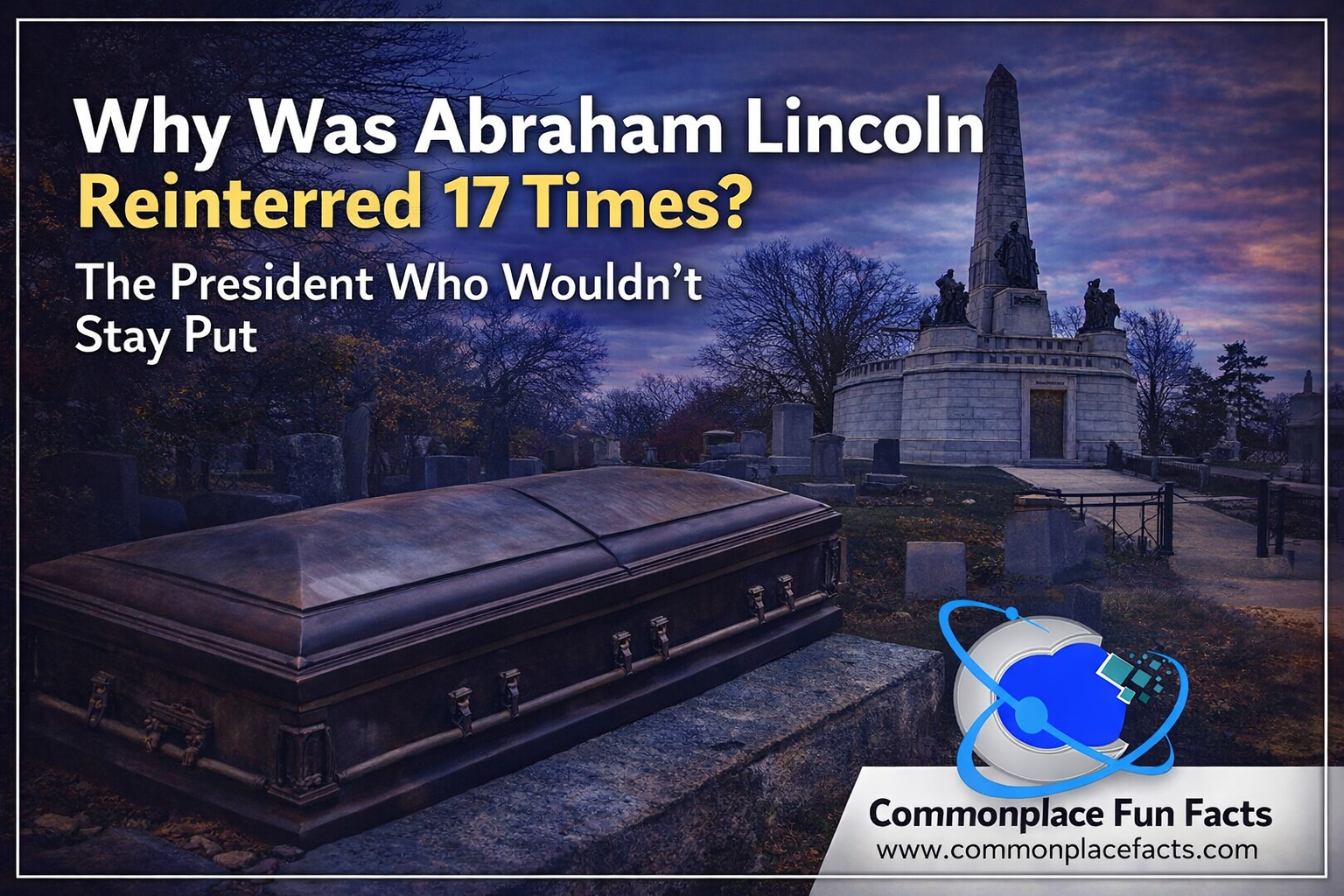
Between 1865 and 1901, Lincoln’s body was reinterred seventeen times.
Seventeen.
This is not a typo. This is not one of those urban legends that also claims Walt Disney is cryogenically waiting for Tomorrowland. This is documented, measured, and counted. If Lincoln had frequent flyer miles for coffin travel, his family could have vacationed for free.
Contents
Phase One: The Temporary Situation That Lasted a While
Lincoln was assassinated on April 14, 1865. The nation entered full-scale grief mode. There was a funeral train. There were viewings in multiple cities, including one that was seen by 6-year-old Theodore Roosevelt. America did not do understated mourning.
Eventually, Lincoln was brought home to Springfield, Illinois, and buried at Oak Ridge Cemetery. Except “buried” is doing some heavy lifting here.

The grand monument that everyone wanted to build for the fallen president was not ready. Because of course it was not. Large architectural tributes rarely spring fully formed from the prairie.
So Lincoln’s coffin went into a receiving vault. Then into a temporary vault. Then back out again when work progressed. Then repositioned when plans changed. Then shifted again when construction details required further adjustment.
This was not intentional drama. It was logistics. The nineteenth century ran on paperwork, optimism, and the firm belief that construction would go exactly as scheduled.
It didn’t. Things haven’t changed much in that regard.
Building a National Shrine (With Moving Parts)

The Lincoln Tomb, as envisioned, was ambitious. It had a tall obelisk, statuary, multiple burial chambers, and enough symbolic gravitas to make ancient Rome nod approvingly.
When the tomb was completed in the 1870s, Lincoln was placed inside. This should have been the end of the story.
It was not the end of the story.
Building a large, conspicuous monument to a beloved martyr has one unintended side effect: it advertises that something extremely valuable is inside.
Which brings us to 1876, the year America celebrated its centennial by nearly turning Lincoln’s body into ransom collateral.
The Grave Robbery Plot That Changed Everything
In November of 1876, a gang of Chicago counterfeiters hatched a plan that can only be described as “ambitious in the worst possible way.”

They intended to steal Abraham Lincoln’s body.
The ransom demand? A hefty sum of money and the release of their imprisoned master engraver. Apparently, when you are running a counterfeit ring and your talent pool is limited, you solve workforce problems with presidential kidnapping—even posthumous ones.
This sounds like satire. It was not.
The Secret Service—yes, the same agency better known today for presidential protection—was involved because its original mission focused on combating counterfeiters. Lincoln’s last official act before his death was the creation of the agency to help protect the nation’s currency. It would not be charged with presidential protection until 1901, yet through a chain of infiltrations, informants, and nineteenth-century detective work, the Secret Service managed to be on hand to protect Lincoln’s body eleven years after his death.
Thanks to some brilliant detective work and a little bit of luck, the plot was stopped at the last minute. Lincoln was not successfully stolen. But the mere fact that someone tried changed everything.
Because once someone tries to steal a president, you have to pretty much assume that common decency is no longer a significant restraining factor.
Curiously, it was a grave robbery involving two other presidents that triggered enough outrage for legislators to get serious about the situation. Read “John Scott Harrison and Grave Robbery of the Only Man To Be the Father And Son of a President” for more about that saga.
Welcome to the Era of Paranoia
After the attempted theft, the caretakers of the tomb became deeply, profoundly anxious.
And with good reason.
The tomb’s design, though impressive, was not Fort Knox. Security systems at the time consisted largely of locks, trust, and hopes that criminals would reconsider their life choices.
They did not reconsider.
So the custodians did the only thing they could think to do: they moved Lincoln’s coffin. Frequently. Strategically. Quietly.
Sometimes it was moved within the tomb. Sometimes hidden behind walls. Sometimes placed in different chambers. Sometimes stored temporarily in less obvious locations.
This is where the reinterment count begins to climb like a nervous investor watching the stock market.
Move after move. Reposition after reposition.
The intention was noble. The execution was… busy.
The Lincoln Guard of Honor
Out of this atmosphere emerged an organized group of local custodians sometimes referred to as the Lincoln Guard of Honor. These were men who took their job seriously. They understood that protecting Lincoln’s remains was not merely a maintenance duty; it was a sacred civic responsibility.

They stood watch. They monitored suspicious activity. They coordinated secrecy.
They also physically handled and supervised the moving of a 400-plus-pound casket multiple times over the course of decades.
If there were merit badges for historical overcommitment, they would have earned several.
Yes, They Opened the Coffin
Here is the part that always makes modern readers lean back slowly.
Lincoln’s coffin was opened on multiple occasions.
This was not done casually. It was done to verify that the body inside was indeed Lincoln’s and not some elaborate substitution achieved by nineteenth-century grave robbers with an eye for detail.
The Victorians had a complicated relationship with death. Viewing the deceased was not unusual. Certainty mattered. Especially when people had already tried to commit the most audacious corpse heist in American history.
Each opening reinforced the conviction that yes, that was still Abraham Lincoln.
Then they closed it again and, in many cases, moved him elsewhere.
Construction Strikes Back
As if attempted crime were not enough, the tomb itself developed structural concerns.
The late nineteenth century did not possess modern preservation techniques. Moisture issues, settling, and architectural imperfections meant that further reconstruction became necessary.

Between 1899 and 1901, significant rebuilding efforts took place.
Guess what happens when you rebuild a tomb.
You move the occupant.
Again.
And again.
And again.
By this point, Lincoln’s posthumous travel itinerary could rival a moderately successful touring musician.
The Seventeen-Move Tally
By the time the dust settled in 1901, Lincoln had been reinterred seventeen times.
Some of these moves were short-distance shifts within the structure. Others were more substantial temporary relocations.
The key is that each counted as a reinterment, earning the 16th president the dubious honor of being reinterred more than any other chief executive.
If you are imagining a giant “Final Placement” ceremony after move number seventeen, you are not far off.
The caretakers decided they were finished with this nonsense.
The Final Solution: Put Him Where No One Can Reach Him
The very last time Abraham Lincoln’s coffin was opened came during the final major reconstruction of his tomb on September 26, 1901. With concerns swirling that the body might somehow have been tampered with in the intervening years, workmen lifted the lid just one more time to make sure the 16th president was still in there — and he was, face still identifiable after more than thirty years underground, if a bit… shall we say, somber in appearance.
One of the last living people to have gazed upon that scene was Fleetwood Lindley, a 14-year-old boy at the time whose presence that morning would make him, decades later, the final authenticated human to have seen Lincoln’s face before the permanent burial was completed; Lindley would go on to live a full life, passing away in 1963 at the age of 75.
After that careful inspection, the casket was sealed, lowered into a steel cage ten feet down and buried under tons of concrete.
Ten feet.
Encased in concrete.
Sealed.
Done.
It was the architectural equivalent of saying, “We are not playing this game anymore.”
No more casual accessibility. No more midnight relocation missions. No more internal reshuffles.
Lincoln had finally, conclusively, permanently been given rest.

Why Was Abraham Lincoln Reinterred So Many Times? (Besides Human Drama)
Seventeen reinterments sounds absurd until you break it into categories.
First: construction logistics. The tomb was built, modified, repaired, and reconstructed. Large stone monuments do not enjoy static stability, especially in the nineteenth century.
Second: security anxiety. The 1876 theft attempt permanently altered how caretakers thought about risk. Once a body becomes a target, complacency disappears.
Third: reverence. Americans treated Lincoln not merely as a president but as a martyr. His body carried symbolic weight. People wanted certainty. Protection. Permanence. Even if achieving those goals required repeated temporary disruption.
The irony is hard to miss. Lincoln’s legacy symbolized stability and unity. His remains experienced decades of logistical instability.
There Is Something Very American About This
In a strange way, the whole saga feels quintessentially American.
We build something grand. We discover flaws. We rebuild it. We panic about security. We create committees. We rearrange things repeatedly. Eventually, we overcorrect and encase everything in reinforced concrete.
The story of Lincoln’s tomb is not grotesque. It is oddly civic. It reflects a young nation trying to balance reverence, security, engineering, and public access without quite having the institutional muscle memory to do it smoothly.
It is messy patriotism.
The Man Who Could Not Be Kidnapped (Anymore)
There is one final delicious irony.
Lincoln spent his presidency navigating literal and political threats to the Union. After his death, he faced an entirely different form of threat: being weaponized by criminals as ransom leverage.
The response was equal parts anxiety and innovation.
By 1901, he had what may be the most secure presidential burial arrangement in American history.
No one is walking off with Abraham Lincoln now.
The same cannot be said, alas, for John Hanson, one of the Founding Fathers, whose remains have mysteriously vanished. Read more about that mystery here.
Rest, At Last
We often imagine burial as a moment of finality. For Lincoln, it was a process.
A decades-long, seventeen-step process.
If there is comfort in this story, it lies in the ending. For over a century now, Lincoln has remained undisturbed in his final resting place at Oak Ridge Cemetery.
The Union survived. The tomb stabilized. The panic subsided.
And the president who preserved a nation finally stopped being moved around by it.
History sometimes refuses to sit still. In Lincoln’s case, neither did his coffin.
Seventeen times is excessive by any standard. It is also uniquely human: a blend of fear, reverence, engineering limitations, and determined caretakers doing their best.
In life, Lincoln carried the weight of a fractured country.
In death, it turns out, he carried the weight of architectural revisions, organized crime schemes, and an anxious republic determined to get it right eventually.
And eventually, it did.
You may also enjoy…

What Happened to the Body of America’s First President? The Bizarre Tale of John Hanson’s Lost Grave
John Hanson, depending on who you ask, may have been the USA’s first president. His name, however, is largely forgotten. As if that weren’t enough, thanks to late 20th century grave robbers, even his body is missing. Find out the mysterious details in this intriguing article.

William Henry Harrison’s Terrifying Voice From the Grave
Why could a voice be heard crying out from the grave of William Henry Harrison?

The Explosive Funeral of William the Conqueror
William the Conqueror’s funeral was anything but dignified — looting, fire, lawsuits, and a coffin disaster that ended in a stomach-churning explosion. Discover the shocking, chaotic send-off of England’s first Norman king.






Leave a Reply