
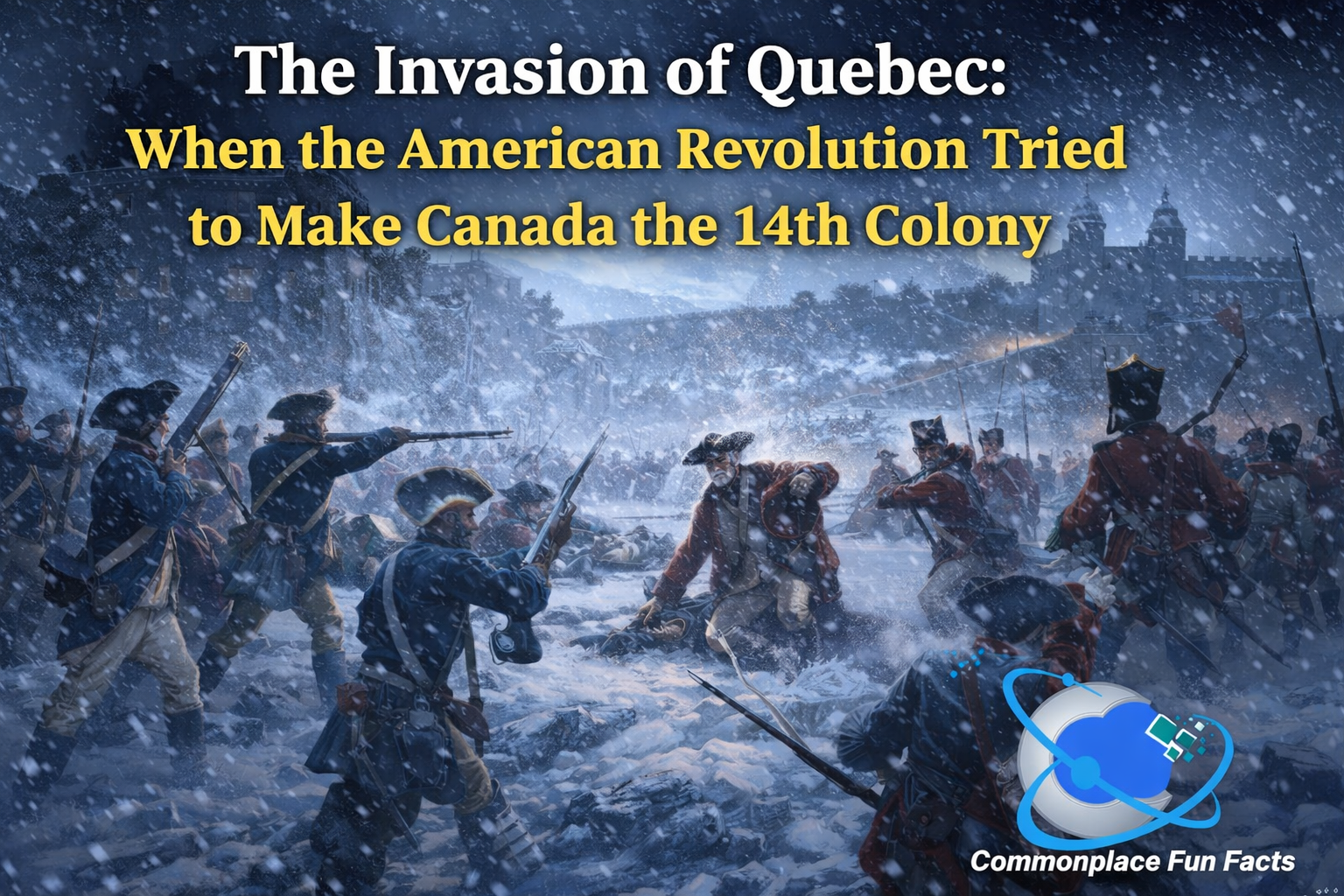

When most people think about the American Revolution, they picture the usual cast of characters and props: Boston tea floating in the harbor, declarations issued by men with powdered wigs, George Washington trying to hold together an army composed partly of patriots and partly of men who looked as if they had wandered in by mistake. What they do not usually picture is an American invasion of Quebec.
After all, Canada and the USA have been BFFs seemingly since time immemorial. The two countries boast that they share the longest unarmed national border in the world. It’s hard to imagine any American thinking of Canada as a likely target for military invasion.
And yet, in 1775 the revolutionaries absolutely did invade Canada. They did this because they believed, with a confidence that can only be described as deeply eighteenth-century, that the people of Quebec might be persuaded to join the rebellion and become the so-called “14th colony.” The plan was to liberate Canada by marching north through wilderness, snow, disease, hunger, and military confusion. Human history remains, as always, a fascinating record of people deciding that terrible ideas sound strategic if presented with enough enthusiasm.
The campaign that followed had everything: political wishful thinking, miserable logistics, an invasion through the Maine wilderness that reads like a survival story written by someone with a grudge against feet, and a dramatic New Year’s Eve attack that ended in blood, chaos, and failure. It also had one of the great historical ironies of the Revolution: long before Benedict Arnold became America’s patron saint of treason, he was busy nearly killing himself in one of the boldest campaigns of the war.
Contents
Why the Americans Thought Canada Might Join Them
At first glance, the idea did not seem entirely absurd. Britain had only acquired Canada from France in 1763, after the Seven Years’ War, which meant British rule there was still relatively new. Quebec was largely French-speaking, overwhelmingly Catholic, and culturally distinct from the thirteen rebellious colonies to the south. American leaders assumed that a population with recent experience under one empire might not feel especially loyal to another. With that reasoning, they believed the people of Quebec might be open to persuasion—or at least open to not shooting at them.

The Continental Congress actively courted that possibility. It sent appeals to the people of Quebec and invited them to join the revolutionary cause. This was not merely a military gamble. It was also a political dream. If Quebec joined the rebellion, Britain would lose a major northern base and the revolution would gain territory, population, and strategic depth. It is the kind of plan that looks terrific from a committee table and significantly less terrific once snow enters the chat.
There was, however, one rather important complication. In 1774, Parliament had passed the Quebec Act, which allowed the Roman Catholic Church to continue functioning freely in the province and preserved French civil law while retaining English criminal law. To many in Quebec, that was not the behavior of a government they were desperate to overthrow. To many in the thirteen colonies, on the other hand, the act was intolerable, partly because it protected Catholic rights and partly because it expanded Quebec’s boundaries into territory the colonies also wanted. So while American revolutionaries saw Quebec as ripe for rebellion, many French Canadians looked at the situation and concluded that Britain, whatever its faults, was at least not asking them to throw themselves into a Protestant-led insurrection whose long-term plans were murky at best.
The Strategic Logic of Going North
There was also a military rationale for the campaign. If Britain held Canada securely, it could use it as a staging area for attacks down the Lake Champlain-Hudson corridor into New York. The Americans wanted to eliminate that threat before it became a larger problem. This was not paranoia. Control of that route mattered enormously throughout the Revolution.
So the invasion of Quebec was born from a blend of military calculation and political optimism. Remove the British threat in Canada, encourage local support, and perhaps bring a fourteenth colony into the revolutionary fold. In theory, it was smart. In practice, it depended on supply lines, coordination, weather, morale, and popular support. As history repeatedly demonstrates, that is a dangerous number of things to depend upon all at once.
The Two-Pronged Invasion Plan
The Americans did not settle for one invasion route when they could have two and double the opportunities for administrative misery.

The first force moved north by the more conventional route through Lake Champlain under Major General Philip Schuyler, though illness soon forced him to hand command to Richard Montgomery. Montgomery was a capable and respected officer, and his campaign initially went rather well. He advanced into Canada, besieged Fort St. Jean, captured it after a difficult fight, and then took Montreal in November 1775. At that point, American leaders could be forgiven for thinking they were onto something.
The second force, under Benedict Arnold, was assigned a far more dramatic mission. He would lead a separate expedition through the wilderness of Maine, descend into Canada by way of the Chaudière River, and rendezvous with Montgomery near Quebec City. This would place pressure on the British from multiple directions and, in the best-case scenario, produce one of those elegant military operations future historians describe with approving nods.
The northern campaign also attracted a number of enthusiastic volunteers and freelance revolutionaries who were eager to help push the rebellion into Canada. Among them was one of the most colorful figures of the early Revolution: Ethan Allen.
Ethan Allen and the Green Mountain Boys
No discussion of the northern theater of the American Revolution would be complete without mentioning Ethan Allen, a man who managed to combine frontier swagger, revolutionary enthusiasm, and an almost reckless willingness to try things that looked much easier on a map.
Allen had already become a hero of the revolutionary cause before the invasion of Canada even began. In May 1775, only weeks after the first shots of the war were fired at Lexington and Concord, Allen and his militia—known as the Green Mountain Boys—helped capture Fort Ticonderoga from the British. The victory itself was dramatic but relatively bloodless. The British garrison was caught off guard, and the fort fell quickly.
The capture of Ticonderoga proved enormously important for the American cause. The fort contained a valuable supply of artillery—heavy cannons that the poorly equipped Continental forces desperately needed. Later that winter, those guns would be hauled to Boston by Henry Knox and placed on the heights overlooking the city, forcing the British to evacuate in March 1776. In other words, Allen’s early victory helped provide the firepower that made one of the Revolution’s first major successes possible.
Allen also became important in another way: he was a symbol. Tall, loud, confident, and thoroughly comfortable with frontier bravado, he embodied the image of the rugged American rebel. His reputation spread quickly through newspapers and word of mouth, and stories of the bold Green Mountain Boys helped energize the revolutionary cause at a moment when morale and legitimacy mattered enormously.

With that reputation behind him, Allen soon looked north toward Canada. In September 1775, during the early stages of the American invasion of Quebec, Allen attempted to capture Montreal with a small force of Americans and Canadian sympathizers. Unfortunately for Allen, the plan depended heavily on coordination with another force that never arrived. British troops quickly surrounded his men near Longue-Pointe, and Allen was captured after a brief fight.
The British recognized that they had a valuable prisoner on their hands. Allen spent more than two years in captivity, at times held under harsh conditions and eventually transported across the Atlantic before being returned to North America. While he was gone, however, his legend continued to grow. His earlier exploits—especially the seizure of Fort Ticonderoga—had already secured his place in revolutionary folklore.
In that sense, Ethan Allen’s importance to the American cause went beyond any single battlefield victory. He helped provide an early symbolic triumph at a moment when the rebellion desperately needed one. His actions gave the revolutionaries artillery, momentum, and a larger-than-life frontier hero whose reputation suggested that the British Empire might not be quite as invincible as it seemed.
While Allen languished in British captivity, the rest of the northern campaign continued—most dramatically in the desperate expedition being led through the Maine wilderness by Benedict Arnold.
Benedict Arnold’s Extremely Bad Wilderness Experience
Arnold set out in September 1775 with roughly 1,100 men. The expedition was bold, secretive, and catastrophically underprepared. The maps were poor. The bateaux, or flat-bottomed boats used to carry men and supplies, were badly made and leaked. The rivers were difficult to navigate. The weather was miserable. The terrain looked as if nature itself had united with the British against the upstart colonists.

As the expedition pushed through the Maine wilderness, supplies were ruined, boats broke apart, men fell sick, and rations ran low. Then they ran lower. Then they reached that special historical phase in which armies stop discussing victory and begin discussing what else might technically count as food. Accounts from the march describe men reduced to eating dogs, shoe leather, and candle wax. Admittedly, this is precisely what many children believe school lunch ladies use as staples on their menus, but it is not the sort of culinary innovation that usually accompanies a glorious liberation campaign.
A large number of Arnold’s men turned back. Others died or became too weak to continue. By the time the survivors finally emerged into Canada, they had endured weeks of cold, starvation, and exhaustion. Arnold deserves genuine credit here. Before he later reinvented himself as America’s most famous traitor, he showed ferocious courage and stamina. The march was a logistical shambles, but it was also one of the most extraordinary feats of endurance in the war.
There is a lesson in this, and it is one the eighteenth century insisted on teaching repeatedly: daring is not the same thing as planning. The two occasionally overlap, but not nearly as often as statues would like us to believe.
Montgomery’s Success Raises Hopes
While Arnold and his men were busy starving their way through Maine, Montgomery was making real progress. After taking Fort St. Jean, he captured Montreal on November 13, 1775. British governor Guy Carleton escaped to Quebec City, which now became the obvious focus of the campaign.
Montgomery then moved downriver and joined forces with Arnold in early December. On paper, this was the moment when the invasion should have looked impressive. The two American commanders had managed to converge on Quebec despite one army having crawled through a frozen nightmare and the other having fought its way up from Lake Champlain. If there had been a time for the people of Quebec to fling open the gates and announce their enthusiasm for the revolutionary experiment, this would have been it.
They did not do that.
Instead, the Americans found themselves outside a heavily fortified city, in winter, without enough artillery to force a surrender, with enlistments running short, supplies thin, smallpox in bountiful supply, and morale wobbling like a chair with one bad leg. Under those conditions, the troops would have struggled to organize a successful attack on an afternoon picnic.
Quebec Refuses to Cooperate
Quebec City was not an easy target. Its fortifications were formidable, and Guy Carleton proved an effective defender. The Americans hoped for local support from French Canadians, but that support never arrived in the way they had imagined. Some locals remained neutral. Some aided the British. Many simply had no interest in trading one imperial uncertainty for another.
This is one of the campaign’s most important points, because it exposes the flaw at the heart of the invasion. The Americans assumed that because they viewed British rule as intolerable, the people of Quebec would naturally feel the same way. History enjoys punishing that kind of assumption. Different populations have different grievances, different loyalties, and different ideas about what counts as a bad government. The revolutionaries were trying to export a rebellion to people who had not signed up for the same list of complaints.
The New Year’s Eve Assault
With time running out and many soldiers’ enlistments about to expire, Montgomery and Arnold decided to gamble on a direct assault. The attack took place in the early hours of December 31, 1775, during a snowstorm, because launching major military operations in the worst of winter conditions has historically worked out so spectacularly well. (We pause briefly for a dramatic eye roll.) The plan called for feints against the city walls while the main attacks struck the lower town from two directions.
It began badly and then deteriorated with commitment.
Montgomery led one column along a narrow path near the St. Lawrence River. Early in the attack, he and several of his officers were killed by a burst of British and Canadian fire. Their column collapsed almost immediately. Arnold, leading the other main assault, was wounded in the leg and carried from the field. Command then fell to Daniel Morgan, who managed to push farther into the lower town with his men, but the Americans became isolated, confused, and trapped. British defenders counterattacked, and many of the surviving attackers were captured.

The assault was a disaster. Montgomery was dead. Arnold was wounded. The hoped-for dramatic victory had turned into a failed gamble in the dark and snow. One can imagine the collective mood of the surviving Americans as they contemplated the campaign at that point: frozen, hungry, sick, under-supplied, and now very much not inside Quebec.
The Long Decline of the Campaign
The failed attack did not end the American presence in Canada immediately. Arnold tried to maintain a loose siege, which sounds much more impressive than it really was. The Americans lacked the manpower, artillery, and supplies needed to take the city. Disease continued to spread. Reinforcements dribbled in, but so did discouragement.
When British reinforcements finally arrived in the spring of 1776, the entire American position in Canada became untenable. The Continental forces withdrew, first from Quebec and then from the rest of Canada, eventually retreating south toward Lake Champlain. The dream of winning Canada for the Revolution was over.
It would remain over. The Americans made additional efforts in Canada during the war, but the great vision of Quebec as the fourteenth colony had already gone the way of so many revolutionary fantasies: into the filing cabinet marked “seemed plausible at the time.”
Why the Invasion Failed
The simplest explanation is that the campaign failed because almost everything that could go wrong did go wrong. The Americans underestimated the difficulty of the terrain, overestimated the willingness of Canadians to rise up, failed to secure enough supplies, lacked sufficient artillery, operated in brutal winter conditions, suffered from disease, and attempted a high-risk assault against a fortified city under desperate circumstances.
That said, the deeper problem was political. Military campaigns of this kind rarely succeed without local support, and the Americans never got enough of it. French Canadians had little reason to trust that the predominantly Protestant revolutionaries to the south would protect their religion, laws, and institutions better than Britain already had under the Quebec Act. Neutrality looked safer. Loyalty looked practical. Revolution looked like a lot of freezing strangers arriving with opinions.
The Strange Legacy of the Invasion
The invasion of Quebec matters partly because it failed. It reveals how uncertain the early Revolution really was. In 1775, nothing about the future of North America was settled. The United States did not yet exist as an independent nation. Canada’s future was not fully defined. Men on both sides were making enormous decisions with limited information and excessive confidence, as governments have always done and apparently always will.
Interestingly, the idea of invading Canada did not entirely disappear from American strategic thinking. In the 1930s, the United States even developed a contingency plan for a potential war with Britain that included an invasion of Canada—known as War Plan Red. Apparently, someone in the Pentagon looked at the events of 1775 and decided the concept deserved another look.
The campaign also serves as a reminder that Benedict Arnold was once one of the boldest officers in the American cause. Before betrayal turned his name into a synonym for treachery, he earned admiration through sheer nerve. The march to Quebec was brutal, foolish in parts, and astonishing in execution. History has a perverse sense of humor, and one of its favorite tricks is letting a man play hero and villain in different acts of the same story.
Most of all, the invasion of Quebec is memorable because it feels so improbable. The Revolution was barely underway, and yet the Americans were already trying to recruit Canada at gunpoint while marching through snow and swamps. It is the sort of episode that would sound implausible in a historical novel if it were not documented so well by people who had the misfortune of living through it.
Conclusion
For a brief moment in 1775, it looked possible that the American Revolution might spread north and bring Quebec into the rebellion as the 14th colony. That possibility died outside the walls of Quebec City, in the snow, under musket fire, amid failed assumptions and dreadful logistics. The Canadians did not join. The city did not fall. The invasion collapsed.
Still, it remains one of the most fascinating might-have-beens in early American history. Had the campaign succeeded, the political map of North America might look very different today. Instead, the episode survives as a cautionary tale about ambition outrunning preparation, about the hazards of assuming other people share your revolutionary zeal, and about the eternal military principle that winter is not a hobby.
Perhaps the strangest thing about the invasion of Quebec is how thoroughly history moved on from it. Within a few generations, the United States and Canada would become some of the friendliest neighbors on earth, sharing trade, culture, and the longest undefended border in the world. The idea that American troops once marched north hoping to recruit Canada into the Revolution now feels almost surreal. Yet for a few cold months in 1775, it was a very real possibility. History is full of these near-misses—moments when the future briefly wobbled before settling into the version we now take for granted.
You may also enjoy…

War Plan Red: The Secret U.S. Plan to Invade Canada and Fight Britain
Yes, the U.S. once planned to invade Canada. Explore War Plan Red, the secret 1930s strategy for a potential war with Britain and its empire.

Conplan 888: The Suprising U.S. Government Plan for Surviving the Zombie Apocalypse
Conplan 888: Proof that the Government Has a Plan for Everything If you are a reasonably well-informed person (which you obviously are, since you read Commonplace Fun Facts), you know that the U.S. government has plans for just about everything. These contingencies range from the plan for making sure you pay your taxes after a…

How the Republic of Indian Stream Became a Country Between the United States and Canada
Canada and the USA share a unique history with the Republic of Indian Stream being a brief independent territory between them. Disputes over borders and taxation led to its proclamation of sovereignty in 1832. Despite brief independence, it eventually requested annexation by the United States in 1835, leading to a clarified border in 1842.







Leave a Reply to Dr. John Persico Jr.Cancel reply