

There are times that human demonstrate a remarkable talent for looking at the natural world and asking the worst possible follow-up questions.
A normal person sees a pigeon and thinks, “That bird is pecking at a french fry.” Others see a pigeon and wonder, “Could that bird carry a camera, deliver a message, guide a missile, and perhaps fill out a brief post-mission assessment?”
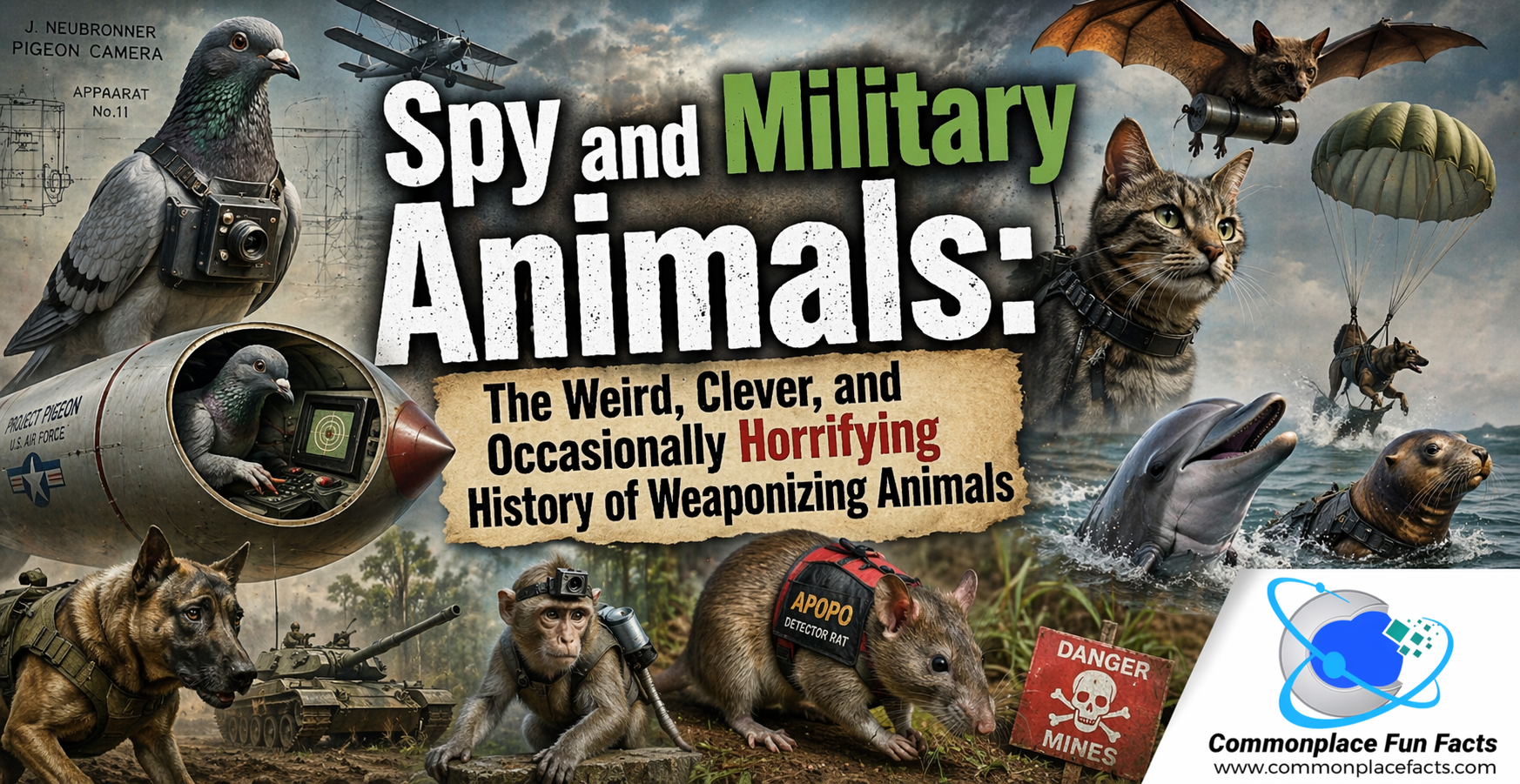
This, more or less, has been our relationship with animals in war and espionage for centuries. Horses and elephants are the obvious examples, and dogs have long been used for scouting, guarding, tracking, and attack. That part is old news. What gets more interesting is the moment when imagination veers off the paved road and into the wilderness of military animals and spy animals. That is where we find spy cats, camera pigeons, anti-tank dogs, mine-detecting rats, military dolphins, and at least one missile concept that depended on pigeons doing their jobs under conditions that would cause most humans to consider an exciting career as an Amway salesman.
We have previously taken a closer look at two of the better-known entries in this category: Acoustic Kitty, the CIA’s famously ill-fated effort to turn a cat into a walking listening device, and the bat bomb project, a World War II scheme to drop incendiary-equipped bats over Japan. Those deserve their place in the hall of fame, or perhaps the hall of deeply questionable ideas. This time, however, we are widening the lens.
Once you start digging into the history of animals in military and intelligence work, you quickly realize that the real pattern is not that a few unusual ideas slipped through. The pattern is that, for a very long time, governments kept looking at the animal kingdom like it was an untapped defense contractor.
Contents
The Pigeon: Nature’s Original Communications Platform
If one animal deserves a medal for long and loyal service to military bureaucracy, it is the pigeon.

Carrier pigeons were used for centuries to carry messages, but they became especially valuable in the modern age of warfare, when telegraph lines could be cut, radios could fail, and messengers could get shot. Pigeons did not care about any of that. Give them a destination, attach a message, and off they went, making them one of the few communication systems in history that could be disrupted by hawks but not by supply-chain issues.
During both world wars, pigeons were used extensively for battlefield communication. They were small, fast, difficult to intercept, and, unlike some human messengers, not inclined to stop and explain why the mission was impossible. Entire military pigeon services were established to breed, train, transport, and care for these birds. In the United States, this was not some improvised side hobby run by one guy with a coop and patriotic enthusiasm. It became a formal Army function, complete with training centers, veterinary oversight, records, logistics, and all the paperwork needed to prove that the government can turn anything into a system.
And pigeons did not merely carry messages. They often saved lives. Some became war heroes for delivering information under fire when every other means of communication had failed. That sounds romantic, and in fairness it is, but it is also a reminder that even in an age of machines, war often still comes down to whether a living creature can get from Point A to Point B while chaos erupts in every direction.
For details about one particular pigeon who was recognized as a hero, read “Cher Ami: The Heroic Pigeon of WWI Who Saved Nearly 200 Lives.”
When Someone Put a Camera on the Pigeon
Of course, once humans had successfully convinced pigeons to carry messages, the next logical step was to ask whether they could also do surveillance.
The answer was yes, at least to a point.

Long before modern drones became the default symbol of aerial reconnaissance, inventors were experimenting with tiny cameras mounted on pigeons. In the early twentieth century, German apothecary and inventor Julius Neubronner developed a lightweight pigeon camera that could take photographs automatically during flight. It sounds like a novelty gadget, and in some ways it was, but it also represented a genuinely clever way to gather aerial imagery before aircraft photography became routine.
The idea did not die there. During the Cold War, the CIA revisited the concept and developed miniature cameras that pigeons could carry on their chests. The bird would be released over a target area and, in theory, fly home while snapping photographs along the way. Compared to other intelligence platforms, a pigeon had certain advantages. It did not roar overhead like an aircraft. It did not announce itself like a satellite. It was just a bird, doing suspiciously patriotic bird things.
This may be the most sensible idea in the whole menagerie of spy-animal proposals. Pigeons were common, hard to notice, capable of traveling over contested areas, and already proven as message carriers. The moment you read about it, the reaction is not, “Who thought this was a good idea?” The reaction is, “Honestly, given the technology available at the time, that is disturbingly clever.”
Of course, if one subscribes to the “Birds Aren’t Real” school of thought, this is less an innovation and more a long-overdue confirmation, since all birds are theoretically surveillance devices. At that point, the only remaining question is whether the pigeons were ever working for us at all.
Acoustic Kitty, Briefly, Because the Cat Still Deserves Its Cameo
No survey of espionage animals would be complete without acknowledging the CIA’s attempt to turn a cat into a covert listening device. Since we have already covered that strange saga in detail in our earlier article on Acoustic Kitty, we will not retell the whole episode here.
The short version is that the agency believed a cat, fitted with recording and transmission equipment, could inconspicuously approach foreign targets and capture useful conversations. This plan failed for reasons that will not shock anyone who has ever met a cat. The problem with using cats in espionage is that cats do not share our policy objectives. They serve no flag. They recognize no chain of command. They are not interested in the national interest unless the national interest involves tuna.
It remains one of the most famous examples of a government discovering, at considerable expense, that feline independence is not just a personality trait. It is an unchangeable reality.
Dolphins and Sea Lions: The Programs That Sound Fake but Are Not
If the pigeon story is old and the cat story is absurd, the military dolphin story sits in that uncomfortable middle zone where it sounds like a conspiracy theory but is, in fact, real.

The United States Navy has long maintained a marine mammal program using bottlenose dolphins and California sea lions. This is not the kind of thing one expects to find on a perfectly ordinary government website, but there it is. The animals have been trained to detect, locate, and mark objects underwater, including mines, lost equipment, and potentially dangerous intruders in harbors and coastal areas.
The reason is simple enough. Dolphins are extraordinarily good at underwater detection. Their natural echolocation is highly effective in conditions that challenge or defeat many human-made systems. Sea lions, meanwhile, are agile, trainable, and well suited for certain recovery and marking tasks. In other words, nature had already done a fair amount of research and development before the Pentagon arrived with a clipboard.
What makes these programs fascinating is that they are not merely weird. They are practical. A lot of the stranger animal-military schemes collapse under the weight of fantasy, wishful thinking, or the assumption that animals will behave like obedient robots. Dolphins and sea lions, by contrast, were selected because they were genuinely good at tasks humans needed done underwater. This was not a fever dream. It was applied biology with a budget.
That does not make it uncontroversial. The ethics of using intelligent marine mammals in military operations remain contested, and the secrecy surrounding such programs has naturally fueled rumors ranging from plausible to cinematic. Still, among all the stories in this category, this is one of the clearest examples of animals being incorporated into real military practice in a sustained and operationally useful way.
Rats: The Unexpected Heroes of the Minefield
Not every story in this subject is absurd or grim. Some are quietly admirable, even if they do involve vermin.

In more recent years, African giant pouched rats have been trained to detect landmines and unexploded ordnance. Their role is not to attack anything or spy on anyone. Their job is to locate hidden explosives so that humans can remove them safely. It is one of the clearest examples of animals being used not to wage war, but to clean up after it.
The rats are particularly well suited to the work. They have a strong sense of smell, can be trained using food rewards, and are light enough that they do not trigger the mines they are trying to find. This is the rare military-adjacent animal story that actually improves as you learn more about it. No one is trying to turn the rats into weapons. No one is asking them to deliver classified information to a handler while avoiding enemy patrols. They are simply helping humans undo one of our most enduring and shameful habits: leaving explosives in the ground long after the war is over.
Ironically, an animal that is almost universally loathed is not harmed in this scenario, whereas man’s best friend, the dog, has not fared nearly as well.
Dogs: Noble, Loyal, and Frequently Given the Worst Assignments
Dogs have been used in war for so long that they can almost disappear into the background of the subject. They should not. Their history in military service is vast, serious, and often endearing. See “George Washington and the Dogs of War” for one such example.
They have served as scouts, guards, trackers, messengers, rescue animals, and sentries. In modern times, dogs have been especially important in explosives detection, patrol work, and search operations. Few animals have contributed more consistently or more capably to military efforts. If the story ended there, it would be impressive enough.
Unfortunately, humans being humans, the story does not end there.
One of the grimmest examples of animal use in warfare came from the Soviet Union during World War II, when dogs were trained as anti-tank weapons. Explosives were strapped to the animals, which were then sent toward enemy tanks. The program was born from desperation, and it showed. It was brutal, unreliable, and deeply cruel. Some dogs reportedly ran toward familiar Soviet vehicles rather than enemy ones, which is the sort of operational flaw one would ideally identify before implementing the plan in combat.
Skinner’s Missile Pigeons, Because Apparently One Pigeon Idea Was Not Enough
As if camera pigeons were not sufficient evidence that pigeons have done more for military theory than most of us, we also need to discuss the attempt to use pigeons to guide missiles.
Yes, really.
During World War II, psychologist B. F. Skinner worked on a project in which pigeons would be trained to peck at images of a target displayed inside a missile nose cone. Their pecking would help steer the weapon toward its objective. This was known as Project Pigeon, later renamed Project Orcon, presumably because someone realized that “our missile is guided by pigeons” did not sound quite as intimidating in procurement meetings as they had hoped.
The underlying concept was not entirely insane. Pigeons have excellent vision, can be trained to respond consistently to visual cues, and remain surprisingly focused amid distraction. The technology of the day had limitations, and there was real interest in alternative guidance systems. In that sense, Project Pigeon was not a joke. It was a serious attempt to solve a serious problem.
Still, there is no way around the fact that this means a nation at war spent part of its intellectual energy and financial resources trying to create a weapon system whose accuracy depended on the work ethic of birds.
The project never became an operational weapon, but it remains one of the finest examples of military innovation wandering into territory so improbable that it almost loops back around into genius.
Monkeys, Sabotage, and the Point Where the Plot Escapes Its Cage
If your reaction to missile pigeons is that military planners could not possibly have gone any farther down this road, we regret to inform you that they absolutely could.

A declassified film has revealed at least one Cold War-era Air Force project involving rhesus monkeys trained for reconnaissance and sabotage roles. The concept envisioned remotely directing monkeys into hostile areas to carry cameras, supplies, or even explosives. This is one of those cases where the existence of the idea is almost more informative than the feasibility of the idea.
What it reveals is a recurring military habit: when humans encounter an environment too dangerous, inaccessible, or politically inconvenient for sending in people, they begin looking for some other living thing to do the job. Sometimes that means pigeons. Sometimes dolphins. Sometimes, apparently, monkeys drafted into a mission that sounds like it was pitched halfway through a very long night.
There is no evidence that this particular monkey scheme became an operational success. But as a window into the mindset of military experimentation, it is invaluable. It tells us that once animals had been accepted as possible communication systems, sensors, or delivery mechanisms, the boundary for what might be proposed became alarmingly flexible.
Bees, Chickens, and the Broader Pattern of Military Imagination Going Feral
Once you start exploring this topic, you find a long tail of proposals that never became famous enough to dominate public memory but are too strange to ignore.
Honeybees have been studied for their ability to detect explosives, making them potential tools for identifying landmines and other hazards. Chickens were once proposed as a heat source for a British nuclear mine design, in one of those moments where the sentence becomes more alarming with every additional word. Countless armies have used mules, horses, camels, and other animals for transport and logistics, which may not sound exotic, but was often the difference between an army moving and an army starving in place.
Even parachuting animals become their own strange subcategory once you start paying attention. Dogs, pigeons, and other creatures have been dropped into military environments to support communications, accompany handlers, or carry out specialized functions. It turns out that if humans invent a new way to enter danger, eventually we will ask an animal to try it too.
This is the deeper truth that ties all these stories together. Military use of animals did not happen because people were eccentric in isolated bursts. It happened because war creates relentless incentives to exploit any available advantage, and animals offered mobility, senses, stamina, camouflage, and trainability that technology either lacked or had not yet matched. In some cases, that led to genuinely effective cooperation. In others, it led to monstrous or ridiculous schemes. Often, it led to both.
What Military Animals and Spy Animals Say About Us
The most revealing part of this history is not what it says about animals. It is what it says about us.

Animals did not volunteer for espionage. Pigeons did not wake up wanting to join the intelligence community. Dolphins did not request a role in harbor security. Dogs did not lobby for anti-tank assignments. The pattern here is entirely human. We looked at creatures with useful abilities and saw extensions of our own ambitions.
Sometimes that impulse produced genuine partnerships, especially in roles involving communication, detection, rescue, or protection. Sometimes it produced cruelty dressed up as innovation. Sometimes it produced plans so outlandish that the only possible response is to stare at the historical record for a moment and say, “You know what, that is enough research for today.”
But the through line is unmistakable. In war and espionage, people have repeatedly tried to borrow the gifts of other species, whether that meant a pigeon’s navigation, a dolphin’s sonar, a dog’s loyalty, a rat’s nose, or a cat’s supposed inconspicuousness, which was always an overestimation bordering on theology.
And perhaps that is why this topic is so compelling. It is not merely a catalog of weird anecdotes. It is a history of ingenuity, desperation, arrogance, and occasional brilliance. It shows how far governments will go in the search for an edge. It shows how thin the line can be between clever and absurd. Most of all, it shows that if an animal can do something humans find useful, someone, somewhere, will eventually ask whether it can do it in uniform.
Usually, the answer is yes.
Whether that was a good idea is another matter entirely.
You may also enjoy…

Wojtek the Soldier Bear of WWII
Learn about Corporal Wojtek, the heroic bear of World War II

The War of the Stray Dog: How a Runaway Pup Sparked a War in 1925
Discover the bizarre true story of the War of the Stray Dog, a 1925 border skirmish where a runaway pup escalated tensions between Greece and Bulgaria. Learn how this small act sparked big consequences.

Cher Ami: The Heroic Pigeon of WWI Who Saved Nearly 200 Lives
Learn about Cher Ami, the heroic pigeon who saved 200 people during World War I.






Leave a Reply