

There are bad ideas. There are very bad ideas. There are ideas so spectacularly bad that they should come with their own warning label, legal disclaimer, and possibly a small brass band playing “Nearer, My God, to Thee.”
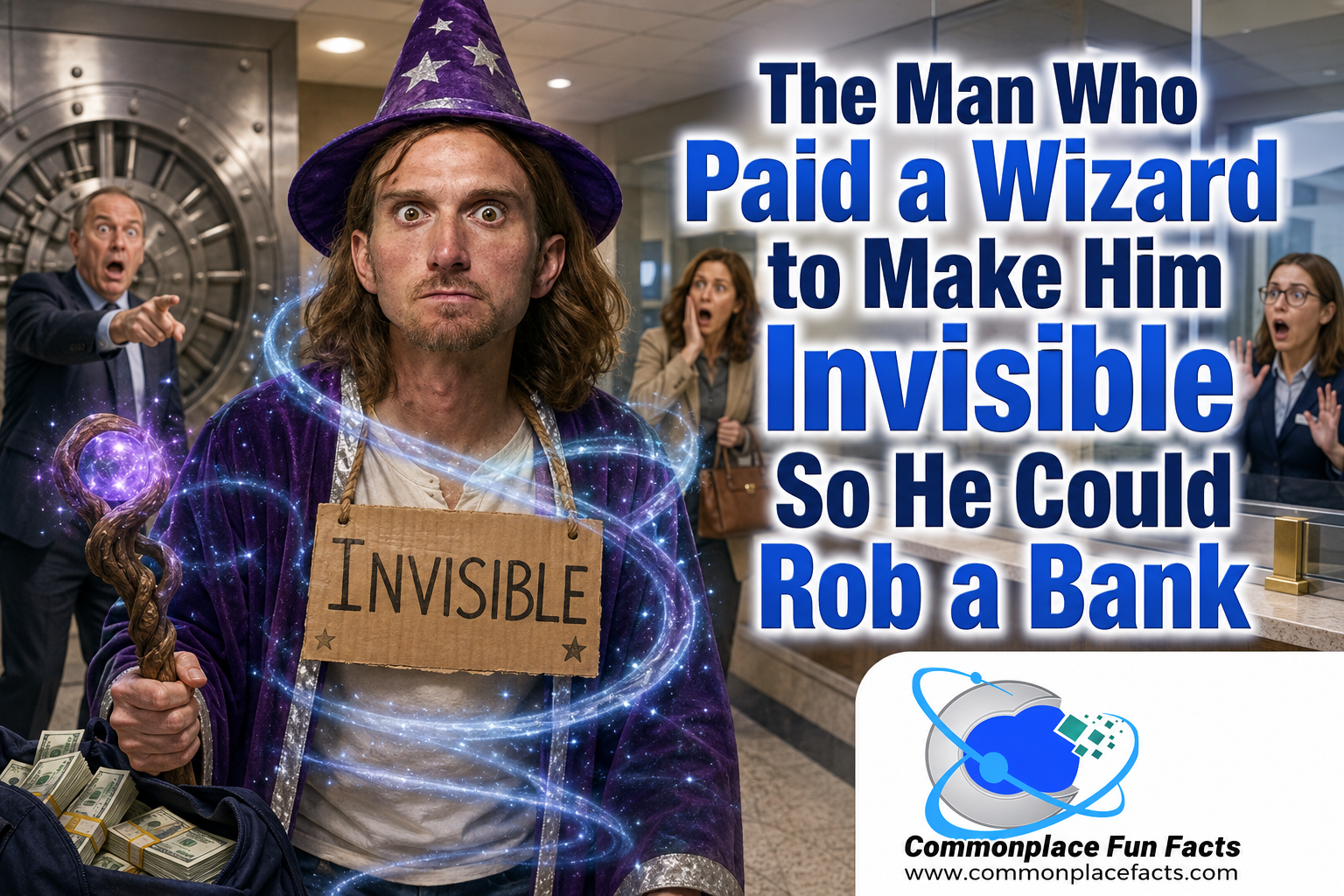
Then there is the idea of paying a wizard to turn you into an invisible bank robber.
According to a story originally reported by Factual Facts, one man in Iran found himself standing before a court after what may be one of the least successful bank robbery attempts in the long and regrettable history of people making poor career choices.
His defense was not that he had been framed. It was not that he had been coerced. It was not even the old reliable “I was holding the money for a friend,” which, while unconvincing, at least has the dignity of sounding like something a person might say after ten seconds of panicked improvisation.
No, his explanation was much better.
He believed he was invisible.
Contents
The Investment Opportunity of a Lifetime
The trouble began when the would-be robber encountered a man claiming to be a sorcerer. This is already the kind of sentence that suggests everyone involved should pause, hydrate, and reconsider the direction of the afternoon.

The alleged sorcerer offered a service that, admittedly, would be extremely useful if real: invisibility. Not “good at hiding.” Not “wearing beige near a wall.” Actual invisibility.
The price was five million rials, which was reported at the time as being just under £290. In American terms, the story has often been passed around as a roughly $500 transaction, which feels about right for bargain-bin wizardry. It is expensive enough to be painful, but cheap enough to make a person wonder whether perhaps the sorcerer was running a special.
For his money, the man received a set of spells to tie to his arm. The wizard then reportedly assured him that these spells would render him invisible, allowing him to rob banks without being seen.
This is where most people would ask a few follow-up questions. For example: “How long does the invisibility last?” “Does it cover clothing?” “Can dogs still smell me?” “Why, if you possess the power to turn people invisible, are you selling this service instead of quietly controlling the world?”
Our hero, however, seems to have skipped the due diligence phase and moved directly to implementation.
The Invisible Bank Robber Enters the Bank
Armed with his magic spells and, apparently, a business plan drafted by a squirrel with a head injury, the man entered a bank.
Now, a normal bank robber generally tries to disguise himself. He may use a mask, sunglasses, a hat, or at least the vague hope that the surveillance camera is having a lazy day. This man had no need for such amateur theatrics. He had magic tied to his arm. He was beyond disguise. He was beyond detection. He was, in his own mind, a ghostly phantom of the financial sector.
Unfortunately, he had failed to account for one small operational detail: everyone could see him.
Instead of slipping unnoticed behind the counter or silently cleaning out a vault like a low-budget Persian reboot of Mission: Impossible, he began snatching money out of customers’ hands.
Not from drawers. Not from safes. From the hands of actual people standing in the bank, who were presumably surprised to discover that the invisible robber was shaped exactly like a visible man grabbing their cash.
At this point, the plan encountered what military strategists call “contact with the enemy,” and what ordinary people call “being tackled by everyone in the room.” The customers quickly overpowered him.
It is hard to know the precise moment when he realized the spell had failed. Perhaps it was when the first person shouted. Perhaps it was when several very visible hands seized him. Perhaps it was when he found himself restrained by people who, against all assurances from the wizarding community, appeared fully aware of his location.
However it happened, the age of magical bank robbery came to a sudden and disappointing end.
A Courtroom Explanation for the Ages
Once in court, the man explained what had happened. He had paid the sorcerer. He had tied the spells to his arm. He had believed he was invisible. He had gone to the bank expecting to commit the perfect crime.
Instead, he had committed the kind of crime that makes police officers exchange looks and silently agree that paperwork is not the worst part of the job after all.
“I made a mistake,” he reportedly told the court. “I understand now what a big trick was played on me.”
That may be one of the great understatements in criminal history. It sits somewhere between “The Titanic appears damp” and “Napoleon’s Russia trip could have used better planning.”
The Wizard Problem
Still, it is worth pausing to consider the other person in this story: the supposed wizard.
The failed robber, to be clear, was not exactly a criminal genius. If bank robbery were a college course, he would not merely fail the final exam; he would accidentally eat the syllabus. But somewhere out there was a man who allegedly convinced another human being that arm-tied spells could provide invisibility sufficient for felony-grade financial misconduct.
That takes confidence.
Not moral character, obviously. Not wisdom. Not anything that would look good embroidered on a throw pillow. But confidence? Absolutely.
One imagines the sales pitch had to be impressive. The wizard apparently did not promise good luck, courage, or a reduced chance of being recognized by a teller. He went straight for invisibility. No trial version. No partial transparency. No “your outline may shimmer slightly under fluorescent lighting.” Full invisibility, suitable for robbing banks all you want.
It is the kind of claim that should have triggered suspicion. Then again, human beings have purchased diet teas, magnetic bracelets, miracle hair tonics, cryptocurrency named after dogs, and extended warranties on printers. We are, as a species, dangerously committed to the possibility that reality might be negotiable if the sales pitch is enthusiastic enough.
The Ancient Dream of Not Being Seen
The appeal of invisibility is not hard to understand. It has fascinated people for centuries. Mythology, folklore, comic books, fantasy novels, and science fiction are packed with characters who become invisible and then immediately prove that moral restraint is often just a lighting condition.
It was one such person whose attempts to become invisible through the use of lemon juice who inspired the Dunning-Kruger Effect. Read about that criminal mastermind in this article.
Give a person invisibility, and you learn a great deal about character. Usually, what you learn is that character has left the building through a side door.
That is part of what makes this story so wonderfully absurd. The man did not just believe in magic. He believed in magic with a very specific and practical application. He did not seek invisibility to uncover hidden truths, escape persecution, or move unseen through enemy lines. He went straight to: “Excellent. I shall rob banks.”
There is something almost admirable about the efficiency of that thought process. Terrible, yes. Criminal, certainly. But focused. Some people spend years trying to identify their life’s purpose. This man needed only one fraudulent wizard and a handful of arm spells.
When Magic Meets Customer Service
The most striking part of the story may be how ordinary the failure was. There was no dramatic chase. No elaborate security breach. No cinematic vault sequence. No smoke. No mirrors. No mysterious footprints appearing in dust.
Just a man walking into a bank, taking money in full view of everyone, and being stopped by people who had the unfair advantage of eyesight.
It is a reminder that the gap between ambition and execution can be very wide, especially when your ambition depends on a wizard whose credentials were apparently not verified by any recognized accrediting body.
In the end, the man learned the hard way that invisibility is not something one should buy from a stranger. Especially not a stranger whose business model appears to consist of selling felony accessories with a supernatural warranty.
There are many lessons here. Do not rob banks. Do not trust impostor sorcerers. Do not assume a string of spells tied to your arm has rendered you undetectable. And if you ever think you have become invisible, maybe test the theory somewhere low-stakes before proceeding directly to bank robbery.
For example, stand in front of a mirror.
Or wave at a bus driver.
Or ask someone, “Can you see me?”
Granted, this may slightly reduce the mystique of your criminal enterprise, but it could save everyone a lot of trouble. Especially you.
You may also enjoy…

Highwaymen, Footpads, and Royal Scamps: How Britain Ranked Criminals by Class and Courtesy
Once upon a time, even crime had class. Meet Britain’s highwaymen, footpads, and royal scamps—and their very polite excuses.

The IP Address Mapping Error that Made a Kansas Farmhouse a Major Criminal Hangout
Discover how a Kansas farmhouse became the target of FBI raids, angry calls, and scammers, all due to an IP address mapping error. Learn about one family’s geolocation digital nightmare.

Spies, Invisible Ink, Toenails, and Other Declassified CIA Secrets
Invisible ink, often seen in spy fiction, was actually utilized by intelligence agencies like the CIA during World War I. Declassified CIA documents reveal methods for writing and revealing secret messages, including chemical recipes and techniques for discreet communication. These intriguing strategies showcase the blend of creativity and science in espionage.






Leave a Reply