

Victorian photography has a reputation for being a little unsettling.
This was, after all, an era that gave us photographs that were supposed to reveal recently deceased loved ones, plenty of stern faces, elaborate mourning customs, and enough sepia-toned children standing beside tiny chairs to populate an entire haunted doll convention. What else should we expect from a time when photographers told their subjects to say “prunes” instead of “cheese”?
Even by those standards, however, one particular photographic trend stands out for its unique ability to make modern viewers pause, squint, and ask, “Why does that ottoman appear to be alive?”
We are referring, of course, to the strange and wonderful world of hidden mother photography.
Contents
Because Early Photography Was Not Designed by Anyone Who Had Met a Toddler
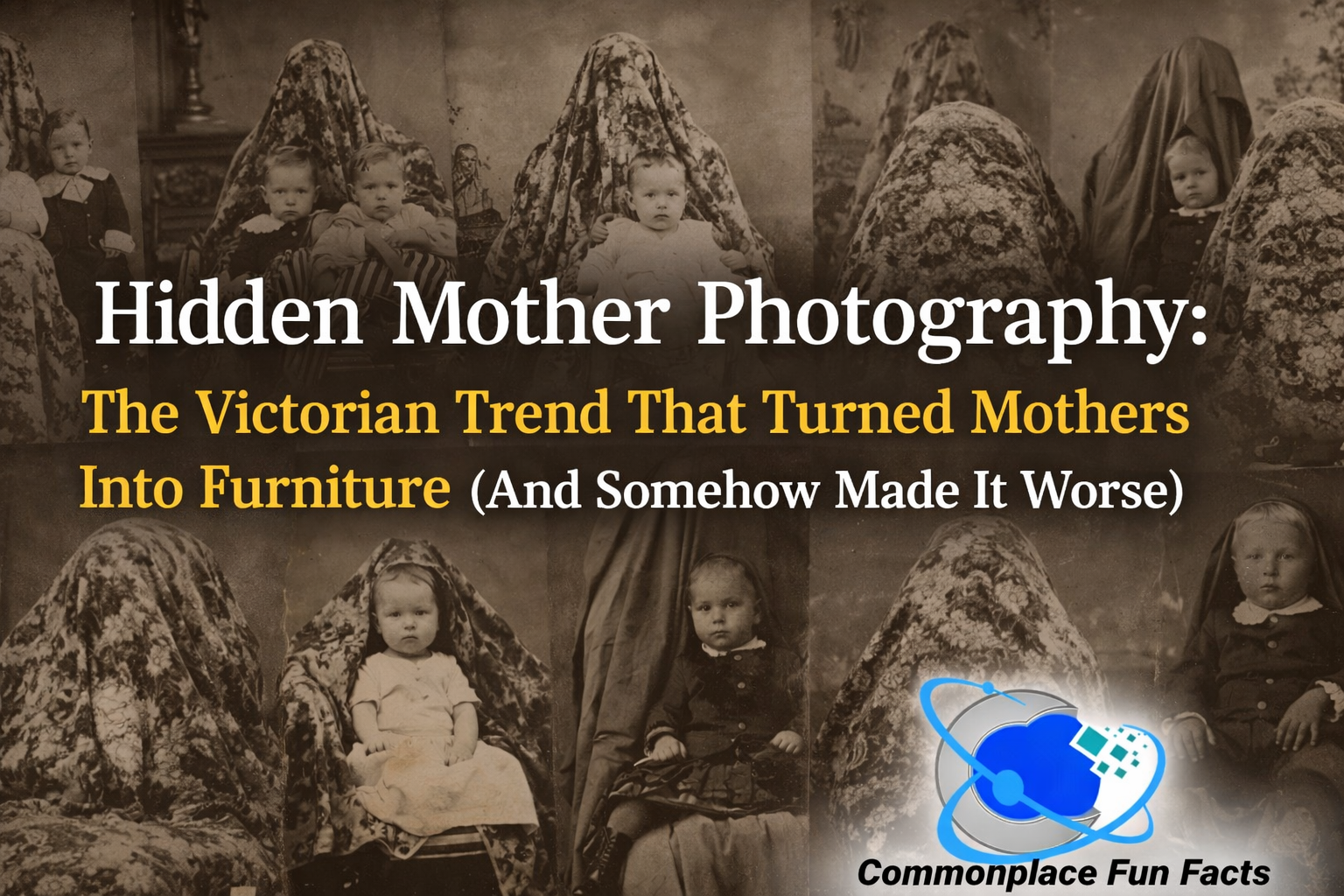
If you have never encountered one of these images, here is the basic idea: Victorian parents wanted a photograph of their baby. The baby, having the normal priorities of a baby, had no interest in sitting motionless for the camera. The solution was for the mother, or sometimes another adult caretaker, to hold the child still while attempting to remain out of sight. This often meant hiding behind drapery, crouching behind furniture, wrapping oneself in cloth, or otherwise disguising one’s presence in a manner that today reads less “subtle assistance” and more “domestic apparition.”

The result is one of the oddest visual genres ever produced by respectable middle-class family life: baby portraits in which the mother is technically present, strategically absent, and frequently shaped like a cursed armchair.
To understand why this happened, it helps to remember that early photography was not exactly user-friendly. Daguerreotypes and other early photographic processes required subjects to stay still for long exposure times. Adults could sometimes manage this by summoning all the emotional energy of a person waiting at the DMV. Babies, however, were less cooperative. Babies squirmed. Babies cried. Babies lunged unexpectedly in directions not approved by portrait studios.
This created a problem for Victorian photographers. Parents wanted portraits of their children, and photographers wanted images that did not look like abstract interpretations of infancy. Somebody needed to keep the child steady long enough for the exposure to work. That somebody was usually Mom.
There was, however, one small catch. The mother was not supposed to be the subject of the picture. The child was the star. The child was the point. The child was the treasured center of the composition. The mother was there only to perform the modest task of preventing the treasured center of the composition from face-planting off the chair.
And so photographic history gave us one of its least appreciated technical innovations: the transformation of mothers into invisible load-bearing infrastructure.
The Fine Art of Hiding a Full-Grown Woman in Plain Sight
The methods used to conceal mothers varied, but they all share a certain improvisational quality that suggests the photographer and family were making up the rules as they went.
One popular approach was the blanket method. The mother would sit in a chair behind the child and drape herself in fabric so that she blended into the background. In theory, this allowed the viewer to focus on the baby. In practice, it often created the appearance of a ghost with upholstery ambitions.
Another method involved partial concealment. A mother might hide behind a curtain, crouch just outside the frame, or tuck herself behind studio props. Sometimes only a hand remained visible, gripping the child’s shoulder with the quiet intensity of a person determined not to repeat this process twice in one afternoon. The effect is memorable. You look at the picture and think, “That infant seems strangely composed,” and then notice a floating adult hand emerging from nowhere like a supporting character in a supernatural thriller.
Some photographers attempted a more refined solution by cropping, matting, or retouching the image to reduce the visibility of the adult. This was the nineteenth-century equivalent of saying, “We’ll fix it in post,” except “post” involved scissors, paper overlays, and a level of optimism that deserves recognition.
Not all of these efforts were equally successful. In some hidden mother photographs, the disguise is fairly subtle. In others, the mother is hidden in the same sense that a moose standing under a bed sheet is hidden.
Victorian Family Portraits, Now With Extra Nightmare Fuel
The reason these images fascinate modern audiences is simple: they are creepy in precisely the wrong way, much like the residents of Miss Peregrines’s Home for Peculiar Children.
The original intention was perfectly practical. There was no effort to create anything eerie. Nobody in a Victorian studio was aiming for “accidental folk horror.” They just wanted a clear likeness of little Augustus before he wriggled into the kerosene lamp.

Modern viewers, however, do not see only the practicality. We see a baby seated calmly on a chair while, behind him, an enormous draped figure looms like a specter summoned from the linen closet. We notice a patterned fabric that somehow has knees. We detect a human silhouette where no human silhouette ought to be. Our brains recognize that something is off, and the image becomes unsettling not because it was meant to be frightening, but because it was meant to be invisible and failed in a spectacularly memorable way.
This gives hidden mother photographs their peculiar charm. They are intimate family portraits that accidentally wandered into the visual neighborhood of ghost stories. They sit at the crossroads of sentimentality and menace, where motherhood, furniture, and low-speed camera technology join forces to create something art historians study and horror directors would absolutely steal.
Why Hide the Mother at All?
The deeper question is not merely how this happened, but why people felt the need to hide the mother in the first place — especially when they could have used someone who doesn’t cast an image in photographs to start with, such as a vampire, lawyer, or other creature of the night.

Part of the answer is compositional. The point of the portrait was the child. A baby portrait was meant to be just that: a portrait of the baby. The adult holding the child steady was a practical necessity, not the intended subject. Concealing the mother allowed the image to preserve the illusion of the child as independent, composed, and photogenic, which, as any parent knows, is not always how those sessions begin.
Part of the answer is also cultural. Victorian ideals of motherhood were deeply bound up with self-sacrifice, nurturing, and domestic invisibility. Mothers were central to family life, but in a way that was often expected to be quiet, supportive, and taken for granted. Hidden mother photographs embody that dynamic so literally that they almost become satire. The mother is indispensable to the creation of the image, yet she is also expected to disappear from it.
In other words, the entire genre can be summarized as follows: “Please hold everything together while receiving none of the credit.” Which, now that we mention it, does sound like a fair amount of motherhood across several centuries.
It Was Not Always the Mother
Despite the name, the hidden figure was not always the child’s mother. Sometimes it was a father, nanny, nursemaid, or studio assistant. The term “hidden mother” stuck because mothers were the most common participants, but the broader reality was more flexible. Anyone capable of holding a child still and willing to spend several minutes disguised as a draped side table could be drafted into service.
This only adds to the amusement. Somewhere in photographic history is an exhausted father who spent part of a Saturday afternoon disguised as a curtain. Somewhere a studio assistant began the day expecting to arrange props and ended it crouched behind a chair while a stranger’s toddler screamed into the middle distance. History is full of untold sacrifices, and some of them involved pretending not to exist in front of a camera.
No, This Does Not Mean Every Victorian Photo Was Secretly About Death
At this point, it is probably wise to address the internet’s favorite hobby: seeing one unusual Victorian photograph and immediately concluding that everyone in it is dead, haunted, cursed, or all three.

Victorian photography does include post-mortem portraiture, which has led many people to approach every old photograph as if it were evidence in a supernatural cold case. Hidden mother photography, however, is generally much simpler. In most cases, these images are not about death. They are about motion. More specifically, they are about the challenge of persuading small children to remain motionless long enough for an exposure to finish.
That said, it is understandable that people get confused. Victorian visual culture already contains enough solemn expressions and eerie composition choices to keep modern imaginations busy. Once you add a half-concealed adult draped like a phantom over a chair, misunderstandings are inevitable. The Victorians did not mean to invent one of the creepiest subgenres in family portrait history. They just happened to back into it with confidence.
How Modern Audiences Rediscovered the Hidden Mothers
One of the more delightful aspects of this story is that hidden mother photographs have enjoyed a modern revival, largely because people keep encountering them and reacting exactly as one would expect: “Excuse me, what on earth is going on in this picture?”
Collectors, museums, historians, and photography writers have helped bring renewed attention to these images. Seen together, the photographs become more than odd curiosities. They reveal the practical realities of early portrait studios, the technological limitations of the time, and the often-overlooked labor behind images that were supposed to look effortless.
That labor is one reason the photographs remain interesting beyond their accidental creepiness. They preserve a little truth that many polished family portraits try to hide: children rarely become picture-ready by magic. Someone is always just outside the frame making the entire enterprise possible. In Victorian studios, that person was sometimes not outside the frame at all. She was right there, under the blanket, hoping history would at least appreciate the effort.
The Hidden Mother Never Really Went Away
For all their old-fashioned strangeness, hidden mother photographs also feel surprisingly modern. The details have changed, but the pattern has not disappeared.
Today, mothers are often missing from family pictures for a much simpler reason: they are the ones taking them. They arrange the outfits, wipe the faces, locate the shoes, negotiate the moods, and then stand behind the phone making wild gestures in the hope that one child will smile while the other refrains from licking a window. The result is a lovely image of family life in which the person who orchestrated the whole thing is absent.
The Victorian version of this was simply more literal. Instead of being behind the camera, mothers were inside the photograph and still somehow invisible. Technology has improved. The social pattern has proven annoyingly durable.
When Maternal Devotion Meets Haunted Upholstery
There is something both funny and oddly touching about hidden mother photography. On one level, these images are absurd. They present us with babies perched on chairs while shrouded human lumps attempt, with mixed success, to pass as décor. They invite modern viewers to play an impromptu game of “spot the concealed parent,” which is not a sentence anybody expected to say about nineteenth-century portraiture.
On another level, the pictures are unexpectedly tender. Each one represents a parent’s desire to preserve a child’s image at a time when photography was still cumbersome, technical, and expensive. Someone cared enough to go through the trouble. Someone sat still under suffocating fabric. Someone held a restless child in place and accepted invisibility as part of the bargain. Beneath all the accidental weirdness is a very ordinary human impulse: we love these small chaotic people, and we would like one decent picture before they wriggle free.
That may be the real reason hidden mother photography endures. It is bizarre, yes. It is eerie, absolutely. It is also relatable. Strip away the Victorian drapery, and what you have is a timeless scene: a parent doing all the work so the child can look adorable.
Only the Victorians, being the Victorians, managed to express that truth in the visual language of “possessed loveseat with infant.”
And honestly, we have to admire the commitment.
You may also enjoy…

Optograms, Spirit Photos, and Fritz Angerstein, the Killer Who Couldn’t Escape a Snapshot
Discover the bizarre history of optograms and spirit photography, and how they collided in the shocking 1924 Fritz Angerstein murder case. Pseudoscience, ghosts, and forensic failure await.

Learn What Prompted The Most Intelligent Photo Ever Taken
What Prompted the Most Intelligent Photo Ever Taken? When John F. Kennedy welcomed a gathering of Nobel Prize winners at the White House in 1962, he said, “I think this is the most extraordinary collection of talent, of human knowledge, that has ever been gathered together at the White House, with the possible exception of…

Why Didn’t People Smile in Old Photos? Because “Say Cheese” Hadn’t Been Invented Yet
Why Didn’t People Smile in Old Photos? Learn the fascinating history about photographs before the era of “say cheese.”







Leave a Reply to cat9984Cancel reply